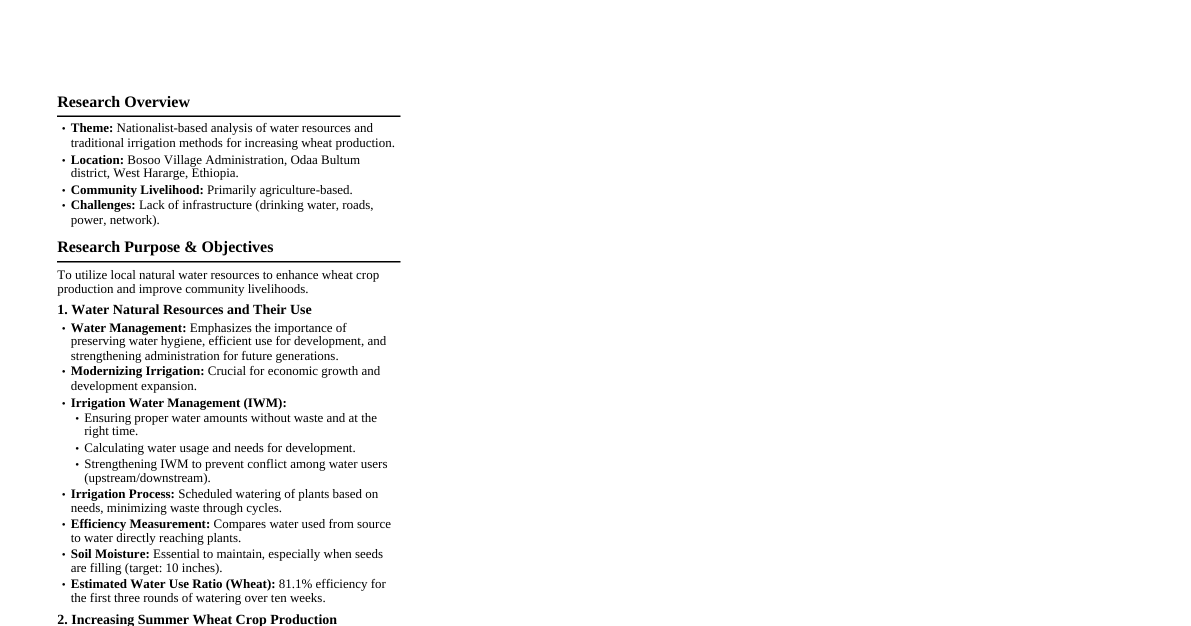
1. Introduction to Research 1.1. Research Background - Bosoo Village Location: Odaa Bultum district, 39.39 km from Baddessa town, 60.9 km south of Ciroo town. Community: Primarily engaged in agriculture, social, but lacks infrastructure (drinking water, roads, power, network). 2. Research Purpose: Wheat Production & Community Life To utilize local water resources to increase wheat crop production and improve community livelihoods. 2.1. Water Natural Resources and Use (10 Weeks Analysis) Emphasizes modernizing irrigation management systems (IWM) for economic growth and development, ensuring efficient use and equitable distribution of water. Irrigation Water Management (IWM) Principles: Scheduled watering based on plant needs to minimize waste. Comparison of water used from source vs. water reaching plants. Maintain soil moisture, especially during seed filling (aim for 10 inches water penetration). Wheat Crop Water Usage Efficiency: Estimated efficiency for initial three rounds of watering: 81.1% . This indicates high efficiency of water delivery to plants/farmland. Estimated Water Volume Used (10 Weeks): Total water to be used: $7131.6 \, m^3$ Total water applied to land: $8788.4 \, m^3$ Efficiency calculation: $\frac{7131.6}{8788.4} \approx 81.1\%$ This confirms the efficient application of water resources to agricultural land. 2.2. Increasing Summer Wheat Crop Production Focuses on accelerating economic growth and food security by comparing expenditure and revenue from wheat development in the Saaqata River area over 13 weeks. Key strategies to increase wheat production: Boost production by 1%-30%. Protect soil health. Use clean fertilizer. Modernize farming practices. Wheat Production Cost and Revenue Analysis: Item Estimated Quantity (kg) Notes Farmland Area 10.38 hectares Wheat Variety (seed + transport) 1338 kg Fertilizer (including transport) 6596.32 kg Tractor Cost (equivalent) 1000 kg Harvesting Machine Value (equivalent) 4613.33 kg Pesticides 300 kg Labor, living, transport, minor expenses 700 kg Total Wheat Production from 1338 kg seeds (10.38 hectares) Calculated indirectly Result: Wheat production profit increased by 15.6% compared to income from the Saaqata River. This indicates improved food security and economic efficiency. 3. Summary of Findings Water Management Efficiency: Using IWM tools, the estimated water usage efficiency was 81.1% , indicating efficient irrigation. Economic Impact: Through irrigation and financial analysis techniques, wheat production profit increased by 15.6% , leading to enhanced food security and economic efficiency.