Acid-Base Balance
Shared 3/23/2026•68 views
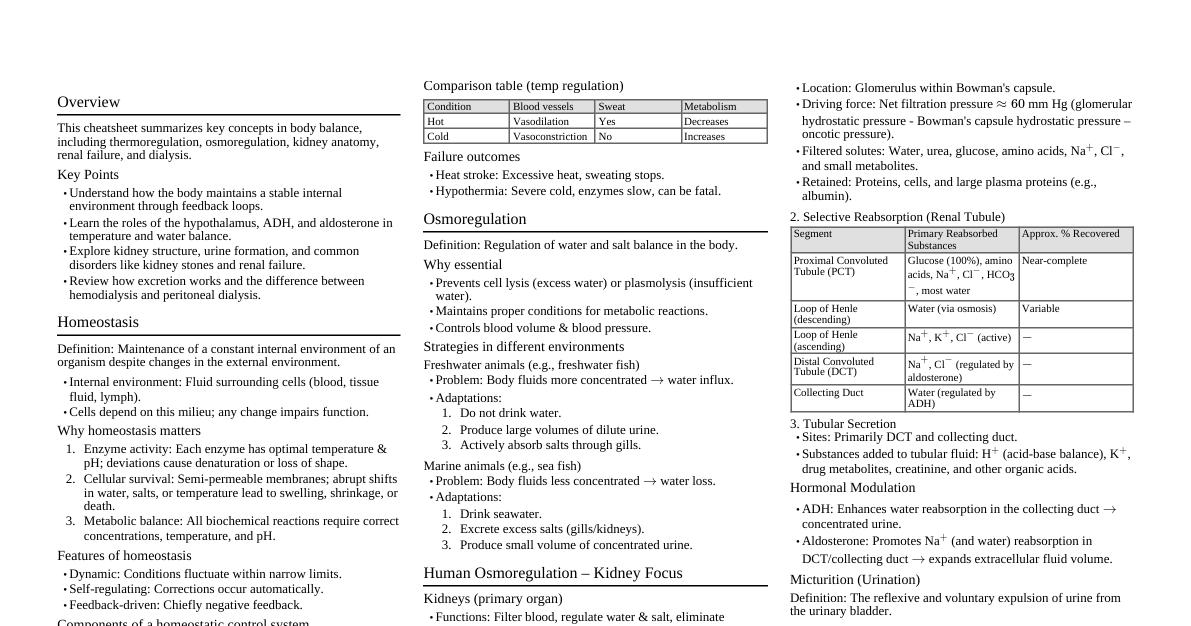
### Introduction to Acid-Base Balance - **Definition:** Maintaining the pH of body fluids within a narrow range (7.35-7.45). - **Importance:** Crucial for enzyme function, metabolic processes, and cellular integrity. - **Key Players:** Lungs (CO2 excretion), Kidneys (HCO3- reabsorption/excretion, H+ secretion), Buffer Systems. ### pH Scale & Definitions - **pH:** Measure of hydrogen ion concentration ($$p\text{H} = -\log[\text{H}^+]$$) - Normal range: 7.35 - 7.45 - Acidosis: pH 7.45 - **Acids:** Substances that donate H+ ions (e.g., HCl, carbonic acid $$(\text{H}_2\text{CO}_3)$$) - **Bases:** Substances that accept H+ ions (e.g., NaOH, bicarbonate $$(\text{HCO}_3^-)$$) ### Buffer Systems - **Function:** Resist changes in pH by absorbing excess H+ or OH-. - **Bicarbonate Buffer System:** Most important extracellular buffer. - Equation: $$\text{CO}_2 + \text{H}_2\text{O} \rightleftharpoons \text{H}_2\text{CO}_3 \rightleftharpoons \text{H}^+ + \text{HCO}_3^-$$ - Regulated by lungs (CO2) and kidneys (HCO3-). - **Phosphate Buffer System:** Important intracellular and renal tubular buffer. - **Protein Buffer System:** Most abundant buffer system (hemoglobin, plasma proteins). - Amphoteric properties: can act as both acid and base. ### Respiratory Regulation - **Mechanism:** Lungs regulate CO2 levels, which directly affects H2CO3 concentration. - **Hyperventilation:** Decreases PCO2, shifting equilibrium left, reducing H+, increasing pH (compensates for acidosis). - **Hypoventilation:** Increases PCO2, shifting equilibrium right, increasing H+, decreasing pH (compensates for alkalosis). - **Speed:** Rapid response (minutes to hours). ### Renal Regulation - **Mechanism:** Kidneys regulate HCO3- (bicarbonate) and excrete H+. - **Key Processes:** 1. **Reabsorption of Filtered Bicarbonate:** Nearly all HCO3- is reabsorbed in proximal tubules. 2. **Secretion of H+:** Primarily by type A intercalated cells in collecting ducts. 3. **Generation of New Bicarbonate:** Coupled with H+ excretion. 4. **Excretion of Titratable Acids:** H+ buffered by phosphate. 5. **Excretion of Ammonium (NH4+):** Most significant mechanism for H+ excretion and new HCO3- generation. - **Speed:** Slower response (hours to days), but most powerful long-term regulator. ### ABG Interpretation (ROME) - **R**espiratory **O**pposite, **M**etabolic **E**qual - **Steps:** 1. **Analyze pH:** Acidosis ( 7.45)? 2. **Analyze PCO2 (Respiratory Component):** Normal (35-45 mmHg)? - If pH and PCO2 move in opposite directions (e.g., pH low, PCO2 high) = Respiratory issue. 3. **Analyze HCO3- (Metabolic Component):** Normal (22-26 mEq/L)? - If pH and HCO3- move in the same direction (e.g., pH low, HCO3- low) = Metabolic issue. 4. **Determine Compensation:** Is the body trying to correct the primary disorder? - **Respiratory Acidosis:** High PCO2, low pH. Kidneys compensate by increasing HCO3- reabsorption. - **Respiratory Alkalosis:** Low PCO2, high pH. Kidneys compensate by decreasing HCO3- reabsorption. - **Metabolic Acidosis:** Low HCO3-, low pH. Lungs compensate by increasing ventilation (decreasing PCO2). - **Metabolic Alkalosis:** High HCO3-, high pH. Lungs compensate by decreasing ventilation (increasing PCO2). ### Acid-Base Disorders | Disorder | pH | PCO2 | HCO3- | Primary Problem | Compensation | |--------------------------|----------|----------|----------|----------------------|--------------------------------------------| | **Respiratory Acidosis** | Low | High | Normal / High (Comp.)| Hypoventilation | Renal HCO3- retention | | **Respiratory Alkalosis**| High | Low | Normal / Low (Comp.) | Hyperventilation | Renal HCO3- excretion | | **Metabolic Acidosis** | Low | Normal / Low (Comp.)| Low | H+ gain or HCO3- loss| Respiratory hyperventilation (↓ PCO2) | | **Metabolic Alkalosis** | High | Normal / High (Comp.)| High | H+ loss or HCO3- gain| Respiratory hypoventilation (↑ PCO2) | ### Anion Gap (AG) - **Formula:** $$ \text{AG} = [\text{Na}^+] - ([\text{Cl}^-] + [\text{HCO}_3^-]) $$ - **Normal Range:** 8-12 mEq/L - **Use:** Differentiates causes of Metabolic Acidosis. - **High Anion Gap Metabolic Acidosis (HAGMA):** Accumulation of unmeasured anions (e.g., lactate, ketones). - **MUDPILES:** Methanol, Uremia, DKA, Paraldehyde, Iron/Isoniazid, Lactic acidosis, Ethylene glycol, Salicylates. - **Normal Anion Gap Metabolic Acidosis (NAGMA):** Loss of HCO3- or gain of Cl-. - **HARDASS:** Hyperalimentation, Acetazolamide, Renal tubular acidosis, Diarrhea, Adrenal insufficiency, Saline infusion.