Corrosion Rate in Cooling Wate
Cheatsheet Content
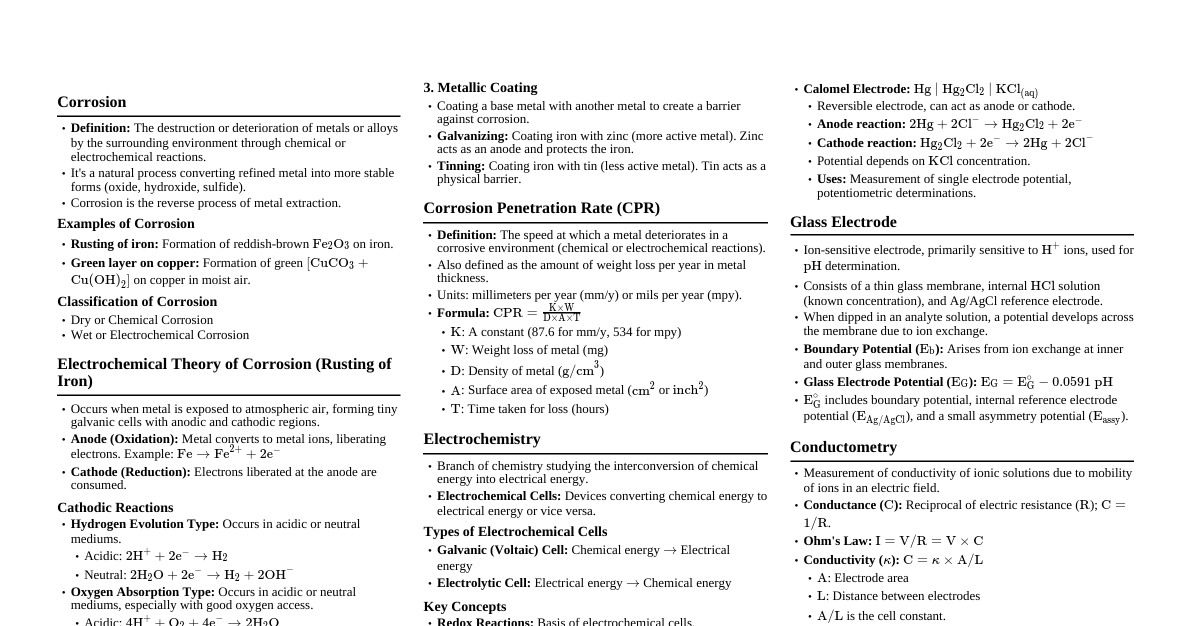
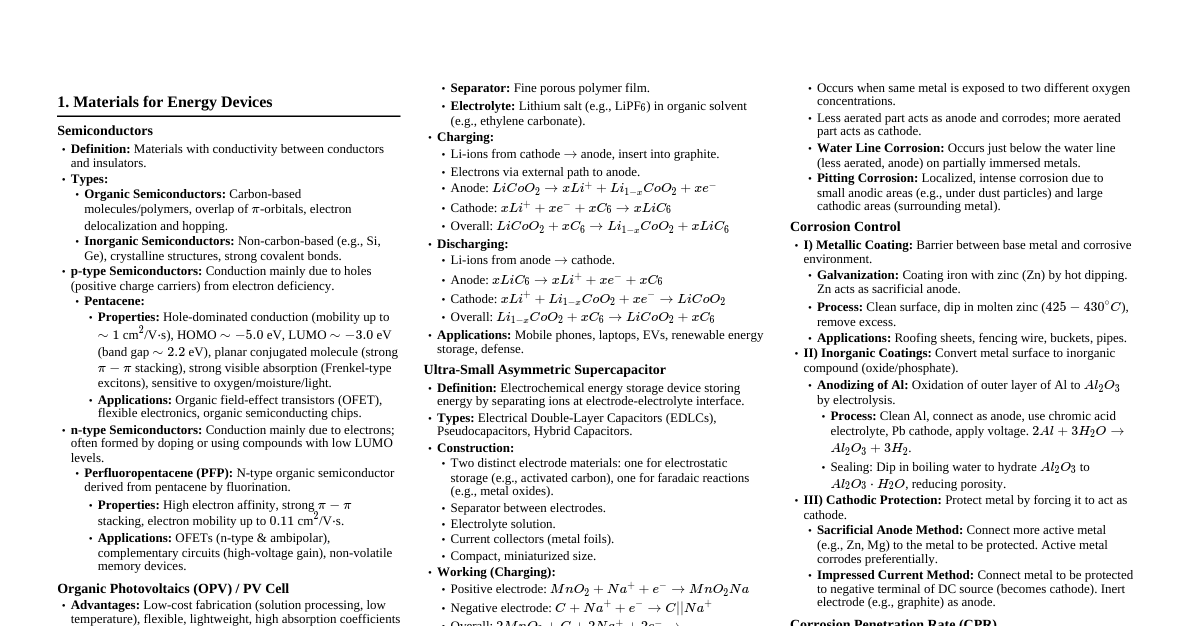
### Introduction to Corrosion Rate Corrosion is the deterioration of a material, usually a metal, due to a chemical reaction with its environment. In cooling water systems, corrosion can lead to equipment failure, reduced heat transfer efficiency, and increased maintenance costs. Monitoring and controlling corrosion rates are crucial for effective water treatment. ### Corrosion Rate (mpy) Definition Corrosion rate is commonly expressed in **mils per year (mpy)**, where a mil is one-thousandth of an inch (0.001 inches). This unit provides a practical measure of how quickly a material is corroding over time. $$ 1 \text{ mil} = 0.001 \text{ inches} $$ $$ 1 \text{ inch} = 25.4 \text{ mm} $$ $$ 1 \text{ mil} = 0.0254 \text{ mm} $$ ### Calculation of Corrosion Rate in mpy The corrosion rate in mpy can be calculated using the following formula: $$ \text{Corrosion Rate (mpy)} = \frac{\text{Weight Loss (mg)} \times 22300}{\text{Density (g/cm}^3) \times \text{Area (in}^2) \times \text{Time (days)}} $$ Where: - **Weight Loss (mg):** The total weight loss of the corrosion coupon or metal sample in milligrams. This is determined by weighing the sample before and after exposure to the cooling water. - **22300:** A conversion constant that incorporates unit conversions (mg to lbs, cm to inches, days to years, etc.). - **Density (g/cm$^3$):** The density of the metal being tested. - Common densities: - Carbon Steel: $\approx 7.85 \text{ g/cm}^3$ - Copper: $\approx 8.96 \text{ g/cm}^3$ - Stainless Steel (304/316): $\approx 8.00 \text{ g/cm}^3$ - **Area (in$^2$):** The total surface area of the metal sample exposed to the cooling water, in square inches. For a typical rectangular coupon, the area is calculated as: $$ \text{Area} = 2 \times (\text{Length} \times \text{Width}) + 2 \times (\text{Length} \times \text{Thickness}) + 2 \times (\text{Width} \times \text{Thickness}) $$ Ensure all dimensions are in inches before calculation. If the coupon has a hole for mounting, its area is typically negligible and often not subtracted unless it's a significant portion of the total surface. - **Time (days):** The duration of exposure of the metal sample to the cooling water, in days. #### Steps for Calculation: 1. **Prepare Coupon:** Clean and weigh a metal coupon (e.g., carbon steel, copper) of known dimensions. Record its initial weight ($W_i$) and surface area ($A$). 2. **Expose Coupon:** Place the coupon in the cooling water system for a specified period (e.g., 30, 60, or 90 days). 3. **Retrieve & Clean Coupon:** Remove the coupon, clean off corrosion products carefully without removing base metal, and re-weigh it. Record its final weight ($W_f$). 4. **Calculate Weight Loss:** $\text{Weight Loss (mg)} = W_i (\text{mg}) - W_f (\text{mg})$ 5. **Apply Formula:** Plug the values into the mpy formula. ### Factors Affecting Corrosion Rate Several factors influence corrosion rates in cooling water systems: - **Water Chemistry:** pH, alkalinity, hardness, dissolved oxygen, chloride, sulfate, and other ion concentrations. - **Temperature:** Higher temperatures generally accelerate corrosion reactions. - **Flow Rate:** Both very low (stagnation) and very high (erosion-corrosion) flow rates can increase corrosion. - **Microbiological Activity:** Microorganisms (e.g., SRBs, APBs) can cause microbiologically influenced corrosion (MIC). - **Material Type:** Different metals have different corrosion resistances. - **System Design:** Dead legs, dissimilar metal contact, and poor circulation can create localized corrosion sites. ### Acceptable Corrosion Rates Acceptable corrosion rates vary depending on the specific metal, system design, and industry standards. General guidelines for cooling water systems often suggest: - **Carbon Steel:** - Excellent: $ 5.0 \text{ mpy}$ - **Copper/Brass:** - Excellent: $ 0.5 \text{ mpy}$ - **Stainless Steel:** Typically much lower, often $