JEE Chemical Bonding
Cheatsheet Content
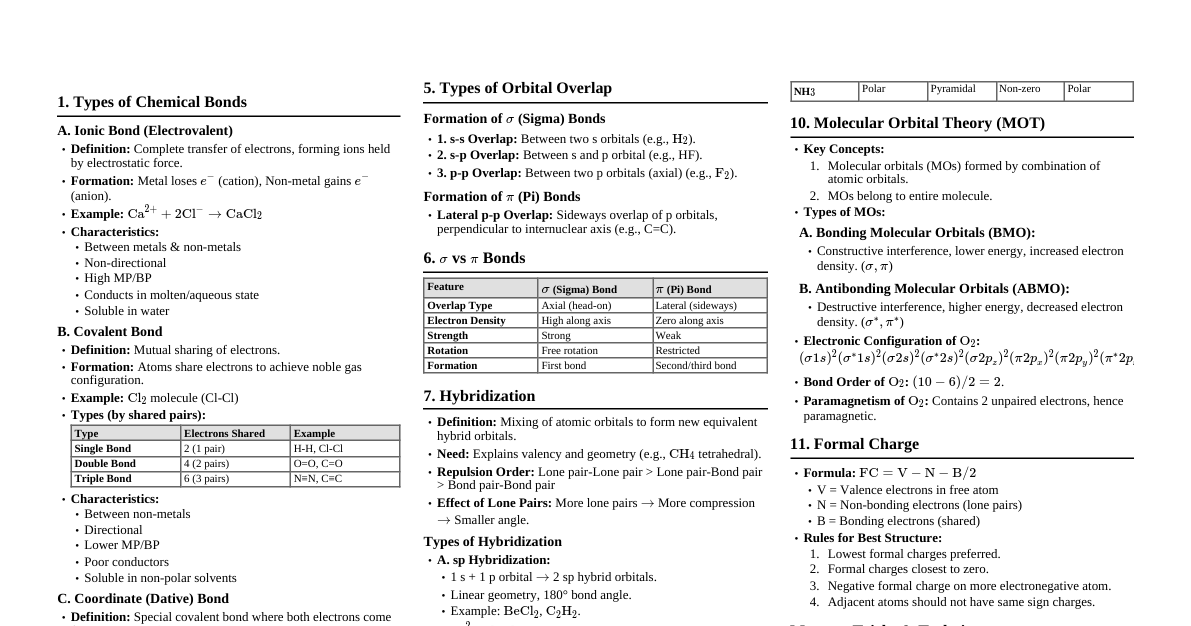
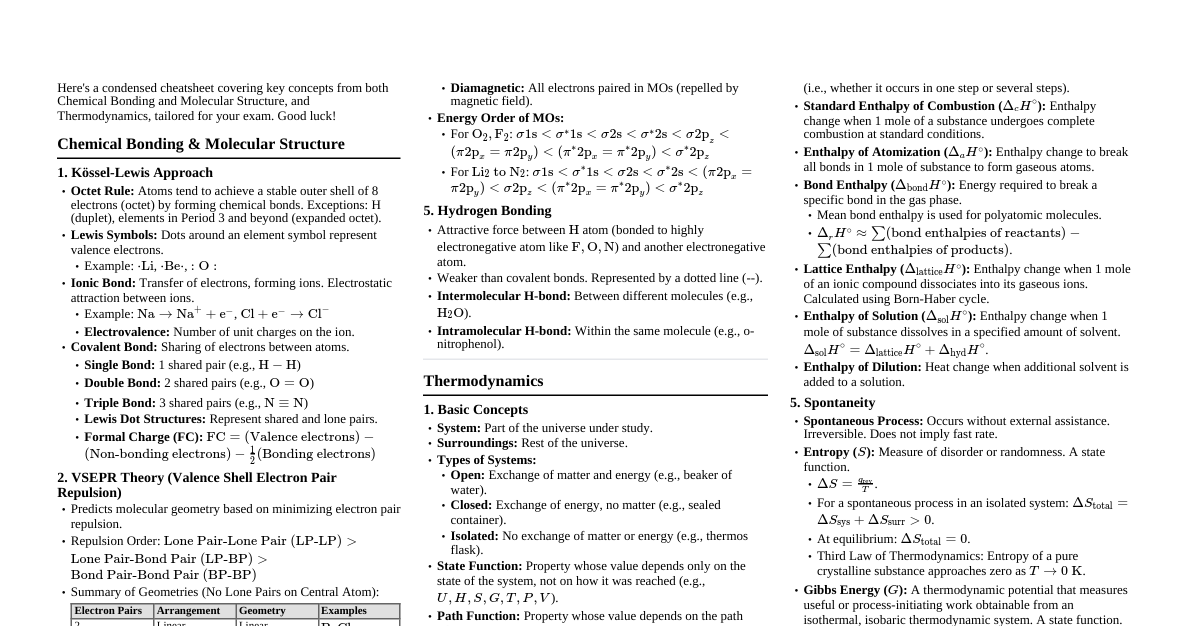
1. Introduction to Chemical Bonding Definition: The attractive force that holds different constituents (atoms, ions, etc.) together in different chemical species. Octet Rule: Atoms tend to gain, lose, or share electrons to achieve a stable configuration of eight electrons in their outermost shell. (Exceptions exist: H, Li, Be, B, PCl$_5$, SF$_6$). Duplet Rule: For H, Li, Be, they tend to achieve two electrons in their outermost shell. 2. Ionic Bonding (Electrovalent Bond) Formation: Formed by the complete transfer of one or more electrons from one atom (typically a metal) to another atom (typically a non-metal). Conditions for Ionic Bond Formation: Low ionization enthalpy for the metal atom. High electron gain enthalpy for the non-metal atom. High lattice enthalpy for the ionic compound formed. Characteristics: Crystalline solids. High melting and boiling points. Soluble in polar solvents (e.g., water). Conduct electricity in molten state or aqueous solution. Non-directional bond. Fajans' Rules: Predict the degree of covalent character in an ionic bond. Small size of cation, large size of anion $\rightarrow$ greater covalent character. High charge on cation or anion $\rightarrow$ greater covalent character. Cations with pseudo noble gas configuration ($ns^2np^6nd^{10}$) have greater polarizing power than noble gas configuration ($ns^2np^6$) $\rightarrow$ greater covalent character. (e.g., CuCl vs NaCl). Lattice Energy: Energy released when one mole of an ionic compound is formed from its gaseous ions. $$U = \frac{k |q_1 q_2|}{r}$$ Where $k$ is a constant, $q_1, q_2$ are charges, $r$ is internuclear distance. 3. Covalent Bonding Formation: Formed by the mutual sharing of electrons between two atoms, usually non-metals. Types of Covalent Bonds: Single Bond: Sharing of one electron pair (e.g., H-H). Double Bond: Sharing of two electron pairs (e.g., O=O). Triple Bond: Sharing of three electron pairs (e.g., N$\equiv$N). Characteristics: Can be solid, liquid, or gas. Lower melting and boiling points than ionic compounds. Generally insoluble in water, soluble in non-polar solvents. Do not conduct electricity (except graphite). Directional bond. Covalent Character in Ionic Bonds (Fajans' Rules): (Repeated for emphasis) Small cation, large anion $\rightarrow$ more covalent. High charge on ions $\rightarrow$ more covalent. Cation with pseudo noble gas configuration ($Cu^+, Ag^+$) $\rightarrow$ more covalent. 4. Coordinate Bonding (Dative Bond) Formation: A type of covalent bond where both shared electrons are contributed by only one of the participating atoms. Donor Atom: Provides the electron pair (has a lone pair). Acceptor Atom: Accepts the electron pair (has an empty orbital). Representation: An arrow from the donor to the acceptor (e.g., $NH_3 \rightarrow BF_3$). Examples: $NH_4^+$, $H_3O^+$, $CO$, complex compounds. 5. Lewis Structures Represent atoms and their valence electrons using dots (lone pairs) and lines (shared pairs). Steps to draw Lewis structures: Count total valence electrons. Identify central atom (usually least electronegative, or single atom). Draw single bonds to central atom. Distribute remaining electrons to satisfy octets (or duplets) of outer atoms first, then central atom. If octet not satisfied for central atom, form multiple bonds using lone pairs from outer atoms. Formal Charge: $$FC = (\text{Valence electrons}) - (\text{Non-bonding electrons}) - \frac{1}{2}(\text{Bonding electrons})$$ Sum of formal charges in a molecule = 0. Sum of formal charges in an ion = charge on ion. 6. Valence Shell Electron Pair Repulsion (VSEPR) Theory Predicts the geometry of molecules based on the repulsion between electron pairs (both bonding and non-bonding) in the valence shell of the central atom. Rules: Electron pairs repel each other and tend to occupy positions that minimize repulsion. Lone pair-lone pair repulsion > lone pair-bond pair repulsion > bond pair-bond pair repulsion. The geometry is determined by the number of electron domains (lone pairs + bond pairs). Steric Number (SN) = (Number of bond pairs) + (Number of lone pairs) Common Geometries: SN Bond Pairs Lone Pairs Geometry Example 2 2 0 Linear $BeCl_2$, $CO_2$ 3 3 0 Trigonal Planar $BF_3$, $SO_3$ 3 2 1 Bent (V-shape) $SO_2$, $O_3$ 4 4 0 Tetrahedral $CH_4$, $CCl_4$ 4 3 1 Trigonal Pyramidal $NH_3$, $PCl_3$ 4 2 2 Bent (V-shape) $H_2O$ 5 5 0 Trigonal Bipyramidal $PCl_5$ 5 4 1 Seesaw $SF_4$ 5 3 2 T-shaped $ClF_3$ 5 2 3 Linear $XeF_2$ 6 6 0 Octahedral $SF_6$ 6 5 1 Square Pyramidal $BrF_5$ 6 4 2 Square Planar $XeF_4$ 7. Valence Bond Theory (VBT) Explains bond formation in terms of overlapping atomic orbitals. Main Postulates: A covalent bond is formed by the overlapping of half-filled atomic orbitals containing electrons with opposite spins. The strength of the bond depends on the extent of orbital overlap. Greater overlap $\rightarrow$ stronger bond. The direction of the bond is along the region of maximum overlap. Types of Overlap: Sigma ($\sigma$) Bond: Formed by head-on (axial) overlap of atomic orbitals (s-s, s-p, p-p). Strongest type of covalent bond. Pi ($\pi$) Bond: Formed by sideways (lateral) overlap of p-orbitals. Weaker than $\sigma$ bond. Always present along with a $\sigma$ bond in multiple bonds. Hybridization: The concept of intermixing of atomic orbitals of slightly different energies to form new set of equivalent orbitals having equivalent energy and shape. Features: Only orbitals of comparable energy hybridize. Number of hybrid orbitals formed = number of atomic orbitals participating. Hybrid orbitals are equivalent in energy and shape. Hybrid orbitals are more effective in forming stable bonds than pure atomic orbitals. Types of Hybridization: Hybridization Orbitals Mixed Geometry Bond Angle Example $sp$ one s, one p Linear $180^\circ$ $BeCl_2$, $C_2H_2$ $sp^2$ one s, two p Trigonal Planar $120^\circ$ $BF_3$, $C_2H_4$ $sp^3$ one s, three p Tetrahedral $109.5^\circ$ $CH_4$, $NH_3$, $H_2O$ $sp^3d$ one s, three p, one d Trigonal Bipyramidal $120^\circ, 90^\circ$ $PCl_5$ $sp^3d^2$ one s, three p, two d Octahedral $90^\circ$ $SF_6$ $dsp^2$ one d, one s, two p Square Planar $90^\circ$ $[Ni(CN)_4]^{2-}$ Calculating Hybridization using Steric Number: SN (as defined in VSEPR) directly corresponds to hybridization. SN = 2 $\rightarrow sp$ SN = 3 $\rightarrow sp^2$ SN = 4 $\rightarrow sp^3$ SN = 5 $\rightarrow sp^3d$ SN = 6 $\rightarrow sp^3d^2$ 8. Molecular Orbital Theory (MOT) Explains bonding by combining atomic orbitals to form molecular orbitals (MOs). Main Postulates: Atomic orbitals combine to form molecular orbitals. Number of MOs formed = number of combining AOs. MOs are filled according to Aufbau principle, Pauli exclusion principle, and Hund's rule. Electrons in bonding MOs stabilize the molecule; electrons in antibonding MOs destabilize it. Linear Combination of Atomic Orbitals (LCAO): When two AOs combine, they form two MOs: Bonding Molecular Orbital (BMO): Lower energy, formed by constructive interference. Antibonding Molecular Orbital (ABMO): Higher energy, formed by destructive interference. Designated as $\sigma, \pi$ for BMOs and $\sigma^*, \pi^*$ for ABMOs. Energy Level Diagrams: For $N_2$ and lighter diatomic molecules ($B_2, C_2, N_2$): $$\sigma 1s, \sigma^* 1s, \sigma 2s, \sigma^* 2s, (\pi 2p_x = \pi 2p_y), \sigma 2p_z, (\pi^* 2p_x = \pi^* 2p_y), \sigma^* 2p_z$$ (Order of $\pi 2p$ and $\sigma 2p_z$ is swapped compared to $O_2$ and heavier) For $O_2, F_2, Ne_2$ and heavier diatomic molecules: $$\sigma 1s, \sigma^* 1s, \sigma 2s, \sigma^* 2s, \sigma 2p_z, (\pi 2p_x = \pi 2p_y), (\pi^* 2p_x = \pi^* 2p_y), \sigma^* 2p_z$$ Bond Order (BO): $$BO = \frac{1}{2} [(\text{Number of electrons in BMOs}) - (\text{Number of electrons in ABMOs})]$$ BO > 0 $\rightarrow$ molecule exists. BO = 0 $\rightarrow$ molecule does not exist. Higher BO $\rightarrow$ stronger bond, shorter bond length. Magnetic Properties: Paramagnetic: Contains unpaired electrons (attracted to magnetic field). Diamagnetic: All electrons are paired (repelled by magnetic field). Examples: $H_2$: $(\sigma 1s)^2$, BO = 1, Diamagnetic. $He_2$: $(\sigma 1s)^2 (\sigma^* 1s)^2$, BO = 0, Does not exist. $O_2$: $(\sigma 1s)^2 (\sigma^* 1s)^2 (\sigma 2s)^2 (\sigma^* 2s)^2 (\sigma 2p_z)^2 (\pi 2p_x)^2 (\pi 2p_y)^2 (\pi^* 2p_x)^1 (\pi^* 2p_y)^1$, BO = 2, Paramagnetic (2 unpaired electrons). 9. Hydrogen Bonding Definition: A special type of dipole-dipole attraction that occurs when a hydrogen atom bonded to a highly electronegative atom (F, O, or N) is attracted to another electronegative atom in the same or a different molecule. Conditions: Presence of a highly electronegative atom (F, O, N) bonded to H. Presence of a small size and high electronegativity of the atom. Types: Intermolecular H-bonding: Between different molecules of the same or different compounds (e.g., $H_2O$, $HF$, alcohols). Increases boiling point, solubility. Intramolecular H-bonding: Within the same molecule (e.g., o-nitrophenol, salicylaldehyde). Decreases boiling point, solubility. Effects: Anomalous properties of water, high boiling points of $HF, H_2O, NH_3$, solubility of alcohols in water. 10. Dipole Moment ($\mu$) Definition: A measure of the polarity of a chemical bond or of a molecule. It is a vector quantity. $$\mu = q \times d$$ Where $q$ is the magnitude of the charge and $d$ is the distance between the charges. Units: Debye (D). $1 D = 3.33564 \times 10^{-30} Cm$. Factors Affecting Dipole Moment: Electronegativity difference. Bond length. Molecular geometry (symmetry). Applications: Predicting polarity of molecules. Distinguishing cis and trans isomers (cis usually has higher dipole moment due to vector addition). Predicting percentage ionic character: $$\% \text{Ionic character} = \frac{\text{Observed dipole moment}}{\text{Calculated dipole moment (for 100% ionic)}} \times 100$$ Zero Dipole Moment: Symmetrical molecules often have zero dipole moment even if individual bonds are polar (e.g., $CO_2$, $CH_4$, $BF_3$, $CCl_4$). 11. Resonance Definition: When a single Lewis structure cannot adequately describe a molecule, and two or more canonical structures (resonance structures) are used to represent the molecule. Resonance Hybrid: The actual structure of the molecule, which is an intermediate of all canonical forms. It is more stable than any single canonical structure. Conditions for Resonance: Atoms involved must be coplanar. There must be delocalization of $\pi$ electrons or lone pairs. The number of unpaired electrons in all canonical forms must be the same. Resonance Energy: The difference in energy between the resonance hybrid and the most stable canonical structure. Higher resonance energy $\rightarrow$ greater stability. Examples: Benzene ($C_6H_6$), Carbonate ion ($CO_3^{2-}$), Nitrate ion ($NO_3^-$), Ozone ($O_3$). 12. Bond Parameters Bond Length: The equilibrium distance between the nuclei of two bonded atoms. Factors: Size of atoms (larger atoms, longer bond), bond order (higher bond order, shorter bond). Bond Angle: The angle between the orbitals containing bonding electron pairs around the central atom in a molecule. Factors: Steric number, lone pair repulsion (decreases bond angle). Bond Enthalpy (Bond Energy): The amount of energy required to break one mole of a particular type of bond between two atoms in a gaseous state. Higher bond order, higher bond enthalpy. Stronger bond, higher bond enthalpy. Bond Order: The number of bonds between two atoms in a molecule. (For MOT, defined differently).