Laplace Transforms
Cheatsheet Content
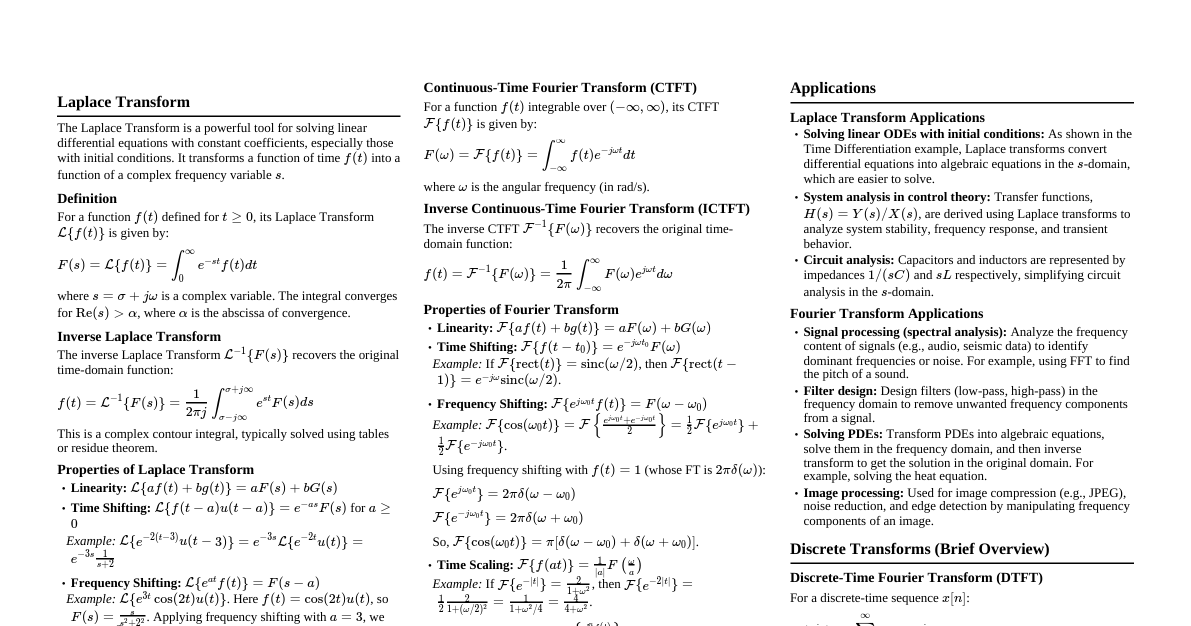
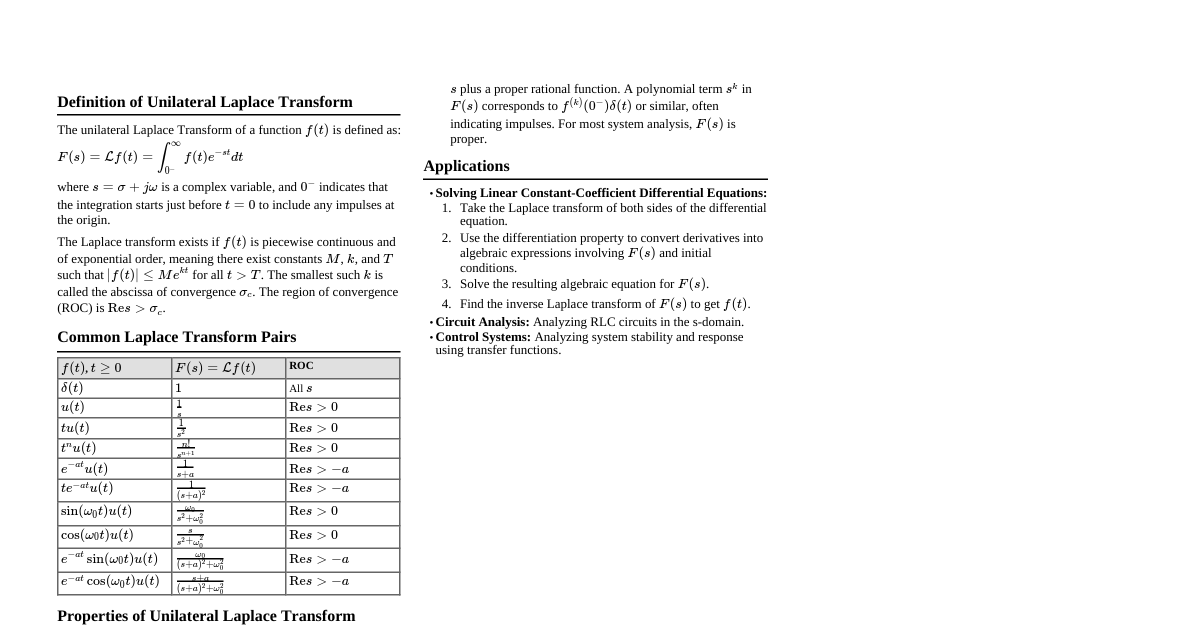
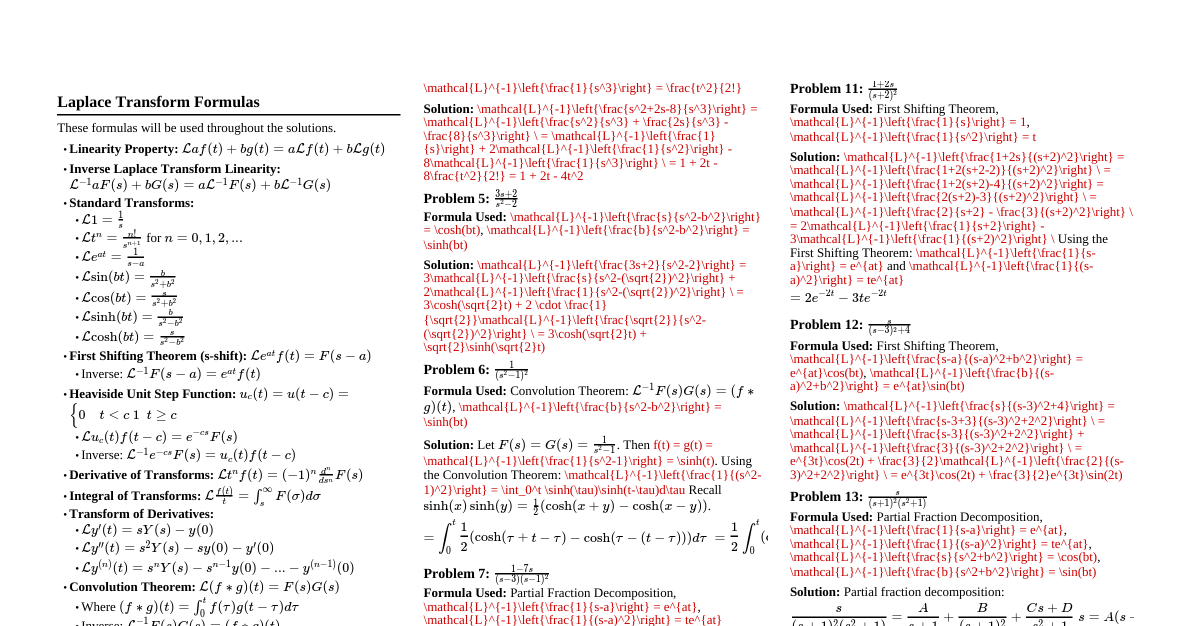
### Laplace Transform Basics - **Definition:** $\mathcal{L}\{f(t)\} = F(s) = \int_0^\infty e^{-st} f(t) dt$ - **Inverse Laplace Transform:** $f(t) = \mathcal{L}^{-1}\{F(s)\}$ - **Common Transforms:** - $\mathcal{L}\{1\} = \frac{1}{s}$ - $\mathcal{L}\{e^{at}\} = \frac{1}{s-a}$ - $\mathcal{L}\{t^n\} = \frac{n!}{s^{n+1}}$ (for $n=0, 1, 2, \dots$) - $\mathcal{L}\{\cos(at)\} = \frac{s}{s^2+a^2}$ - $\mathcal{L}\{\sin(at)\} = \frac{a}{s^2+a^2}$ - $\mathcal{L}\{\cosh(at)\} = \frac{s}{s^2-a^2}$, $|s|>|a|$ - $\mathcal{L}\{\sinh(at)\} = \frac{a}{s^2-a^2}$, $|s|>|a|$ ### Properties of Laplace Transforms - **Linearity:** $\mathcal{L}\{af(t) + bg(t)\} = aF(s) + bG(s)$ - **First Shifting Theorem:** $\mathcal{L}\{e^{at}f(t)\} = F(s-a)$ - **Second Shifting Theorem:** $\mathcal{L}\{f(t-a)u(t-a)\} = e^{-as}F(s)$ (where $u(t-a)$ is the unit step function) - **Derivative of a Function:** $\mathcal{L}\{f'(t)\} = sF(s) - f(0)$ - $\mathcal{L}\{f''(t)\} = s^2F(s) - sf(0) - f'(0)$ - **Integral of a Function:** $\mathcal{L}\left\{\int_0^t f(\tau) d\tau\right\} = \frac{F(s)}{s}$ - **Multiplication by $t^n$:** $\mathcal{L}\{t^n f(t)\} = (-1)^n \frac{d^n}{ds^n} F(s)$ - **Division by $t$:** $\mathcal{L}\left\{\frac{f(t)}{t}\right\} = \int_s^\infty F(u) du$ ### Laplace Transforms of Special Functions - **Unit Step Function:** $\mathcal{L}\{u(t-a)\} = \frac{e^{-as}}{s}$ - For $a=0$, $\mathcal{L}\{u(t)\} = \frac{1}{s}$ - **Dirac Delta (Impulse) Function:** $\mathcal{L}\{\delta(t-a)\} = e^{-as}$ - For $a=0$, $\mathcal{L}\{\delta(t)\} = 1$ - **Periodic Function:** If $f(t)$ is periodic with period $T$, then $$\mathcal{L}\{f(t)\} = \frac{1}{1 - e^{-sT}} \int_0^T e^{-st} f(t) dt$$ ### Convolution Theorem - **Definition of Convolution:** $(f * g)(t) = \int_0^t f(\tau) g(t-\tau) d\tau$ - **Theorem:** $\mathcal{L}\{(f * g)(t)\} = F(s)G(s)$ - **Inverse:** $\mathcal{L}^{-1}\{F(s)G(s)\} = (f * g)(t)$ ### Solution of Ordinary Differential Equations **Steps:** 1. Take the Laplace transform of both sides of the differential equation. 2. Use the linearity and derivative properties, incorporating initial conditions. 3. Solve the resulting algebraic equation for $Y(s) = \mathcal{L}\{y(t)\}$. 4. Find the inverse Laplace transform $y(t) = \mathcal{L}^{-1}\{Y(s)\}$ to get the solution. **Example for $ay'' + by' + cy = f(t)$:** $\mathcal{L}\{ay'' + by' + cy\} = \mathcal{L}\{f(t)\}$ $a(s^2Y(s) - sy(0) - y'(0)) + b(sY(s) - y(0)) + cY(s) = F(s)$ $Y(s)(as^2 + bs + c) - (asy(0) + ay'(0) + by(0)) = F(s)$ $Y(s) = \frac{F(s) + asy(0) + ay'(0) + by(0)}{as^2 + bs + c}$ Then, $y(t) = \mathcal{L}^{-1}\{Y(s)\}$. #### System of Linear Differential Equations - Apply Laplace transform to each equation in the system. - Solve the resulting system of algebraic equations for $Y_1(s), Y_2(s), \dots$. - Find the inverse Laplace transform for each variable. ### Applications to Electrical Circuits - **Components:** - **Resistor (R):** $V(s) = RI(s)$ - **Inductor (L):** $V(s) = L(sI(s) - i(0))$ - **Capacitor (C):** $V(s) = \frac{1}{C}\left(\frac{I(s)}{s} + \frac{q(0)}{s}\right)$ or $I(s) = C(sV(s) - v(0))$ - **Method:** 1. Write down the differential equations for the circuit using Kirchhoff's Voltage/Current Laws. 2. Apply Laplace transform to these equations, incorporating initial conditions (e.g., initial current in inductor, initial voltage across capacitor). 3. Solve the transformed algebraic equations for the desired current or voltage in the $s$-domain. 4. Perform inverse Laplace transform to obtain the time-domain solution. **Example (RLC Series Circuit):** $L\frac{di}{dt} + Ri + \frac{1}{C}\int i dt = v(t)$ Applying Laplace transform: $L(sI(s) - i(0)) + RI(s) + \frac{1}{C}\frac{I(s)}{s} + \frac{q(0)}{s} = V(s)$ $I(s)\left(Ls + R + \frac{1}{Cs}\right) = V(s) + Li(0) - \frac{q(0)}{s}$ Solve for $I(s)$ and then find $i(t) = \mathcal{L}^{-1}\{I(s)\}$.