Hibbeler
Cheatsheet Content
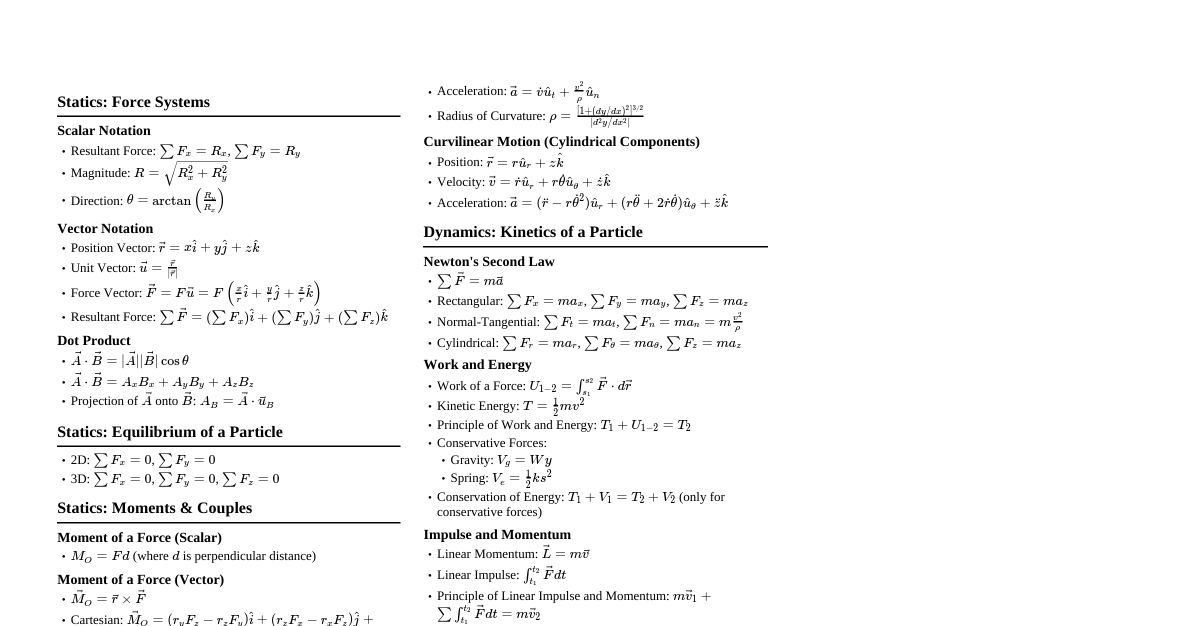
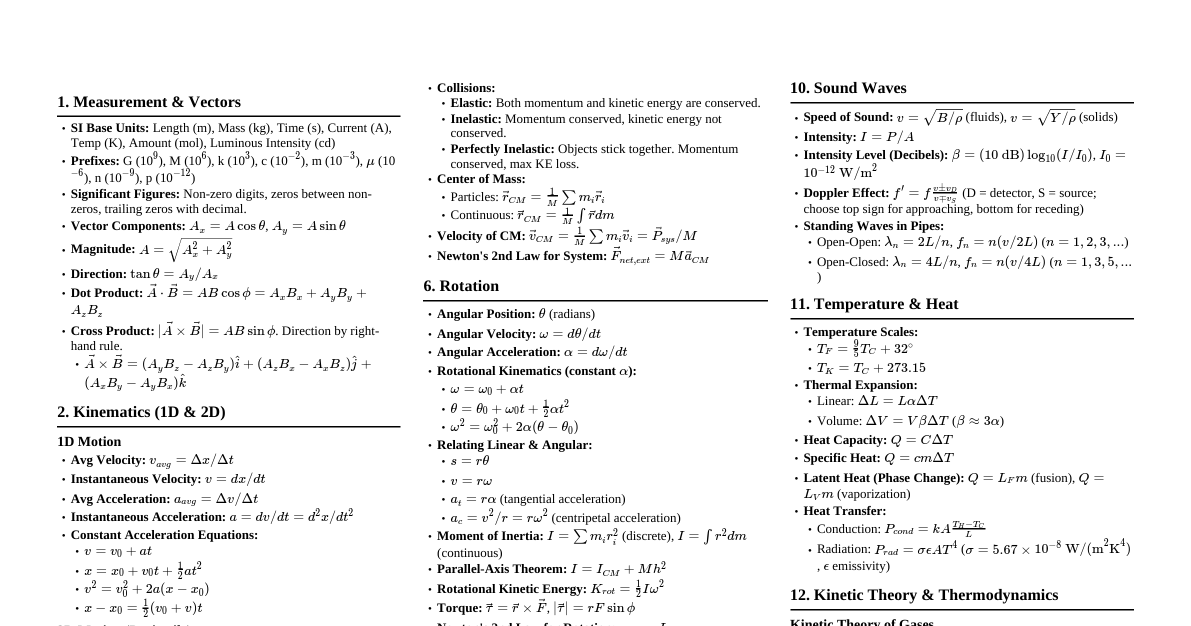
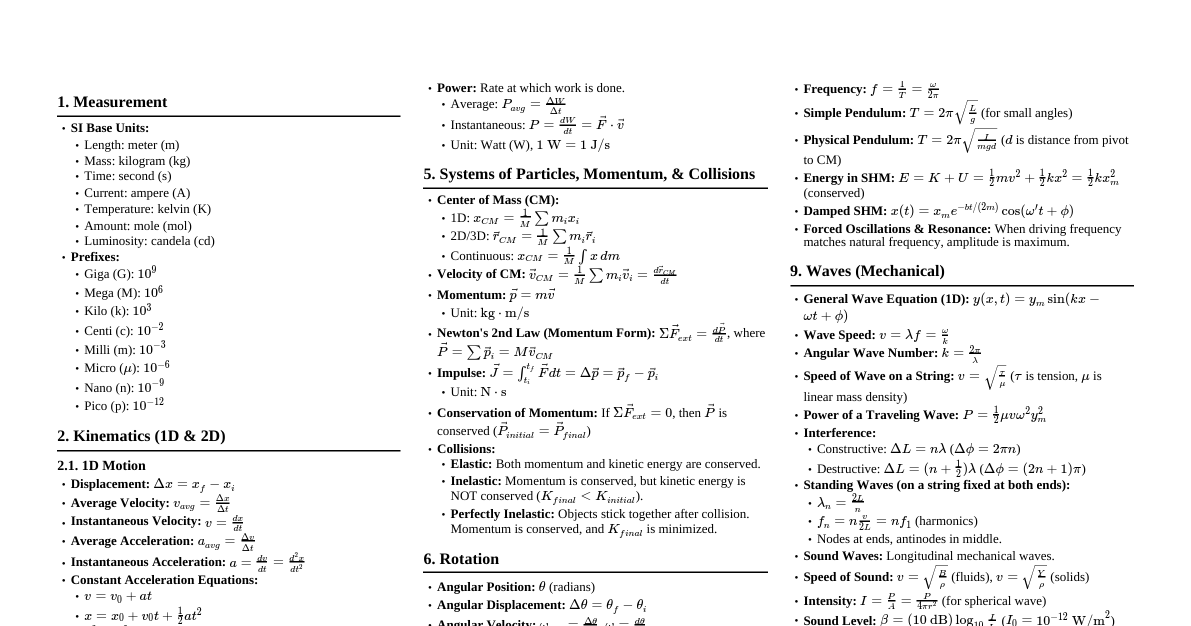
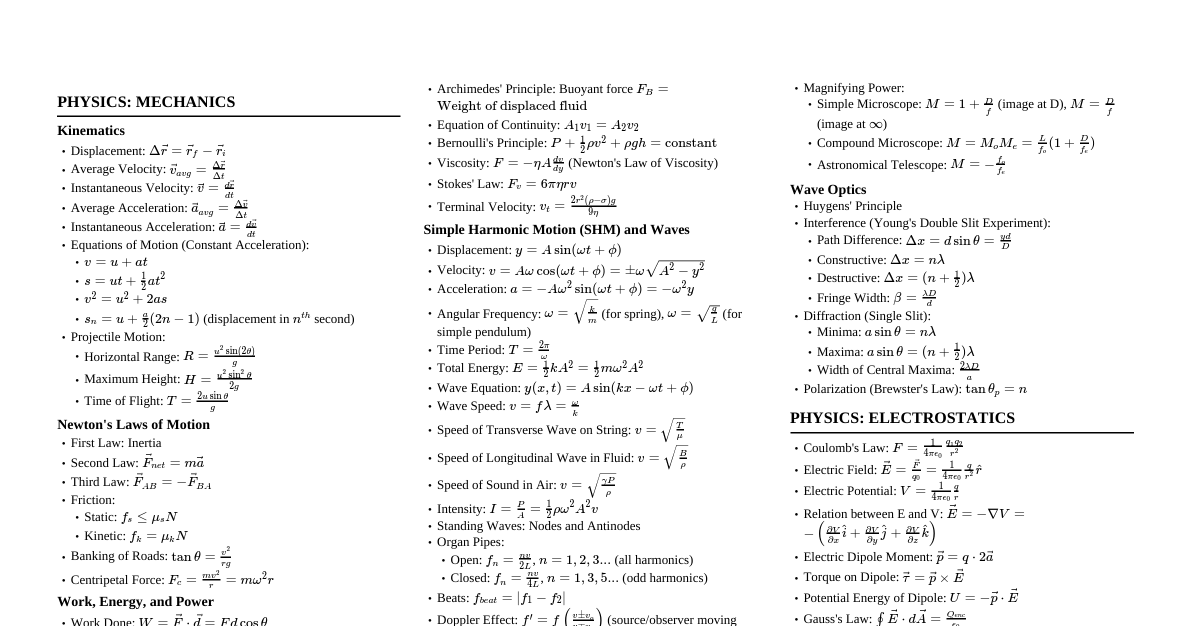
1. General Principles Newton's First Law: A particle originally at rest, or moving in a straight line with constant velocity, will remain in this state unless acted upon by an unbalanced force. Newton's Second Law: A particle acted upon by an unbalanced force $\vec{F}$ experiences an acceleration $\vec{a}$ that has the same direction as $\vec{F}$ and a magnitude that is directly proportional to $\vec{F}$. If $\vec{F}$ is applied to a particle of mass $m$, then $\vec{F} = m\vec{a}$. Newton's Third Law: The mutual forces of action and reaction between two particles are equal, opposite, and collinear. Gravitational Law: $F = G \frac{m_1 m_2}{r^2}$, where $G = 66.73 \times 10^{-12} \text{ m}^3/(\text{kg} \cdot \text{s}^2)$. Weight: $W = mg$, where $g = 9.81 \text{ m/s}^2$ or $32.2 \text{ ft/s}^2$. 2. Force Vectors 2.1. Scalar & Vector Quantities Scalar: Mass, volume, length, time. Vector: Force, velocity, acceleration. Has magnitude, direction, and point of application. 2.2. Vector Operations Addition (Parallelogram Law): $\vec{R} = \vec{A} + \vec{B}$. Tail-to-head method. Subtraction: $\vec{R'} = \vec{A} - \vec{B} = \vec{A} + (-\vec{B})$. Components: $F_x = F \cos \theta$, $F_y = F \sin \theta$. Magnitude: $F = \sqrt{F_x^2 + F_y^2}$. Direction: $\theta = \arctan(F_y/F_x)$. 2.3. Position Vectors $\vec{r} = (x_2 - x_1)\hat{i} + (y_2 - y_1)\hat{j} + (z_2 - z_1)\hat{k}$. 2.4. Dot Product $\vec{A} \cdot \vec{B} = AB \cos \theta$. $\vec{A} \cdot \vec{B} = A_x B_x + A_y B_y + A_z B_z$. Angle between vectors: $\cos \theta = \frac{\vec{A} \cdot \vec{B}}{AB}$. Projection: $A_B = \vec{A} \cdot \hat{u}_B = A \cos \theta$. 3. Equilibrium of a Particle Free-Body Diagram (FBD): Essential for problem-solving. Shows all external forces acting on the particle. Equations of Equilibrium: 2D: $\sum F_x = 0$, $\sum F_y = 0$. 3D: $\sum F_x = 0$, $\sum F_y = 0$, $\sum F_z = 0$. Spring Force: $F = ks$, where $k$ is spring stiffness, $s$ is deformation. 4. Force System Resultants 4.1. Moment of a Force Scalar (2D): $M_O = Fd$, where $d$ is perpendicular distance from $O$ to line of action of $F$. Vector (3D): $\vec{M}_O = \vec{r} \times \vec{F}$. $\vec{r} = x\hat{i} + y\hat{j} + z\hat{k}$ $\vec{F} = F_x\hat{i} + F_y\hat{j} + F_z\hat{k}$ $\vec{M}_O = \begin{vmatrix} \hat{i} & \hat{j} & \hat{k} \\ x & y & z \\ F_x & F_y & F_z \end{vmatrix}$ Varignon's Theorem: $\vec{M}_O = \vec{r} \times (\vec{F}_1 + \vec{F}_2 + ...) = \vec{r} \times \vec{F}_1 + \vec{r} \times \vec{F}_2 + ...$ 4.2. Moment about an Axis $M_L = \hat{u}_L \cdot (\vec{r} \times \vec{F})$. 4.3. Couple Moment $\vec{M} = \vec{r} \times \vec{F}$, where $\vec{r}$ is from negative to positive force. Magnitude $M = Fd$. 4.4. Equivalent System $\vec{F}_R = \sum \vec{F}$. $\vec{M}_{R_O} = \sum \vec{M}_O + \sum \vec{M}_{couple}$. 4.5. Distributed Load Resultant Force: $F_R = \int w(x) dx$ (area under loading curve). Location: $\bar{x} = \frac{\int x w(x) dx}{\int w(x) dx}$ (centroid of area). 5. Equilibrium of a Rigid Body 5.1. Types of Supports and Reactions Support Type Reactions Roller, Rocker, Smooth surface One force $\perp$ to surface Pin, Hinge Two force components Fixed Support Two force components, one couple moment 5.2. Equations of Equilibrium 2D: $\sum F_x = 0$, $\sum F_y = 0$, $\sum M_O = 0$. 3D: $\sum F_x = 0$, $\sum F_y = 0$, $\sum F_z = 0$, $\sum M_x = 0$, $\sum M_y = 0$, $\sum M_z = 0$. 5.3. Two- and Three-Force Members Two-Force Member: Forces act only at two points; must be collinear. Three-Force Member: Forces concurrent or parallel. 6. Trusses Assumptions: Members are two-force members, loads applied at joints. Method of Joints: Apply particle equilibrium ($\sum F_x = 0, \sum F_y = 0$) at each joint. Method of Sections: Cut truss to expose members, apply rigid body equilibrium ($\sum F_x = 0, \sum F_y = 0, \sum M_O = 0$) to section. Zero-Force Members: If two non-collinear members meet at an unloaded joint, both are zero-force members. If three members meet at an unloaded joint, two collinear, the third is a zero-force member. Determinacy: $b+r = 2j$ (statically determinate), $b+r > 2j$ (indeterminate), $b+r 7. Frames and Machines Frames are designed to support loads, machines transmit or alter forces. Separate structure into its component parts. Each part is a rigid body. Apply Newton's Third Law for internal forces (action-reaction pairs). 8. Center of Gravity and Centroid Centroid of Area: $\bar{x} = \frac{\int_A x dA}{\int_A dA}$, $\bar{y} = \frac{\int_A y dA}{\int_A dA}$. Composite Bodies: $\bar{X} = \frac{\sum \tilde{x} A}{\sum A}$, $\bar{Y} = \frac{\sum \tilde{y} A}{\sum A}$. Theorems of Pappus and Guldinus: Area of surface of revolution: $A = \theta \bar{r} L$. Volume of body of revolution: $V = \theta \bar{r} A$. ($\theta$ in radians). 9. Moments of Inertia Area Moment of Inertia: $I_x = \int_A y^2 dA$. $I_y = \int_A x^2 dA$. Polar Moment of Inertia: $J_O = I_x + I_y = \int_A r^2 dA$. Parallel-Axis Theorem: $I_x = \bar{I}_{x'} + Ad_y^2$. $I_y = \bar{I}_{y'} + Ad_x^2$. $J_O = \bar{J}_C + Ad^2$. Radius of Gyration: $k = \sqrt{I/A}$. 10. Friction Static Friction: $F_s \le \mu_s N$. Maximum occurs at impending motion. Kinetic Friction: $F_k = \mu_k N$. Occurs during motion. $\mu_k Angle of Friction: $\tan \phi_s = F_s/N = \mu_s$. Wedges, Screws, Bearings, Belts: Specific formulas apply. For flat belts: $T_2 = T_1 e^{\mu_s \beta}$. 11. Kinematics of a Particle 11.1. Rectilinear Motion $v = ds/dt$. $a = dv/dt = v dv/ds$. Constant Acceleration: $v = v_0 + at$. $s = s_0 + v_0 t + \frac{1}{2} at^2$. $v^2 = v_0^2 + 2a(s - s_0)$. 11.2. Curvilinear Motion $\vec{v} = d\vec{r}/dt$. $\vec{a} = d\vec{v}/dt$. Rectangular Components: $v_x = \dot{x}$, $v_y = \dot{y}$, $v_z = \dot{z}$. $a_x = \ddot{x}$, $a_y = \ddot{y}$, $a_z = \ddot{z}$. Normal and Tangential Components: $v = v \hat{u}_t$. $a_t = \dot{v}$ or $v dv/ds$. $a_n = v^2/\rho$. $\vec{a} = a_t \hat{u}_t + a_n \hat{u}_n$. Cylindrical Components: $v_r = \dot{r}$, $v_\theta = r\dot{\theta}$. $a_r = \ddot{r} - r\dot{\theta}^2$. $a_\theta = r\ddot{\theta} + 2\dot{r}\dot{\theta}$. 12. Kinetics of a Particle: Force and Acceleration $\sum \vec{F} = m\vec{a}$. Rectangular: $\sum F_x = ma_x$, $\sum F_y = ma_y$, $\sum F_z = ma_z$. Normal/Tangential: $\sum F_t = ma_t$, $\sum F_n = ma_n$. Cylindrical: $\sum F_r = ma_r$, $\sum F_\theta = ma_\theta$, $\sum F_z = ma_z$. 13. Kinetics of a Particle: Work and Energy Work of a Force: $U_{1-2} = \int \vec{F} \cdot d\vec{r}$. Constant force: $U_{1-2} = (F \cos \theta) s$. Weight: $U_{1-2} = -W(y_2 - y_1)$. Spring: $U_{1-2} = \frac{1}{2} ks_1^2 - \frac{1}{2} ks_2^2$. Principle of Work and Energy: $T_1 + \sum U_{1-2} = T_2$. Kinetic Energy: $T = \frac{1}{2} mv^2$. Power: $P = dU/dt = \vec{F} \cdot \vec{v}$. Efficiency: $\epsilon = (P_{out}/P_{in}) \times 100\%$. Conservation of Energy: $T_1 + V_1 = T_2 + V_2$. Potential Energy: $V = V_g + V_e$. Gravitational: $V_g = Wy$. Elastic: $V_e = \frac{1}{2} ks^2$. 14. Kinetics of a Particle: Impulse and Momentum Linear Momentum: $\vec{L} = m\vec{v}$. Principle of Linear Impulse and Momentum: $m\vec{v}_1 + \sum \int_{t_1}^{t_2} \vec{F} dt = m\vec{v}_2$. Conservation of Linear Momentum: If $\sum \vec{F} = 0$, then $\sum m\vec{v}_1 = \sum m\vec{v}_2$. Impact: Coefficient of Restitution: $e = \frac{(v_B)_2 - (v_A)_2}{(v_A)_1 - (v_B)_1}$. $e=1$ (elastic), $e=0$ (plastic). Angular Momentum: $(\vec{H}_O)_1 + \sum \int_{t_1}^{t_2} \vec{M}_O dt = (\vec{H}_O)_2$. $\vec{H}_O = \vec{r} \times m\vec{v}$. 15. Planar Kinematics of a Rigid Body 15.1. Types of Motion Translation: All points have same velocity and acceleration. Rectilinear: Straight path. Curvilinear: Curved path. Rotation about a Fixed Axis: $\omega = d\theta/dt$. $\alpha = d\omega/dt = \omega d\omega/d\theta$. $v = r\omega$. $a_t = r\alpha$. $a_n = r\omega^2 = v^2/r$. General Plane Motion: Combination of translation and rotation. 15.2. Relative Motion Analysis Velocity: $\vec{v}_B = \vec{v}_A + \vec{\omega} \times \vec{r}_{B/A}$. Acceleration: $\vec{a}_B = \vec{a}_A + \vec{\alpha} \times \vec{r}_{B/A} - \omega^2 \vec{r}_{B/A}$. 15.3. Instantaneous Center of Zero Velocity (IC) Point on the body or its extension that has zero velocity at a given instant. $\vec{v} = \omega r_{IC}$. 16. Planar Kinetics of a Rigid Body: Force and Acceleration $\sum F_x = m(\bar{a}_x)$. $\sum F_y = m(\bar{a}_y)$. $\sum M_G = I_G \alpha$. (Moment about center of mass G) $\sum M_P = I_P \alpha$. (Moment about fixed point P) Mass Moment of Inertia: $I = \int r^2 dm$. Parallel-Axis Theorem for Mass Moment of Inertia: $I = \bar{I} + md^2$. 17. Planar Kinetics of a Rigid Body: Work and Energy Kinetic Energy: $T = \frac{1}{2} m \bar{v}^2 + \frac{1}{2} \bar{I} \omega^2$. Principle of Work and Energy: $T_1 + \sum U_{1-2} = T_2$. Conservation of Energy: $T_1 + V_1 = T_2 + V_2$. 18. Vibrations Undamped Free Vibration: Equation: $m\ddot{x} + kx = 0$. Natural Frequency: $\omega_n = \sqrt{k/m}$ (rad/s). Period: $\tau = 2\pi/\omega_n$. Frequency: $f = 1/\tau = \omega_n/(2\pi)$. Damped Free Vibration: Critical Damping: $c_c = 2m\omega_n = 2\sqrt{km}$. Damping Ratio: $\zeta = c/c_c$.