Breathing & Gas Exchange
Cheatsheet Content
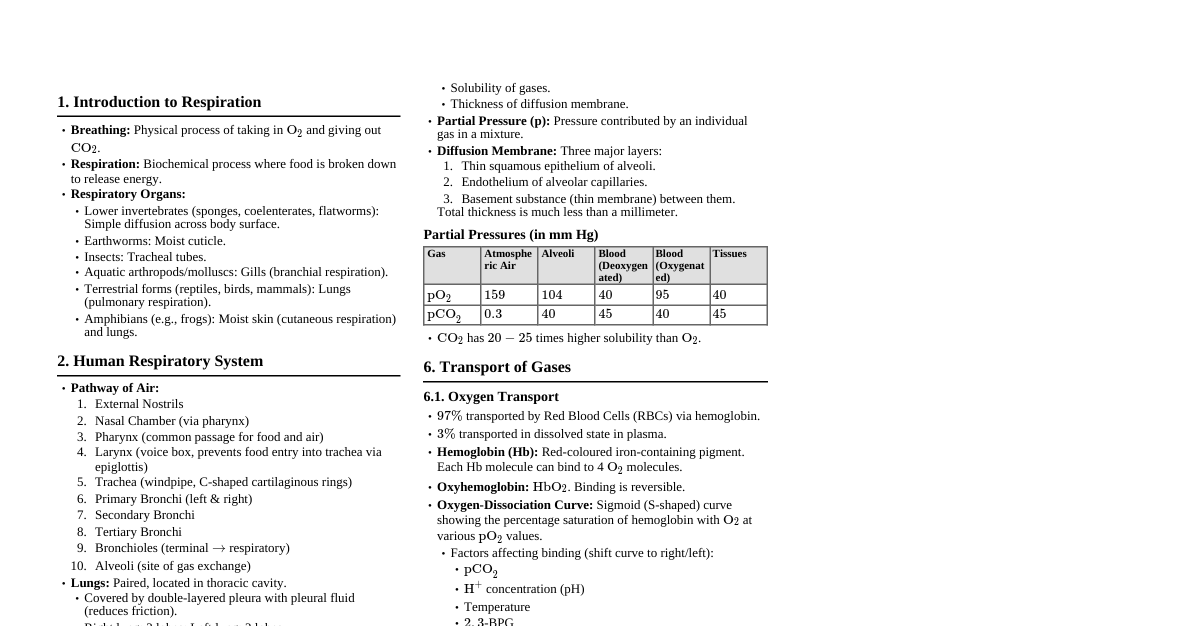
### Introduction to Respiration Respiration is the process of exchange of gases ($O_2$ from the atmosphere with $CO_2$ produced by the cells) at various levels. Organisms have evolved different mechanisms for gas exchange depending on their habitat and level of organization. ### Respiratory Organs Different animals use different organs for respiration: - **Sponges, Coelenterates, Flatworms:** Exchange $O_2$ and $CO_2$ by simple diffusion across their entire body surface. - **Earthworms:** Use their moist cuticle. - **Insects:** Have a network of tubes (tracheal tubes) to transport atmospheric air directly to cells. - **Aquatic Arthropods, Molluscs:** Use gills (branchial respiration). - **Reptiles, Birds, Mammals:** Use lungs (pulmonary respiration). - **Amphibians (e.g., frogs):** Can respire through moist skin (cutaneous respiration) and lungs. Humans have a well-developed respiratory system. ### Human Respiratory System The human respiratory system consists of: - **External nostrils:** Open into a nasal chamber above the palate. - **Nasal chamber:** Opens into the pharynx. - **Pharynx:** A common passage for food and air. - **Larynx (sound box):** Cartilaginous box that helps in sound production. During swallowing, the epiglottis (a thin elastic cartilaginous flap) covers the glottis (opening of the larynx) to prevent food entry into the larynx. - **Trachea (windpipe):** A straight tube extending up to the mid-thoracic cavity, dividing at the 5th thoracic vertebra into primary bronchi. - **Bronchi:** Each primary bronchus divides repeatedly into secondary and tertiary bronchi and then into fine terminal bronchioles. - **Bronchioles:** End up in very thin, irregular-walled vascularised bag-like structures called alveoli. - **Lungs:** There are two lungs, enclosed by a double-layered pleura. Pleural fluid between the layers reduces friction. The conducting part (nostrils to terminal bronchioles) transports air, humidifies it, and brings it to body temperature. The respiratory or exchange part (alveoli and their ducts) is the actual site of gas exchange. ### Mechanism of Breathing Breathing involves two stages: inspiration and expiration. 1. **Inspiration:** Intake of atmospheric air. - Diaphragm contracts (flattens). - External intercostal muscles contract, pulling ribs and sternum upwards and outwards. - Increases thoracic volume (antero-posterior and dorso-ventral axes). - Pulmonary volume increases, decreasing intra-pulmonary pressure below atmospheric pressure. - Air rushes into the lungs. 2. **Expiration:** Release of alveolar air. - Diaphragm relaxes (domes upwards). - External intercostal muscles relax, allowing ribs and sternum to return to original position. - Decreases thoracic volume. - Pulmonary volume decreases, increasing intra-pulmonary pressure above atmospheric pressure. - Air is expelled from the lungs. **Forceful breathing:** Involves additional muscles (internal intercostals and abdominal muscles). ### Respiratory Volumes and Capacities - **Tidal Volume (TV):** Volume of air inspired or expired during a normal respiration (approx. 500 mL). - **Inspiratory Reserve Volume (IRV):** Additional volume of air a person can inspire by a forceful inspiration (2500-3000 mL). - **Expiratory Reserve Volume (ERV):** Additional volume of air a person can expire by a forceful expiration (1000-1100 mL). - **Residual Volume (RV):** Volume of air remaining in the lungs after a forceful expiration (1100-1200 mL). **Respiratory Capacities:** - **Inspiratory Capacity (IC):** Total volume of air a person can inspire after a normal expiration (TV + IRV). - **Expiratory Capacity (EC):** Total volume of air a person can expire after a normal inspiration (TV + ERV). - **Functional Residual Capacity (FRC):** Volume of air remaining in the lungs after a normal expiration (ERV + RV). - **Vital Capacity (VC):** Maximum volume of air a person can breathe in after a forceful expiration, or maximum volume of air a person can breathe out after a forceful inspiration (ERV + TV + IRV). - **Total Lung Capacity (TLC):** Total volume of air accommodated in the lungs at the end of a forceful inspiration (RV + ERV + TV + IRV or VC + RV). ### Exchange of Gases Gas exchange occurs at two sites: 1. **Alveoli:** Between alveoli and blood (atmospheric $O_2$ to blood, $CO_2$ from blood to alveoli). 2. **Tissues:** Between blood and tissues ($O_2$ from blood to tissues, $CO_2$ from tissues to blood). Exchange occurs by simple diffusion, primarily based on: - **Partial pressure gradient:** Pressure contributed by an individual gas in a mixture of gases. - Partial pressures ($P_{O_2}$, $P_{CO_2}$) are crucial. - $P_{O_2}$ in atmospheric air > alveoli > deoxygenated blood > tissues. - $P_{CO_2}$ in tissues > deoxygenated blood > alveoli > atmospheric air. - **Solubility of gases:** $CO_2$ is 20-25 times more soluble than $O_2$. - **Thickness of diffusion membrane:** The diffusion membrane (alveolar squamous epithelium, endothelium of alveolar capillaries, and basement substance) is very thin (less than 1 mm). | Respiratory Gas | Air (mm Hg) | Alveoli (mm Hg) | Blood (Deoxygenated) (mm Hg) | Blood (Oxygenated) (mm Hg) | Tissues (mm Hg) | |:----------------|:------------|:----------------|:-----------------------------|:---------------------------|:----------------| | $O_2$ | 159 | 104 | 40 | 95 | 40 | | $CO_2$ | 0.3 | 40 | 45 | 40 | 45 | ### Transport of Gases **A. Oxygen Transport:** - **By Haemoglobin (Hb):** - $O_2$ binds with Hb (a red-coloured iron-containing pigment in RBCs) to form oxyhaemoglobin ($HbO_2$). - Each Hb molecule can carry a maximum of four $O_2$ molecules. - Binding is reversible and depends on $P_{O_2}$, $P_{CO_2}$, $H^+$ concentration (pH), and temperature. - **Oxygen Dissociation Curve:** A sigmoidal curve showing the percentage saturation of Hb with $O_2$ at different $P_{O_2}$. - **Factors favouring $O_2$ binding to Hb (in alveoli):** High $P_{O_2}$, low $P_{CO_2}$, low $H^+$ (high pH), lower temperature. - **Factors favouring $O_2$ dissociation from Hb (in tissues):** Low $P_{O_2}$, high $P_{CO_2}$, high $H^+$ (low pH), higher temperature. - Every 100 mL of oxygenated blood delivers approximately 5 mL of $O_2$ to the tissues under normal physiological conditions. **B. Carbon Dioxide Transport:** - $CO_2$ is transported in three forms: 1. **As dissolved state in plasma:** About 7% of $CO_2$ is carried in dissolved form through plasma. 2. **As bicarbonate ions:** About 70% of $CO_2$ is transported as bicarbonate. - $CO_2$ diffuses into RBCs, reacts with water to form carbonic acid ($H_2CO_3$) in the presence of carbonic anhydrase. - $H_2CO_3$ dissociates into $H^+$ and $HCO_3^-$. - $HCO_3^-$ moves into plasma, and $Cl^-$ ions move into RBCs to maintain ionic balance (Chloride shift). - In alveoli, the reaction reverses, releasing $CO_2$. 3. **As carbamino-haemoglobin:** About 20-25% of $CO_2$ binds to amino groups of Hb (and plasma proteins) to form carbamino-haemoglobin. - Binding depends on $P_{CO_2}$ and $P_{O_2}$. - High $P_{CO_2}$ and low $P_{O_2}$ (in tissues) favour binding. - Low $P_{CO_2}$ and high $P_{O_2}$ (in alveoli) favour dissociation. - Every 100 mL of deoxygenated blood delivers approximately 4 mL of $CO_2$ to the alveoli. ### Regulation of Respiration The rhythm of respiration is maintained by the nervous system. - **Respiratory Rhythm Centre:** Located in the medulla region of the brain, primarily responsible for regulating respiration. - **Pneumotaxic Centre:** Located in the pons region of the brain, can moderate the functions of the rhythm centre. It can reduce the duration of inspiration and thereby alter the respiratory rate. - **Chemosensitive Area:** Adjacent to the rhythm centre, highly sensitive to $CO_2$ and $H^+$ ions. An increase in these substances activates the centre, which in turn signals the rhythm centre to make necessary adjustments in the respiratory process for their elimination. - **Oxygen's role:** $O_2$ has an insignificant role in the regulation of respiratory rhythm. Receptors associated with the aortic arch and carotid artery also recognize changes in $CO_2$ and $H^+$ concentration and send necessary signals to the rhythm centre. ### Disorders of Respiratory System - **Asthma:** Difficulty in breathing due to inflammation of bronchi and bronchioles. - **Emphysema:** Chronic disorder where alveolar walls are damaged, decreasing respiratory surface. Caused by cigarette smoking. - **Occupational Respiratory Disorders:** Caused by prolonged exposure to dust in industries (e.g., grinding, stone-breaking). Leads to fibrosis (proliferation of fibrous tissue). Workers should wear protective masks.