Inverse Trigonometric Function
Shared 5/4/2026•1 views
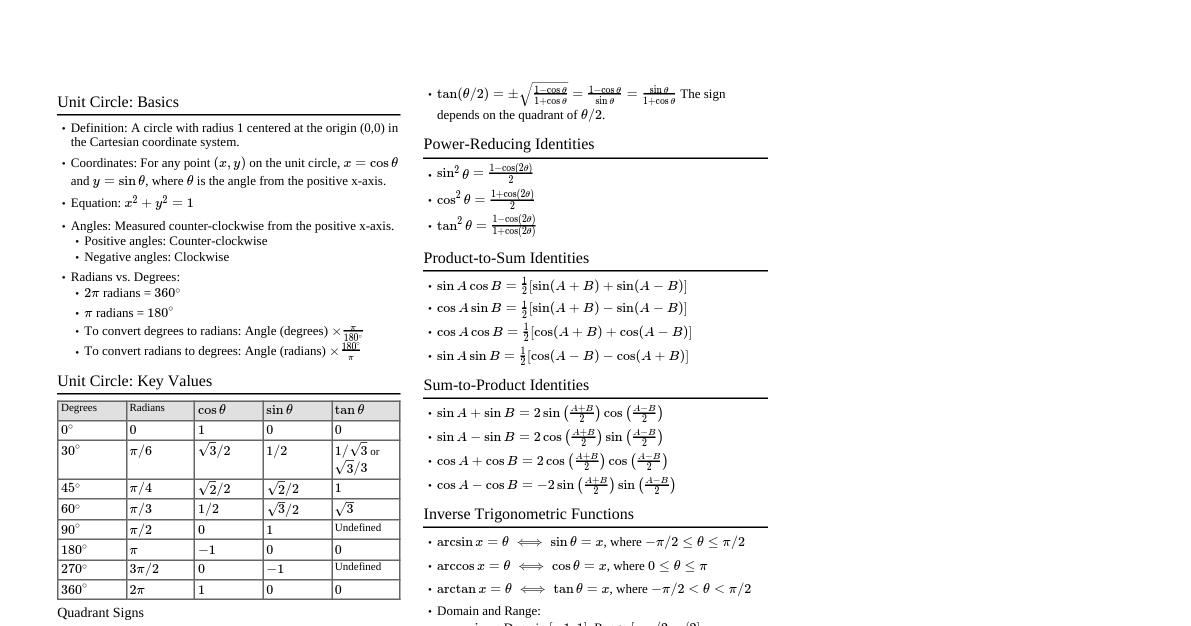
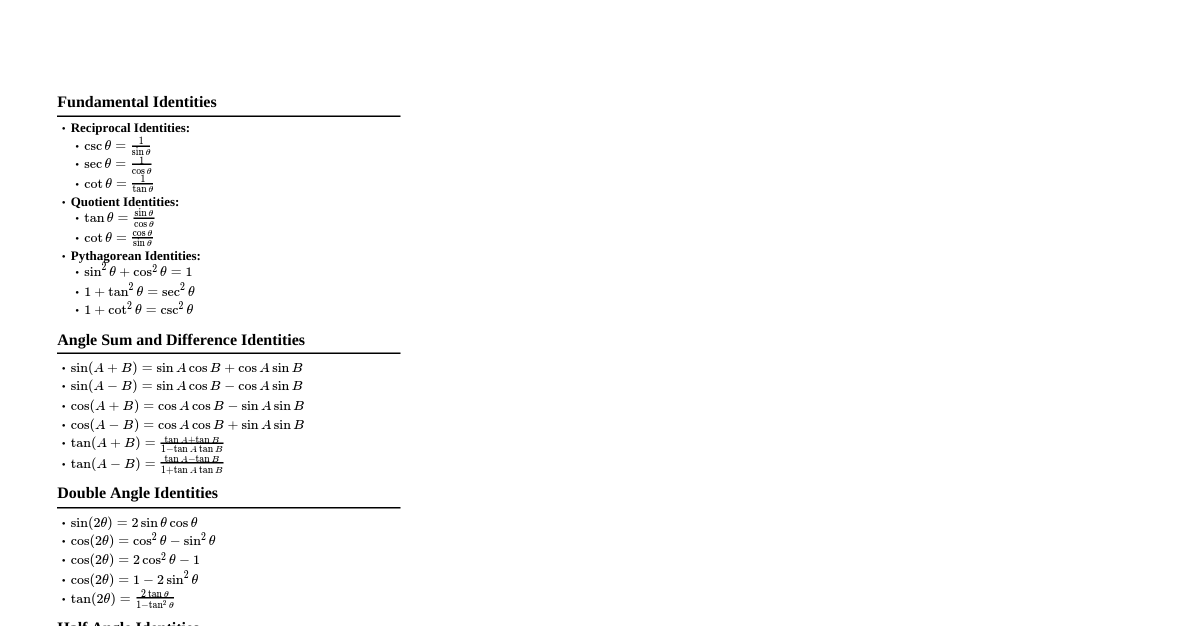
### Introduction Inverse trigonometric functions (also known as inverse circular functions) are denoted by $\sin^{-1}x$, $\cos^{-1}x$, $\tan^{-1}x$, etc. These functions represent the angle whose sine, cosine, or tangent is equal to $x$. The chosen angle is typically the numerically smallest one. It's important to note that standard trigonometric functions like $\sin x$, $\cos x$, etc., are not generally invertible. Their inverse is defined by restricting their domain and co-domain to make them invertible. ### Domain & Range of Inverse Trigonometric Functions | S.No. | $f(x)$ | Domain | Range | |:------|:--------------|:-------------|:-------------------------------| | (1) | $\sin^{-1}x$ | $|x| \le 1$ | $[-\frac{\pi}{2}, \frac{\pi}{2}]$ | | (2) | $\cos^{-1}x$ | $|x| \le 1$ | $[0, \pi]$ | | (3) | $\tan^{-1}x$ | $x \in R$ | $(-\frac{\pi}{2}, \frac{\pi}{2})$ | | (4) | $\sec^{-1}x$ | $|x| \ge 1$ | $[0, \pi] - \{\frac{\pi}{2}\}$ | | (5) | $\csc^{-1}x$ | $|x| \ge 1$ | $[-\frac{\pi}{2}, \frac{\pi}{2}] - \{0\}$ | | (6) | $\cot^{-1}x$ | $x \in R$ | $(0, \pi)$ | ### Important Points on Inverse Trigonometric Functions - All inverse trigonometric functions represent an angle. - If $x \ge 0$, all six functions ($\sin^{-1}x$, $\cos^{-1}x$, $\tan^{-1}x$, $\sec^{-1}x$, $\csc^{-1}x$, $\cot^{-1}x$) represent an acute angle. - If $x ### Properties of Inverse Circular Functions (P-1) - **Identity Functions:** - $\sin(\sin^{-1}x) = x$, for $x \in [-1, 1]$ - $\cos(\cos^{-1}x) = x$, for $x \in [-1, 1]$ - $\tan(\tan^{-1}x) = x$, for $x \in R$ - $\cot(\cot^{-1}x) = x$, for $x \in R$ - $\csc(\csc^{-1}x) = x$, for $|x| \ge 1$ - $\sec(\sec^{-1}x) = x$, for $|x| \ge 1$ These functions are generally aperiodic. ### Properties of Inverse Circular Functions (P-2) - **Inverse of Inverse Functions:** - $\sin^{-1}(\sin x) = x$, for $x \in [-\frac{\pi}{2}, \frac{\pi}{2}]$ - $\cos^{-1}(\cos x) = x$, for $x \in [0, \pi]$ - $\tan^{-1}(\tan x) = x$, for $x \in (-\frac{\pi}{2}, \frac{\pi}{2})$ - $\cot^{-1}(\cot x) = x$, for $x \in (0, \pi)$ - $\sec^{-1}(\sec x) = x$, for $x \in [0, \pi] - \{\frac{\pi}{2}\}$ - $\csc^{-1}(\csc x) = x$, for $x \in [-\frac{\pi}{2}, \frac{\pi}{2}] - \{0\}$ ### Properties of Inverse Circular Functions (P-3) - **Negative Argument Identities:** - $\sin^{-1}(-x) = -\sin^{-1}x$, for $x \in [-1, 1]$ - $\tan^{-1}(-x) = -\tan^{-1}x$, for $x \in R$ - $\csc^{-1}(-x) = -\csc^{-1}x$, for $|x| \ge 1$ - $\cos^{-1}(-x) = \pi - \cos^{-1}x$, for $x \in [-1, 1]$ - $\cot^{-1}(-x) = \pi - \cot^{-1}x$, for $x \in R$ - $\sec^{-1}(-x) = \pi - \sec^{-1}x$, for $|x| \ge 1$ ### Properties of Inverse Circular Functions (P-4) - **Reciprocal Identities:** - $\csc^{-1}x = \sin^{-1}(\frac{1}{x})$, for $|x| \ge 1$ - $\sec^{-1}x = \cos^{-1}(\frac{1}{x})$, for $|x| \ge 1$ - $\cot^{-1}x = \tan^{-1}(\frac{1}{x})$, for $x > 0$ - $\cot^{-1}x = \pi + \tan^{-1}(\frac{1}{x})$, for $x ### Properties of Inverse Circular Functions (P-5) - **Complementary Angle Identities:** - $\sin^{-1}x + \cos^{-1}x = \frac{\pi}{2}$, for $x \in [-1, 1]$ - $\tan^{-1}x + \cot^{-1}x = \frac{\pi}{2}$, for $x \in R$ - $\csc^{-1}x + \sec^{-1}x = \frac{\pi}{2}$, for $|x| \ge 1$ ### Properties of Inverse Circular Functions (P-6) - **Conversion Identities:** - $\sin(\cos^{-1}x) = \cos(\sin^{-1}x) = \sqrt{1-x^2}$, for $x \in [-1, 1]$ - $\tan(\cot^{-1}x) = \cot(\tan^{-1}x) = \frac{1}{x}$, for $x \in R, x \ne 0$ - $\csc(\sec^{-1}x) = \sec(\csc^{-1}x) = \frac{|x|}{\sqrt{x^2-1}}$, for $|x| > 1$ ### Identities of Addition and Subtraction #### 1. For $\sin^{-1}x$ and $\cos^{-1}x$: - $\sin^{-1}x + \sin^{-1}y = \sin^{-1}(x\sqrt{1-y^2} + y\sqrt{1-x^2})$ - If $x \ge 0, y \ge 0$ and $x^2+y^2 \le 1$ - Or if $x \ge 0, y \ge 0$ and $x^2+y^2 > 1$, then $\pi - \sin^{-1}(x\sqrt{1-y^2} + y\sqrt{1-x^2})$ - $\sin^{-1}x - \sin^{-1}y = \sin^{-1}(x\sqrt{1-y^2} - y\sqrt{1-x^2})$, for $x \ge 0, y \ge 0$ - $\cos^{-1}x + \cos^{-1}y = \cos^{-1}(xy - \sqrt{1-x^2}\sqrt{1-y^2})$, for $x \ge 0, y \ge 0$ - $\cos^{-1}x - \cos^{-1}y = \cos^{-1}(xy + \sqrt{1-x^2}\sqrt{1-y^2})$, for $x \ge 0, y \ge 0, x \le y$ #### 2. For $\tan^{-1}x$: - $\tan^{-1}x + \tan^{-1}y = \tan^{-1}(\frac{x+y}{1-xy})$ - If $xy 1$, then $\pi + \tan^{-1}(\frac{x+y}{1-xy})$ - If $xy = 1$, then $\frac{\pi}{2}$ (for $x,y > 0$) - $\tan^{-1}x - \tan^{-1}y = \tan^{-1}(\frac{x-y}{1+xy})$ - $\tan^{-1}x + \tan^{-1}y + \tan^{-1}z = \tan^{-1}(\frac{x+y+z-xyz}{1-xy-yz-zx})$ - If $x,y,z \ge 0$ and $xy+yz+zx ### Simplified Inverse Trigonometric Functions - $2\sin^{-1}x = \sin^{-1}(2x\sqrt{1-x^2})$ - If $-\frac{1}{\sqrt{2}} \le x \le \frac{1}{\sqrt{2}}$ - If $x > \frac{1}{\sqrt{2}}$, then $\pi - \sin^{-1}(2x\sqrt{1-x^2})$ - If $x ### Equations Involving Inverse Trigonometric Functions Solving equations involving inverse trigonometric functions often requires using the properties and identities to simplify the expressions. It's crucial to check for extraneous solutions by verifying the solutions in the original equation's domain. **Example:** Solve $\tan^{-1}x + \tan^{-1}2x = \frac{\pi}{4}$ Using $\tan^{-1}A + \tan^{-1}B = \tan^{-1}(\frac{A+B}{1-AB})$: $\tan^{-1}(\frac{x+2x}{1-x(2x)}) = \frac{\pi}{4}$ $\tan^{-1}(\frac{3x}{1-2x^2}) = \frac{\pi}{4}$ $\frac{3x}{1-2x^2} = \tan(\frac{\pi}{4}) = 1$ $3x = 1-2x^2$ $2x^2 + 3x - 1 = 0$ Using the quadratic formula, $x = \frac{-3 \pm \sqrt{3^2 - 4(2)(-1)}}{2(2)} = \frac{-3 \pm \sqrt{9+8}}{4} = \frac{-3 \pm \sqrt{17}}{4}$. We must ensure that $x$ and $2x$ satisfy the condition $x(2x) 1$. This is an extraneous solution. So, the only solution is $x = \frac{-3 + \sqrt{17}}{4}$. ### Inequalities Involving Inverse Trigonometric Functions Solving inequalities with inverse trigonometric functions often involves: 1. Using the properties and definitions of inverse trigonometric functions. 2. Considering the domain and range of the functions. 3. Graphing the functions to identify regions satisfying the inequality. 4. Squaring both sides (if applicable) and checking for extraneous solutions. ### Summation of Series Many series involving inverse trigonometric functions can be simplified using the telescoping sum method, often by applying identities like $\tan^{-1}x - \tan^{-1}y = \tan^{-1}(\frac{x-y}{1+xy})$. **Example:** Sum the series $\sum_{n=1}^{\infty} \tan^{-1}\left(\frac{1}{n^2+n+1}\right)$. Notice that $\frac{1}{n^2+n+1} = \frac{(n+1)-n}{1+n(n+1)}$. So, $\tan^{-1}\left(\frac{1}{n^2+n+1}\right) = \tan^{-1}(n+1) - \tan^{-1}(n)$. This is a telescoping sum: $S_N = \sum_{n=1}^{N} [\tan^{-1}(n+1) - \tan^{-1}(n)]$ $S_N = (\tan^{-1}2 - \tan^{-1}1) + (\tan^{-1}3 - \tan^{-1}2) + \dots + (\tan^{-1}(N+1) - \tan^{-1}N)$ $S_N = \tan^{-1}(N+1) - \tan^{-1}1$ As $N \to \infty$, $S_N = \lim_{N \to \infty} (\tan^{-1}(N+1) - \tan^{-1}1) = \frac{\pi}{2} - \frac{\pi}{4} = \frac{\pi}{4}$.