Continuous Function Open/Closed Proof
Cheatsheet Content
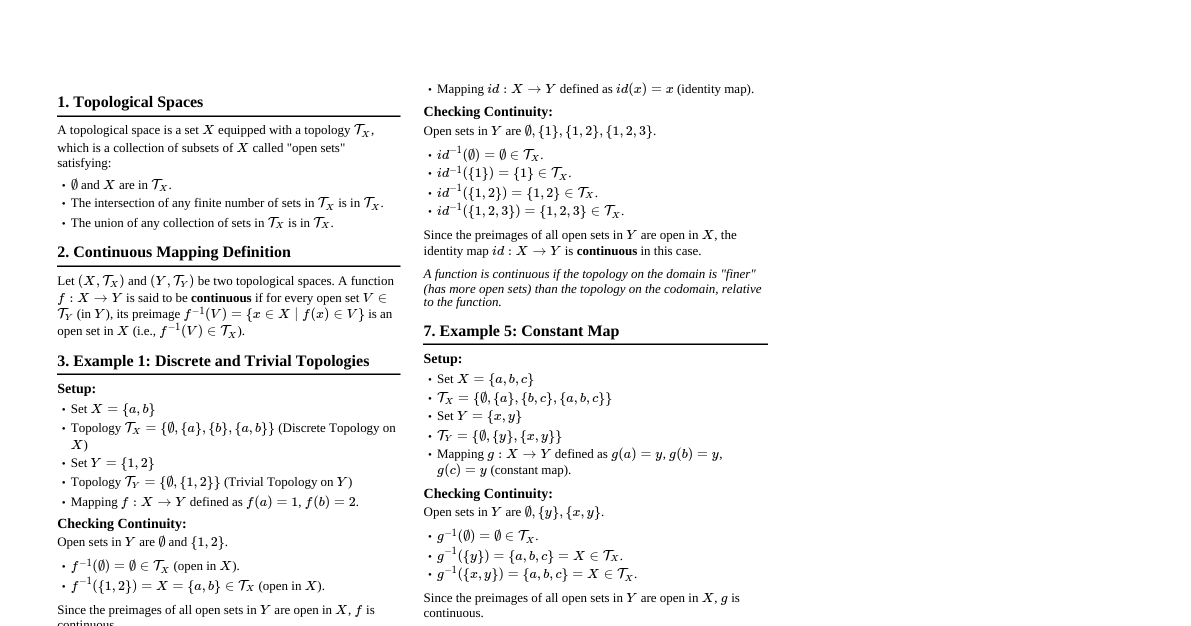
Continuity Definition A function $f: (X, \tau_1) \to (Y, \tau_2)$ is continuous if for every open set $V \in \tau_2$ in $Y$, its preimage $f^{-1}(V)$ is an open set in $X$ (i.e., $f^{-1}(V) \in \tau_1$). Given Topologies and Function Space $X = \{a, b, c\}$ with topology $\tau_1 = \{\emptyset, \{a, b\}, X\}$. Space $Y = \{p, q, r\}$ with topology $\tau_2 = \{\emptyset, \{p, r\}, Y\}$. Function $f: X \to Y$ defined as $f(a)=p, f(b)=p, f(c)=p$. 1. Check for Continuity of $f$ We must check the preimage of every open set in $Y$ ($V \in \tau_2$). For $V = \emptyset$: $f^{-1}(\emptyset) = \emptyset$. Since $\emptyset \in \tau_1$, this condition holds. For $V = \{p, r\}$: $f^{-1}(\{p, r\}) = \{x \in X \mid f(x) \in \{p, r\}\}$. Since $f(a)=p$, $f(b)=p$, $f(c)=p$, then $f^{-1}(\{p, r\}) = \{a, b, c\} = X$. Since $X \in \tau_1$, this condition holds. For $V = Y$: $f^{-1}(Y) = X$. Since $X \in \tau_1$, this condition holds. Since the preimage of every open set in $Y$ is open in $X$, the function $f$ is continuous. 2. Show $f$ is Not an Open Map A function $f$ is an open map if the image of every open set in $X$ is open in $Y$. Consider the open sets in $X$ (elements of $\tau_1$): For $U = \emptyset$: $f(U) = f(\emptyset) = \emptyset$. Since $\emptyset \in \tau_2$, this is open. For $U = \{a, b\}$: $f(U) = f(\{a, b\}) = \{f(a), f(b)\} = \{p, p\} = \{p\}$. Is $\{p\}$ an open set in $Y$? No, because $\{p\} \notin \tau_2$. Since there exists an open set in $X$ (namely $\{a, b\}$) whose image under $f$ (which is $\{p\}$) is not open in $Y$, the continuous function $f$ is not an open map. 3. Show $f$ is Not a Closed Map A function $f$ is a closed map if the image of every closed set in $X$ is closed in $Y$. First, find the closed sets in $X$ and $Y$. Closed sets in $X$ (complements of open sets in $\tau_1$): $X \setminus \emptyset = X$ $X \setminus \{a, b\} = \{c\}$ $X \setminus X = \emptyset$ So, the closed sets in $X$ are $\{\emptyset, \{c\}, X\}$. Closed sets in $Y$ (complements of open sets in $\tau_2$): $Y \setminus \emptyset = Y$ $Y \setminus \{p, r\} = \{q\}$ $Y \setminus Y = \emptyset$ So, the closed sets in $Y$ are $\{\emptyset, \{q\}, Y\}$. Now, consider the image of every closed set in $X$ under $f$: For $A = \emptyset$: $f(A) = f(\emptyset) = \emptyset$. Since $\emptyset$ is closed in $Y$, this holds. For $A = \{c\}$: $f(A) = f(\{c\}) = \{f(c)\} = \{p\}$. Is $\{p\}$ a closed set in $Y$? No, because $\{p\} \notin \{\emptyset, \{q\}, Y\}$. Since there exists a closed set in $X$ (namely $\{c\}$) whose image under $f$ (which is $\{p\}$) is not closed in $Y$, the continuous function $f$ is not a closed map. Conclusion We have shown that the function $f: X \to Y$ defined above is continuous. However, $f$ is neither an open map nor a closed map, as demonstrated by specific counterexamples for open and closed sets.