Physics Formulas Class 11
Cheatsheet Content
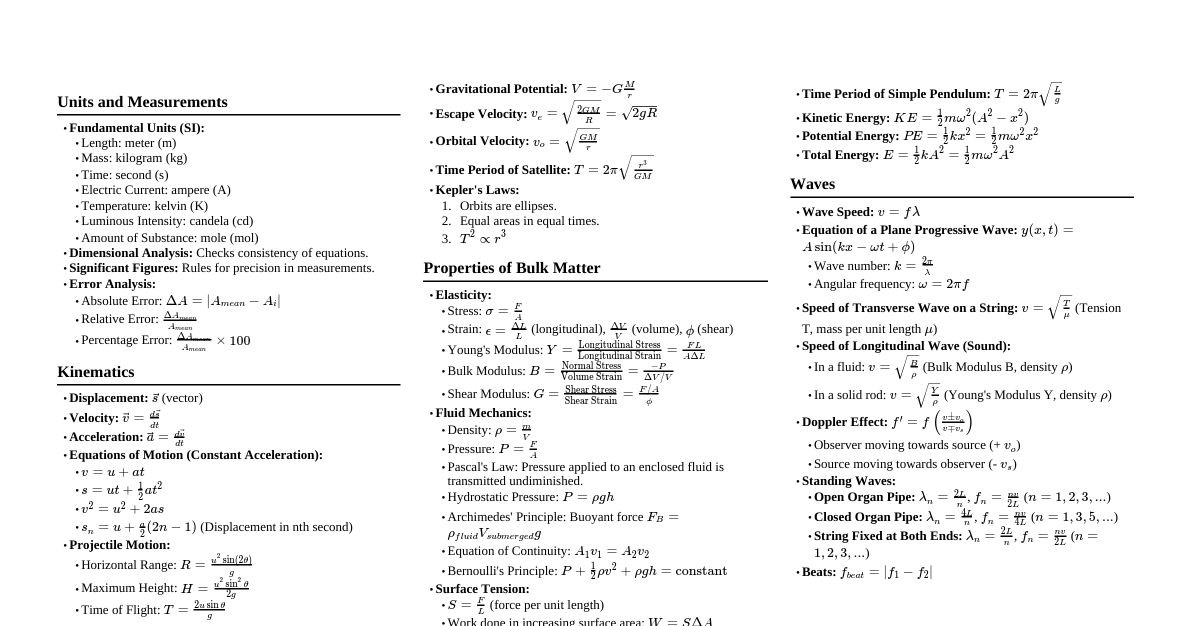
### Units and Measurements - **Significant Figures:** - **Addition/Subtraction:** Result has same number of decimal places as the measurement with the fewest decimal places. - **Multiplication/Division:** Result has same number of significant figures as the measurement with the fewest significant figures. - **Dimensional Analysis:** Used to check the consistency of equations and to derive relations between physical quantities. Principle of homogeneity of dimensions states that dimensions of terms on both sides of an equation must be the same. - **Error Analysis:** - **Absolute Error ($\Delta A$):** The magnitude of the difference between the true value (or mean value) and the individual measured value. $\Delta A = |A_{mean} - A_i|$ - **Mean Absolute Error ($\Delta A_{mean}$):** The arithmetic mean of all the absolute errors. $\Delta A_{mean} = \frac{\sum |\Delta A_i|}{n}$ - **Relative Error:** The ratio of the mean absolute error to the mean value of the quantity. $\text{Relative Error} = \frac{\Delta A_{mean}}{A_{mean}}$ - **Percentage Error:** Relative error expressed as a percentage. $\text{Percentage Error} = \frac{\Delta A_{mean}}{A_{mean}} \times 100\%$ - **Combination of Errors:** - Sum/Difference: If $Z = A \pm B$, then $\Delta Z = \Delta A + \Delta B$. - Product/Quotient: If $Z = A \times B$ or $Z = A / B$, then $\frac{\Delta Z}{Z} = \frac{\Delta A}{A} + \frac{\Delta B}{B}$. - Power: If $Z = A^n$, then $\frac{\Delta Z}{Z} = n \frac{\Delta A}{A}$. ### Kinematics - **Distance:** Total path length covered (scalar). - **Displacement ($\vec{s}$):** Shortest distance from initial to final position (vector). - **Speed:** Rate of change of distance (scalar). Average speed = Total distance / Total time. - **Velocity ($\vec{v}$):** Rate of change of displacement (vector). $\vec{v} = \frac{d\vec{s}}{dt}$. Average velocity = Total displacement / Total time. - **Acceleration ($\vec{a}$):** Rate of change of velocity (vector). $\vec{a} = \frac{d\vec{v}}{dt} = \frac{d^2\vec{s}}{dt^2}$. - **Equations of Motion (for constant acceleration $a$):** - **Final Velocity:** $v = u + at$ (relates final velocity $v$ to initial velocity $u$, acceleration $a$, and time $t$) - **Displacement:** $s = ut + \frac{1}{2}at^2$ (relates displacement $s$ to $u, a, t$) - **Final Velocity (without time):** $v^2 = u^2 + 2as$ (relates $v, u, a, s$) - **Displacement in $n^{\text{th}}$ second:** $s_n = u + \frac{a}{2}(2n-1)$ (displacement covered specifically during the $n$-th second) - **Projectile Motion (assuming launch from ground, air resistance neglected):** - **Initial velocity components:** $u_x = u \cos\theta$, $u_y = u \sin\theta$ - **Time of Flight ($T$):** Total time the projectile is in the air. $T = \frac{2u \sin\theta}{g}$ - **Maximum Height ($H$):** Highest vertical position reached. $H = \frac{u^2 \sin^2\theta}{2g}$ - **Horizontal Range ($R$):** Total horizontal distance covered. $R = \frac{u^2 \sin(2\theta)}{g}$ - **Equation of Trajectory:** $y = x \tan\theta - \frac{gx^2}{2u^2 \cos^2\theta}$ ### Laws of Motion - **Newton's First Law (Law of Inertia):** An object at rest stays at rest and an object in motion stays in motion with the same speed and in the same direction unless acted upon by an unbalanced force. - **Newton's Second Law:** The net force acting on an object is equal to the rate of change of its momentum, or, if mass is constant, $F_{net} = ma$. (Where $F$ is net external force, $m$ is mass, $a$ is acceleration). - **Newton's Third Law:** For every action, there is an equal and opposite reaction. Forces always occur in pairs. - **Momentum ($\vec{p}$):** A measure of the mass in motion. $\vec{p} = m\vec{v}$ (Where $m$ is mass, $\vec{v}$ is velocity). - **Impulse ($\vec{I}$):** The change in momentum of an object. $\vec{I} = \vec{F}_{avg} \Delta t = \Delta \vec{p} = \vec{p}_f - \vec{p}_i$. - **Conservation of Momentum:** In an isolated system (no external forces), the total momentum remains constant. For a collision between two objects: $m_1u_1 + m_2u_2 = m_1v_1 + m_2v_2$. - **Friction:** A force that opposes relative motion or attempted motion between surfaces in contact. - **Static Friction ($f_s$):** Acts when there is no relative motion. $f_s \le \mu_s N$ (where $\mu_s$ is coefficient of static friction, $N$ is normal force). - **Kinetic Friction ($f_k$):** Acts when there is relative motion. $f_k = \mu_k N$ (where $\mu_k$ is coefficient of kinetic friction). - **Centripetal Force ($F_c$):** The force required to keep an object moving in a circular path, directed towards the center of the circle. $F_c = \frac{mv^2}{r} = m\omega^2 r$. ### Work, Energy, and Power - **Work Done ($W$):** When a force $\vec{F}$ causes a displacement $\vec{d}$. $W = \vec{F} \cdot \vec{d} = Fd \cos\theta$ (where $\theta$ is the angle between $\vec{F}$ and $\vec{d}$). If force is variable, $W = \int \vec{F} \cdot d\vec{s}$. - **Kinetic Energy ($K$):** Energy due to motion. $K = \frac{1}{2}mv^2$. - **Potential Energy:** Stored energy due to position or configuration. - **Gravitational Potential Energy ($U_g$):** Energy due to height in a gravitational field. $U_g = mgh$ (near Earth's surface, $h$ is height). - **Elastic Potential Energy ($U_s$):** Energy stored in a spring (or other elastic material). $U_s = \frac{1}{2}kx^2$ (where $k$ is spring constant, $x$ is displacement from equilibrium). - **Work-Energy Theorem:** The net work done on an object equals its change in kinetic energy. $W_{net} = \Delta K = K_f - K_i$. - **Power ($P$):** The rate at which work is done or energy is transferred. $P = \frac{W}{t} = \vec{F} \cdot \vec{v}$ (for constant force and velocity). If power is variable, $P = \frac{dW}{dt}$. - **Conservation of Mechanical Energy:** In the absence of non-conservative forces (like friction), the total mechanical energy (kinetic + potential) of a system remains constant. $K_i + U_i = K_f + U_f$. ### Rotational Motion - **Angular Displacement ($\theta$):** The angle swept by a rotating body (measured in radians). - **Angular Velocity ($\omega$):** Rate of change of angular displacement. $\omega = \frac{d\theta}{dt}$. Its direction is given by the right-hand rule. - **Angular Acceleration ($\alpha$):** Rate of change of angular velocity. $\alpha = \frac{d\omega}{dt} = \frac{d^2\theta}{dt^2}$. - **Relations between Linear and Angular Quantities (for a point at radius $r$ from axis):** - **Linear Speed:** $v = r\omega$ - **Tangential Acceleration:** $a_t = r\alpha$ (component parallel to velocity) - **Centripetal (Radial) Acceleration:** $a_c = r\omega^2 = \frac{v^2}{r}$ (component perpendicular to velocity, directed towards center) - **Equations of Rotational Motion (for constant angular acceleration $\alpha$):** - $\omega = \omega_0 + \alpha t$ - $\theta = \omega_0 t + \frac{1}{2}\alpha t^2$ - $\omega^2 = \omega_0^2 + 2\alpha\theta$ - **Torque ($\vec{\tau}$):** The rotational analogue of force; causes angular acceleration. $\vec{\tau} = \vec{r} \times \vec{F}$ (where $\vec{r}$ is position vector from pivot to force application point). Magnitude: $\tau = rF\sin\theta$. - **Moment of Inertia ($I$):** The rotational analogue of mass; a measure of an object's resistance to angular acceleration. For a system of discrete particles: $I = \sum m_i r_i^2$. For a continuous body: $I = \int r^2 dm$. - **Torque and Angular Acceleration:** $\tau_{net} = I\alpha$. - **Angular Momentum ($\vec{L}$):** The rotational analogue of linear momentum. $\vec{L} = I\vec{\omega}$ for rigid body rotating about fixed axis. For a particle: $\vec{L} = \vec{r} \times \vec{p}$. - **Conservation of Angular Momentum:** In an isolated system (no external torque), total angular momentum remains constant. $I_1\omega_1 = I_2\omega_2$. - **Rotational Kinetic Energy ($K_{rot}$):** Energy due to rotation. $K_{rot} = \frac{1}{2}I\omega^2$. - **Rolling Motion:** A combination of translational and rotational motion. - Without slipping: $v_{CM} = R\omega$. - Total Kinetic Energy: $K_{total} = K_{translational} + K_{rotational} = \frac{1}{2}Mv_{CM}^2 + \frac{1}{2}I_{CM}\omega^2$. ### Gravitation - **Newton's Law of Universal Gravitation:** The attractive force between two point masses $m_1$ and $m_2$ separated by distance $r$. $F = G \frac{m_1 m_2}{r^2}$ (where $G = 6.674 \times 10^{-11} \text{ N m}^2/\text{kg}^2$ is the universal gravitational constant). - **Acceleration due to Gravity ($g$):** Acceleration experienced by an object due to Earth's gravity. $g = \frac{GM}{R^2}$ (where $M$ is mass of Earth, $R$ is radius of Earth). - **Variation of $g$ with Altitude ($h$):** $g_h = g(1 - \frac{2h}{R_e})$ (for $h \ll R_e$). A more precise formula is $g_h = G\frac{M}{(R_e+h)^2}$. - **Variation of $g$ with Depth ($d$):** $g_d = g(1 - \frac{d}{R_e})$. - **Gravitational Potential Energy ($U_g$):** Energy stored in the gravitational field of two masses. $U_g = -\frac{GMm}{r}$ (defined as zero at infinite separation). - **Gravitational Potential ($V_g$):** Gravitational potential energy per unit mass. $V_g = -\frac{GM}{r}$. - **Escape Velocity ($v_e$):** Minimum velocity required for an object to escape Earth's gravitational field. $v_e = \sqrt{\frac{2GM}{R_e}} = \sqrt{2gR_e}$. - **Orbital Velocity ($v_o$):** Velocity required for an object to maintain a stable orbit at radius $r$ around a planet of mass $M$. $v_o = \sqrt{\frac{GM}{r}}$. - **Time Period of Satellite:** $T = 2\pi r \sqrt{\frac{r}{GM}}$. - **Kepler's Laws of Planetary Motion:** - **First Law (Law of Orbits):** All planets move in elliptical orbits with the Sun at one of the foci. - **Second Law (Law of Areas):** The radius vector drawn from the Sun to a planet sweeps out equal areas in equal intervals of time. (Consequence of conservation of angular momentum). - **Third Law (Law of Periods):** The square of the orbital period ($T$) of any planet is proportional to the cube of the semi-major axis ($a$) of its orbit. $T^2 \propto a^3$ or $\frac{T^2}{a^3} = \frac{4\pi^2}{GM}$. ### Mechanical Properties of Solids - **Stress ($\sigma$):** Restoring force per unit area. $\sigma = \frac{F}{A}$. Unit: Pascal (Pa) or N/m$^2$. - **Normal Stress:** Perpendicular to surface (tensile or compressive). - **Tangential (Shearing) Stress:** Parallel to surface. - **Strain ($\epsilon$):** Fractional change in dimension. Dimensionless. - **Longitudinal Strain:** $\epsilon_L = \frac{\Delta L}{L}$ (change in length / original length). - **Volume Strain:** $\epsilon_V = \frac{\Delta V}{V}$ (change in volume / original volume). - **Shearing Strain:** $\phi = \frac{\Delta x}{L}$ (relative displacement of faces / length). Also $\tan\phi \approx \phi$. - **Hooke's Law:** Within the elastic limit, stress is directly proportional to strain. Stress $\propto$ Strain. - **Modulus of Elasticity:** The constant of proportionality between stress and strain. - **Young's Modulus ($Y$):** For longitudinal stress and strain. $Y = \frac{\text{Normal Stress}}{\text{Longitudinal Strain}} = \frac{F/A}{\Delta L/L}$. - **Bulk Modulus ($B$):** For volume stress (pressure) and volume strain. $B = \frac{\text{Volume Stress}}{\text{Volume Strain}} = \frac{-P}{\Delta V/V}$. (Negative sign indicates increase in pressure causes decrease in volume). - **Shear Modulus (Modulus of Rigidity, $G$):** For tangential stress and shearing strain. $G = \frac{\text{Shearing Stress}}{\text{Shearing Strain}} = \frac{F/A}{\phi}$. - **Poisson's Ratio ($\nu$):** The ratio of lateral strain to longitudinal strain. $\nu = -\frac{\text{Lateral Strain}}{\text{Longitudinal Strain}}$. (Negative sign because length increase causes diameter decrease). ### Mechanical Properties of Fluids - **Density ($\rho$):** Mass per unit volume. $\rho = \frac{m}{V}$. - **Pressure ($P$):** Force per unit area. $P = \frac{F}{A}$. Unit: Pascal (Pa). - **Pressure in a Fluid Column:** Pressure at depth $h$ below the surface of a fluid. $P = P_0 + \rho gh$ (where $P_0$ is atmospheric pressure). - **Pascal's Law:** Pressure applied to an enclosed incompressible fluid is transmitted undiminished to every portion of the fluid and the walls of the containing vessel. - **Archimedes' Principle:** When a body is immersed wholly or partially in a fluid, it experiences an upward buoyant force equal to the weight of the fluid displaced by it. Buoyant Force $F_B = \rho_{fluid} V_{submerged} g$. - **Equation of Continuity:** For an incompressible, non-viscous fluid in steady flow, the product of the cross-sectional area and the fluid speed is constant along a streamline. $A_1v_1 = A_2v_2 = \text{constant}$. - **Bernoulli's Principle:** For an ideal fluid in streamline flow, the sum of pressure energy, kinetic energy, and potential energy per unit volume remains constant. $P + \frac{1}{2}\rho v^2 + \rho gh = \text{constant}$. - **Viscosity:** The property of a fluid by virtue of which it opposes the relative motion between its different layers. - **Stokes' Law:** Drag force on a spherical object of radius $r$ moving with velocity $v$ through a fluid of viscosity $\eta$. $F_v = 6\pi\eta rv$. - **Terminal Velocity ($v_t$):** Constant velocity attained by an object falling through a fluid when drag force equals gravitational force and buoyant force. $v_t = \frac{2}{9}\frac{r^2(\rho_{object} - \rho_{fluid})g}{\eta}$. - **Surface Tension ($S$ or $\gamma$):** The force per unit length acting perpendicularly to a line drawn on the surface of a liquid, tending to minimize the surface area. $S = \frac{F}{L}$. - **Surface Energy:** Work done per unit area in increasing the surface area of a liquid. Equal to surface tension. - **Excess Pressure:** - **Inside a liquid drop:** $\Delta P = \frac{2S}{R}$. - **Inside a soap bubble:** $\Delta P = \frac{4S}{R}$. - **Capillary Rise/Fall:** The rise or fall of a liquid in a narrow tube (capillary) due to surface tension. $h = \frac{2S \cos\theta}{\rho rg}$ (where $\theta$ is contact angle, $r$ is tube radius). ### Thermal Properties of Matter - **Heat ($Q$):** Energy transferred due to temperature difference. - **Heat Capacity ($C$):** Amount of heat required to raise the temperature of a substance by $1^\circ C$ or $1 K$. $C = \frac{\Delta Q}{\Delta T}$. - **Specific Heat Capacity ($c$):** Heat capacity per unit mass. $c = \frac{C}{m} = \frac{1}{m}\frac{\Delta Q}{\Delta T}$. $Q = mc\Delta T$. - **Latent Heat ($L$):** Heat required to change the state of a unit mass of a substance without changing its temperature. $Q = mL$. - **Latent Heat of Fusion ($L_f$):** For melting/freezing. - **Latent Heat of Vaporization ($L_v$):** For boiling/condensation. - **Thermal Expansion:** Change in dimensions of a substance due to temperature change. - **Linear Expansion:** $\Delta L = L_0 \alpha \Delta T$ (where $\alpha$ is coefficient of linear expansion). - **Area Expansion:** $\Delta A = A_0 \beta \Delta T$ (where $\beta$ is coefficient of area expansion). $\beta = 2\alpha$. - **Volume Expansion:** $\Delta V = V_0 \gamma \Delta T$ (where $\gamma$ is coefficient of volume expansion). $\gamma = 3\alpha$. - **Heat Transfer:** - **Conduction:** Transfer of heat through direct contact without actual movement of matter. - **Rate of Heat Flow:** $\frac{Q}{t} = \frac{KA(T_1 - T_2)}{L}$ (where $K$ is thermal conductivity, $A$ is cross-sectional area, $L$ is thickness, $T_1-T_2$ is temperature difference). - **Convection:** Transfer of heat by the actual movement of fluid particles. No specific general formula. - **Radiation:** Transfer of heat in the form of electromagnetic waves, does not require a medium. - **Stefan-Boltzmann Law:** Rate of energy radiated by a black body. $\frac{Q}{t} = \sigma A e T^4$ (where $\sigma = 5.67 \times 10^{-8} \text{ W m}^{-2} \text{ K}^{-4}$ is Stefan-Boltzmann constant, $A$ is surface area, $e$ is emissivity (1 for black body), $T$ is absolute temperature). - **Newton's Law of Cooling:** The rate of loss of heat by a body is directly proportional to the temperature difference between the body and its surroundings. $\frac{dT}{dt} = -k(T - T_s)$ (where $T_s$ is surrounding temperature). ### Thermodynamics - **Zeroth Law of Thermodynamics:** If two systems are each in thermal equilibrium with a third system, then they are in thermal equilibrium with each other. This law defines temperature. - **First Law of Thermodynamics:** Energy cannot be created or destroyed, only transferred or changed from one form to another. It's a statement of conservation of energy. - $\Delta U = Q - W$ (where $\Delta U$ is change in internal energy, $Q$ is heat supplied *to* the system, $W$ is work done *by* the system). - **Work Done by a Gas:** $W = \int P dV$. For constant pressure, $W = P(V_f - V_i)$. - **Thermodynamic Processes:** - **Isothermal Process:** Temperature remains constant ($\Delta T = 0 \implies \Delta U = 0$). $Q=W$. $W = nRT \ln\left(\frac{V_f}{V_i}\right)$. - **Adiabatic Process:** No heat exchange with surroundings ($Q=0$). $\Delta U = -W$. $PV^\gamma = \text{constant}$, $T V^{\gamma-1} = \text{constant}$, $P^{1-\gamma} T^\gamma = \text{constant}$. $W = \frac{nR(T_i - T_f)}{\gamma - 1}$. - **Isobaric Process:** Pressure remains constant ($\Delta P = 0$). $W = P(V_f - V_i)$. - **Isochoric Process:** Volume remains constant ($\Delta V = 0 \implies W = 0$). $\Delta U = Q$. - **Specific Heat Capacities of Gases:** - $C_P$: Molar specific heat at constant pressure. - $C_V$: Molar specific heat at constant volume. - **Mayer's Relation:** $C_P - C_V = R$ (where $R$ is universal gas constant). - **Ratio of Specific Heats:** $\gamma = \frac{C_P}{C_V}$. - **Second Law of Thermodynamics:** - **Kelvin-Planck Statement:** It is impossible to construct a heat engine that operates in a cycle and produces no effect other than the extraction of heat from a reservoir and the performance of an equivalent amount of work. - **Clausius Statement:** It is impossible for a self-acting machine, unaided by any external agency, to transfer heat from a body at a lower temperature to another body at a higher temperature. - **Entropy:** A measure of disorder or randomness in a system. The entropy of an isolated system never decreases; it either increases or remains constant. - **Heat Engines and Refrigerators:** - **Efficiency of Heat Engine ($\eta$):** $\eta = \frac{\text{Work Done}}{\text{Heat Input}} = \frac{W}{Q_H} = 1 - \frac{Q_C}{Q_H}$. - **Carnot Engine Efficiency (ideal engine):** $\eta_{Carnot} = 1 - \frac{T_C}{T_H}$ (where $T_C$ and $T_H$ are absolute temperatures of cold and hot reservoirs). - **Coefficient of Performance (COP) for Refrigerator:** $COP_R = \frac{Q_C}{W} = \frac{Q_C}{Q_H - Q_C}$. - **Coefficient of Performance (COP) for Heat Pump:** $COP_{HP} = \frac{Q_H}{W} = \frac{Q_H}{Q_H - Q_C}$. ### Kinetic Theory of Gases - **Ideal Gas Equation:** Relates pressure ($P$), volume ($V$), number of moles ($n$), and absolute temperature ($T$) of an ideal gas. $PV = nRT = Nk_BT$ (where $R = 8.314 \text{ J mol}^{-1} \text{ K}^{-1}$ is universal gas constant, $N$ is number of molecules, $k_B = 1.38 \times 10^{-23} \text{ J K}^{-1}$ is Boltzmann constant). - **Pressure Exerted by an Ideal Gas:** $P = \frac{1}{3}\frac{nm\langle v^2 \rangle}{V} = \frac{1}{3}\rho \langle v^2 \rangle$ (where $n$ is number of molecules, $m$ is mass of one molecule, $\langle v^2 \rangle$ is mean square speed). - **Average Kinetic Energy of a Gas Molecule:** Directly proportional to absolute temperature. $E_{avg} = \frac{3}{2}k_BT$. - **Root Mean Square Speed ($v_{rms}$):** The square root of the mean of the squares of the speeds of the individual molecules. $v_{rms} = \sqrt{\frac{3RT}{M}} = \sqrt{\frac{3k_BT}{m}}$ (where $M$ is molar mass, $m$ is molecular mass). - **Degrees of Freedom ($f$):** The total number of independent ways in which a system can possess energy. - **Monatomic Gas:** $f=3$ (3 translational). - **Diatomic Gas:** $f=5$ (3 translational + 2 rotational, at moderate temperatures). - **Polyatomic Gas:** $f=6$ (3 translational + 3 rotational, for non-linear molecules). - **Law of Equipartition of Energy:** For any thermodynamic system in thermal equilibrium, the total energy is equally distributed among its degrees of freedom, and the energy associated with each degree of freedom is $\frac{1}{2}k_BT$. - **Internal Energy of an Ideal Gas:** $U = \frac{f}{2}nRT$. ### Oscillations - **Periodic Motion:** Motion that repeats itself over a fixed interval of time. - **Oscillatory Motion:** A type of periodic motion in which a body moves back and forth about a mean position. - **Simple Harmonic Motion (SHM):** A special type of oscillatory motion where the restoring force is directly proportional to the displacement from the equilibrium position and acts towards the equilibrium. $F = -kx$. - **Differential Equation of SHM:** $\frac{d^2x}{dt^2} + \omega^2 x = 0$. - **Displacement ($x(t)$):** $x(t) = A \sin(\omega t + \phi)$ or $x(t) = A \cos(\omega t + \phi)$ (where $A$ is amplitude, $\omega$ is angular frequency, $\phi$ is initial phase). - **Velocity ($v(t)$):** $v(t) = \frac{dx}{dt} = A\omega \cos(\omega t + \phi) = \pm \omega \sqrt{A^2 - x^2}$. - **Acceleration ($a(t)$):** $a(t) = \frac{dv}{dt} = -A\omega^2 \sin(\omega t + \phi) = -\omega^2 x$. - **Angular Frequency ($\omega$):** For a spring-mass system, $\omega = \sqrt{\frac{k}{m}}$. - **Time Period ($T$):** Time taken for one complete oscillation. $T = \frac{2\pi}{\omega}$. For spring-mass: $T = 2\pi\sqrt{\frac{m}{k}}$. - **Frequency ($f$):** Number of oscillations per unit time. $f = \frac{1}{T} = \frac{\omega}{2\pi}$. - **Simple Pendulum:** A point mass suspended by a light inextensible string from a rigid support. - **Time Period:** $T = 2\pi\sqrt{\frac{L}{g}}$ (for small angles of oscillation, where $L$ is length of pendulum). - **Energy in SHM:** - **Kinetic Energy ($K$):** $K = \frac{1}{2}mv^2 = \frac{1}{2}m\omega^2(A^2 - x^2)$. - **Potential Energy ($U$):** $U = \frac{1}{2}kx^2 = \frac{1}{2}m\omega^2 x^2$. - **Total Energy ($E$):** $E = K + U = \frac{1}{2}kA^2 = \frac{1}{2}m\omega^2 A^2$. (Total energy is constant and proportional to square of amplitude). - **Damped Oscillations:** Oscillations where energy is dissipated over time, causing amplitude to decrease. - **Forced Oscillations and Resonance:** When an oscillating system is driven by an external periodic force, it undergoes forced oscillations. Resonance occurs when the driving frequency matches the natural frequency, leading to large amplitudes. ### Waves - **Wave:** A disturbance that propagates through space and time, transferring energy without transferring matter. - **Wave Types:** - **Transverse Waves:** Particles of the medium oscillate perpendicular to the direction of wave propagation (e.g., light, waves on a string). - **Longitudinal Waves:** Particles of the medium oscillate parallel to the direction of wave propagation (e.g., sound). - **General Wave Equation:** For a sinusoidal wave propagating in positive x-direction: $y(x,t) = A \sin(kx - \omega t + \phi)$ (where $A$ is amplitude, $k$ is angular wave number, $\omega$ is angular frequency, $\phi$ is initial phase). - **Angular Wave Number ($k$):** $k = \frac{2\pi}{\lambda}$ (where $\lambda$ is wavelength). - **Angular Frequency ($\omega$):** $\omega = 2\pi f = \frac{2\pi}{T}$ (where $f$ is frequency, $T$ is period). - **Wave Speed ($v$):** $v = f\lambda = \frac{\omega}{k}$. - **Speed of Transverse Wave on a Stretched String:** $v = \sqrt{\frac{T}{\mu}}$ (where $T$ is tension in the string, $\mu$ is linear mass density (mass per unit length)). - **Speed of Longitudinal Wave in a Fluid:** $v = \sqrt{\frac{B}{\rho}}$ (where $B$ is bulk modulus, $\rho$ is density of the fluid). - **Speed of Sound in Air (Newton's formula with Laplace's correction):** $v = \sqrt{\frac{\gamma P}{\rho}}$ (where $\gamma = C_P/C_V$, $P$ is pressure, $\rho$ is density). - **Intensity of Wave ($I$):** Power transmitted per unit area. $I = \frac{P_{avg}}{A} \propto A^2 f^2 \propto A^2 \omega^2$. - **Principle of Superposition of Waves:** When two or more waves overlap, the resultant displacement at any point and at any instant is the vector sum of the displacements due to individual waves. - **Standing Waves (Stationary Waves):** Formed when two identical waves travelling in opposite directions superpose. Nodes are points of zero displacement, antinodes are points of maximum displacement. - **String fixed at both ends:** - Wavelengths: $\lambda_n = \frac{2L}{n}$ (where $n=1, 2, 3, ...$ are mode numbers). - Frequencies: $f_n = \frac{nv}{2L} = n f_1$. ($f_1$ is fundamental frequency or first harmonic). - **Open Organ Pipe (open at both ends):** - Wavelengths: $\lambda_n = \frac{2L}{n}$. - Frequencies: $f_n = \frac{nv}{2L} = n f_1$. - **Closed Organ Pipe (closed at one end):** - Wavelengths: $\lambda_n = \frac{4L}{(2n-1)}$ (where $n=1, 2, 3, ...$). - Frequencies: $f_n = \frac{(2n-1)v}{4L} = (2n-1) f_1$. (Only odd harmonics are present). - **Beats:** Periodic variations in the intensity of sound caused by the superposition of two sound waves of slightly different frequencies. - **Beat Frequency:** $f_{beat} = |f_1 - f_2|$. - **Doppler Effect:** The apparent change in frequency of a wave due to the relative motion between the source and the observer. - **General Formula for Sound:** $f' = f \left(\frac{v \pm v_o}{v \mp v_s}\right)$ - $f'$: apparent frequency - $f$: actual frequency of source - $v$: speed of sound in medium - $v_o$: speed of observer - $v_s$: speed of source - **Sign Convention:** - For $v_o$: Use '+' if observer moves towards source, '-' if away. - For $v_s$: Use '-' if source moves towards observer, '+' if away.