Math Fundamentals
Cheatsheet Content
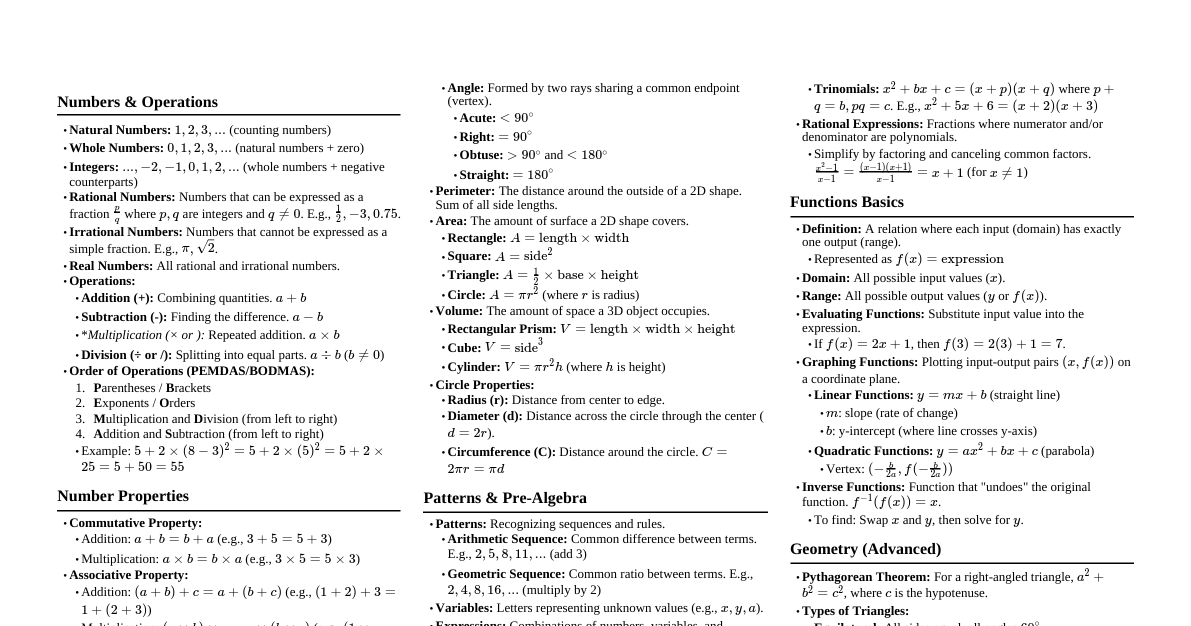
### Exponents and Surds #### Exponents - **Definition:** $a^n = a \times a \times ... \times a$ (n times) - **Rules:** - $a^m \times a^n = a^{m+n}$ - $a^m \div a^n = a^{m-n}$ - $(a^m)^n = a^{mn}$ - $(ab)^n = a^n b^n$ - $(\frac{a}{b})^n = \frac{a^n}{b^n}$ - $a^0 = 1$ (for $a \neq 0$) - $a^{-n} = \frac{1}{a^n}$ - $a^{\frac{m}{n}} = \sqrt[n]{a^m}$ #### Surds (Radicals) - **Definition:** A surd is a root of an integer that cannot be expressed as an integer or a rational fraction. E.g., $\sqrt{2}$, $\sqrt[3]{5}$. - **Rules:** - $\sqrt{ab} = \sqrt{a} \times \sqrt{b}$ - $\sqrt{\frac{a}{b}} = \frac{\sqrt{a}}{\sqrt{b}}$ - $x\sqrt{a} \pm y\sqrt{a} = (x \pm y)\sqrt{a}$ - **Rationalizing the Denominator:** - For $\frac{a}{\sqrt{b}}$, multiply by $\frac{\sqrt{b}}{\sqrt{b}}$: $\frac{a\sqrt{b}}{b}$ - For $\frac{a}{c \pm \sqrt{d}}$, multiply by the conjugate $\frac{c \mp \sqrt{d}}{c \mp \sqrt{d}}$ ### Equations and Inequalities #### Linear Equations - **Form:** $ax + b = 0$ - **Solution:** $x = -\frac{b}{a}$ #### Quadratic Equations - **Form:** $ax^2 + bx + c = 0$ - **Methods to Solve:** 1. **Factoring:** If $ax^2 + bx + c = (px+q)(rx+s)$, then $x = -\frac{q}{p}$ or $x = -\frac{s}{r}$. 2. **Quadratic Formula:** $x = \frac{-b \pm \sqrt{b^2 - 4ac}}{2a}$ 3. **Completing the Square:** $x^2 + \frac{b}{a}x + (\frac{b}{2a})^2 = -\frac{c}{a} + (\frac{b}{2a})^2$ - **Discriminant:** $\Delta = b^2 - 4ac$ - $\Delta > 0$: Two distinct real roots - $\Delta = 0$: One real root (repeated) - $\Delta b$, then $a+c > b+c$ - If $a > b$ and $c > 0$, then $ac > bc$ - If $a > b$ and $c ### Functions and Graphs #### Functions - **Definition:** A relation where each input (domain) has exactly one output (range). - **Notation:** $y = f(x)$ - **Types of Functions:** - **Linear:** $f(x) = mx + c$ (straight line) - **Quadratic:** $f(x) = ax^2 + bx + c$ (parabola) - **Cubic:** $f(x) = ax^3 + bx^2 + cx + d$ - **Rational:** $f(x) = \frac{P(x)}{Q(x)}$ where $P(x), Q(x)$ are polynomials. - **Exponential:** $f(x) = a^x$ - **Logarithmic:** $f(x) = \log_a x$ - **Domain:** Set of all possible input values for $x$. - **Range:** Set of all possible output values for $f(x)$. - **One-to-one function:** Each output corresponds to exactly one input. - **Onto function:** Every element in the codomain is mapped to by at least one element in the domain. - **Inverse Function ($f^{-1}(x)$):** Reflects $f(x)$ across the line $y=x$. For $f^{-1}(f(x)) = x$ and $f(f^{-1}(x)) = x$. #### Graphing Techniques - **Intercepts:** - x-intercept(s): Set $y=0$ and solve for $x$. - y-intercept: Set $x=0$ and solve for $y$. - **Symmetry:** - **y-axis symmetry (Even function):** $f(-x) = f(x)$ - **Origin symmetry (Odd function):** $f(-x) = -f(x)$ - **Asymptotes:** - **Vertical Asymptotes:** Occur where the denominator of a rational function is zero (and numerator is non-zero). - **Horizontal Asymptotes:** - If degree of numerator degree of denominator, no H.A. (may have slant/oblique asymptote). - **Transformations:** - $f(x) + c$: Shift up - $f(x) - c$: Shift down - $f(x + c)$: Shift left - $f(x - c)$: Shift right - $-f(x)$: Reflect across x-axis - $f(-x)$: Reflect across y-axis - $cf(x)$: Vertical stretch/compression - $f(cx)$: Horizontal stretch/compression