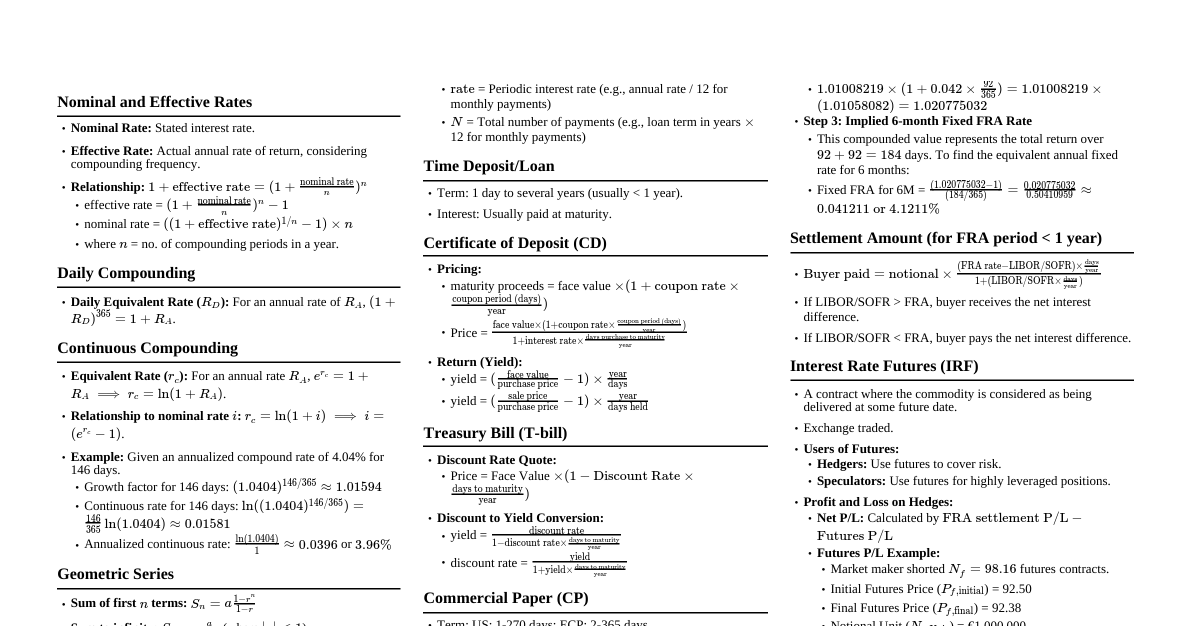
### Time Value of Money The concept that a sum of money is worth more now than the same sum will be at a future date due to its potential earning capacity. #### Future Value (FV) - **Single Period:** $FV = PV \times (1 + r)$ - **Multiple Periods (Compounded Annually):** $FV = PV \times (1 + r)^n$ - **Compounded `m` times per year:** $FV = PV \times (1 + \frac{r}{m})^{mn}$ - **Continuous Compounding:** $FV = PV \times e^{rn}$ - $PV$: Present Value - $r$: Annual Interest Rate - $n$: Number of Periods (years) - $m$: Number of compounding periods per year #### Present Value (PV) - **Single Period:** $PV = \frac{FV}{1 + r}$ - **Multiple Periods (Compounded Annually):** $PV = \frac{FV}{(1 + r)^n}$ ### Annuities A series of equal payments made at regular intervals. #### Future Value of an Ordinary Annuity (FVOA) Payments made at the end of each period. $$FVOA = P \times \frac{(1 + r)^n - 1}{r}$$ - $P$: Payment per period #### Present Value of an Ordinary Annuity (PVOA) $$PVOA = P \times \frac{1 - (1 + r)^{-n}}{r}$$ #### Perpetuity An annuity that continues indefinitely. $$PV_{Perpetuity} = \frac{P}{r}$$ ### Loan Amortization Calculating loan payments. #### Fixed Payment (A) for a Loan (PV) $$A = PV \times \frac{r(1 + r)^n}{(1 + r)^n - 1}$$ - $PV$: Principal amount of the loan - $r$: Interest rate per period - $n$: Total number of payments ### Basic Investment Metrics #### Net Present Value (NPV) The sum of the present values of all cash inflows and outflows associated with a project or investment. $$NPV = \sum_{t=0}^{n} \frac{CF_t}{(1 + r)^t}$$ - $CF_t$: Net cash flow at time $t$ - $r$: Discount rate (cost of capital) #### Internal Rate of Return (IRR) The discount rate that makes the NPV of all cash flows from a particular project equal to zero. - Found by solving $NPV = 0$ for $r$. - If $IRR > \text{Cost of Capital}$, accept the project. ### Risk & Return #### Expected Return ($E[R]$) The weighted average of possible returns. $$E[R] = \sum_{i=1}^{k} P_i R_i$$ - $P_i$: Probability of return $R_i$ #### Variance ($\sigma^2$) Measures the dispersion of returns around the expected return. $$\sigma^2 = \sum_{i=1}^{k} P_i (R_i - E[R])^2$$ #### Standard Deviation ($\sigma$) The square root of variance, a common measure of total risk. $$\sigma = \sqrt{\sigma^2}$$ #### Coefficient of Variation (CV) Measures risk per unit of return. $$CV = \frac{\sigma}{E[R]}$$