Gluconeogenesis Pathways
Cheatsheet Content
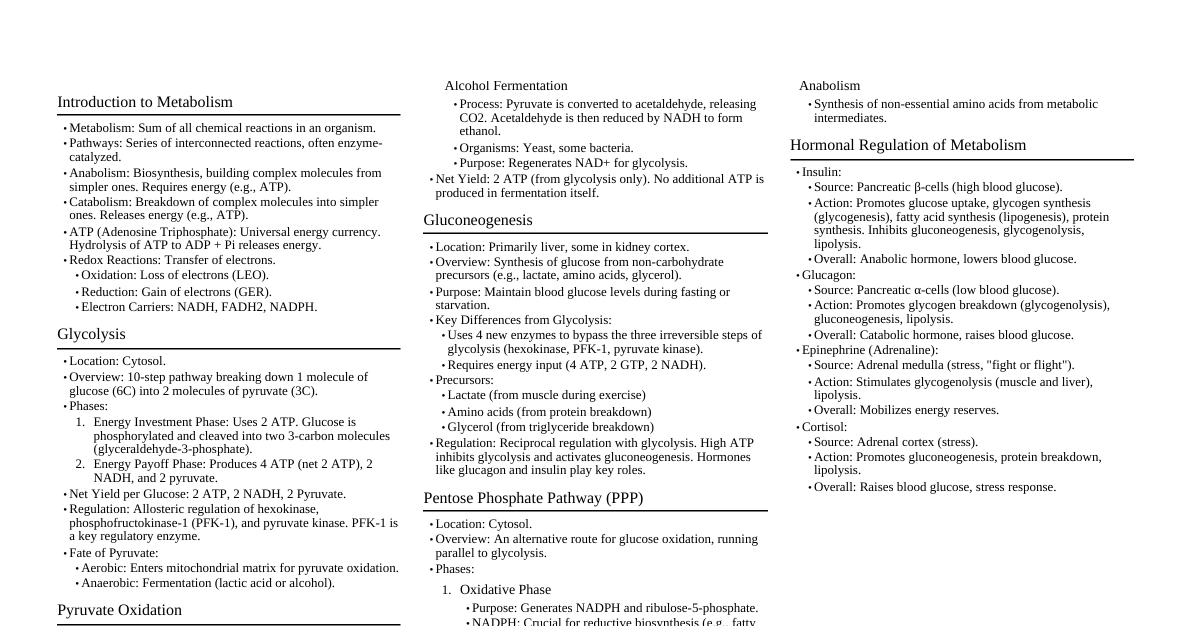
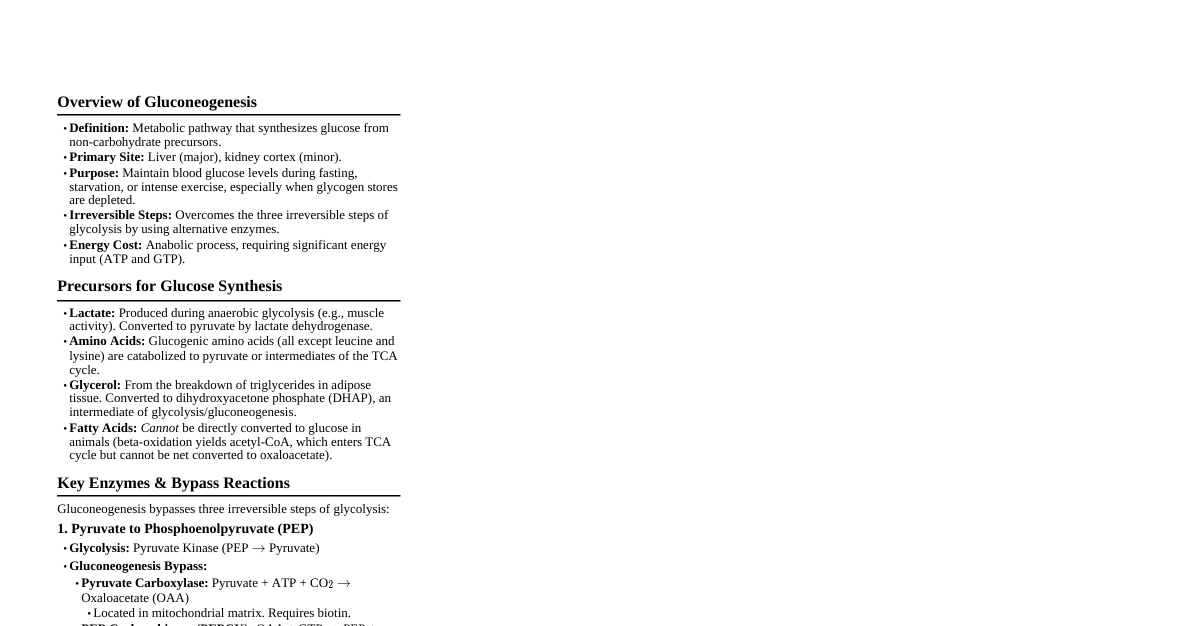
### Gluconeogenesis (GNG) Overview - **Definition:** Synthesis of glucose from non-carbohydrate precursors. - **Primary Sites:** Liver (90%), Kidney (10%). - **Key Precursors:** Lactate, Alanine, Glycerol, Propionate, Pyruvate. - **Irreversible Glycolysis Steps Bypassed:** 1. Hexokinase (Glucose to G6P) 2. PFK-1 (F6P to F-1,6-BP) 3. Pyruvate Kinase (PEP to Pyruvate) - **Key Enzymes for Bypasses:** - Pyruvate Carboxylase & PEP Carboxykinase (PEPCK) - Fructose-1,6-bisphosphatase - Glucose-6-phosphatase ### From Pyruvate - **Source:** Pyruvate is a direct precursor. - **Steps:** 1. **Pyruvate to Oxaloacetate (OAA):** - Enzyme: Pyruvate Carboxylase (Mitochondrial) - Requires: ATP, $\text{CO}_2$, Biotin - Reaction: Pyruvate + $\text{ATP} + \text{HCO}_3^- \rightarrow \text{OAA} + \text{ADP} + \text{Pi}$ 2. **Oxaloacetate to Malate (or Aspartate):** - OAA cannot cross mitochondrial membrane. - Converted to Malate (via Malate Dehydrogenase, NADH-dependent) or Aspartate for transport to cytoplasm. 3. **Malate (or Aspartate) back to OAA:** - In cytoplasm, Malate/Aspartate is converted back to OAA. 4. **Oxaloacetate to Phosphoenolpyruvate (PEP):** - Enzyme: PEP Carboxykinase (PEPCK) (Cytoplasmic) - Requires: GTP - Reaction: OAA + $\text{GTP} \rightarrow \text{PEP} + \text{GDP} + \text{CO}_2$ - **Subsequent Steps:** PEP proceeds through the remaining GNG pathway (reversal of glycolysis steps) to glucose. ### From Lactate - **Source:** Anaerobic glycolysis in muscle, RBCs (Cori Cycle). - **Steps:** 1. **Lactate to Pyruvate:** - Enzyme: Lactate Dehydrogenase (Cytoplasmic) - Requires: $\text{NAD}^+$ - Reaction: Lactate + $\text{NAD}^+ \rightleftharpoons \text{Pyruvate} + \text{NADH} + \text{H}^+$ 2. **Pyruvate to Glucose:** Follows the "From Pyruvate" pathway. - **Significance:** Replenishes glucose during intense exercise and in oxygen-deprived tissues. ### From Alanine - **Source:** Muscle protein breakdown (Glucose-Alanine Cycle). - **Steps:** 1. **Alanine to Pyruvate:** - Enzyme: Alanine Transaminase (ALT) - Requires: $\alpha$-ketoglutarate (forms Glutamate) - Reaction: Alanine + $\alpha$-ketoglutarate $\rightleftharpoons \text{Pyruvate} + \text{Glutamate}$ 2. **Pyruvate to Glucose:** Follows the "From Pyruvate" pathway. - **Significance:** Transports nitrogen from muscle to liver (as alanine) and carbon skeletons for glucose synthesis. ### From Glycerol - **Source:** Breakdown of triglycerides (fat) in adipose tissue. - **Steps:** 1. **Glycerol to Glycerol-3-Phosphate:** - Enzyme: Glycerol Kinase (Liver only) - Requires: ATP - Reaction: Glycerol + $\text{ATP} \rightarrow \text{Glycerol-3-Phosphate} + \text{ADP}$ 2. **Glycerol-3-Phosphate to Dihydroxyacetone Phosphate (DHAP):** - Enzyme: Glycerol-3-Phosphate Dehydrogenase - Requires: $\text{NAD}^+$ - Reaction: Glycerol-3-Phosphate + $\text{NAD}^+ \rightleftharpoons \text{DHAP} + \text{NADH} + \text{H}^+$ - **Subsequent Steps:** DHAP is an intermediate in glycolysis/GNG and can be isomerized to Glyceraldehyde-3-Phosphate, then proceeds to glucose. - **Note:** Fatty acids cannot be converted to glucose in humans (acetyl-CoA cannot be converted to pyruvate). ### From Propionate - **Source:** - Oxidation of odd-chain fatty acids. - Metabolism of branched-chain amino acids (Valine, Isoleucine). - Bacterial fermentation in ruminants (major source). - **Steps (Propionate Pathway):** 1. **Propionate to Propionyl-CoA:** - Enzyme: Propionyl-CoA Synthetase - Requires: ATP, $\text{CoA}$ 2. **Propionyl-CoA to D-Methylmalonyl-CoA:** - Enzyme: Propionyl-CoA Carboxylase - Requires: ATP, $\text{CO}_2$, Biotin 3. **D-Methylmalonyl-CoA to L-Methylmalonyl-CoA:** - Enzyme: Methylmalonyl-CoA Racemase 4. **L-Methylmalonyl-CoA to Succinyl-CoA:** - Enzyme: Methylmalonyl-CoA Mutase - Requires: Vitamin $\text{B}_{12}$ (Cobalamin) - **Subsequent Steps:** Succinyl-CoA is a TCA cycle intermediate. It can enter the TCA cycle and be converted to OAA, then proceeds through the "From Pyruvate" pathway (via PEPCK) to glucose. - **Significance:** Only fatty acid derivative (from odd-chain FAs) that can be glucogenic in humans.