Metabolic Pathways
Cheatsheet Content
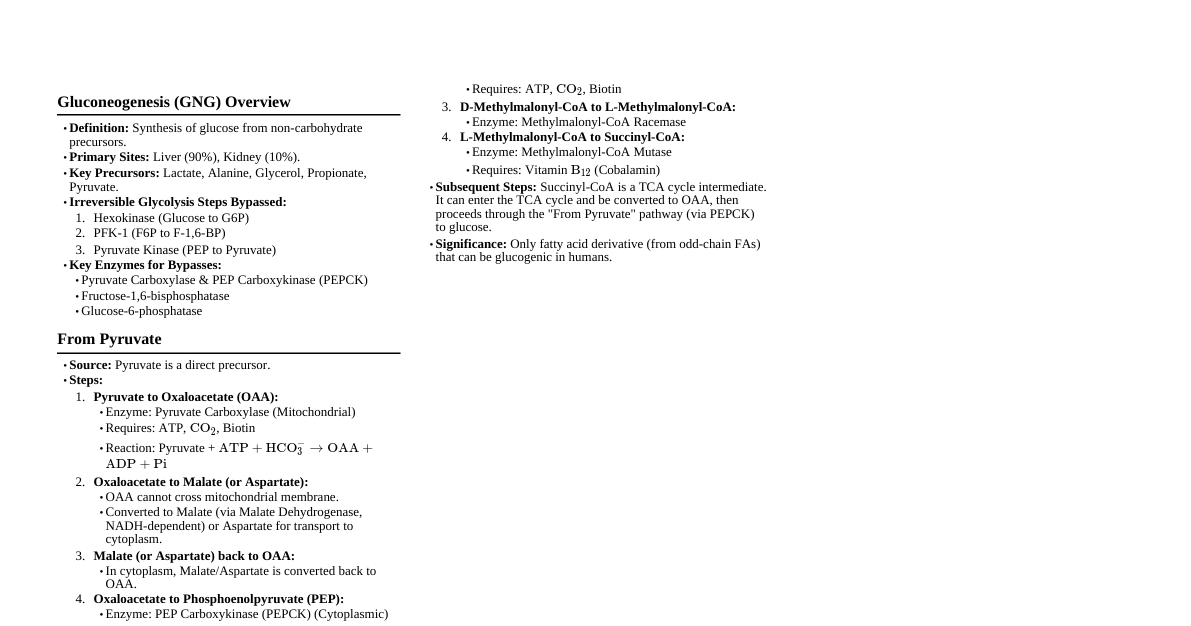
### Introduction to Metabolism - **Metabolism:** Sum of all chemical reactions in an organism. - **Pathways:** Series of interconnected reactions, often enzyme-catalyzed. - **Anabolism:** Biosynthesis, building complex molecules from simpler ones. Requires energy (e.g., ATP). - **Catabolism:** Breakdown of complex molecules into simpler ones. Releases energy (e.g., ATP). - **ATP (Adenosine Triphosphate):** Universal energy currency. Hydrolysis of ATP to ADP + Pi releases energy. - **Redox Reactions:** Transfer of electrons. - **Oxidation:** Loss of electrons (LEO). - **Reduction:** Gain of electrons (GER). - **Electron Carriers:** NADH, FADH2, NADPH. ### Glycolysis - **Location:** Cytosol. - **Overview:** 10-step pathway breaking down 1 molecule of glucose (6C) into 2 molecules of pyruvate (3C). - **Phases:** 1. **Energy Investment Phase:** Uses 2 ATP. Glucose is phosphorylated and cleaved into two 3-carbon molecules (glyceraldehyde-3-phosphate). 2. **Energy Payoff Phase:** Produces 4 ATP (net 2 ATP), 2 NADH, and 2 pyruvate. - **Net Yield per Glucose:** 2 ATP, 2 NADH, 2 Pyruvate. - **Regulation:** Allosteric regulation of hexokinase, phosphofructokinase-1 (PFK-1), and pyruvate kinase. PFK-1 is a key regulatory enzyme. - **Fate of Pyruvate:** - **Aerobic:** Enters mitochondrial matrix for pyruvate oxidation. - **Anaerobic:** Fermentation (lactic acid or alcohol). ### Pyruvate Oxidation - **Location:** Mitochondrial matrix. - **Overview:** Links glycolysis to the citric acid cycle. Each pyruvate (3C) is converted to Acetyl-CoA (2C). - **Steps per Pyruvate:** 1. Carboxyl group removed (CO2 released). 2. Remaining 2C molecule oxidized, electrons transferred to NAD+ to form NADH. 3. Coenzyme A (CoA) attaches to form Acetyl-CoA. - **Net Yield per Glucose (2 Pyruvate):** 2 Acetyl-CoA, 2 NADH, 2 CO2. ### Citric Acid Cycle (Krebs Cycle) - **Location:** Mitochondrial matrix. - **Overview:** Oxidizes Acetyl-CoA completely to CO2. Cyclic pathway. - **Key Steps per Acetyl-CoA:** 1. Acetyl-CoA (2C) combines with oxaloacetate (4C) to form citrate (6C). 2. Citrate undergoes a series of reactions, releasing 2 CO2. 3. Energy carriers are reduced: 3 NADH, 1 FADH2. 4. 1 ATP (or GTP) is produced via substrate-level phosphorylation. 5. Oxaloacetate is regenerated. - **Net Yield per Glucose (2 Acetyl-CoA):** 6 NADH, 2 FADH2, 2 ATP, 4 CO2. - **Regulation:** Citrate synthase, isocitrate dehydrogenase, α-ketoglutarate dehydrogenase. ### Oxidative Phosphorylation - **Location:** Inner mitochondrial membrane. - **Overview:** Most ATP is generated here via chemiosmosis, powered by the electron transport chain (ETC). - #### Electron Transport Chain (ETC) - **Components:** Series of protein complexes (I, II, III, IV) and mobile carriers (Ubiquinone, Cytochrome c). - **Process:** NADH and FADH2 donate electrons. Electrons move down the chain, releasing energy. - **Proton Pumping:** Energy released is used to pump H+ ions from the mitochondrial matrix into the intermembrane space, creating a proton gradient. - **Final Electron Acceptor:** O2 accepts electrons and H+ to form H2O (aerobic respiration). - #### Chemiosmosis - **ATP Synthase:** H+ ions flow back into the matrix through ATP synthase, a protein complex that harnesses the proton motive force to phosphorylate ADP to ATP. - **ATP Yield:** Approximately 26-28 ATP per glucose. - **Total ATP per Glucose (Theoretical Max):** ~30-32 ATP (Glycolysis: 2 ATP, CAC: 2 ATP, OP: 26-28 ATP). ### Fermentation - **Location:** Cytosol. - **Overview:** Occurs in the absence of oxygen (anaerobic conditions) to regenerate NAD+ for glycolysis. - **Types:** - #### Lactic Acid Fermentation - **Process:** Pyruvate is directly reduced by NADH to form lactate. - **Organisms:** Muscle cells (during strenuous exercise), some bacteria. - **Purpose:** Regenerates NAD+ so glycolysis can continue. - #### Alcohol Fermentation - **Process:** Pyruvate is converted to acetaldehyde, releasing CO2. Acetaldehyde is then reduced by NADH to form ethanol. - **Organisms:** Yeast, some bacteria. - **Purpose:** Regenerates NAD+ for glycolysis. - **Net Yield:** 2 ATP (from glycolysis only). No additional ATP is produced in fermentation itself. ### Gluconeogenesis - **Location:** Primarily liver, some in kidney cortex. - **Overview:** Synthesis of glucose from non-carbohydrate precursors (e.g., lactate, amino acids, glycerol). - **Purpose:** Maintain blood glucose levels during fasting or starvation. - **Key Differences from Glycolysis:** - Uses 4 new enzymes to bypass the three irreversible steps of glycolysis (hexokinase, PFK-1, pyruvate kinase). - Requires energy input (4 ATP, 2 GTP, 2 NADH). - **Precursors:** - Lactate (from muscle during exercise) - Amino acids (from protein breakdown) - Glycerol (from triglyceride breakdown) - **Regulation:** Reciprocal regulation with glycolysis. High ATP inhibits glycolysis and activates gluconeogenesis. Hormones like glucagon and insulin play key roles. ### Pentose Phosphate Pathway (PPP) - **Location:** Cytosol. - **Overview:** An alternative route for glucose oxidation, running parallel to glycolysis. - **Phases:** 1. #### Oxidative Phase - **Purpose:** Generates NADPH and ribulose-5-phosphate. - **NADPH:** Crucial for reductive biosynthesis (e.g., fatty acid synthesis, cholesterol synthesis) and detoxification of reactive oxygen species. - **Ribulose-5-phosphate:** Precursor for nucleotide and nucleic acid synthesis. 2. #### Non-oxidative Phase - **Purpose:** Interconverts various sugar phosphates, allowing for the synthesis of 5-carbon sugars needed for nucleotides, or conversion back to glycolytic intermediates (fructose-6-phosphate, glyceraldehyde-3-phosphate). - **Key Enzyme (Oxidative Phase):** Glucose-6-phosphate dehydrogenase (G6PD). - **Regulation:** Primarily by the cellular demand for NADPH. ### Fatty Acid Metabolism - #### Fatty Acid Synthesis (Lipogenesis) - **Location:** Cytosol (primarily liver, adipose tissue). - **Overview:** Synthesizes fatty acids from Acetyl-CoA. - **Key Precursor:** Acetyl-CoA (from glucose or amino acid catabolism). - **Key Enzyme:** Fatty acid synthase complex. - **Energy Input:** Requires ATP and NADPH. - **Process:** Acetyl-CoA is transported to the cytosol, converted to malonyl-CoA, and then elongated by sequential addition of 2-carbon units. - **Regulation:** Insulin activates, glucagon inhibits. - #### Beta-Oxidation of Fatty Acids - **Location:** Mitochondrial matrix. - **Overview:** Catabolism of fatty acids to Acetyl-CoA. - **Process:** Fatty acids are activated and transported into the mitochondria. They undergo a series of four reactions (oxidation, hydration, oxidation, thiolysis) that remove 2-carbon units as Acetyl-CoA. - **Yield per cycle:** 1 FADH2, 1 NADH, 1 Acetyl-CoA. - **Energy Yield:** Each Acetyl-CoA enters the Citric Acid Cycle, generating significant ATP. Palmitate (16C) yields ~106 ATP. - **Regulation:** High ATP inhibits, low ATP activates. ### Amino Acid Metabolism - **Overview:** Amino acids are used for protein synthesis, but excess can be catabolized for energy or converted to other molecules. - #### Catabolism - **Transamination:** Transfer of amino group to α-ketoglutarate to form glutamate and a new α-keto acid. Catalyzed by aminotransferases. - **Deamination:** Removal of amino group, often as ammonia (NH3). - **Urea Cycle:** In the liver, ammonia (toxic) is converted to urea (non-toxic) for excretion. - **Carbon Skeletons:** The remaining carbon skeletons are converted to intermediates of glycolysis or the citric acid cycle. - **Glucogenic Amino Acids:** Converted to pyruvate or CAC intermediates, can be used for gluconeogenesis. - **Ketogenic Amino Acids:** Converted to Acetyl-CoA or acetoacetate, can be used to synthesize fatty acids or ketone bodies. - #### Anabolism - Synthesis of non-essential amino acids from metabolic intermediates. ### Hormonal Regulation of Metabolism - **Insulin:** - **Source:** Pancreatic β-cells (high blood glucose). - **Action:** Promotes glucose uptake, glycogen synthesis (glycogenesis), fatty acid synthesis (lipogenesis), protein synthesis. Inhibits gluconeogenesis, glycogenolysis, lipolysis. - **Overall:** Anabolic hormone, lowers blood glucose. - **Glucagon:** - **Source:** Pancreatic α-cells (low blood glucose). - **Action:** Promotes glycogen breakdown (glycogenolysis), gluconeogenesis, lipolysis. - **Overall:** Catabolic hormone, raises blood glucose. - **Epinephrine (Adrenaline):** - **Source:** Adrenal medulla (stress, "fight or flight"). - **Action:** Stimulates glycogenolysis (muscle and liver), lipolysis. - **Overall:** Mobilizes energy reserves. - **Cortisol:** - **Source:** Adrenal cortex (stress). - **Action:** Promotes gluconeogenesis, protein breakdown, lipolysis. - **Overall:** Raises blood glucose, stress response.