Gluconeogenesis
Cheatsheet Content
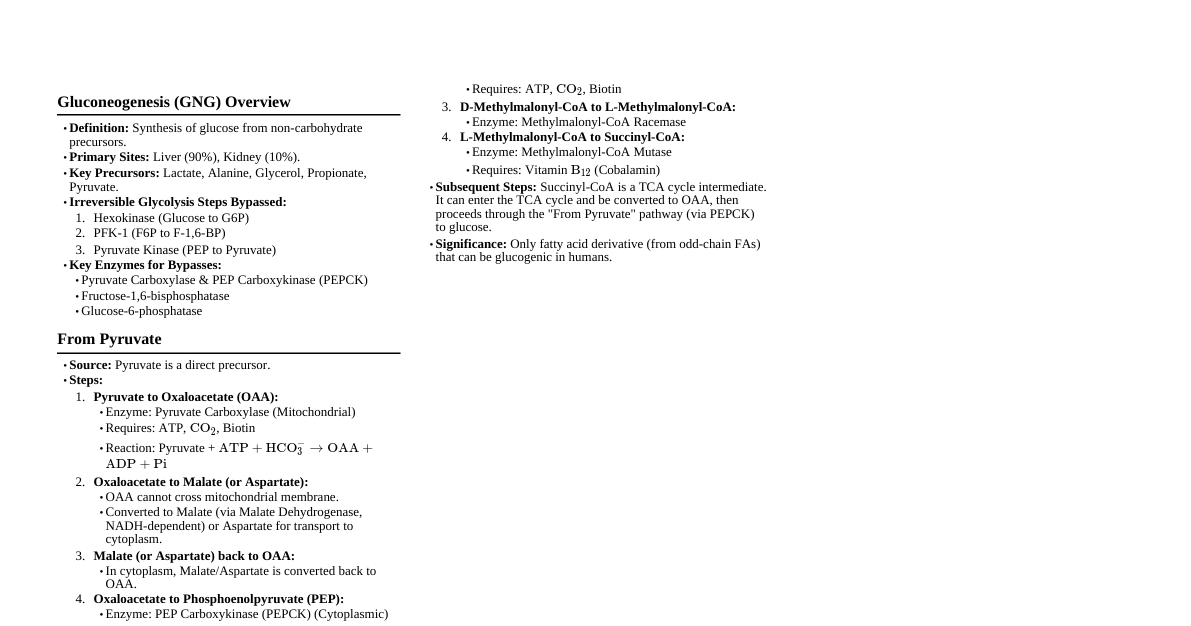
### Overview of Gluconeogenesis - **Definition:** Metabolic pathway that synthesizes glucose from non-carbohydrate precursors. - **Primary Site:** Liver (major), kidney cortex (minor). - **Purpose:** Maintain blood glucose levels during fasting, starvation, or intense exercise, especially when glycogen stores are depleted. - **Irreversible Steps:** Overcomes the three irreversible steps of glycolysis by using alternative enzymes. - **Energy Cost:** Anabolic process, requiring significant energy input (ATP and GTP). ### Precursors for Glucose Synthesis - **Lactate:** Produced during anaerobic glycolysis (e.g., muscle activity). Converted to pyruvate by lactate dehydrogenase. - **Amino Acids:** Glucogenic amino acids (all except leucine and lysine) are catabolized to pyruvate or intermediates of the TCA cycle. - **Glycerol:** From the breakdown of triglycerides in adipose tissue. Converted to dihydroxyacetone phosphate (DHAP), an intermediate of glycolysis/gluconeogenesis. - **Fatty Acids:** *Cannot* be directly converted to glucose in animals (beta-oxidation yields acetyl-CoA, which enters TCA cycle but cannot be net converted to oxaloacetate). ### Key Enzymes & Bypass Reactions Gluconeogenesis bypasses three irreversible steps of glycolysis: #### 1. Pyruvate to Phosphoenolpyruvate (PEP) - **Glycolysis:** Pyruvate Kinase (PEP $\rightarrow$ Pyruvate) - **Gluconeogenesis Bypass:** - **Pyruvate Carboxylase:** Pyruvate + ATP + CO$_2$ $\rightarrow$ Oxaloacetate (OAA) - Located in mitochondrial matrix. Requires biotin. - **PEP Carboxykinase (PEPCK):** OAA + GTP $\rightarrow$ PEP + GDP + CO$_2$ - Can be mitochondrial or cytosolic depending on species. OAA must be transported out of mitochondria (as malate or aspartate) if PEPCK is cytosolic. #### 2. Fructose-1,6-bisphosphate to Fructose-6-phosphate - **Glycolysis:** Phosphofructokinase-1 (Fructose-6-P $\rightarrow$ Fructose-1,6-BP) - **Gluconeogenesis Bypass:** - **Fructose-1,6-bisphosphatase (FBPase-1):** Fructose-1,6-BP + H$_2$O $\rightarrow$ Fructose-6-P + P$_i$ - Rate-limiting step. #### 3. Glucose-6-phosphate to Glucose - **Glycolysis:** Hexokinase/Glucokinase (Glucose $\rightarrow$ Glucose-6-P) - **Gluconeogenesis Bypass:** - **Glucose-6-phosphatase:** Glucose-6-P + H$_2$O $\rightarrow$ Glucose + P$_i$ - Located in the endoplasmic reticulum membrane of liver and kidney cells. - Free glucose is then released into the bloodstream. ### Energy Cost - **Overall Reaction (from 2x Pyruvate):** 2 Pyruvate + 4 ATP + 2 GTP + 2 NADH + 2 H$^+$ + 6 H$_2$O $\rightarrow$ Glucose + 4 ADP + 2 GDP + 6 P$_i$ + 2 NAD$^+$ - **Net Energy Requirement:** 4 ATP, 2 GTP, 2 NADH per glucose molecule synthesized. ### Regulation Gluconeogenesis and glycolysis are reciprocally regulated to prevent a futile cycle. #### Hormonal Regulation - **Glucagon:** Stimulates gluconeogenesis (and inhibits glycolysis) by: - Increasing cAMP levels, activating PKA. - PKA phosphorylates and inactivates pyruvate kinase. - PKA activates FBPase-2/inhibits PFK-2, leading to decreased Fructose-2,6-bisphosphate (an allosteric activator of PFK-1 and inhibitor of FBPase-1). - Inducing synthesis of PEPCK. - **Insulin:** Inhibits gluconeogenesis (and stimulates glycolysis) by: - Decreasing cAMP levels, deactivating PKA. - Activating phosphoprotein phosphatases, dephosphorylating and activating pyruvate kinase. - Activating PFK-2/inhibiting FBPase-2, leading to increased Fructose-2,6-bisphosphate. - Repressing synthesis of PEPCK. - **Cortisol:** Stimulates gluconeogenesis by increasing the expression of PEPCK and FBPase-1. #### Allosteric Regulation - **Fructose-1,6-bisphosphatase (FBPase-1):** - Inhibited by AMP (low energy state, favors glycolysis). - Inhibited by Fructose-2,6-bisphosphate. - **Pyruvate Carboxylase:** - Activated by Acetyl-CoA (indicates high fatty acid oxidation, signaling energy for gluconeogenesis). - **PEP Carboxykinase (PEPCK):** - Regulated primarily by gene expression (induced by glucagon/cortisol, repressed by insulin). - **Glucose-6-phosphatase:** - Substrate level control; activity primarily regulated by availability of G6P.