Integration Cheatsheet
Cheatsheet Content
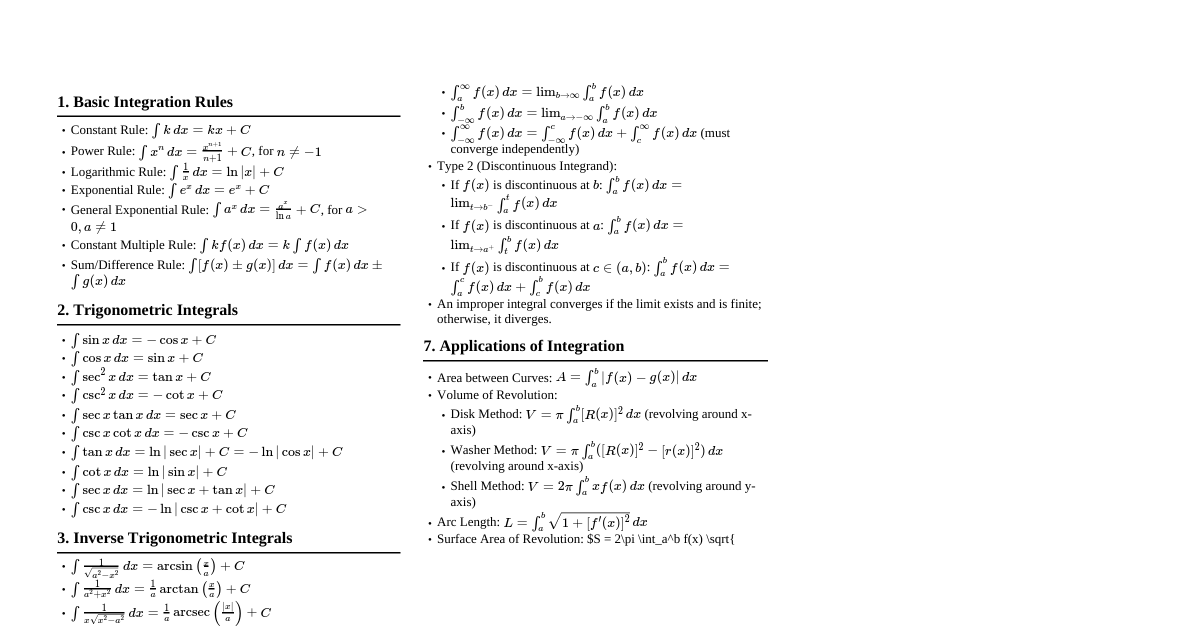
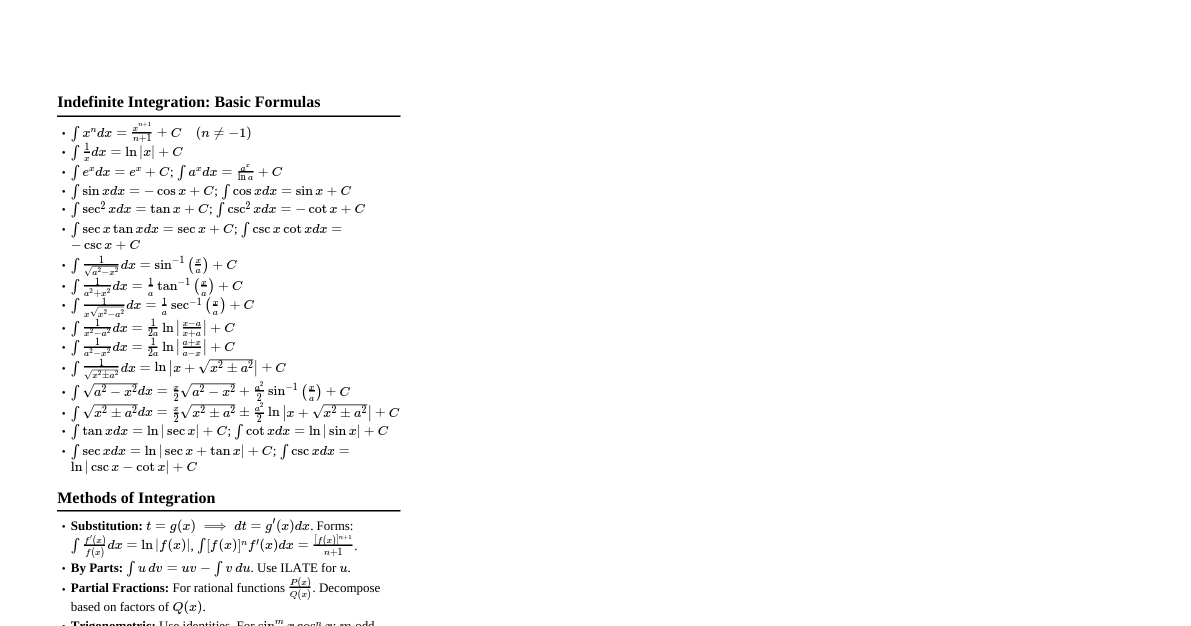
1. Indefinite Integrals (Antiderivatives) The indefinite integral of a function $f(x)$ is denoted by $\int f(x) dx = F(x) + C$, where $F'(x) = f(x)$ and $C$ is the constant of integration. Basic Integration Formulas Constant Rule: $\int k dx = kx + C$ Power Rule: $\int x^n dx = \frac{x^{n+1}}{n+1} + C$ (for $n \neq -1$) Logarithmic Rule: $\int \frac{1}{x} dx = \ln|x| + C$ Exponential Rule: $\int e^x dx = e^x + C$ General Exponential Rule: $\int a^x dx = \frac{a^x}{\ln a} + C$ (for $a > 0, a \neq 1$) Trigonometric: $\int \sin x dx = -\cos x + C$ $\int \cos x dx = \sin x + C$ $\int \sec^2 x dx = \tan x + C$ $\int \csc^2 x dx = -\cot x + C$ $\int \sec x \tan x dx = \sec x + C$ $\int \csc x \cot x dx = -\csc x + C$ Inverse Trigonometric: $\int \frac{1}{\sqrt{a^2 - x^2}} dx = \arcsin\left(\frac{x}{a}\right) + C$ $\int \frac{1}{a^2 + x^2} dx = \frac{1}{a}\arctan\left(\frac{x}{a}\right) + C$ $\int \frac{1}{x\sqrt{x^2 - a^2}} dx = \frac{1}{a}\operatorname{arcsec}\left(\frac{|x|}{a}\right) + C$ Properties of Indefinite Integrals Constant Multiple: $\int c f(x) dx = c \int f(x) dx$ Sum/Difference: $\int [f(x) \pm g(x)] dx = \int f(x) dx \pm \int g(x) dx$ 2. Definite Integrals The definite integral of $f(x)$ from $a$ to $b$ is $\int_a^b f(x) dx = F(b) - F(a)$, where $F(x)$ is any antiderivative of $f(x)$. Fundamental Theorem of Calculus Part 1: If $F(x) = \int_a^x f(t) dt$, then $F'(x) = f(x)$. Part 2: $\int_a^b f(x) dx = F(b) - F(a)$, where $F$ is an antiderivative of $f$. Properties of Definite Integrals $\int_a^a f(x) dx = 0$ $\int_a^b f(x) dx = -\int_b^a f(x) dx$ $\int_a^b c f(x) dx = c \int_a^b f(x) dx$ $\int_a^b [f(x) \pm g(x)] dx = \int_a^b f(x) dx \pm \int_a^b g(x) dx$ $\int_a^b f(x) dx = \int_a^c f(x) dx + \int_c^b f(x) dx$ (for any $c$) 3. Techniques of Integration Substitution (u-Substitution) If $u = g(x)$, then $du = g'(x) dx$. $\int f(g(x))g'(x) dx = \int f(u) du$. For definite integrals: $\int_a^b f(g(x))g'(x) dx = \int_{g(a)}^{g(b)} f(u) du$. Integration by Parts Formula: $\int u dv = uv - \int v du$. Choose $u$ using LIATE (Logarithmic, Inverse Trig, Algebraic, Trigonometric, Exponential) for the function that becomes "simpler" when differentiated. Trigonometric Integrals Powers of $\sin x$ and $\cos x$: If power of $\sin x$ is odd, save one $\sin x$, convert rest to $\cos x$ using $\sin^2 x = 1 - \cos^2 x$. Let $u = \cos x$. If power of $\cos x$ is odd, save one $\cos x$, convert rest to $\sin x$ using $\cos^2 x = 1 - \sin^2 x$. Let $u = \sin x$. If both powers are even, use half-angle identities: $\sin^2 x = \frac{1 - \cos(2x)}{2}$ $\cos^2 x = \frac{1 + \cos(2x)}{2}$ Powers of $\tan x$ and $\sec x$: If power of $\sec x$ is even, save $\sec^2 x$, convert rest to $\tan x$ using $\sec^2 x = 1 + \tan^2 x$. Let $u = \tan x$. If power of $\tan x$ is odd, save $\sec x \tan x$, convert rest to $\sec x$ using $\tan^2 x = \sec^2 x - 1$. Let $u = \sec x$. Trigonometric Substitution Used for integrands involving $\sqrt{a^2 - x^2}$, $\sqrt{a^2 + x^2}$, $\sqrt{x^2 - a^2}$. Expression Substitution Identity $\sqrt{a^2 - x^2}$ $x = a \sin\theta$, $dx = a \cos\theta d\theta$ $a^2 - a^2\sin^2\theta = a^2\cos^2\theta$ $\sqrt{a^2 + x^2}$ $x = a \tan\theta$, $dx = a \sec^2\theta d\theta$ $a^2 + a^2\tan^2\theta = a^2\sec^2\theta$ $\sqrt{x^2 - a^2}$ $x = a \sec\theta$, $dx = a \sec\theta \tan\theta d\theta$ $a^2\sec^2\theta - a^2 = a^2\tan^2\theta$ Partial Fraction Decomposition Used for rational functions $\frac{P(x)}{Q(x)}$ where degree of $P(x)$ is less than degree of $Q(x)$. Factor $Q(x)$ into linear and irreducible quadratic factors. Linear factor $(ax+b)$: $\frac{A}{ax+b}$ Repeated linear factor $(ax+b)^n$: $\frac{A_1}{ax+b} + \frac{A_2}{(ax+b)^2} + \dots + \frac{A_n}{(ax+b)^n}$ Irreducible quadratic factor $(ax^2+bx+c)$: $\frac{Ax+B}{ax^2+bx+c}$ Repeated irreducible quadratic factor $(ax^2+bx+c)^n$: $\frac{A_1x+B_1}{ax^2+bx+c} + \dots + \frac{A_nx+B_n}{(ax^2+bx+c)^n}$ 4. Applications of Integration Area Between Curves Area $A = \int_a^b [f(x) - g(x)] dx$, where $f(x) \ge g(x)$ on $[a, b]$. If integrating with respect to $y$: $A = \int_c^d [f(y) - g(y)] dy$. Volume of Revolution Disk Method: $V = \pi \int_a^b [R(x)]^2 dx$ (revolving about x-axis or horizontal line) Washer Method: $V = \pi \int_a^b ([R(x)]^2 - [r(x)]^2) dx$ (revolving about x-axis or horizontal line) Shell Method: $V = 2\pi \int_a^b x f(x) dx$ (revolving about y-axis or vertical line) Arc Length For $y=f(x)$ from $x=a$ to $x=b$: $L = \int_a^b \sqrt{1 + [f'(x)]^2} dx$ For $x=g(y)$ from $y=c$ to $y=d$: $L = \int_c^d \sqrt{1 + [g'(y)]^2} dy$ Surface Area of Revolution About x-axis: $S = 2\pi \int_a^b f(x) \sqrt{1 + [f'(x)]^2} dx$ About y-axis: $S = 2\pi \int_a^b x \sqrt{1 + [f'(x)]^2} dx$ Work Work done by a variable force $F(x)$ from $a$ to $b$: $W = \int_a^b F(x) dx$ Pumping liquids: $W = \int_a^b \rho g A(y) D(y) dy$, where $\rho$ is density, $g$ is gravity, $A(y)$ is cross-sectional area, $D(y)$ is distance to pump. Average Value of a Function Average value of $f(x)$ on $[a, b]$: $f_{avg} = \frac{1}{b-a} \int_a^b f(x) dx$ 5. Improper Integrals Integrals with infinite limits or discontinuous integrands. Type 1 (Infinite Limits): $\int_a^\infty f(x) dx = \lim_{t \to \infty} \int_a^t f(x) dx$ $\int_{-\infty}^b f(x) dx = \lim_{t \to -\infty} \int_t^b f(x) dx$ $\int_{-\infty}^\infty f(x) dx = \int_{-\infty}^c f(x) dx + \int_c^\infty f(x) dx$ Type 2 (Discontinuous Integrands): If $f$ is discontinuous at $b$: $\int_a^b f(x) dx = \lim_{t \to b^-} \int_a^t f(x) dx$ If $f$ is discontinuous at $a$: $\int_a^b f(x) dx = \lim_{t \to a^+} \int_t^b f(x) dx$ If $f$ is discontinuous at $c \in (a, b)$: $\int_a^b f(x) dx = \int_a^c f(x) dx + \int_c^b f(x) dx$ An improper integral converges if the limit exists and is finite; otherwise, it diverges.