Theory of Relativity
Cheatsheet Content
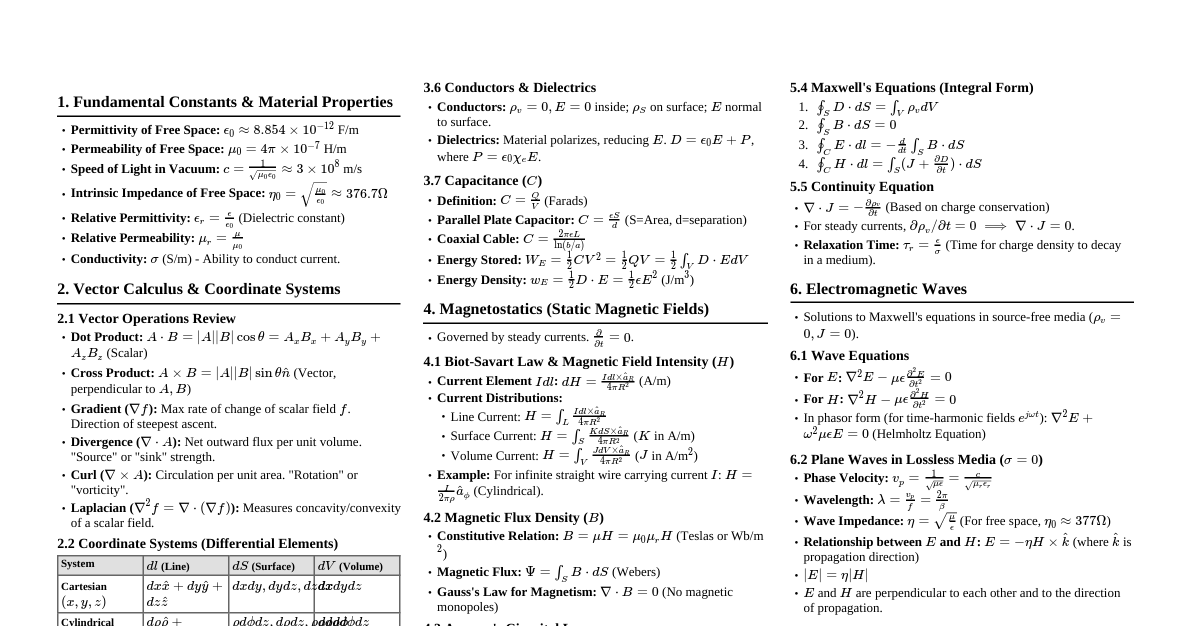
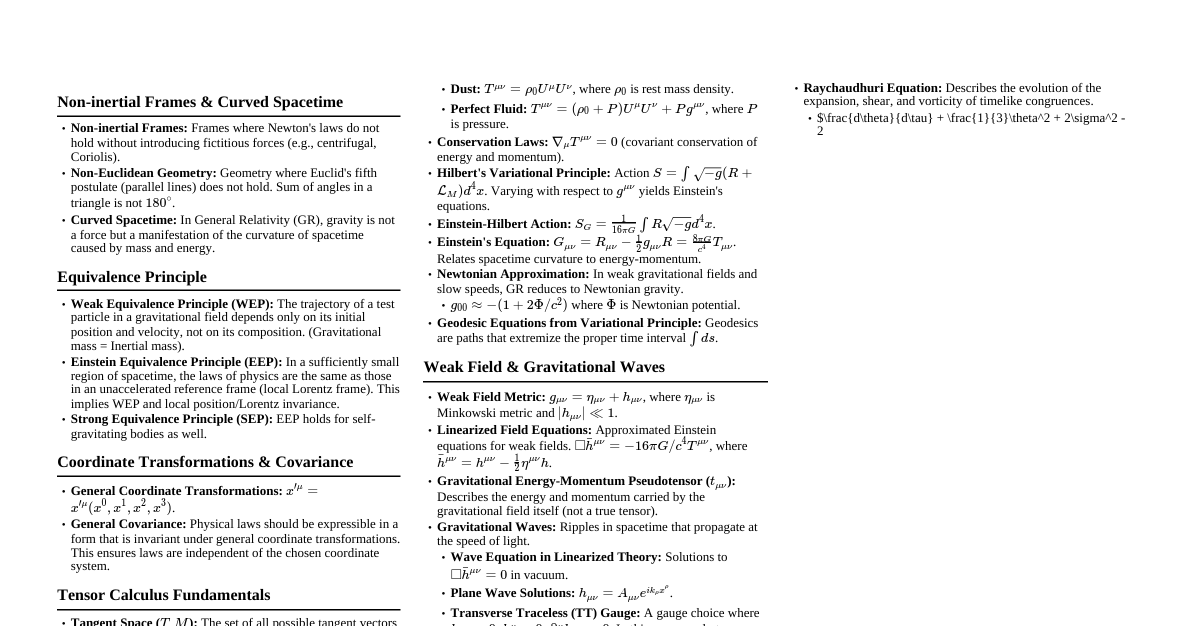
1. Special Relativity (SR) Developed by Albert Einstein in 1905, deals with the relationship between space and time for objects moving at constant speeds in a straight line. Postulates of Special Relativity: Principle of Relativity: The laws of physics are the same for all observers in uniform motion relative to one another (inertial frames of reference). Principle of the Constancy of the Speed of Light: The speed of light in a vacuum ($c$) is the same for all inertial observers, regardless of the motion of the light source. ($c \approx 3 \times 10^8 \text{ m/s}$). Key Concepts of SR: Inertial Frame of Reference: A frame where Newton's first law (inertia) holds true. Simultaneity is Relative: Events simultaneous in one inertial frame may not be simultaneous in another. Relativistic Effects: Time Dilation: Moving clocks run slower relative to a stationary observer. $$ \Delta t' = \gamma \Delta t_0 = \frac{\Delta t_0}{\sqrt{1 - v^2/c^2}} $$ where $\Delta t_0$ is proper time (time in the object's rest frame), $\Delta t'$ is dilated time, $v$ is relative velocity, and $\gamma$ is the Lorentz factor. Length Contraction: The length of an object moving relative to an observer is measured to be shorter along the direction of motion. $$ L' = \frac{L_0}{\gamma} = L_0 \sqrt{1 - v^2/c^2} $$ where $L_0$ is proper length (length in the object's rest frame), and $L'$ is contracted length. Relativistic Mass and Momentum: Mass and momentum increase with velocity. $$ m = \gamma m_0 $$ $$ p = \gamma m_0 v $$ where $m_0$ is rest mass. Mass-Energy Equivalence: Mass and energy are interchangeable. $$ E = mc^2 = \gamma m_0 c^2 $$ $$ E_0 = m_0 c^2 $$ where $E_0$ is rest energy. Total energy is $E^2 = (pc)^2 + (m_0 c^2)^2$. 2. General Relativity (GR) Developed by Albert Einstein in 1915, extends special relativity to include gravity and accelerated frames of reference. Key Principles of GR: Principle of Equivalence: A uniform gravitational field is indistinguishable from a uniformly accelerating frame of reference. Gravity is not a force, but a manifestation of spacetime curvature. Gravitation describes Spacetime Curvature: Mass and energy warp spacetime, and this curvature dictates the paths of objects (including light). Mathematical Foundation: Einstein Field Equations (EFE): Relates spacetime curvature (described by the Einstein tensor $G_{\mu\nu}$) to the distribution of mass and energy (described by the stress-energy tensor $T_{\mu\nu}$). $$ G_{\mu\nu} + \Lambda g_{\mu\nu} = \frac{8\pi G}{c^4} T_{\mu\nu} $$ where $G$ is Newton's gravitational constant, $c$ is the speed of light, $g_{\mu\nu}$ is the metric tensor, and $\Lambda$ is the cosmological constant. Metric Tensor ($g_{\mu\nu}$): Describes the geometry of spacetime and how distances and time intervals are measured. Observable Phenomena of GR: Gravitational Time Dilation: Clocks run slower in stronger gravitational potentials (closer to massive objects). $$ \Delta t_f = \Delta t_0 \sqrt{1 - \frac{2GM}{rc^2}} $$ where $\Delta t_f$ is time far from the mass, $\Delta t_0$ is time near the mass, $G$ is gravitational constant, $M$ is mass, $r$ is distance from mass. Gravitational Lensing: Massive objects bend light paths, acting like lenses and distorting images of distant objects. Precession of Perihelia: Explains the anomalous precession of Mercury's orbit. Gravitational Redshift: Light emitted from a strong gravitational field is shifted to longer wavelengths (lower energy). $$ \frac{\Delta \lambda}{\lambda} \approx \frac{GM}{rc^2} $$ Black Holes: Regions of spacetime where gravity is so strong that nothing, not even light, can escape. Defined by an event horizon. Gravitational Waves: Ripples in spacetime caused by accelerating massive objects (e.g., merging black holes, neutron stars), predicted by GR and detected in 2015. 3. Comparison SR vs GR Feature Special Relativity General Relativity Scope Inertial frames, constant velocity All frames (including accelerated), gravity Gravity Does not include gravity Gravity as spacetime curvature Spacetime Flat (Minkowski spacetime) Curved (Riemannian spacetime) Key Equation $E=mc^2$ Einstein Field Equations