Math Fundamentals
Cheatsheet Content
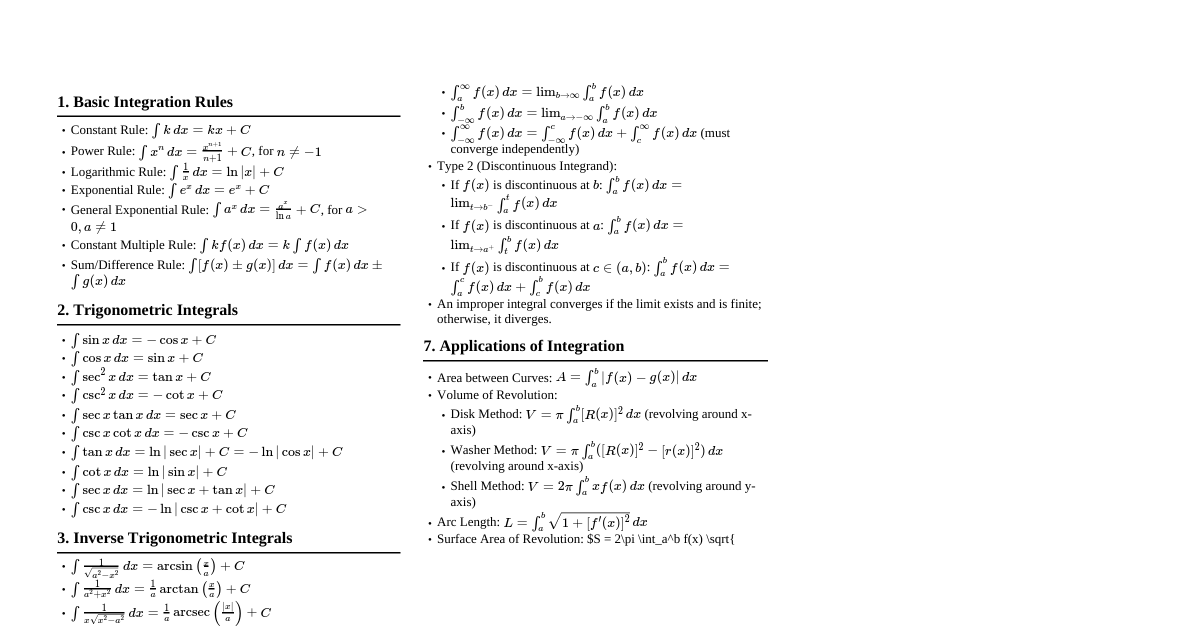
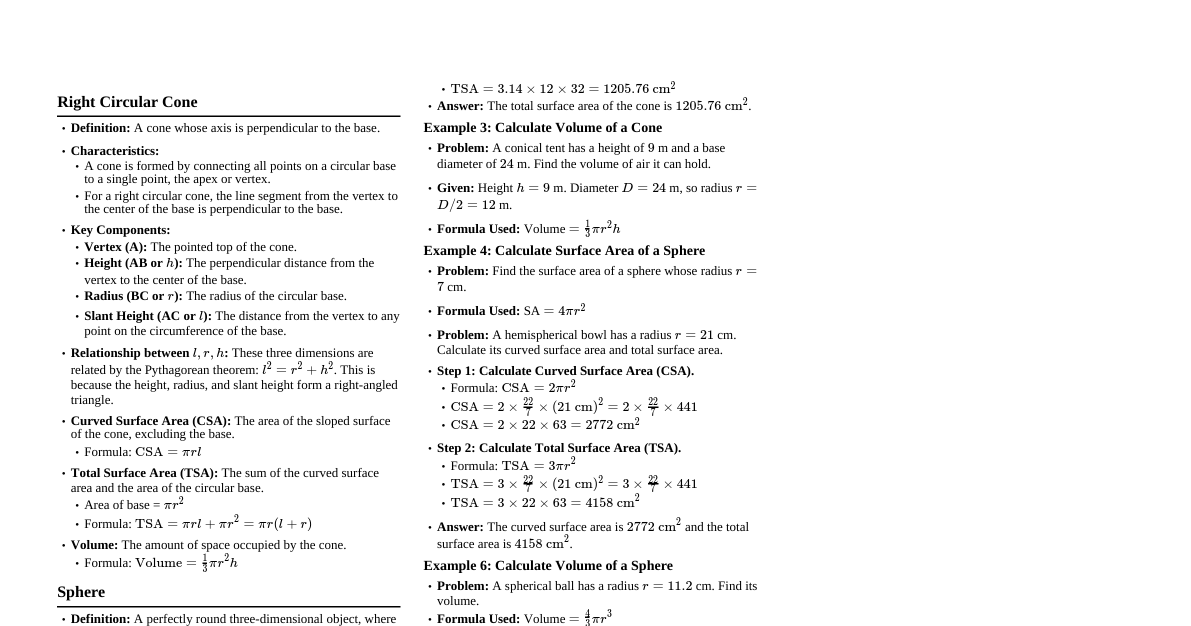
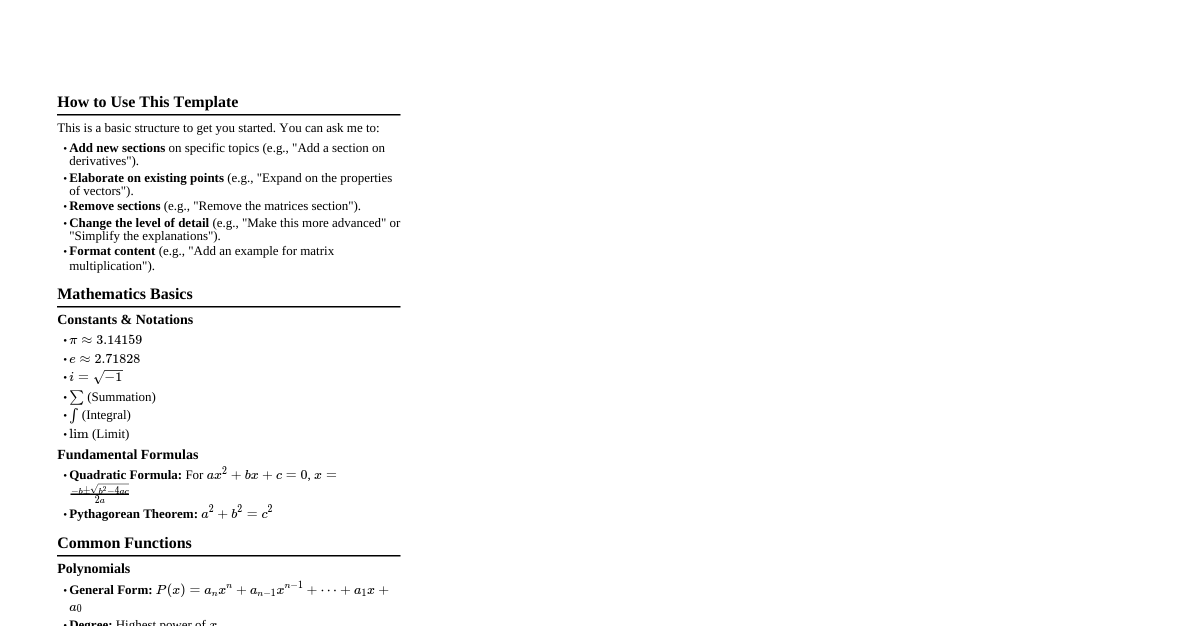
### Algebra Basics - **Order of Operations (PEMDAS/BODMAS):** Parentheses/Brackets, Exponents/Orders, Multiplication & Division (left to right), Addition & Subtraction (left to right). - **Properties of Real Numbers:** - Commutative: $a+b = b+a$, $ab = ba$ - Associative: $(a+b)+c = a+(b+c)$, $(ab)c = a(bc)$ - Distributive: $a(b+c) = ab+ac$ - Identity: $a+0 = a$, $a \cdot 1 = a$ - Inverse: $a+(-a) = 0$, $a \cdot (1/a) = 1$ (for $a \neq 0$) - **Exponents:** - $x^a \cdot x^b = x^{a+b}$ - $x^a / x^b = x^{a-b}$ - $(x^a)^b = x^{ab}$ - $(xy)^a = x^a y^a$ - $(x/y)^a = x^a / y^a$ - $x^0 = 1$ (for $x \neq 0$) - $x^{-a} = 1/x^a$ - $x^{a/b} = \sqrt[b]{x^a}$ - **Radicals:** - $\sqrt{ab} = \sqrt{a}\sqrt{b}$ - $\sqrt{a/b} = \sqrt{a}/\sqrt{b}$ - $\sqrt[n]{a^n} = |a|$ (if $n$ is even), $a$ (if $n$ is odd) ### Factoring & Polynomials - **Difference of Squares:** $a^2 - b^2 = (a-b)(a+b)$ - **Sum/Difference of Cubes:** - $a^3 + b^3 = (a+b)(a^2 - ab + b^2)$ - $a^3 - b^3 = (a-b)(a^2 + ab + b^2)$ - **Perfect Square Trinomials:** - $a^2 + 2ab + b^2 = (a+b)^2$ - $a^2 - 2ab + b^2 = (a-b)^2$ - **Quadratic Formula:** For $ax^2+bx+c=0$, $x = \frac{-b \pm \sqrt{b^2-4ac}}{2a}$ - **Discriminant ($D=b^2-4ac$):** - $D > 0$: Two distinct real roots - $D = 0$: One real root (repeated) - $D ### Logarithms - **Definition:** $y = \log_b x \iff b^y = x$ - **Properties:** - $\log_b 1 = 0$ - $\log_b b = 1$ - $\log_b (MN) = \log_b M + \log_b N$ - $\log_b (M/N) = \log_b M - \log_b N$ - $\log_b (M^p) = p \log_b M$ - $\log_b x = \frac{\log_a x}{\log_a b}$ (Change of Base Formula) - $\ln x = \log_e x$ (Natural Log) - $\log x = \log_{10} x$ (Common Log) ### Trigonometric Functions - **SOH CAH TOA:** - $\sin \theta = \text{Opposite} / \text{Hypotenuse}$ - $\cos \theta = \text{Adjacent} / \text{Hypotenuse}$ - $\tan \theta = \text{Opposite} / \text{Adjacent} = \sin \theta / \cos \theta$ - **Reciprocal Functions:** - $\csc \theta = 1/\sin \theta$ - $\sec \theta = 1/\cos \theta$ - $\cot \theta = 1/\tan \theta = \cos \theta / \sin \theta$ - **Unit Circle:** *(Note: Image URL is a placeholder. A real image would be provided by user.)* - **Special Angles (0, $\pi/6$, $\pi/4$, $\pi/3$, $\pi/2$):** | $\theta$ | $0$ | $\pi/6$ ($30^\circ$) | $\pi/4$ ($45^\circ$) | $\pi/3$ ($60^\circ$) | $\pi/2$ ($90^\circ$) | |---|---|---|---|---|---| | $\sin \theta$ | $0$ | $1/2$ | $\sqrt{2}/2$ | $\sqrt{3}/2$ | $1$ | | $\cos \theta$ | $1$ | $\sqrt{3}/2$ | $\sqrt{2}/2$ | $1/2$ | $0$ | | $\tan \theta$ | $0$ | $1/\sqrt{3}$ | $1$ | $\sqrt{3}$ | Undefined | ### Trigonometric Identities - **Pythagorean Identities:** - $\sin^2 \theta + \cos^2 \theta = 1$ - $1 + \tan^2 \theta = \sec^2 \theta$ - $1 + \cot^2 \theta = \csc^2 \theta$ - **Angle Sum/Difference:** - $\sin(A \pm B) = \sin A \cos B \pm \cos A \sin B$ - $\cos(A \pm B) = \cos A \cos B \mp \sin A \sin B$ - $\tan(A \pm B) = \frac{\tan A \pm \tan B}{1 \mp \tan A \tan B}$ - **Double Angle:** - $\sin(2\theta) = 2 \sin \theta \cos \theta$ - $\cos(2\theta) = \cos^2 \theta - \sin^2 \theta = 2\cos^2 \theta - 1 = 1 - 2\sin^2 \theta$ - $\tan(2\theta) = \frac{2 \tan \theta}{1 - \tan^2 \theta}$ - **Half Angle:** - $\sin^2 \theta = \frac{1 - \cos(2\theta)}{2}$ - $\cos^2 \theta = \frac{1 + \cos(2\theta)}{2}$ ### Law of Sines & Cosines - **Law of Sines:** $\frac{a}{\sin A} = \frac{b}{\sin B} = \frac{c}{\sin C}$ - **Law of Cosines:** - $a^2 = b^2 + c^2 - 2bc \cos A$ - $b^2 = a^2 + c^2 - 2ac \cos B$ - $c^2 = a^2 + b^2 - 2ab \cos C$ ### Geometric Shapes & Formulas - **Perimeter/Circumference & Area:** - **Square:** $P=4s$, $A=s^2$ - **Rectangle:** $P=2(l+w)$, $A=lw$ - **Triangle:** $P=a+b+c$, $A=\frac{1}{2}bh$ - **Circle:** $C=2\pi r = \pi d$, $A=\pi r^2$ - **Trapezoid:** $A=\frac{1}{2}(b_1+b_2)h$ - **Volume & Surface Area:** - **Cube:** $V=s^3$, $SA=6s^2$ - **Rectangular Prism:** $V=lwh$, $SA=2(lw+lh+wh)$ - **Cylinder:** $V=\pi r^2 h$, $SA=2\pi r h + 2\pi r^2$ - **Cone:** $V=\frac{1}{3}\pi r^2 h$, $SA=\pi r^2 + \pi r l$ (where $l$ is slant height) - **Sphere:** $V=\frac{4}{3}\pi r^3$, $SA=4\pi r^2$ ### Coordinate Geometry - **Distance Formula:** $d = \sqrt{(x_2-x_1)^2 + (y_2-y_1)^2}$ - **Midpoint Formula:** $(\frac{x_1+x_2}{2}, \frac{y_1+y_2}{2})$ - **Slope of a Line:** $m = \frac{y_2-y_1}{x_2-x_1}$ - **Equations of a Line:** - **Slope-intercept:** $y = mx+b$ - **Point-slope:** $y-y_1 = m(x-x_1)$ - **Standard form:** $Ax+By=C$ - **Parallel Lines:** Have the same slope ($m_1 = m_2$) - **Perpendicular Lines:** Slopes are negative reciprocals ($m_1 m_2 = -1$) ### Pythagorean Theorem - For a right-angled triangle with legs $a, b$ and hypotenuse $c$: $a^2 + b^2 = c^2$ ### Statistics: Descriptive - **Measures of Central Tendency:** - **Mean ($\bar{x}$):** Average of all values. $\bar{x} = \frac{\sum x_i}{n}$ - **Median:** Middle value when data is ordered. If $n$ is even, average of the two middle values. - **Mode:** Most frequent value(s). - **Measures of Spread (Variability):** - **Range:** Max value - Min value. - **Variance ($\sigma^2$ or $s^2$):** Average of squared differences from the mean. - Population: $\sigma^2 = \frac{\sum (x_i - \mu)^2}{N}$ - Sample: $s^2 = \frac{\sum (x_i - \bar{x})^2}{n-1}$ - **Standard Deviation ($\sigma$ or $s$):** Square root of variance. - Population: $\sigma = \sqrt{\frac{\sum (x_i - \mu)^2}{N}}$ - Sample: $s = \sqrt{\frac{\sum (x_i - \bar{x})^2}{n-1}}$ - **Interquartile Range (IQR):** $Q_3 - Q_1$ (difference between 75th and 25th percentiles) - **Empirical Rule (for Normal Distribution):** - $\approx 68\%$ of data within $\pm 1$ standard deviation of the mean. - $\approx 95\%$ of data within $\pm 2$ standard deviations of the mean. - $\approx 99.7\%$ of data within $\pm 3$ standard deviations of the mean. ### Probability Basics - **Probability of an Event A:** $P(A) = \frac{\text{Number of favorable outcomes}}{\text{Total number of possible outcomes}}$ - **Complement Rule:** $P(A') = 1 - P(A)$ (Probability of A not happening) - **Addition Rule:** - For any events A and B: $P(A \text{ or } B) = P(A) + P(B) - P(A \text{ and } B)$ - For mutually exclusive events: $P(A \text{ or } B) = P(A) + P(B)$ - **Multiplication Rule:** - For any events A and B: $P(A \text{ and } B) = P(A|B)P(B) = P(B|A)P(A)$ - For independent events: $P(A \text{ and } B) = P(A)P(B)$ - **Conditional Probability:** $P(A|B) = \frac{P(A \text{ and } B)}{P(B)}$ (Probability of A given B) ### Discrete Probability Distributions - **Binomial Distribution:** $P(X=k) = \binom{n}{k} p^k (1-p)^{n-k}$ - Mean: $np$ - Variance: $np(1-p)$ - **Poisson Distribution:** $P(X=k) = \frac{\lambda^k e^{-\lambda}}{k!}$ - Mean: $\lambda$ - Variance: $\lambda$ ### Calculus: Limits - **Definition of a Limit:** $\lim_{x \to c} f(x) = L$ if $f(x)$ gets arbitrarily close to $L$ as $x$ approaches $c$. - **One-Sided Limits:** - $\lim_{x \to c^-} f(x)$ (from the left) - $\lim_{x \to c^+} f(x)$ (from the right) - A limit exists if and only if $\lim_{x \to c^-} f(x) = \lim_{x \to c^+} f(x) = L$ - **Limit Properties:** - $\lim_{x \to c} [f(x) \pm g(x)] = \lim_{x \to c} f(x) \pm \lim_{x \to c} g(x)$ - $\lim_{x \to c} [f(x) \cdot g(x)] = \lim_{x \to c} f(x) \cdot \lim_{x \to c} g(x)$ - $\lim_{x \to c} [f(x) / g(x)] = \lim_{x \to c} f(x) / \lim_{x \to c} g(x)$ (if $\lim_{x \to c} g(x) \neq 0$) - $\lim_{x \to c} k f(x) = k \lim_{x \to c} f(x)$ - **L'Hôpital's Rule:** If $\lim_{x \to c} \frac{f(x)}{g(x)}$ is of the form $\frac{0}{0}$ or $\frac{\infty}{\infty}$, then $\lim_{x \to c} \frac{f(x)}{g(x)} = \lim_{x \to c} \frac{f'(x)}{g'(x)}$. ### Calculus: Differentiation - **Definition of Derivative:** $f'(x) = \lim_{h \to 0} \frac{f(x+h) - f(x)}{h}$ - **Basic Differentiation Rules:** - **Constant Rule:** $\frac{d}{dx}(c) = 0$ - **Power Rule:** $\frac{d}{dx}(x^n) = nx^{n-1}$ - **Constant Multiple Rule:** $\frac{d}{dx}(cf(x)) = c f'(x)$ - **Sum/Difference Rule:** $\frac{d}{dx}(f(x) \pm g(x)) = f'(x) \pm g'(x)$ - **Product Rule:** $\frac{d}{dx}(f(x)g(x)) = f'(x)g(x) + f(x)g'(x)$ - **Quotient Rule:** $\frac{d}{dx}\left(\frac{f(x)}{g(x)}\right) = \frac{f'(x)g(x) - f(x)g'(x)}{[g(x)]^2}$ - **Chain Rule:** $\frac{d}{dx}(f(g(x))) = f'(g(x)) \cdot g'(x)$ - **Derivatives of Common Functions:** - $\frac{d}{dx}(\sin x) = \cos x$ - $\frac{d}{dx}(\cos x) = -\sin x$ - $\frac{d}{dx}(\tan x) = \sec^2 x$ - $\frac{d}{dx}(e^x) = e^x$ - $\frac{d}{dx}(\ln x) = 1/x$ - $\frac{d}{dx}(a^x) = a^x \ln a$ - $\frac{d}{dx}(\log_a x) = \frac{1}{x \ln a}$ ### Calculus: Applications of Derivatives - **Optimization:** Find max/min values by setting $f'(x)=0$ (critical points) and using first/second derivative test. - **Related Rates:** Use chain rule to find rates of change of related quantities. - **Concavity:** - $f''(x) > 0$: Concave Up - $f''(x) ### Calculus: Integration - **Definition of Definite Integral:** $\int_a^b f(x) dx = \lim_{n \to \infty} \sum_{i=1}^n f(x_i^*) \Delta x$ - **Fundamental Theorem of Calculus (FTC):** - **Part 1:** If $F(x) = \int_a^x f(t) dt$, then $F'(x) = f(x)$. - **Part 2:** $\int_a^b f(x) dx = F(b) - F(a)$, where $F'(x) = f(x)$. - **Basic Integration Rules:** - **Power Rule:** $\int x^n dx = \frac{x^{n+1}}{n+1} + C$ (for $n \neq -1$) - $\int \frac{1}{x} dx = \ln|x| + C$ - $\int e^x dx = e^x + C$ - $\int a^x dx = \frac{a^x}{\ln a} + C$ - $\int \sin x dx = -\cos x + C$ - $\int \cos x dx = \sin x + C$ - $\int \sec^2 x dx = \tan x + C$ - **Techniques of Integration:** - **Substitution (u-substitution):** Used to simplify integrands, often reversing the chain rule. - **Integration by Parts:** $\int u dv = uv - \int v du$ ### Calculus: Applications of Integrals - **Area Between Curves:** $\int_a^b [f(x) - g(x)] dx$ (where $f(x) \ge g(x)$) - **Volume of Solids of Revolution:** - **Disk Method:** $V = \pi \int_a^b [R(x)]^2 dx$ - **Washer Method:** $V = \pi \int_a^b ([R(x)]^2 - [r(x)]^2) dx$ - **Shell Method:** $V = 2\pi \int_a^b x h(x) dx$ - **Arc Length:** $L = \int_a^b \sqrt{1 + [f'(x)]^2} dx$ - **Average Value of a Function:** $f_{avg} = \frac{1}{b-a} \int_a^b f(x) dx$