Conic Sections
Cheatsheet Content
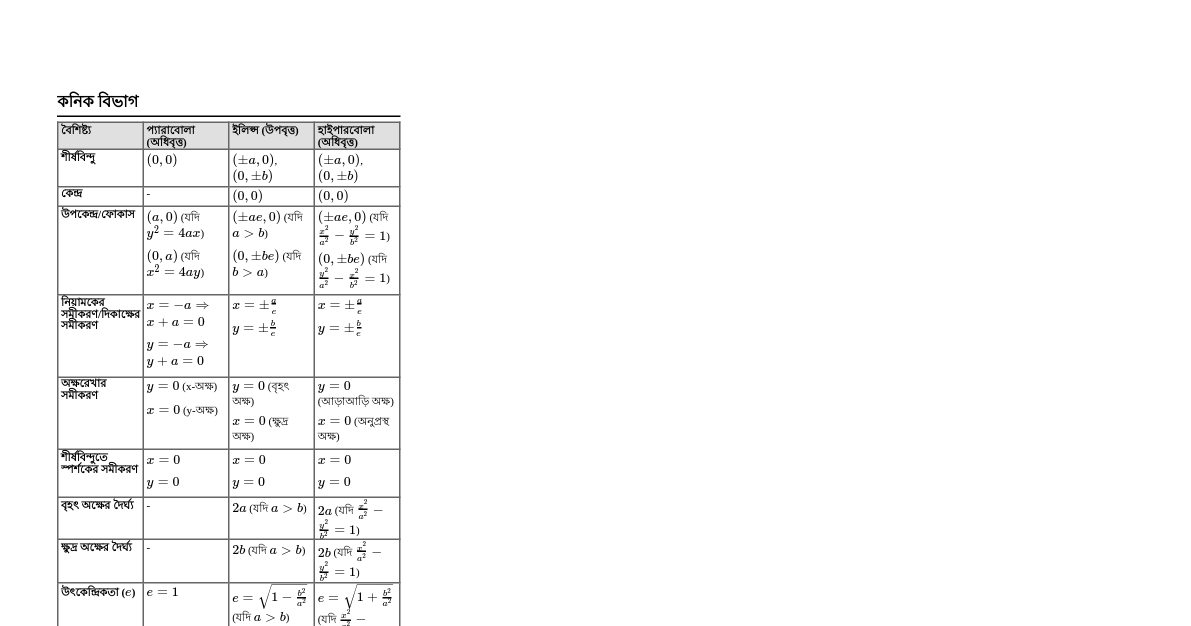
### Introduction to Conic Sections Conic sections are curves formed by the intersection of a plane and a double-napped cone. There are four main types: **circle**, **ellipse**, **parabola**, and **hyperbola**. * **Degenerate Conics:** Occur when the plane passes through the apex of the cone. Examples include a point, a line, or two intersecting lines. * **General Equation:** The general form of a conic section is $Ax^2 + Bxy + Cy^2 + Dx + Ey + F = 0$. * **Discriminant:** $B^2 - 4AC$ determines the type of conic: * $B^2 - 4AC 0$: Hyperbola ### Circle A circle is the set of all points equidistant from a central point. * **Standard Form:** $(x-h)^2 + (y-k)^2 = r^2$ * Center: $(h, k)$ * Radius: $r$ * **Key Properties:** * Every point on the circle is $r$ units away from the center. * If the center is at the origin $(0,0)$, the equation simplifies to $x^2 + y^2 = r^2$. * **Example:** $(x-1)^2 + (y+2)^2 = 9$ represents a circle with center $(1, -2)$ and radius $r=3$. ### Ellipse An ellipse is the set of all points for which the sum of the distances from two fixed points (foci) is constant. * **Standard Form (Center at origin):** * Horizontal major axis: $\frac{x^2}{a^2} + \frac{y^2}{b^2} = 1$ (where $a > b$) * Vertical major axis: $\frac{x^2}{b^2} + \frac{y^2}{a^2} = 1$ (where $a > b$) * **Standard Form (Center at $(h, k)$):** * Horizontal major axis: $\frac{(x-h)^2}{a^2} + \frac{(y-k)^2}{b^2} = 1$ * Vertical major axis: $\frac{(x-h)^2}{b^2} + \frac{(y-k)^2}{a^2} = 1$ * **Key Properties:** * **Center:** $(h, k)$ * **Major Axis Length:** $2a$ * **Minor Axis Length:** $2b$ * **Foci:** $c^2 = a^2 - b^2$. Foci are at $(\pm c, 0)$ for horizontal, or $(0, \pm c)$ for vertical, relative to the center. * **Vertices:** $(\pm a, 0)$ for horizontal, or $(0, \pm a)$ for vertical, relative to the center. * **Eccentricity:** $e = \frac{c}{a}$, where $0 ### Parabola A parabola is the set of all points equidistant from a fixed point (focus) and a fixed line (directrix). * **Standard Form (Vertex at origin $(0,0)$):** * Opens Up/Down: $x^2 = 4py$ (Focus: $(0, p)$, Directrix: $y = -p$) * Opens Left/Right: $y^2 = 4px$ (Focus: $(p, 0)$, Directrix: $x = -p$) * **Standard Form (Vertex at $(h, k)$):** * Opens Up/Down: $(x-h)^2 = 4p(y-k)$ * Opens Left/Right: $(y-k)^2 = 4p(x-h)$ * **Key Properties:** * **Vertex:** $(h, k)$ * **Focus:** $p$ is the distance from the vertex to the focus and from the vertex to the directrix. * **Axis of Symmetry:** The line passing through the focus and vertex. * **Latus Rectum:** A line segment through the focus, perpendicular to the axis of symmetry, with endpoints on the parabola. Its length is $|4p|$. * **Example:** $(x-2)^2 = 8(y+1)$ is a parabola with vertex $(2, -1)$, opening upwards. Here $4p=8$, so $p=2$. Focus is $(2, -1+2) = (2, 1)$. Directrix is $y = -1-2 = -3$. ### Hyperbola A hyperbola is the set of all points for which the absolute difference of the distances from two fixed points (foci) is constant. * **Standard Form (Center at origin):** * Horizontal transverse axis: $\frac{x^2}{a^2} - \frac{y^2}{b^2} = 1$ * Vertical transverse axis: $\frac{y^2}{a^2} - \frac{x^2}{b^2} = 1$ * **Standard Form (Center at $(h, k)$):** * Horizontal transverse axis: $\frac{(x-h)^2}{a^2} - \frac{(y-k)^2}{b^2} = 1$ * Vertical transverse axis: $\frac{(y-k)^2}{a^2} - \frac{(x-h)^2}{b^2} = 1$ * **Key Properties:** * **Center:** $(h, k)$ * **Vertices:** $(\pm a, 0)$ for horizontal, or $(0, \pm a)$ for vertical, relative to the center. * **Foci:** $c^2 = a^2 + b^2$. Foci are at $(\pm c, 0)$ for horizontal, or $(0, \pm c)$ for vertical, relative to the center. * **Asymptotes:** Lines that the hyperbola approaches but never touches. * Horizontal: $y - k = \pm \frac{b}{a}(x - h)$ * Vertical: $y - k = \pm \frac{a}{b}(x - h)$ * **Eccentricity:** $e = \frac{c}{a}$, where $e > 1$. * **Example:** $\frac{(y-2)^2}{4} - \frac{(x+3)^2}{9} = 1$ is a hyperbola with center $(-3, 2)$, vertical transverse axis ($a=2$, $b=3$).