Logarithms: Zero to Hero
Cheatsheet Content
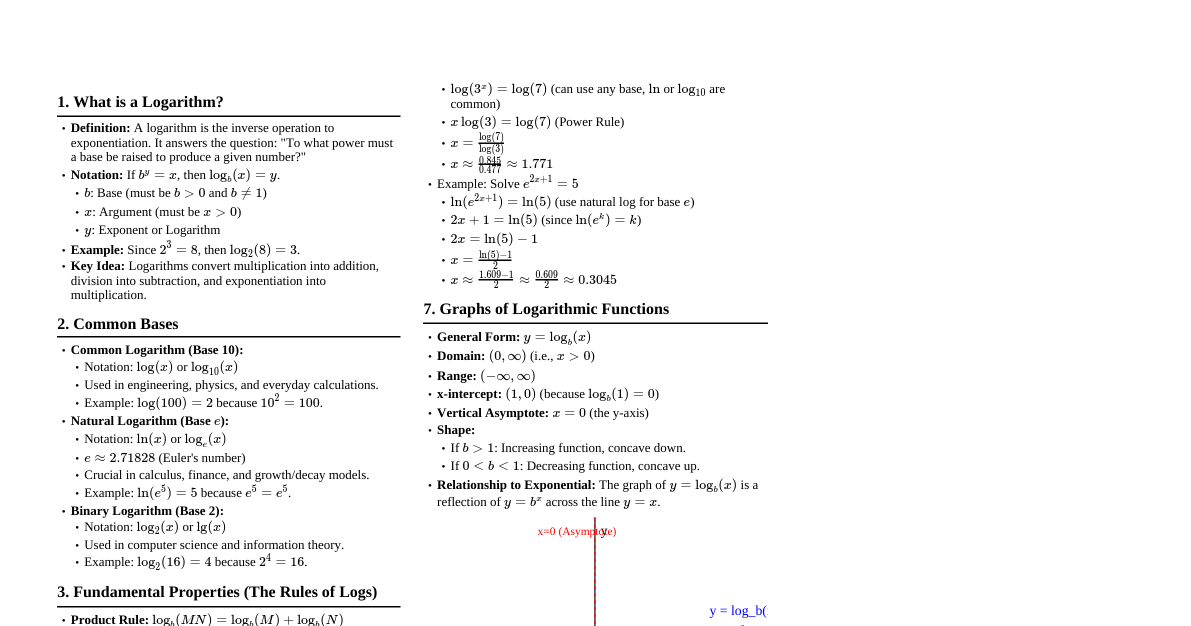
1. What is a Logarithm? Definition: A logarithm is the inverse operation to exponentiation. It answers the question: "To what power must a base be raised to produce a given number?" Notation: If $b^y = x$, then $\log_b(x) = y$. $b$: Base (must be $b > 0$ and $b \neq 1$) $x$: Argument (must be $x > 0$) $y$: Exponent or Logarithm Example: Since $2^3 = 8$, then $\log_2(8) = 3$. Key Idea: Logarithms convert multiplication into addition, division into subtraction, and exponentiation into multiplication. 2. Common Bases Common Logarithm (Base 10): Notation: $\log(x)$ or $\log_{10}(x)$ Used in engineering, physics, and everyday calculations. Example: $\log(100) = 2$ because $10^2 = 100$. Natural Logarithm (Base $e$): Notation: $\ln(x)$ or $\log_e(x)$ $e \approx 2.71828$ (Euler's number) Crucial in calculus, finance, and growth/decay models. Example: $\ln(e^5) = 5$ because $e^5 = e^5$. Binary Logarithm (Base 2): Notation: $\log_2(x)$ or $\lg(x)$ Used in computer science and information theory. Example: $\log_2(16) = 4$ because $2^4 = 16$. 3. Fundamental Properties (The Rules of Logs) Product Rule: $\log_b(MN) = \log_b(M) + \log_b(N)$ Example: $\log_2(4 \cdot 8) = \log_2(4) + \log_2(8) = 2 + 3 = 5$ (since $4 \cdot 8 = 32$ and $\log_2(32)=5$) Quotient Rule: $\log_b\left(\frac{M}{N}\right) = \log_b(M) - \log_b(N)$ Example: $\log_3\left(\frac{27}{9}\right) = \log_3(27) - \log_3(9) = 3 - 2 = 1$ (since $\frac{27}{9}=3$ and $\log_3(3)=1$) Power Rule: $\log_b(M^k) = k \cdot \log_b(M)$ Example: $\log_2(8^2) = 2 \cdot \log_2(8) = 2 \cdot 3 = 6$ (since $8^2=64$ and $\log_2(64)=6$) Change of Base Formula: $\log_b(x) = \frac{\log_c(x)}{\log_c(b)}$ Most common form: $\log_b(x) = \frac{\ln(x)}{\ln(b)} = \frac{\log(x)}{\log(b)}$ Allows calculation of logs in any base using a calculator (which usually only has $\log_{10}$ and $\ln$). Example: $\log_2(10) = \frac{\ln(10)}{\ln(2)} \approx \frac{2.302}{0.693} \approx 3.32$ 4. Special Logarithm Values $\log_b(1) = 0$ (because $b^0 = 1$ for any valid base $b$) $\log_b(b) = 1$ (because $b^1 = b$) $\log_b(b^k) = k$ (direct consequence of definition) $b^{\log_b(x)} = x$ (inverse property) 5. Solving Logarithmic Equations 5.1. Isolating the Logarithm If $\log_b(x) = y$, then convert to exponential form: $x = b^y$. Example: Solve $\log_3(x) = 4$ $x = 3^4$ $x = 81$ 5.2. Using Log Properties to Combine/Expand Example: Solve $\log_2(x) + \log_2(x-2) = 3$ Combine: $\log_2(x(x-2)) = 3$ (Product Rule) Convert to exponential: $x(x-2) = 2^3$ $x^2 - 2x = 8$ $x^2 - 2x - 8 = 0$ $(x-4)(x+2) = 0$ Possible solutions: $x=4$ or $x=-2$ Check Domain: Argument of log must be positive. For $\log_2(x)$, $x>0$. For $\log_2(x-2)$, $x-2>0 \Rightarrow x>2$. So $x=4$ is valid, $x=-2$ is extraneous. Solution: $x=4$. 5.3. When Logs on Both Sides If $\log_b(M) = \log_b(N)$, then $M = N$. Example: Solve $\ln(x+1) = \ln(2x-3)$ $x+1 = 2x-3$ $4 = x$ Check Domain: $x+1 > 0 \Rightarrow 4+1 > 0$ (True) $2x-3 > 0 \Rightarrow 2(4)-3 = 5 > 0$ (True) Solution: $x=4$. 6. Solving Exponential Equations using Logarithms When the variable is in the exponent, take the logarithm of both sides. Example: Solve $3^x = 7$ $\log(3^x) = \log(7)$ (can use any base, $\ln$ or $\log_{10}$ are common) $x \log(3) = \log(7)$ (Power Rule) $x = \frac{\log(7)}{\log(3)}$ $x \approx \frac{0.845}{0.477} \approx 1.771$ Example: Solve $e^{2x+1} = 5$ $\ln(e^{2x+1}) = \ln(5)$ (use natural log for base $e$) $2x+1 = \ln(5)$ (since $\ln(e^k)=k$) $2x = \ln(5) - 1$ $x = \frac{\ln(5) - 1}{2}$ $x \approx \frac{1.609 - 1}{2} \approx \frac{0.609}{2} \approx 0.3045$ 7. Graphs of Logarithmic Functions General Form: $y = \log_b(x)$ Domain: $(0, \infty)$ (i.e., $x > 0$) Range: $(-\infty, \infty)$ x-intercept: $(1, 0)$ (because $\log_b(1)=0$) Vertical Asymptote: $x=0$ (the y-axis) Shape: If $b > 1$: Increasing function, concave down. If $0 Relationship to Exponential: The graph of $y = \log_b(x)$ is a reflection of $y = b^x$ across the line $y=x$. y x 0 y = log_b(x), b > 1 1 x=0 (Asymptote) 8. Advanced Applications & Concepts 8.1. Logarithmic Scales Used to represent data that spans a very large range of values. Examples: Richter Scale (earthquake magnitude): $\log_{10}(I/I_0)$ pH Scale (acidity): $-\log_{10}[H^+]$ Decibel Scale (sound intensity): $10 \log_{10}(P/P_0)$ 8.2. Logarithm in Calculus Derivative of $\ln(x)$: $\frac{d}{dx}(\ln|x|) = \frac{1}{x}$ Derivative of $\log_b(x)$: $\frac{d}{dx}(\log_b(x)) = \frac{1}{x \ln(b)}$ Integral of $\frac{1}{x}$: $\int \frac{1}{x} dx = \ln|x| + C$ Logarithmic Differentiation: Technique used to differentiate complex products, quotients, or functions with variables in both base and exponent. Example: $y = x^x \Rightarrow \ln(y) = x \ln(x) \Rightarrow \frac{1}{y} \frac{dy}{dx} = \ln(x) + 1 \Rightarrow \frac{dy}{dx} = x^x(\ln(x)+1)$ 8.3. Hyperbolic Functions Inverse hyperbolic functions can be expressed using natural logarithms. Example: $\text{arsinh}(x) = \ln(x + \sqrt{x^2+1})$ 9. Common Pitfalls & Reminders Domain Restrictions: Always remember $x > 0$ for $\log_b(x)$. The base $b$ must be $b > 0$ and $b \neq 1$. No Log of Negative Numbers or Zero: $\log_b(0)$ and $\log_b(\text{negative number})$ are undefined in real numbers. $\log(A+B) \neq \log(A) + \log(B)$ (This is a common mistake!) $\frac{\log A}{\log B} \neq \log \left(\frac{A}{B}\right)$ (Use change of base or quotient rule correctly) Order of Operations: Apply log rules carefully. $\log(x^2)$ is $2\log(x)$, but $(\log x)^2$ is not.