Pentose Phosphate Pathway
Cheatsheet Content
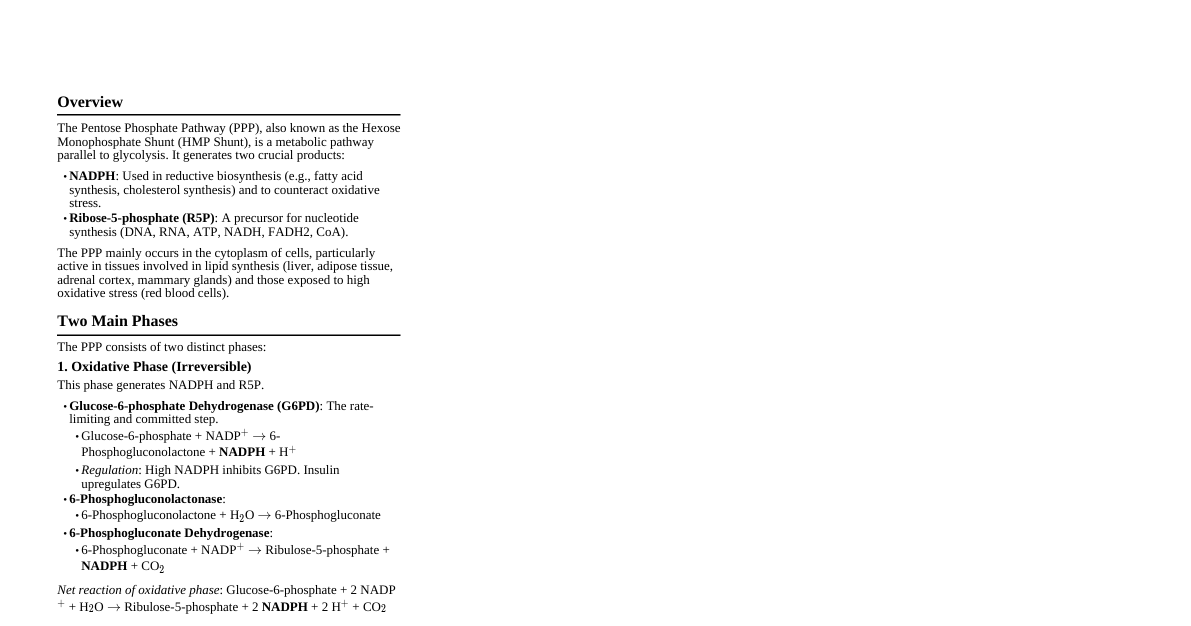
### Overview The Pentose Phosphate Pathway (PPP), also known as the Hexose Monophosphate Shunt (HMP Shunt), is a metabolic pathway parallel to glycolysis. It generates NADPH and the precursor for nucleotide biosynthesis, ribose-5-phosphate. The pathway has two main phases: oxidative and non-oxidative. ### Oxidative Phase (Irreversible) This phase produces NADPH and ribulose-5-phosphate. NADPH is crucial for reductive biosynthesis (e.g., fatty acid synthesis, steroid synthesis) and for neutralizing reactive oxygen species (ROS) via glutathione reductase. 1. **Glucose-6-phosphate dehydrogenase (G6PD):** * **Reaction:** Glucose-6-phosphate + NADP$^+$ $\rightarrow$ 6-phosphoglucono-$\delta$-lactone + NADPH + H$^+$ * **Enzyme:** Glucose-6-phosphate dehydrogenase (G6PD) * **Regulation:** Inhibited by high NADPH. This is the rate-limiting step. 2. **Lactonase:** * **Reaction:** 6-phosphoglucono-$\delta$-lactone + H$_2$O $\rightarrow$ 6-phosphogluconate 3. **6-Phosphogluconate dehydrogenase:** * **Reaction:** 6-phosphogluconate + NADP$^+$ $\rightarrow$ Ribulose-5-phosphate + NADPH + CO$_2$ + H$^+$ * **Enzyme:** 6-Phosphogluconate dehydrogenase **Net result of oxidative phase:** Glucose-6-phosphate + 2 NADP$^+$ + H$_2$O $\rightarrow$ Ribulose-5-phosphate + 2 NADPH + 2 H$^+$ + CO$_2$ ### Non-Oxidative Phase (Reversible) This phase interconverts various sugar phosphates, allowing the synthesis of ribose-5-phosphate for nucleotide synthesis or the regeneration of glycolysis intermediates (fructose-6-phosphate and glyceraldehyde-3-phosphate) if NADPH is the primary need. **Key Enzymes:** * **Phosphopentose isomerase:** Converts ribulose-5-phosphate to ribose-5-phosphate (for nucleotide synthesis) and xylulose-5-phosphate. * **Transketolase:** Transfers 2-carbon units. Requires Thiamine Pyrophosphate (TPP) as a coenzyme. * Ribulose-5-P + Xylulose-5-P $\leftrightarrow$ Glyceraldehyde-3-P + Sedoheptulose-7-P * Erythrose-4-P + Xylulose-5-P $\leftrightarrow$ Fructose-6-P + Glyceraldehyde-3-P * **Transaldolase:** Transfers 3-carbon units. * Sedoheptulose-7-P + Glyceraldehyde-3-P $\leftrightarrow$ Erythrose-4-P + Fructose-6-P **Summary of Interconversions:** $$ \begin{array}{c} \text{3 Ribulose-5-P} \\ \downarrow \text{Isomerase/Epimerase} \\ \text{2 Xylulose-5-P + Ribose-5-P} \\ \downarrow \text{Transketolase} \\ \text{Glyceraldehyde-3-P + Sedoheptulose-7-P} \\ \downarrow \text{Transaldolase} \\ \text{Erythrose-4-P + Fructose-6-P} \\ \downarrow \text{Transketolase} \\ \text{Fructose-6-P + Glyceraldehyde-3-P} \end{array} $$ The Fructose-6-P and Glyceraldehyde-3-P can re-enter glycolysis. ### Physiological Roles * **NADPH Production:** * **Reductive biosynthesis:** Fatty acid, cholesterol, steroid synthesis. * **Detoxification:** Reduction of glutathione (GSSG $\rightarrow$ 2GSH) by glutathione reductase, protecting cells from oxidative damage (especially red blood cells). * **Phagocytosis:** NADPH oxidase in phagocytes produces superoxide radicals for bacterial killing (respiratory burst). * **Ribose-5-phosphate Production:** * Precursor for nucleotide (DNA, RNA) and coenzyme (ATP, NAD$^+$, FAD, CoA) biosynthesis. ### Clinical Relevance: G6PD Deficiency * Most common human enzyme defect. * X-linked recessive disorder. * Leads to reduced NADPH production in red blood cells (RBCs). * RBCs become vulnerable to oxidative stress (e.g., from certain drugs like primaquine, sulfonamides; fava beans; infections). * Oxidative stress causes hemoglobin denaturation (Heinz bodies) and RBC lysis, leading to hemolytic anemia. * Provides some resistance to malaria (Plasmodium falciparum).