Pentose Phosphate Pathway
Cheatsheet Content
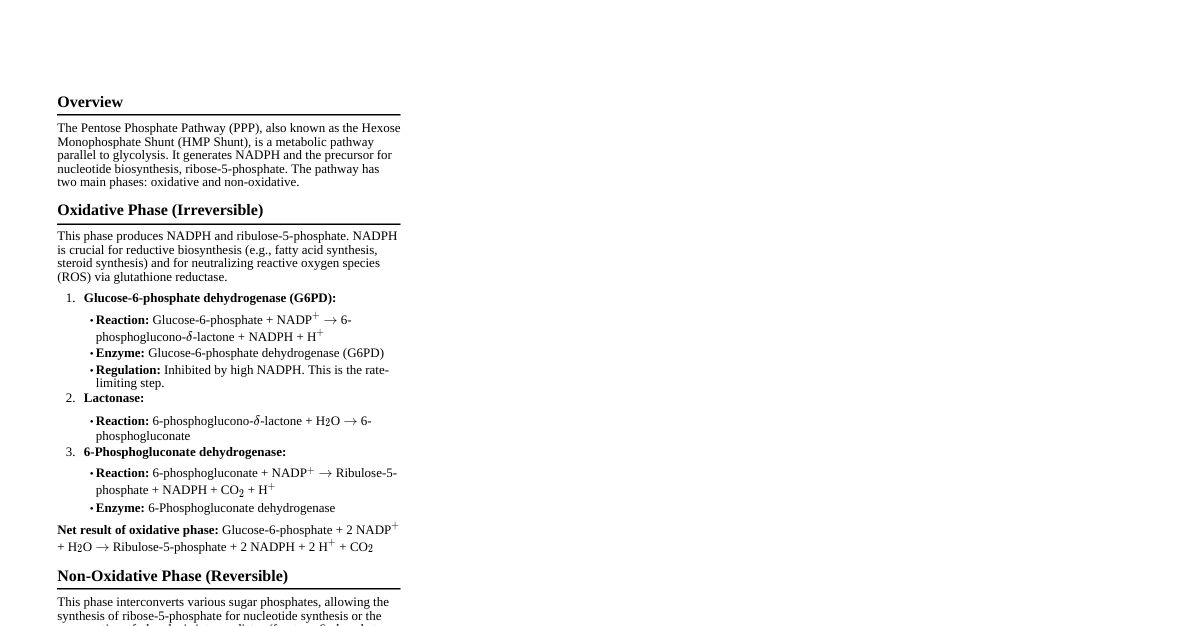
### Overview The Pentose Phosphate Pathway (PPP), also known as the Hexose Monophosphate Shunt (HMP Shunt), is a metabolic pathway parallel to glycolysis. It generates two crucial products: - **NADPH**: Used in reductive biosynthesis (e.g., fatty acid synthesis, cholesterol synthesis) and to counteract oxidative stress. - **Ribose-5-phosphate (R5P)**: A precursor for nucleotide synthesis (DNA, RNA, ATP, NADH, FADH2, CoA). The PPP mainly occurs in the cytoplasm of cells, particularly active in tissues involved in lipid synthesis (liver, adipose tissue, adrenal cortex, mammary glands) and those exposed to high oxidative stress (red blood cells). ### Two Main Phases The PPP consists of two distinct phases: #### 1. Oxidative Phase (Irreversible) This phase generates NADPH and R5P. - **Glucose-6-phosphate Dehydrogenase (G6PD)**: The rate-limiting and committed step. - Glucose-6-phosphate + NADP$^+$ $\rightarrow$ 6-Phosphogluconolactone + **NADPH** + H$^+$ - *Regulation*: High NADPH inhibits G6PD. Insulin upregulates G6PD. - **6-Phosphogluconolactonase**: - 6-Phosphogluconolactone + H$_2$O $\rightarrow$ 6-Phosphogluconate - **6-Phosphogluconate Dehydrogenase**: - 6-Phosphogluconate + NADP$^+$ $\rightarrow$ Ribulose-5-phosphate + **NADPH** + CO$_2$ *Net reaction of oxidative phase*: Glucose-6-phosphate + 2 NADP$^+$ + H$_2$O $\rightarrow$ Ribulose-5-phosphate + 2 **NADPH** + 2 H$^+$ + CO$_2$ ### 2. Non-Oxidative Phase (Reversible) This phase converts Ribulose-5-phosphate into various intermediates that can re-enter glycolysis or gluconeogenesis, depending on the cell's needs for R5P versus NADPH. - **Isomerization and Epimerization**: - Ribulose-5-phosphate (ketose) $\xleftrightarrow{\text{Phosphopentose Isomerase}}$ Ribose-5-phosphate (aldose) - Ribulose-5-phosphate (ketose) $\xleftrightarrow{\text{Phosphopentose Epimerase}}$ Xylulose-5-phosphate (ketose) - **Transketolase and Transaldolase Reactions**: These enzymes facilitate the interconversion of 3-, 4-, 5-, 6-, and 7-carbon sugars. - **Transketolase** (requires Thiamine Pyrophosphate - TPP): Transfers two-carbon units. - Xylulose-5-P (5C) + Ribose-5-P (5C) $\leftrightarrow$ Glyceraldehyde-3-P (3C) + Sedoheptulose-7-P (7C) - Xylulose-5-P (5C) + Erythrose-4-P (4C) $\leftrightarrow$ Glyceraldehyde-3-P (3C) + Fructose-6-P (6C) - **Transaldolase**: Transfers three-carbon units. - Sedoheptulose-7-P (7C) + Glyceraldehyde-3-P (3C) $\leftrightarrow$ Erythrose-4-P (4C) + Fructose-6-P (6C) *Overall, these reactions can convert three 5-carbon sugars (2 Xylulose-5-P + 1 Ribose-5-P) into two 6-carbon sugars (Fructose-6-P) and one 3-carbon sugar (Glyceraldehyde-3-P), which are intermediates of glycolysis.* ### Regulation of PPP The primary control point is the **Glucose-6-phosphate Dehydrogenase (G6PD)** enzyme in the oxidative phase. - **NADPH/NADP$^+$ ratio**: High NADPH levels allosterically inhibit G6PD, decreasing flux through the pathway. Low NADPH (high NADP$^+$) activates G6PD. - **Insulin**: Upregulates G6PD synthesis, increasing PPP activity, especially in adipose tissue and liver, to provide NADPH for fatty acid synthesis. - **Cellular needs**: - If **NADPH is primarily needed**: Both oxidative and non-oxidative phases are active. Glycolytic intermediates are shunted into the PPP, and the 3C/6C products of the non-oxidative phase are recycled back to Glucose-6-phosphate or continue into glycolysis. - If **R5P is primarily needed** (e.g., for DNA synthesis): The oxidative phase is bypassed. Fructose-6-phosphate and Glyceraldehyde-3-phosphate (from glycolysis) are converted to R5P via the reversible non-oxidative reactions. ### Clinical Significance #### G6PD Deficiency - **Most common human enzyme deficiency**. - Impaired ability to produce NADPH in red blood cells (RBCs). - NADPH is crucial for reducing glutathione (GSH) via glutathione reductase. GSH helps neutralize reactive oxygen species (ROS) by glutathione peroxidase. - Without sufficient NADPH, RBCs are susceptible to oxidative damage, leading to **hemolytic anemia** when exposed to oxidative stress (e.g., certain drugs like primaquine, fava beans, infections). - Provides some protection against malaria (Plasmodium falciparum).