Women, Caste, and Reform
Cheatsheet Content
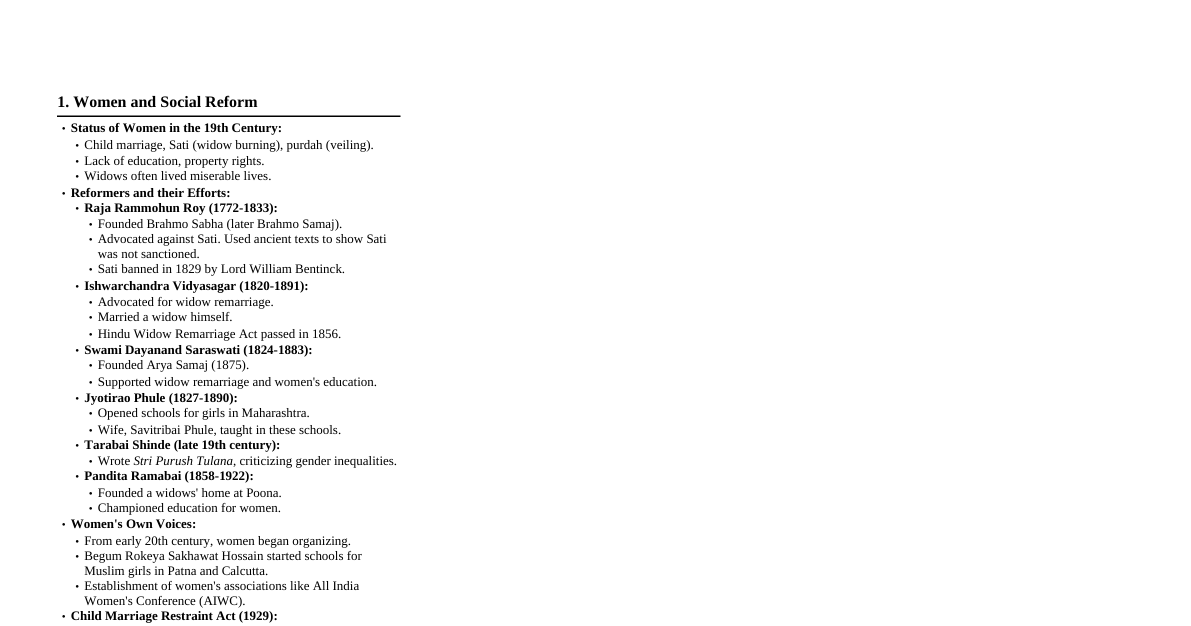
### Women and Social Reform - **Early 19th Century Condition:** - **Sati:** Practice of widows burning themselves on their husband's funeral pyre. - **Child Marriage:** Girls married at a very young age. - **Purdah:** Veiling and seclusion of women, especially in upper-caste Hindu and Muslim families. - **No Education:** Limited or no access to education for girls. - **Property Rights:** Few to no property rights for women. - **Reformers' Efforts:** - **Raja Rammohun Roy (1772-1833):** Campaign against Sati. Formed Brahmo Sabha (later Brahmo Samaj). Used ancient religious texts to argue against Sati, proving it was not sanctioned by ancient traditions. - **Ishwarchandra Vidyasagar (1820-1891):** Advocated for widow remarriage. Used ancient texts to argue that the Vedas permitted widow remarriage. His efforts led to the **Widow Remarriage Act of 1856**. - **Mahadev Govind Ranade (1842-1901):** Founder of the Prarthana Samaj, also worked for social reform and women's rights. - **Jyotirao Phule (1827-1890):** Started schools for girls in Maharashtra. - **Begum Rokeya Sakhawat Hossain (1880-1932):** Established schools for Muslim girls in Patna and Calcutta. A staunch critic of conservative ideas, arguing that religious leaders of every faith accorded an inferior position to women. - **Women's Voices and Education:** - **Tarabai Shinde (late 19th century):** Wrote "Stripurushtulna" (A Comparison Between Women and Men), criticizing the social differences between men and women. - **Pandita Ramabai (1858-1922):** Founded a widows' home at Poona to provide shelter and training for widows, so they could support themselves. - **Rashundari Devi (early 19th century):** Bengali woman who secretly learned to read and write. Wrote her autobiography "Amar Jiban" (My Life), the first full-length autobiography published by an Indian woman. - **Sultana's Dream (1905):** A feminist utopian short story written by Begum Rokeya Sakhawat Hossain, depicting a world where women are in charge and men are secluded. - **Impact of Education:** - Allowed women to question traditional norms. - Led to the formation of women's associations (e.g., All India Women's Conference). - Helped women to write and publish their own views on society. ### Caste and Social Reform - **Caste System:** - **Brahmins, Kshatriyas:** Upper castes, often dominant in society. - **Vaishyas:** Traders, merchants. - **Shudras:** Peasants, artisans, laborers. - **Untouchables (Dalits):** Deemed "impure," faced severe discrimination, denied access to temples, public wells, and education. - **Reform Movements:** - **Jyotirao Phule (1827-1890):** - Born into a Mali (gardener) family, considered "low caste." - Attacked the Brahmin claim of superiority. - Wrote "Gulamgiri" (Slavery) in 1873, dedicating it to the American movement to free slaves. - Argued that the "upper" castes had no right to their land and power, which was originally held by indigenous people. - Founded the **Satnami Samaj** to promote equality. - **Dr. B.R. Ambedkar (1891-1956):** - Born into a Mahar (untouchable) family. - Experienced caste discrimination firsthand. - Studied abroad, became a lawyer and leader of the Dalit community. - Organized temple entry movements (e.g., Mahad Satyagraha). - Demanded separate electorates for Dalits. - Played a crucial role in drafting the Indian Constitution, advocating for the abolition of untouchability and reservation policies. - **Periyar E.V. Ramaswamy Naicker (1879-1973):** - Leader of the Self-Respect Movement in Tamil Nadu. - Argued that all religions were devised by upper castes to establish their authority over lower castes. - Criticized Hindu scriptures, calling them instruments of Brahmin dominance. - Advocated for a society where all castes had equal rights and dignity. - **Other Reformers:** - **Haridas Thakur:** Founded the Matua sect in Eastern Bengal, working among Chandala cultivators. - **Guru Ghasidas:** Established the Satnami movement in Central India, advocating for equality among leatherworkers. - **Swami Dayanand Saraswati (1824-1883):** Founded the Arya Samaj, a reformist movement that aimed to revive Vedic learning and advocated against caste distinctions, child marriage, and promoted women's education. - **Government Action:** - **Indian Constitution (1950):** Abolished untouchability. - **Reservation Policy:** Introduced to ensure representation for Scheduled Castes (Dalits), Scheduled Tribes, and Other Backward Classes in education and government jobs. ### Challenges and Progress - **Continued Discrimination:** Despite legal provisions, caste and gender discrimination persist in many forms, especially in rural areas. - **Urban vs. Rural Divide:** Social reforms often had a greater impact in urban centers, with rural areas remaining more conservative. - **Internal Divisions:** Different reform movements sometimes clashed over methods and objectives. - **Legislative Milestones:** - **Widow Remarriage Act (1856):** Legalized widow remarriage. - **Age of Consent Act (1891):** Raised the age of consent for marriage for girls. - **Child Marriage Restraint Act (1929) / Sarda Act:** Fixed minimum age for marriage (14 for girls, 18 for boys). - **Hindu Code Bill (1950s):** Reformed Hindu personal law, giving women rights to divorce and property. - **Emergence of Women's Organizations:** - **All India Muslim Ladies' Conference (1914):** Focused on education and social upliftment for Muslim women. - **All India Women's Conference (AIWC, 1927):** Advocated for women's rights in education, marriage, and political representation. - **Impact of National Movement:** - The struggle for independence integrated social reform issues, as leaders like Gandhi advocated for the upliftment of women and Dalits. - Women's participation in nationalist protests raised their public profile and strengthened arguments for their rights.