Cinematography: Shots & Angles
Cheatsheet Content
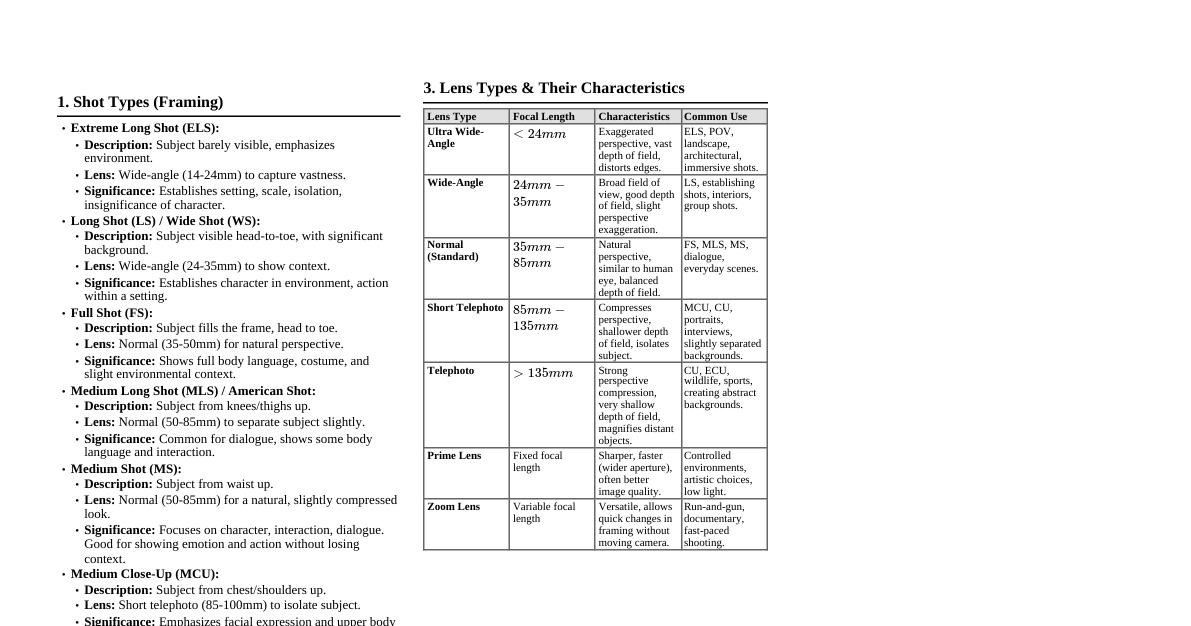
Shot Types (Distance) Extreme Long Shot (ELS): Shows the subject from a very far distance. Significance: Establishes setting, scale, isolation. Subject often dwarfed by environment. Long Shot (LS) / Wide Shot (WS): Shows the entire human figure, often with a good portion of the background. Significance: Establishes character within their environment, shows full body action. Medium Long Shot (MLS) / American Shot: Frames subjects from the knees up. Significance: Common in Westerns to show character and their holstered gun; good for small groups. Medium Shot (MS): Frames subjects from the waist up. Significance: Focuses on interactions between characters, showing body language and some facial expressions. Medium Close-Up (MCU): Frames subjects from the chest or shoulders up. Significance: Emphasizes facial expressions and emotions more than body language. Close-Up (CU): Frames a subject's face, or a specific object, filling the screen. Significance: Reveals strong emotion, draws attention to detail, creates intimacy or tension. Extreme Close-Up (ECU): Frames a very small part of the subject, like an eye, mouth, or a tiny object. Significance: Intensifies emotion, highlights crucial details, creates symbolic meaning. Camera Angles Eye-Level Angle: Camera is at the subject's eye level. Significance: Neutral, objective, common, allows audience to connect with character on an equal footing. High Angle: Camera looks down on the subject. Significance: Makes subject appear small, weak, vulnerable, trapped, or insignificant. Can also provide an overview. Low Angle: Camera looks up at the subject. Significance: Makes subject appear powerful, dominant, heroic, threatening, or larger than life. Dutch Angle (Canted Angle): Camera is tilted to one side, so the horizon line is not level. Significance: Creates a sense of unease, disorientation, psychological imbalance, or tension. Over-the-Shoulder Shot (OTS): Shot from behind one character's shoulder, looking at another character. Significance: Places audience in the perspective of the character, common in conversations. Point-of-View (POV) Shot: Shows what a character sees. Significance: Immerses the audience directly into the character's experience, builds empathy or suspense. Bird's-Eye View (Overhead Shot): Shot directly from above, looking straight down on the scene. Significance: Provides a God-like perspective, shows patterns, scale, or fate. Camera Movement Pan: Camera rotates horizontally from a fixed axis. Significance: Reveals landscape, follows horizontal movement, connects spaces. Tilt: Camera rotates vertically from a fixed axis. Significance: Reveals height, follows vertical movement, emphasizes scale. Tracking / Dolly Shot: Camera moves physically through space, often on tracks or a dolly. Significance: Follows characters, reveals new information, creates dynamic movement. Zoom: Lens adjusts focal length to magnify or de-magnify the subject without physically moving the camera. Significance: Draws attention to details, creates rapid emphasis, can feel artificial or voyeuristic. Crane / Jib Shot: Camera is mounted on a crane or jib arm, allowing for sweeping vertical and horizontal movements. Significance: Grand establishing shots, dramatic reveals, complex character entries/exits. Handheld: Camera is held by the operator, leading to a less stable, more naturalistic look. Significance: Creates a sense of urgency, realism, immediacy, or chaos; often used for POV. Steadicam: Camera rig that stabilizes handheld shots, allowing for smooth, fluid movement through complex spaces. Significance: Creates immersive, flowing shots, often used for following characters seamlessly. Compositional Elements Rule of Thirds: Dividing the frame into nine equal sections with two horizontal and two vertical lines. Placing subjects at intersections or along lines creates more engaging compositions. Significance: Provides visual balance and interest, guides the viewer's eye. Leading Lines: Lines within the frame (roads, fences, walls) that draw the viewer's eye towards a point of interest. Significance: Creates depth, guides attention, adds visual dynamism. Framing: Using elements within the scene (doorways, windows, trees) to create a "frame" around the subject. Significance: Draws focus to the subject, adds depth, can convey entrapment or observation. Depth of Field: The distance between the nearest and farthest objects in a scene that appear acceptably sharp. Significance: Shallow DoF: Isolates subject, blurs background, creates focus on specific elements. Deep DoF: Keeps foreground and background sharp, shows context, allows for multiple points of interest. Symmetry & Asymmetry: Symmetry: Balanced composition, often conveying order, stability, or artificiality. Asymmetry: Unbalanced composition, can create tension, dynamism, or naturalism.