Cinematography Shot Types & Angles
Cheatsheet Content
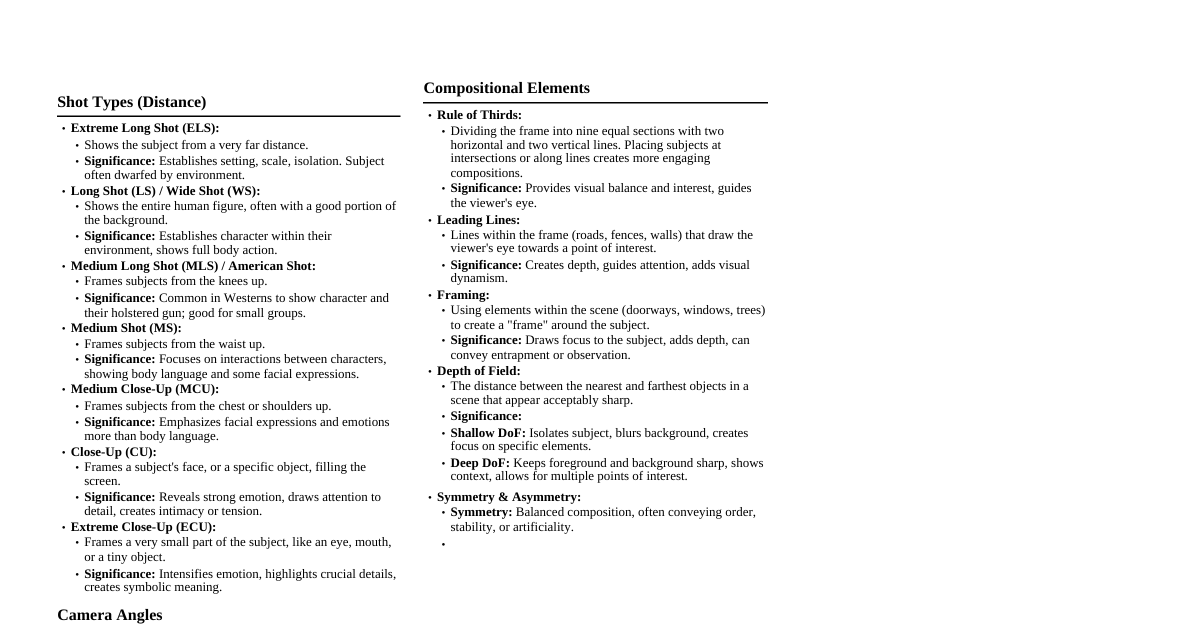
1. Shot Types (Framing) Extreme Long Shot (ELS): Description: Subject barely visible, emphasizes environment. Lens: Wide-angle (14-24mm) to capture vastness. Significance: Establishes setting, scale, isolation, insignificance of character. Long Shot (LS) / Wide Shot (WS): Description: Subject visible head-to-toe, with significant background. Lens: Wide-angle (24-35mm) to show context. Significance: Establishes character in environment, action within a setting. Full Shot (FS): Description: Subject fills the frame, head to toe. Lens: Normal (35-50mm) for natural perspective. Significance: Shows full body language, costume, and slight environmental context. Medium Long Shot (MLS) / American Shot: Description: Subject from knees/thighs up. Lens: Normal (50-85mm) to separate subject slightly. Significance: Common for dialogue, shows some body language and interaction. Medium Shot (MS): Description: Subject from waist up. Lens: Normal (50-85mm) for a natural, slightly compressed look. Significance: Focuses on character, interaction, dialogue. Good for showing emotion and action without losing context. Medium Close-Up (MCU): Description: Subject from chest/shoulders up. Lens: Short telephoto (85-100mm) to isolate subject. Significance: Emphasizes facial expression and upper body gestures; more intimate than MS. Close-Up (CU): Description: Subject's face or specific detail fills the frame. Lens: Short telephoto (85-135mm) to compress space and isolate. Significance: Reveals emotions, reactions, significant details, creates intimacy. Extreme Close-Up (ECU): Description: Very small detail of the subject (e.g., eye, mouth, object). Lens: Telephoto (100mm+) or Macro lens for extreme detail. Significance: Intensifies emotion, highlights crucial details, creates symbolic meaning. Over-the-Shoulder Shot (OTS): Description: Camera looks over one character's shoulder at another. Lens: Normal to short telephoto (50-100mm). Significance: Shows relationship, perspective, dialogue dynamics. Point of View (POV) Shot: Description: Camera acts as the character's eyes. Lens: Varies based on character's perspective; often wide-angle (24-35mm) for immersive feel. Significance: Puts audience in character's shoes, builds empathy or tension. 2. Camera Angles Eye-Level Angle: Description: Camera is at the subject's eye level. Lens: Any, depending on desired framing. Significance: Neutral, natural, and most common. Relates to audience on an equal footing. High Angle: Description: Camera looks down on the subject. Lens: Any, but often normal to telephoto for more isolation. Significance: Makes subject appear smaller, weaker, vulnerable, trapped, or insignificant. Low Angle: Description: Camera looks up at the subject. Lens: Any, but often wide-angle to emphasize height and power. Significance: Makes subject appear larger, more powerful, heroic, dominant, or threatening. Dutch Angle / Canted Angle: Description: Camera is tilted, so the horizon is not level. Lens: Any. Significance: Creates a sense of unease, disorientation, psychological imbalance, or tension. Bird's-Eye View / Top Shot: Description: Directly overhead shot, looking straight down. Lens: Wide-angle (14-24mm) to capture broad area. Significance: Shows overall layout, pattern, fate, or insignificance of characters. Can be God-like perspective. Worm's-Eye View: Description: Shot from ground level, looking directly up. Lens: Wide-angle (14-24mm) to exaggerate height and scale. Significance: Exaggerates size, power, or dominance of subject. Can make audience feel small or vulnerable. 3. Lens Types & Their Characteristics Lens Type Focal Length Characteristics Common Use Ultra Wide-Angle $ Exaggerated perspective, vast depth of field, distorts edges. ELS, POV, landscape, architectural, immersive shots. Wide-Angle $24mm - 35mm$ Broad field of view, good depth of field, slight perspective exaggeration. LS, establishing shots, interiors, group shots. Normal (Standard) $35mm - 85mm$ Natural perspective, similar to human eye, balanced depth of field. FS, MLS, MS, dialogue, everyday scenes. Short Telephoto $85mm - 135mm$ Compresses perspective, shallower depth of field, isolates subject. MCU, CU, portraits, interviews, slightly separated backgrounds. Telephoto $> 135mm$ Strong perspective compression, very shallow depth of field, magnifies distant objects. CU, ECU, wildlife, sports, creating abstract backgrounds. Prime Lens Fixed focal length Sharper, faster (wider aperture), often better image quality. Controlled environments, artistic choices, low light. Zoom Lens Variable focal length Versatile, allows quick changes in framing without moving camera. Run-and-gun, documentary, fast-paced shooting.