Class 10 Arithmetic Progressions
Cheatsheet Content
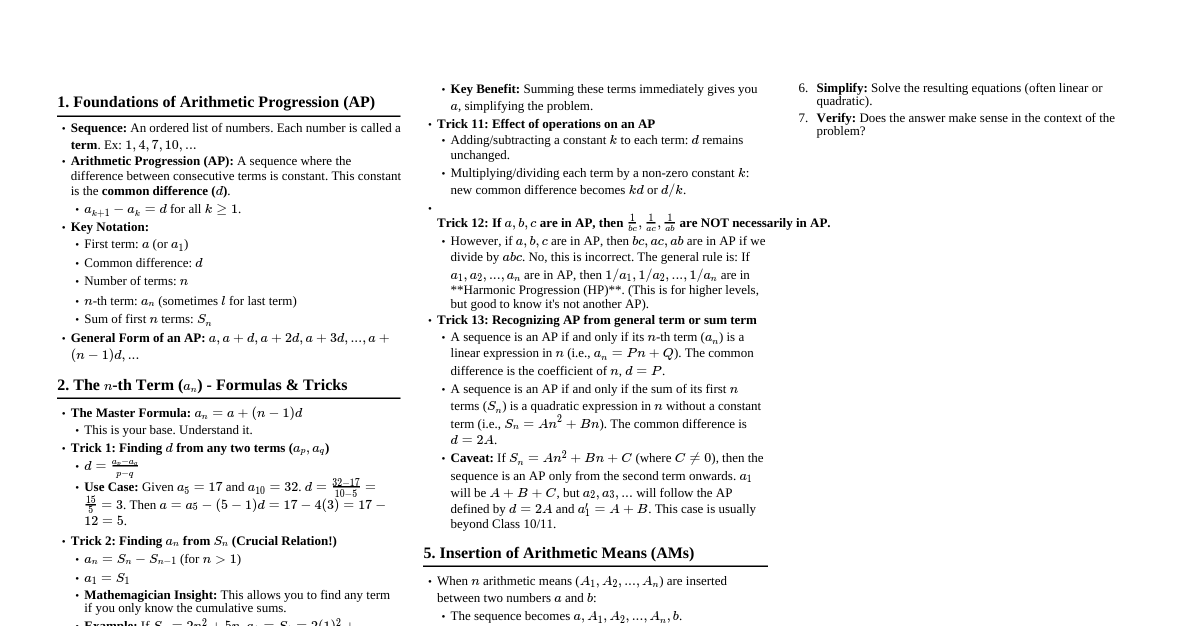
Arithmetic Progressions (AP) - Fundamentals Definition: A sequence of numbers where the difference between consecutive terms is constant. General Form: $a, a+d, a+2d, a+3d, \dots$ First Term: $a$ (or $a_1$) Common Difference: $d = a_n - a_{n-1}$ (constant) $n^{th}$ Term (General Term): $a_n = a + (n-1)d$ Term from End: $a_n' = l - (n-1)d$, where $l$ is the last term. Property: If $a, b, c$ are in AP, then $2b = a+c$. Sum of First $n$ Terms ($S_n$) Formula 1: $S_n = \frac{n}{2}[2a + (n-1)d]$ Formula 2 (when last term $l$ is known): $S_n = \frac{n}{2}[a + l]$ Relation between $S_n$ and $a_n$: $a_n = S_n - S_{n-1}$ (for $n > 1$) Sum of first $n$ positive integers: $S_n = \frac{n(n+1)}{2}$ A. Previous Years Questions (PYQ) - Core Concepts PYQ 2023 (Concepts: $a_n$, $S_n$, finding $d$, problem solving) Find the $15^{th}$ term of the AP whose first term is $7$ and common difference is $3$. ($a_n$) The $10^{th}$ term of an AP is $41$ and $2^{nd}$ term is $5$. Find the common difference. (System of equations for $a, d$) How many terms of the AP $9, 17, 25, \dots$ must be taken to get sum $636$? (Quadratic equation for $n$ from $S_n$) If $5$ times the $5^{th}$ term of an AP is equal to $8$ times its $8^{th}$ term, show that its $13^{th}$ term is zero. (Algebraic manipulation of $a_n$) PYQ 2024 (Concepts: $S_n$, finding term from $S_n$, word problems) Find the sum of the first $20$ terms of the AP: $5, 9, 13, 17, \dots$. ($S_n$ formula) Which term of the AP $3, 8, 13, 18, \dots$ is $88$? ($a_n$ formula to find $n$) The $7^{th}$ term of an AP is $24$ and its $12^{th}$ term is $44$. Find the AP (i.e., $a$ and $d$). (System of equations) The sum of first $n$ terms of an AP is $S_n = 5n^2 + 3n$. Find its $20^{th}$ term. ($a_n = S_n - S_{n-1}$) PYQ 2025 (Expected / Trending Pattern - Mixed difficulty, application) If $a = 12$ and $S_{15} = 705$, find the common difference $d$. ($S_n$ formula for $d$) In an AP, the $4^{th}$ term is $16$ and $20^{th}$ term is $80$. Find the number of terms between them if the AP continues. ($a_n$ and basic counting) A ladder has rungs $25$ cm apart. The bottom rung is $45$ cm long and the top rung is $25$ cm long. If there are $11$ rungs, find the length of the wood required for the rungs. (AP in real-world context, sum of lengths) A sum of ₹$700$ is to be used to give seven cash prizes to students for their overall academic performance. If each prize is ₹$20$ less than its preceding prize, find the value of each of the prizes. (Word problem, AP series in decreasing order) B. Sample Paper Questions - Practice & Variation Sample Paper 2023 Find $n$ if $a = 4, d = 3, a_n = 55$. ($a_n$ formula) The $6^{th}$ term of an AP is $18$ and $16^{th}$ term is $48$. Find the common difference $d$. (Subtracting $a_6$ from $a_{16}$) If $S_n = n(4n + 5)/2$, find the AP (i.e., $a, d$). ($a_1=S_1$, $a_2=S_2-S_1$) Show that $a_m = \frac{a_k(m-n) + a_n(k-m)}{k-n}$ for an AP. (Advanced $a_n$ relation) Sample Paper 2024 If the $1^{st}$ term of an AP is $6$ and $13^{th}$ term is $42$, find $d$. ($a_n$ formula) Find the sum of first $25$ terms of AP: $12, 10, 8, \dots$. ($S_n$ with negative $d$) Which term is $0$ in the AP: $17, 14, 11, \dots$? ($a_n=0$, solve for $n$) The $n^{th}$ term of an AP cannot be $2n^2+1$. Justify. (Linear relationship for $a_n$) Sample Paper 2025 (Expected) A fruit vendor increases price daily in AP. If on day-$1$ price is ₹$30$ and on day-$10$ it is ₹$48$, find the daily increase. (Word problem, find $d$) Find $t_{10}$ if $S_{10} = 290$ and $a = 9$. ($S_n$ formula to find $l$, then $a_n$) If in an AP, $t_5 + t_{15} = 50$ and $d = 2$, find $a$. (System of equations) The sum of three numbers in AP is $27$ and their product is $648$. Find the numbers. (Use $(a-d), a, (a+d)$) C. NCERT Important Questions (Textbook & Exemplar) Key Derivations & Standard Problems Derive the formula for the $n^{th}$ term of an AP. Derive the formula for the sum of the first $n$ terms of an AP. How many terms of the AP: $2, 5, 8, \dots$ are needed to make the sum $120$? The $4^{th}$ term of an AP is zero; find its $20^{th}$ term if $d = 3$. ($a_4=0 \Rightarrow a+3d=0$) Determine the AP whose $3^{rd}$ term is $5$ and the $7^{th}$ term is $9$. Which term of AP $5, 12, 19, \dots$ is $82$? Find the sum of all two-digit numbers divisible by $3$. (Identify $a, d, l$, then $n$, then $S_n$) A contract on construction job specifies a penalty for delay of completion beyond a certain date as follows: ₹$200$ for the first day, ₹$250$ for the second day, ₹$300$ for the third day, etc. How much money the contractor has to pay as penalty, if he has delayed the work by $30$ days? ($S_n$ application) If the sum of the first $p$ terms of an AP is the same as the sum of its first $q$ terms, show that the sum of its first $(p+q)$ terms is zero ($p \neq q$). (Advanced $S_n$ property) The ratio of the $11^{th}$ term to the $18^{th}$ term of an AP is $2:3$. Find the ratio of the $5^{th}$ term to the $21^{st}$ term, and also the ratio of the sum of the first $5$ terms to the sum of the first $21$ terms. (Ratio problems) D. Competency / Case-Based Questions - Application Skills Case Study 1: Auditorium Seating In an auditorium, the number of seats in the first row is $20$. The number of seats in the second row is $22$, in the third row is $24$ and so on. There are $30$ rows in the auditorium. What is the number of seats in the $10^{th}$ row? What is the total number of seats in the auditorium? If a new section is added with $5$ more rows, how many additional seats would be there? Case Study 2: Tree Plantation Drive A group of students decided to plant trees in rows such that the number of trees in each row forms an AP. In the $1^{st}$ row, there is $1$ tree; in the $2^{nd}$ row, there are $3$ trees; in the $3^{rd}$ row, there are $5$ trees, and so on. How many trees are there in the $7^{th}$ row? What is the total number of trees in the first $12$ rows? If there are a total of $100$ trees, how many rows were planted? Case Study 3: Salary Increment A person's starting monthly salary is ₹$10,000$, and he gets an annual increment of ₹$500$. What will be his monthly salary after $5$ years? What will be his total earnings in the first $3$ years? In which year will his monthly salary reach ₹$15,000$? E. High-Order Thinking Skills (HOTS) / Challenging Problems $\checkmark$ Always asked $\checkmark$ High scoring $\checkmark$ Must practice If $S_n$ denotes the sum of the first $n$ terms of an AP, prove that $S_{3n} = 3(S_{2n} - S_n)$. If the $p^{th}$ term of an AP is $q$ and the $q^{th}$ term is $p$, prove that its $n^{th}$ term is $p+q-n$. If the sum of $n$ terms of an AP is $3n^2 + 5n$, find the AP and also its $16^{th}$ term. The ratio of the sums of $m$ and $n$ terms of an AP is $m^2 : n^2$. Show that the ratio of the $m^{th}$ and $n^{th}$ terms is $(2m-1) : (2n-1)$. Find the sum of all integers between $100$ and $200$ which are not divisible by $3$. (Sum of total - Sum of multiples of 3) If $\frac{a^{n+1} + b^{n+1}}{a^n + b^n}$ is the arithmetic mean between $a$ and $b$, then find the value of $n$. (Property of AM) A Spiral is made up of successive semicircles, with centres alternately at A and B, starting with centre at A, of radii $0.5$ cm, $1.0$ cm, $1.5$ cm, $2.0$ cm, ... What is the total length of such a spiral made up of thirteen consecutive semicircles? (Use circumference of semicircle $\pi r$)