Arithmetic Progressions (AP) Cheatsheet
Cheatsheet Content
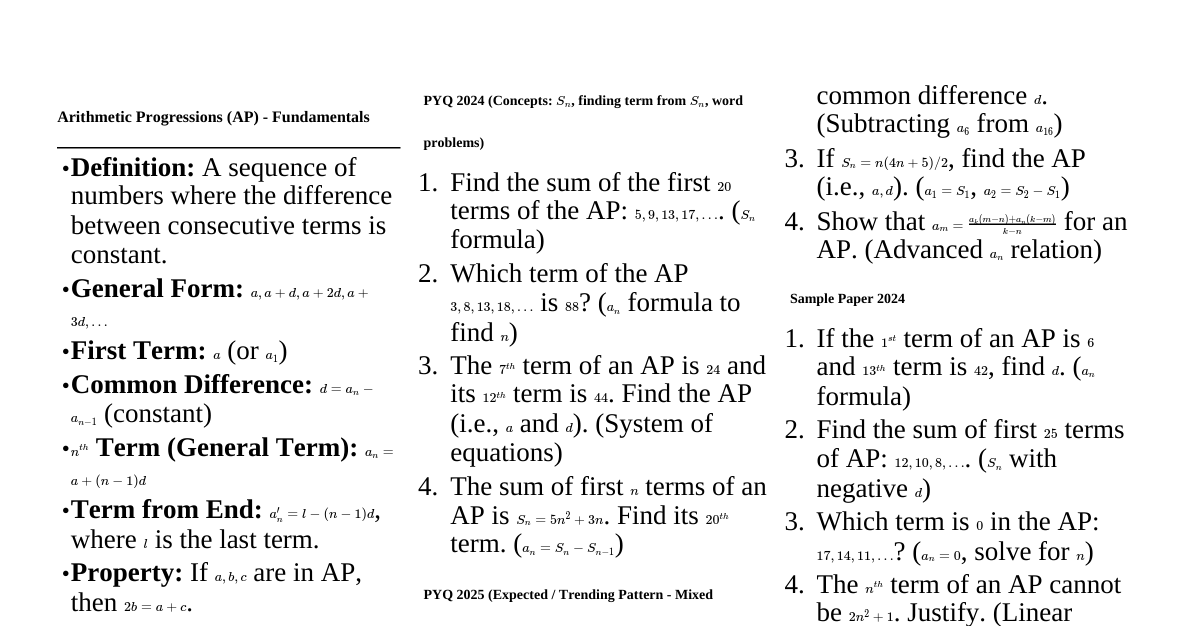
1. Foundations of Arithmetic Progression (AP) Sequence: An ordered list of numbers. Each number is called a term . Ex: $1, 4, 7, 10, ...$ Arithmetic Progression (AP): A sequence where the difference between consecutive terms is constant. This constant is the common difference ($d$) . $a_{k+1} - a_k = d$ for all $k \ge 1$. Key Notation: First term: $a$ (or $a_1$) Common difference: $d$ Number of terms: $n$ $n$-th term: $a_n$ (sometimes $l$ for last term) Sum of first $n$ terms: $S_n$ General Form of an AP: $a, a+d, a+2d, a+3d, ..., a+(n-1)d, ...$ 2. The $n$-th Term ($a_n$) - Formulas & Tricks The Master Formula: $a_n = a + (n-1)d$ This is your base. Understand it. Trick 1: Finding $d$ from any two terms ($a_p, a_q$) $d = \frac{a_p - a_q}{p - q}$ Use Case: Given $a_5 = 17$ and $a_{10} = 32$. $d = \frac{32 - 17}{10 - 5} = \frac{15}{5} = 3$. Then $a = a_5 - (5-1)d = 17 - 4(3) = 17 - 12 = 5$. Trick 2: Finding $a_n$ from $S_n$ (Crucial Relation!) $a_n = S_n - S_{n-1}$ (for $n > 1$) $a_1 = S_1$ Mathemagician Insight: This allows you to find any term if you only know the cumulative sums. Example: If $S_n = 2n^2 + 5n$. $a_1 = S_1 = 2(1)^2 + 5(1) = 7$. $S_2 = 2(2)^2 + 5(2) = 8 + 10 = 18$. $a_2 = S_2 - S_1 = 18 - 7 = 11$. $d = a_2 - a_1 = 11 - 7 = 4$. Thus, $a_n = a_1 + (n-1)d = 7 + (n-1)4 = 7 + 4n - 4 = 4n + 3$. Trick 3: $a_n$ directly from $S_n$ if $S_n$ is quadratic in $n$ (Super Fast!) If $S_n = An^2 + Bn$, then $a_n = (2A)n + (B-A)$. Example: $S_n = 2n^2 + 5n$. Here $A=2, B=5$. $a_n = (2 \times 2)n + (5-2) = 4n + 3$. (Matches previous example!) Trick 4: Relation between $a_m, a_n$ and $a_k$ If $a_m = n$ and $a_n = m$, then $a_k = m+n-k$. (This is a specific case of Trick 1, where $d = \frac{n-m}{m-n} = -1$, and $a = m+n-1$). Example: $a_3 = 7, a_7 = 3$. Find $a_{10}$. $a_{10} = 3+7-10 = 0$. Trick 5: General $n$-th term based on $a_k$ $a_n = a_k + (n-k)d$ (This is just a rearrangement of the master formula, but useful if you start from a term other than $a_1$). 3. Sum of $n$ Terms ($S_n$) - Formulas & Tricks The Master Formulas: $$ S_n = \frac{n}{2} [2a + (n-1)d] $$ $$ S_n = \frac{n}{2} (a + l) \quad \text{where } l = a_n $$ Trick 6: Finding $d$ and $a$ from $S_n$ if $S_n$ is quadratic in $n$ (Reverse Trick 3!) If $S_n = An^2 + Bn$, then: Common difference $d = 2A$. First term $a = A+B$. Example: $S_n = 2n^2 + 5n$. $d = 2(2) = 4$. $a = 2+5 = 7$. The AP is $7, 11, 15, 19, ...$ Trick 7: Sum of terms equidistant from start and end $a_1 + a_n = a_2 + a_{n-1} = a_3 + a_{n-2} = ...$ This sum is always equal to $a+l$. Implication: $S_n = \frac{n}{2} (a_1 + a_n)$ is very efficient. Trick 8: Sum of specific terms (e.g., odd/even positions) If $S_n = a_1 + a_2 + ... + a_n$. Sum of terms at odd positions: $a_1 + a_3 + a_5 + ...$ Sum of terms at even positions: $a_2 + a_4 + a_6 + ...$ These also form APs. Ex: $a_1, a_1+2d, a_1+4d, ...$ (new $d$ is $2d$) 4. Properties of APs - The "Aha!" Moments Trick 9: Three terms in AP If $a, b, c$ are in AP, then $2b = a+c$. ($b$ is the Arithmetic Mean of $a$ and $c$). Application: If $x-y, x, x+y$ are in AP, then $2x = (x-y) + (x+y) \implies 2x = 2x$. Always true! This is why choosing terms like $a-d, a, a+d$ is powerful. Trick 10: Choosing terms for word problems (Strategic Setup) 3 terms: $a-d, a, a+d$ (Sum = $3a$) 4 terms: $a-3d, a-d, a+d, a+3d$ (Common diff is $2d$, Sum = $4a$) 5 terms: $a-2d, a-d, a, a+d, a+2d$ (Sum = $5a$) Key Benefit: Summing these terms immediately gives you $a$, simplifying the problem. Trick 11: Effect of operations on an AP Adding/subtracting a constant $k$ to each term: $d$ remains unchanged. Multiplying/dividing each term by a non-zero constant $k$: new common difference becomes $kd$ or $d/k$. Trick 12: If $a, b, c$ are in AP, then $\frac{1}{bc}, \frac{1}{ac}, \frac{1}{ab}$ are NOT necessarily in AP. However, if $a, b, c$ are in AP, then $bc, ac, ab$ are in AP if we divide by $abc$. No, this is incorrect. The general rule is: If $a_1, a_2, ..., a_n$ are in AP, then $1/a_1, 1/a_2, ..., 1/a_n$ are in **Harmonic Progression (HP)**. (This is for higher levels, but good to know it's not another AP). Trick 13: Recognizing AP from general term or sum term A sequence is an AP if and only if its $n$-th term ($a_n$) is a linear expression in $n$ (i.e., $a_n = Pn + Q$). The common difference is the coefficient of $n$, $d=P$. A sequence is an AP if and only if the sum of its first $n$ terms ($S_n$) is a quadratic expression in $n$ without a constant term (i.e., $S_n = An^2 + Bn$). The common difference is $d=2A$. Caveat: If $S_n = An^2 + Bn + C$ (where $C \ne 0$), then the sequence is an AP only from the second term onwards. $a_1$ will be $A+B+C$, but $a_2, a_3, ...$ will follow the AP defined by $d=2A$ and $a_1'=A+B$. This case is usually beyond Class 10/11. 5. Insertion of Arithmetic Means (AMs) When $n$ arithmetic means ($A_1, A_2, ..., A_n$) are inserted between two numbers $a$ and $b$: The sequence becomes $a, A_1, A_2, ..., A_n, b$. This forms an AP with a total of $N = n+2$ terms. The common difference $d = \frac{b-a}{n+1}$. The $k$-th arithmetic mean $A_k = a + kd$. Trick 14: Sum of inserted AMs (Super Handy!) The sum of all $n$ arithmetic means inserted between $a$ and $b$ is $n \times \text{AM}(a,b)$. Sum of AMs $= n \times \frac{a+b}{2}$. Example: Insert 5 AMs between 10 and 22. Sum of AMs $= 5 \times \frac{10+22}{2} = 5 \times \frac{32}{2} = 5 \times 16 = 80$. 6. Advanced Relations & Problem Solving Strategies Trick 15: Ratio of Sums If the ratio of the $n$-th terms of two APs is $(a_n)/(a_n') = \frac{2n+3}{3n-1}$, then the ratio of their sums of $n$ terms $(S_n)/(S_n')$ can be found by replacing $n$ with $(2n-1)$. This is a more advanced trick for competitive exams. $(S_n)/(S_n') = \frac{2(2n-1)+3}{3(2n-1)-1} = \frac{4n-2+3}{6n-3-1} = \frac{4n+1}{6n-4}$. Conversely, if $(S_n)/(S_n') = \frac{2n+3}{3n-1}$, then $(a_n)/(a_n')$ is found by replacing $n$ with $(n-1/2)$ or $(2n-1)$ for $a_n$ and $a_n'$ respectively. This is complex and usually not needed for Class 10/11. Focus on the basics first. Trick 16: If $m \cdot a_m = n \cdot a_n$ (where $m \ne n$) Then $a_{m+n} = 0$. Proof sketch: $m(a+(m-1)d) = n(a+(n-1)d)$ leads to $a = -(m+n-1)d$, which implies $a+(m+n-1)d = 0$. Trick 17: If $S_m = S_n$ (where $m \ne n$) Then $S_{m+n} = 0$. Proof sketch: $\frac{m}{2}[2a+(m-1)d] = \frac{n}{2}[2a+(n-1)d]$ implies $2a+(m+n-1)d=0$. Then $S_{m+n} = \frac{m+n}{2}[2a+(m+n-1)d] = \frac{m+n}{2}[0] = 0$. Trick 18: Sum of first $n$ natural numbers, odd numbers, even numbers Sum of first $n$ natural numbers: $1+2+...+n = \frac{n(n+1)}{2}$ Sum of first $n$ odd numbers: $1+3+...+(2n-1) = n^2$ Sum of first $n$ even numbers: $2+4+...+2n = n(n+1)$ These are specific APs and good to memorize for speed. 7. Mathemagician's Checklist - Quick Problem Solving Flow Identify: Is it definitely an AP? Check for constant $d$. Extract: What are $a, d, n, a_n, S_n$ given? What needs to be found? Match: If $a_p, a_q$ given, use $d = \frac{a_p - a_q}{p-q}$. If $S_n$ given as $An^2+Bn$, immediately find $a=A+B, d=2A$. If $a_n$ given as $Pn+Q$, immediately find $d=P, a=P+Q$. If sum/product of terms given, use strategic term selection ($a-d, a, a+d$). Apply Formula: Use $a_n = a+(n-1)d$ or $S_n = \frac{n}{2}(a+l)$ or $S_n = \frac{n}{2}[2a+(n-1)d]$. Check Relations: Does any of the advanced tricks ($m \cdot a_m = n \cdot a_n \implies a_{m+n}=0$) apply? Simplify: Solve the resulting equations (often linear or quadratic). Verify: Does the answer make sense in the context of the problem?