Continuous Mappings in Topology
Cheatsheet Content
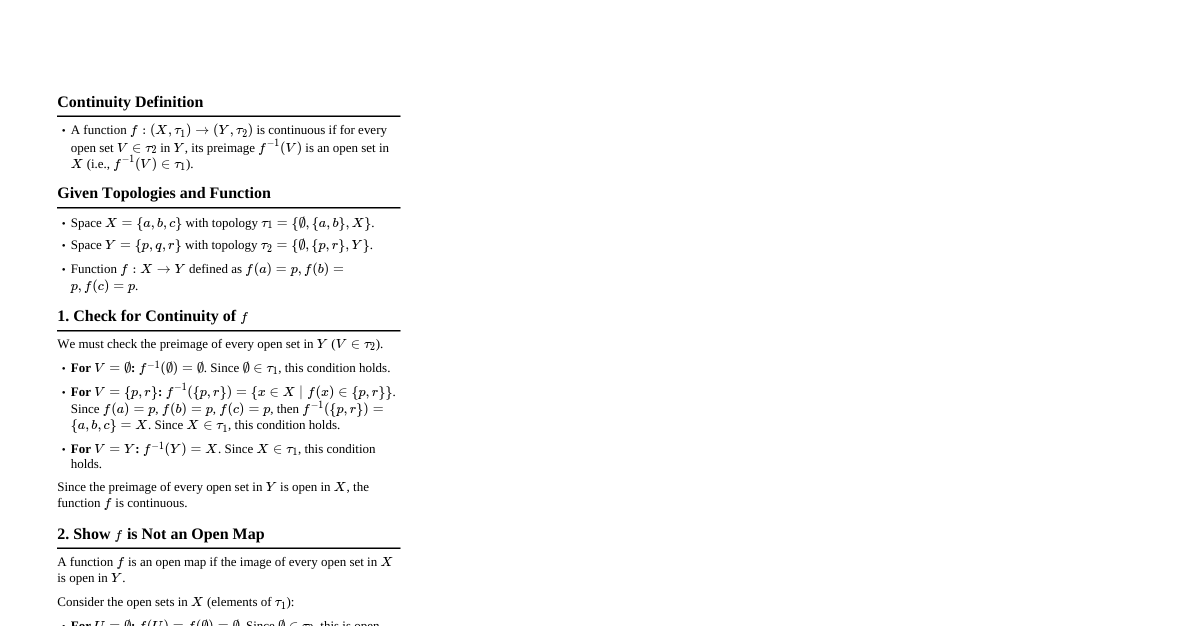
1. Topological Spaces A topological space is a set $X$ equipped with a topology $\mathcal{T}_X$, which is a collection of subsets of $X$ called "open sets" satisfying: $\emptyset$ and $X$ are in $\mathcal{T}_X$. The intersection of any finite number of sets in $\mathcal{T}_X$ is in $\mathcal{T}_X$. The union of any collection of sets in $\mathcal{T}_X$ is in $\mathcal{T}_X$. 2. Continuous Mapping Definition Let $(X, \mathcal{T}_X)$ and $(Y, \mathcal{T}_Y)$ be two topological spaces. A function $f: X \to Y$ is said to be continuous if for every open set $V \in \mathcal{T}_Y$ (in $Y$), its preimage $f^{-1}(V) = \{x \in X \mid f(x) \in V\}$ is an open set in $X$ (i.e., $f^{-1}(V) \in \mathcal{T}_X$). 3. Example 1: Discrete and Trivial Topologies Setup: Set $X = \{a, b\}$ Topology $\mathcal{T}_X = \{\emptyset, \{a\}, \{b\}, \{a, b\}\}$ (Discrete Topology on $X$) Set $Y = \{1, 2\}$ Topology $\mathcal{T}_Y = \{\emptyset, \{1, 2\}\}$ (Trivial Topology on $Y$) Mapping $f: X \to Y$ defined as $f(a) = 1$, $f(b) = 2$. Checking Continuity: Open sets in $Y$ are $\emptyset$ and $\{1, 2\}$. $f^{-1}(\emptyset) = \emptyset \in \mathcal{T}_X$ (open in $X$). $f^{-1}(\{1, 2\}) = X = \{a, b\} \in \mathcal{T}_X$ (open in $X$). Since the preimages of all open sets in $Y$ are open in $X$, $f$ is continuous. Mapping Diagram: a b X 1 2 Y $f$ 4. Example 2: Standard Real Line to Trivial Topology Setup: Set $X = \mathbb{R}$ Topology $\mathcal{T}_X = \mathcal{T}_\text{std}$ (Standard Topology on $\mathbb{R}$, generated by open intervals) Set $Y = \mathbb{R}$ Topology $\mathcal{T}_Y = \{\emptyset, \mathbb{R}\}$ (Trivial Topology on $\mathbb{R}$) Mapping $f: X \to Y$ defined as $f(x) = x^2$. Checking Continuity: Open sets in $Y$ are $\emptyset$ and $\mathbb{R}$. $f^{-1}(\emptyset) = \emptyset \in \mathcal{T}_X$ (open in $X$). $f^{-1}(\mathbb{R}) = X = \mathbb{R} \in \mathcal{T}_X$ (open in $X$). Since the preimages of all open sets in $Y$ are open in $X$, $f$ is continuous. Note: Any function into a trivial topological space is continuous. 5. Example 3: Identity Map (Continuous) Setup: Set $X = \{1, 2, 3\}$ $\mathcal{T}_X = \{\emptyset, \{1\}, \{2, 3\}, \{1, 2, 3\}\}$ Set $Y = \{1, 2, 3\}$ $\mathcal{T}_Y = \{\emptyset, \{1\}, \{1, 2\}, \{1, 2, 3\}\}$ Mapping $id: X \to Y$ defined as $id(x) = x$ (identity map). Checking Continuity: Open sets in $Y$ are $\emptyset, \{1\}, \{1, 2\}, \{1, 2, 3\}$. $id^{-1}(\emptyset) = \emptyset \in \mathcal{T}_X$. $id^{-1}(\{1\}) = \{1\} \in \mathcal{T}_X$. $id^{-1}(\{1, 2\}) = \{1, 2\} \notin \mathcal{T}_X$. Since $\{1, 2\}$ is open in $Y$ but its preimage $\{1, 2\}$ is NOT open in $X$, the identity map $id: X \to Y$ is not continuous in this case. This shows that continuity depends on both the function and the topologies defined on the sets. 6. Example 4: Identity Map (Continuous with different topologies) Setup: Set $X = \{1, 2, 3\}$ $\mathcal{T}_X = \{\emptyset, \{1\}, \{2\}, \{1, 2\}, \{1, 2, 3\}\}$ Set $Y = \{1, 2, 3\}$ $\mathcal{T}_Y = \{\emptyset, \{1\}, \{1, 2\}, \{1, 2, 3\}\}$ Mapping $id: X \to Y$ defined as $id(x) = x$ (identity map). Checking Continuity: Open sets in $Y$ are $\emptyset, \{1\}, \{1, 2\}, \{1, 2, 3\}$. $id^{-1}(\emptyset) = \emptyset \in \mathcal{T}_X$. $id^{-1}(\{1\}) = \{1\} \in \mathcal{T}_X$. $id^{-1}(\{1, 2\}) = \{1, 2\} \in \mathcal{T}_X$. $id^{-1}(\{1, 2, 3\}) = \{1, 2, 3\} \in \mathcal{T}_X$. Since the preimages of all open sets in $Y$ are open in $X$, the identity map $id: X \to Y$ is continuous in this case. A function is continuous if the topology on the domain is "finer" (has more open sets) than the topology on the codomain, relative to the function. 7. Example 5: Constant Map Setup: Set $X = \{a, b, c\}$ $\mathcal{T}_X = \{\emptyset, \{a\}, \{b, c\}, \{a, b, c\}\}$ Set $Y = \{x, y\}$ $\mathcal{T}_Y = \{\emptyset, \{y\}, \{x, y\}\}$ Mapping $g: X \to Y$ defined as $g(a) = y$, $g(b) = y$, $g(c) = y$ (constant map). Checking Continuity: Open sets in $Y$ are $\emptyset, \{y\}, \{x, y\}$. $g^{-1}(\emptyset) = \emptyset \in \mathcal{T}_X$. $g^{-1}(\{y\}) = \{a, b, c\} = X \in \mathcal{T}_X$. $g^{-1}(\{x, y\}) = \{a, b, c\} = X \in \mathcal{T}_X$. Since the preimages of all open sets in $Y$ are open in $X$, $g$ is continuous. Note: Any constant function is continuous between any two topological spaces. Mapping Diagram: a b c X x y Y $g$