Indian Constitution Essentials
Cheatsheet Content
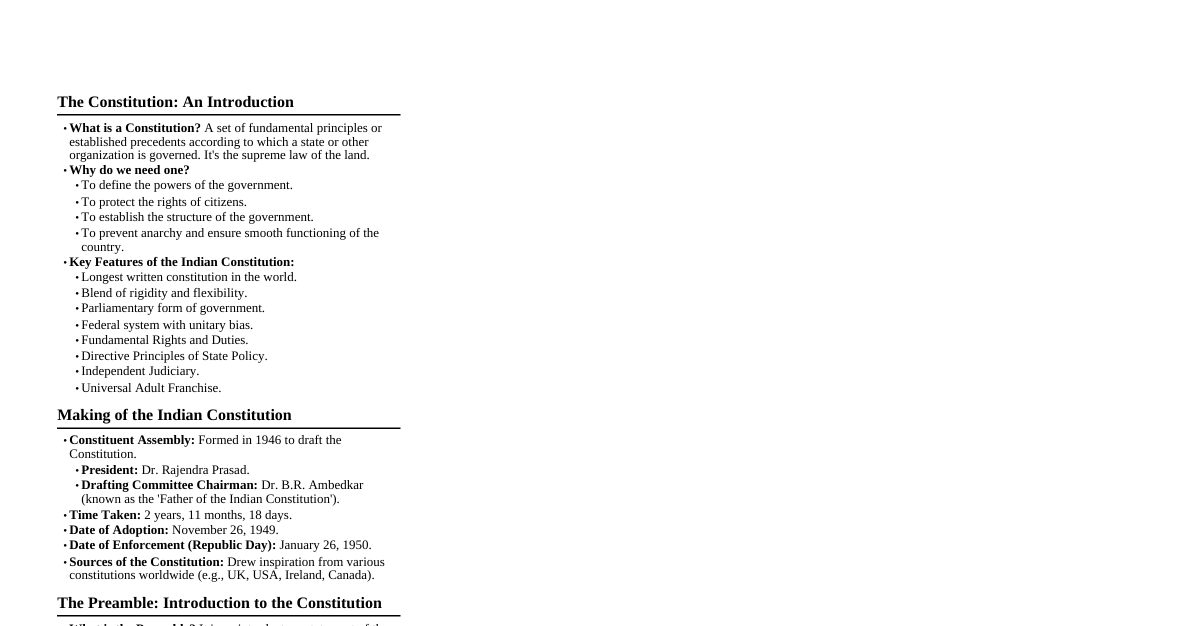
Meaning and Importance of the Constitution Definition: A constitution is a set of fundamental principles or established precedents according to which a state or other organization is governed. Importance: Establishes the framework of government (legislative, executive, judiciary). Defines the powers and limits of governmental institutions. Guarantees fundamental rights to citizens. Provides stability and order in society. Reflects the aspirations and values of the people. Serves as the supreme law of the land, ensuring rule of law. Salient Features of the Indian Constitution Longest Written Constitution: Comprehensive and detailed. Drawn from Various Sources: Synthesizes features from different constitutions globally (e.g., UK, USA, Ireland, Canada). Blend of Rigidity and Flexibility: Amendable but with a prescribed procedure, some parts easier to amend, others harder. Federal System with Unitary Bias: Division of powers between Union and States, but strong central government during emergencies. Parliamentary Form of Government: Based on the Westminster model, with a President as nominal head and Prime Minister as real executive. Integrated and Independent Judiciary: Supreme Court at the apex, ensures judicial review. Fundamental Rights: Enshrined in Part III, justiciable. Directive Principles of State Policy (DPSP): Guidelines for the state, non-justiciable. Fundamental Duties: Added by 42nd Amendment, serve as moral obligations. Secular State: No state religion, equal respect for all religions. Universal Adult Franchise: Voting rights for all citizens aged 18 and above. Single Citizenship: All Indians possess single citizenship. Emergency Provisions: President can impose National, State, or Financial emergencies. Three-tier Government: Original 2-tier structure (Union & States) expanded to include local self-government (Panchayats & Municipalities) by 73rd & 74th Amendments. Preamble of the Constitution Introduction: The Preamble serves as an introduction to the Constitution, summarizing its spirit and objectives. Key Words and their Meaning: WE, THE PEOPLE OF INDIA: Source of authority is the people. SOVEREIGN: India is an independent state, free from external control. SOCIALIST: Aims to achieve social and economic equality (added by 42nd Amendment, 1976). SECULAR: Equal respect for all religions, no state religion (added by 42nd Amendment, 1976). DEMOCRATIC: Government by the people, elected representatives. REPUBLIC: Head of the state (President) is elected, not hereditary. JUSTICE: Social, Economic, and Political. LIBERTY: Of thought, expression, belief, faith, and worship. EQUALITY: Of status and opportunity. FRATERNITY: Assuring the dignity of the individual and the unity and integrity of the Nation (integrity added by 42nd Amendment). Date of Adoption: Adopted on 26th November 1949. Fundamental Rights (Part III, Articles 12-35) Meaning: Basic human rights guaranteed to citizens by the Constitution, enforceable by courts. They are negative in nature (restrain the state). Categories: Right to Equality (Articles 14-18): Art. 14: Equality before law & equal protection of laws. Art. 15: Prohibition of discrimination. Art. 16: Equality of opportunity in public employment. Art. 17: Abolition of untouchability. Art. 18: Abolition of titles. Right to Freedom (Articles 19-22): Art. 19: Six freedoms (speech, assembly, association, movement, residence, profession). Art. 20: Protection in respect of conviction for offences. Art. 21: Protection of life and personal liberty. Art. 21A: Right to elementary education (added by 86th Amendment, 2002). Art. 22: Protection against arrest and detention. Right against Exploitation (Articles 23-24): Art. 23: Prohibition of human trafficking & forced labour. Art. 24: Prohibition of employment of children in factories. Right to Freedom of Religion (Articles 25-28): Art. 25: Freedom of conscience & free profession, practice, and propagation of religion. Art. 26: Freedom to manage religious affairs. Art. 27: Freedom from taxation for promotion of any particular religion. Art. 28: Freedom from attending religious instruction. Cultural and Educational Rights (Articles 29-30): Art. 29: Protection of interests of minorities. Art. 30: Right of minorities to establish & administer educational institutions. Right to Constitutional Remedies (Article 32): Allows individuals to move the Supreme Court for enforcement of Fundamental Rights. SC can issue writs: Habeas Corpus, Mandamus, Prohibition, Certiorari, Quo Warranto. Limitations: Not absolute, subject to reasonable restrictions (e.g., public order, morality, national security). Can be suspended during a National Emergency (except Arts. 20 & 21). Parliament can impose restrictions on FRs of armed forces, police, etc. Directive Principles of State Policy (DPSP) (Part IV, Articles 36-51) Meaning: Guidelines/instructions to the Union and State Governments for framing laws and policies. They are positive obligations on the state. Enforcement: Non-justiciable: Cannot be enforced by any court. Fundamental in the governance of the country; it is the duty of the state to apply these principles in making laws (Art. 37). Categories (illustrative): Socialist Principles: Art. 38 (social order for welfare), Art. 39 (equal pay for equal work, adequate means of livelihood, distribution of wealth), Art. 41 (right to work, education, public assistance), Art. 42 (just and humane conditions of work), Art. 43 (living wage). Gandhian Principles: Art. 40 (organisation of village panchayats), Art. 43 (cottage industries), Art. 46 (educational & economic interests of SC/ST), Art. 47 (prohibition of intoxicating drinks/drugs), Art. 48 (prohibition of cow slaughter). Liberal-Intellectual Principles: Art. 44 (Uniform Civil Code), Art. 45 (early childhood care & education for children below 6), Art. 50 (separation of judiciary from executive), Art. 51 (promotion of international peace & security). Relevance: Act as a moral compass for the government. Help in achieving the goals of a welfare state. Serve as a yardstick for judging the performance of the government. Complement Fundamental Rights by aiming for socio-economic justice. Fundamental Duties (Part IV-A, Article 51A) Meaning: Moral obligations of all citizens to help promote a spirit of patriotism and to uphold the unity of India. (Added by 42nd Amendment, 1976, on recommendations of Swaran Singh Committee). Enforcement: Non-justiciable: Cannot be enforced by writs. Parliament can provide for the imposition of appropriate penalty or punishment for non-compliance with these duties. Key Duties (illustrative): Abide by the Constitution and respect its ideals and institutions. Cherish and follow the noble ideals which inspired our national struggle for freedom. Uphold and protect the sovereignty, unity, and integrity of India. Defend the country. Promote harmony and the spirit of common brotherhood amongst all the people of India. Value and preserve the rich heritage of our composite culture. Protect and improve the natural environment. Develop the scientific temper, humanism, and the spirit of inquiry and reform. Safeguard public property and to abjure violence. Strive towards excellence in all spheres of individual and collective activity. Provide opportunities for education to his child or ward between the age of six and fourteen years (Added by 86th Amendment, 2002). Relevance: Remind citizens that while enjoying rights, they also have duties. Promote a sense of discipline and commitment to the nation. Help in achieving national goals and aspirations. Serve as a source of inspiration for citizens and promote patriotism.