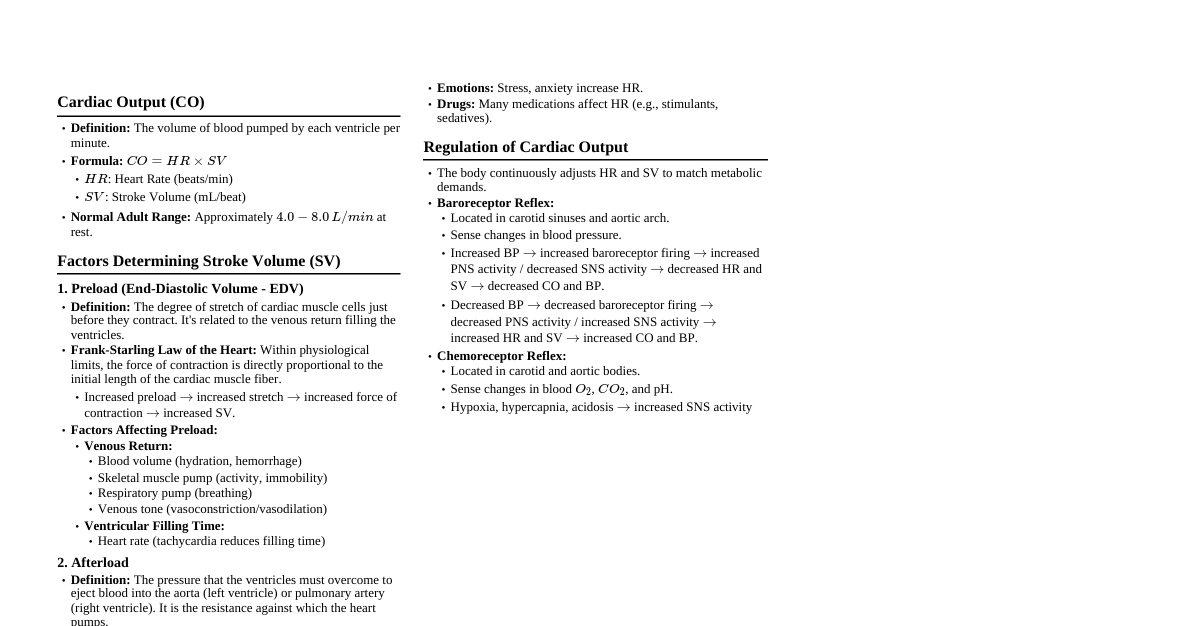
### Cardiac Cycle Overview 1. **Relaxed State (Diastole):** * All four chambers are relaxed. * Tricuspid and bicuspid valves are open. * Blood flows from pulmonary veins and vena cava into left and right ventricles respectively. * Semilunar valves are closed. 2. **SAN Action Potential:** * SAN generates an action potential. * This stimulates both atria to undergo simultaneous contraction (atrial systole). 3. **Atrial Systole:** * Increases blood flow into ventricles by about 30%. * Action potential is conducted to the ventricular side by AVN and AV bundle. * This causes the ventricular muscles to contract (ventricular systole). 4. **Ventricular Systole:** * Ventricular systole increases ventricular pressure. * This causes the closure of tricuspid and bicuspid valves (due to attempted backflow into atria). * Semilunar valves (aortic and pulmonary) are forced open. * Blood flows from ventricles into the pulmonary artery and aorta. 5. **Ventricular Diastole:** * Ventricular pressure declines further. * Semilunar valves close (to prevent backflow into ventricles). * Tricuspid and bicuspid valves open as ventricular pressure falls below atrial pressure. * Blood flows from atria to ventricles, and the cycle repeats. ### Sequential Events & Duration * **Definition:** The sequential event in the heart which is cyclically repeated is called the cardiac cycle. * **Components:** Systole and diastole of both atria and ventricles. * **Heartbeat Rate:** ~72 beats per minute. * **Duration of Cardiac Cycle:** ~0.8 seconds. * **Stroke Volume:** ~70 mL of blood pumped out by each ventricle per cardiac cycle. * **Cardiac Output (CO):** * Volume of blood pumped out by each ventricle per minute. * CO = Stroke Volume × Heart Rate * Average CO: ~5 litres in a healthy individual. * **Body's Ability to Alter CO:** The body has the ability to alter stroke volume as well as heart rate to adjust cardiac output. ### Heart Sounds * **Origin:** Produced during each cardiac cycle by two prominent sounds. * **Listening:** Can be easily heard through a stethoscope. * **"LUB" (First Heart Sound):** * Associated with the closure of the tricuspid and bicuspid valves. * **"DUB" (Second Heart Sound):** * Associated with the closure of the semilunar valves. * **Significance:** These sounds are of clinical diagnostic significance.