Aldehyde, Ketone, Carboxylic A
Cheatsheet Content
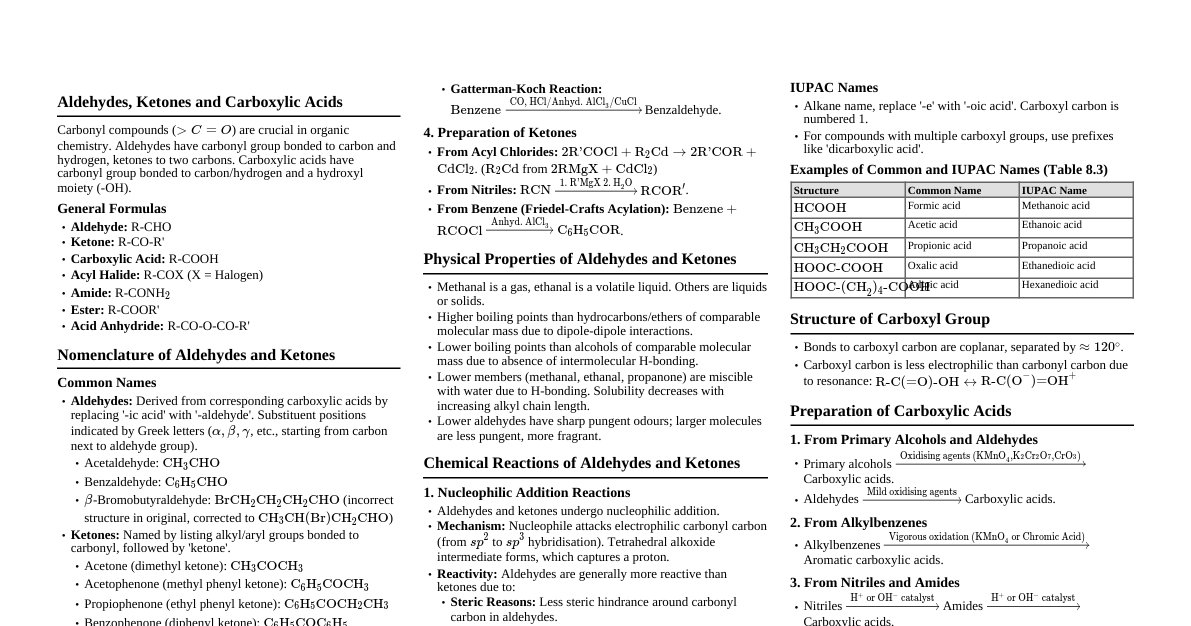
### Aldehyde & Ketone: Preparation - **From Alcohols (Oxidation):** - Primary alcohol $\xrightarrow{\text{PCC}}$ Aldehyde - Secondary alcohol $\xrightarrow{\text{CrO}_3 / \text{PCC}}$ Ketone - **From Hydrocarbons:** - **Ozonolysis of Alkenes:** $R-CH=CH-R' \xrightarrow{\text{O}_3, \text{Zn/H}_2O}$ Aldehyde/Ketone - **Hydration of Alkynes:** $R-C \equiv CH \xrightarrow{\text{H}_2SO_4, \text{HgSO}_4}$ Ketone (except Ethyne $\rightarrow$ Ethanal) - **From Acyl Chlorides:** - **Rosenmund Reaction:** $R-COCl \xrightarrow{\text{H}_2, \text{Pd-BaSO}_4}$ Aldehyde - **From Nitriles (Stephen reaction):** $R-C \equiv N \xrightarrow{\text{SnCl}_2, \text{HCl}}$ Imine $\xrightarrow{\text{H}_3O^+}$ Aldehyde - **From Nitriles (DIBAL-H):** $R-C \equiv N \xrightarrow{\text{DIBAL-H}}$ Imine $\xrightarrow{\text{H}_2O}$ Aldehyde - **From Esters (DIBAL-H):** $R-COOR' \xrightarrow{\text{DIBAL-H}}$ Aldehyde - **From Benzene/Toluene:** - **Etard Reaction:** Toluene $\xrightarrow{\text{CrO}_2Cl_2}$ Benzaldehyde - **Gattermann-Koch Reaction:** Benzene $\xrightarrow{\text{CO, HCl, Anhyd. AlCl}_3}$ Benzaldehyde ### Aldehyde & Ketone: Nucleophilic Addition - **Addition of HCN:** $R_2C=O + HCN \rightarrow R_2C(OH)CN$ (Cyanohydrin) - **Addition of NaHSO$_3$:** $R_2C=O + NaHSO_3 \rightarrow R_2C(OH)SO_3Na$ (Bisulphite addition product) - **Addition of Grignard Reagent:** - HCHO $\xrightarrow{\text{RMgX}}$ Primary Alcohol - Aldehyde $\xrightarrow{\text{RMgX}}$ Secondary Alcohol - Ketone $\xrightarrow{\text{RMgX}}$ Tertiary Alcohol - **Addition of Alcohols:** - Aldehyde $\xrightarrow{\text{R'OH, HCl gas}}$ Acetal - Ketone $\xrightarrow{\text{R'OH, HCl gas}}$ Ketal - **Addition of Ammonia Derivatives:** $R_2C=O + H_2N-Z \rightarrow R_2C=N-Z + H_2O$ - Z = -OH (Hydroxylamine) $\rightarrow$ Oxime - Z = -NH$_2$ (Hydrazine) $\rightarrow$ Hydrazone - Z = -NH-C$_6$H$_5$ (Phenylhydrazine) $\rightarrow$ Phenylhydrazone - Z = -NH-CO-NH$_2$ (Semicarbazide) $\rightarrow$ Semicarbazone ### Aldehyde & Ketone: Oxidation & Reduction - **Oxidation:** - **Tollens' Test:** Aldehyde $\xrightarrow{\text{Ag(NH}_3)_2^+ \text{OH}^-}$ Carboxylic Acid (Silver mirror) - **Fehling's Test:** Aldehyde $\xrightarrow{\text{Cu}^{2+} \text{ (alkaline)}}$ Carboxylic Acid (Red ppt of Cu$_2$O) - **Ketones:** No reaction with Tollens' or Fehling's, resist mild oxidation. Strong oxidation gives carboxylic acids with fewer carbons. - **Haloform Reaction:** Methyl Ketones ($CH_3CO-$) $\xrightarrow{\text{X}_2, \text{NaOH}}$ Haloform ($CHX_3$) + Carboxylate - **Reduction:** - **To Alcohols:** $R_2C=O \xrightarrow{\text{LiAlH}_4 \text{ or NaBH}_4}$ Alcohol - **To Hydrocarbons:** - **Clemmensen Reduction:** $R_2C=O \xrightarrow{\text{Zn-Hg, Conc. HCl}}$ $R_2CH_2$ - **Wolff-Kishner Reduction:** $R_2C=O \xrightarrow{\text{NH}_2NH_2, \text{KOH/Ethylene Glycol, Heat}}$ $R_2CH_2$ ### Aldehyde & Ketone: Other Reactions - **Aldol Condensation:** - Compounds with $\alpha$-hydrogen $\xrightarrow{\text{Dilute NaOH}}$ Aldol/Ketol $\xrightarrow{\text{Heat}}$ $\alpha, \beta$-unsaturated carbonyl compound - **Cross-Aldol Condensation:** Between two different aldehydes/ketones (at least one with $\alpha$-hydrogen). - **Cannizzaro Reaction:** - Aldehydes without $\alpha$-hydrogen $\xrightarrow{\text{Conc. NaOH}}$ Alcohol + Carboxylic Acid salt - **Electrophilic Substitution (Aromatic Aldehydes/Ketones):** - Carbonyl group is deactivating and meta-directing. - Example: Benzaldehyde $\xrightarrow{\text{Conc. HNO}_3, \text{Conc. H}_2SO_4}$ m-Nitrobenzaldehyde ### Carboxylic Acid: Preparation - **From Primary Alcohols:** $R-CH_2OH \xrightarrow{\text{KMnO}_4 \text{ or K}_2Cr_2O_7}$ $R-COOH$ - **From Aldehydes:** $R-CHO \xrightarrow{\text{KMnO}_4 \text{ or K}_2Cr_2O_7 \text{ or Tollens'}}$ $R-COOH$ - **From Nitriles & Amides:** - $R-C \equiv N \xrightarrow{\text{H}_3O^+ \text{ or OH}^-}$ Amide $\xrightarrow{\text{H}_3O^+ \text{ or OH}^-}$ $R-COOH$ - **From Grignard Reagents:** $R-MgX \xrightarrow{\text{1. CO}_2 \text{ (dry ice)} \text{ 2. H}_3O^+}$ $R-COOH$ - **From Acyl Halides & Anhydrides:** Hydrolysis with water. - **From Esters:** $R-COOR' \xrightarrow{\text{H}_3O^+ \text{ or OH}^-}$ $R-COOH + R'OH$ ### Carboxylic Acid: Reactions - **Acidity:** $R-COOH \rightleftharpoons R-COO^- + H^+$ - Electron-withdrawing groups increase acidity. - **Formation of Anhydrides:** $2 R-COOH \xrightarrow{\text{Heat, P}_2O_5}$ $(R-CO)_2O + H_2O$ - **Esterification:** $R-COOH + R'-OH \xrightarrow{\text{Conc. H}_2SO_4}$ $R-COOR' + H_2O$ - **Formation of Acyl Chlorides:** $R-COOH \xrightarrow{\text{SOCl}_2 \text{ or PCl}_5 \text{ or PCl}_3}$ $R-COCl$ - **Formation of Amides:** $R-COOH + NH_3 \xrightarrow{\text{Heat}}$ $R-CONH_2 + H_2O$ - **Reduction:** $R-COOH \xrightarrow{\text{LiAlH}_4}$ $R-CH_2OH$ (Primary Alcohol) - **Decarboxylation:** $R-COONa \xrightarrow{\text{NaOH, CaO, Heat}}$ $R-H + Na_2CO_3$ - **Hell-Volhard-Zelinsky (HVZ) Reaction:** - $R-CH_2-COOH \xrightarrow{\text{1. X}_2/\text{Red P} \text{ 2. H}_2O}$ $R-CH(X)-COOH$ ($\alpha$-Halo Carboxylic Acid) - **Ring Substitution (Aromatic Carboxylic Acids):** - -COOH group is deactivating and meta-directing. - Example: Benzoic acid $\xrightarrow{\text{Conc. HNO}_3, \text{Conc. H}_2SO_4}$ m-Nitrobenzoic acid