Glycolysis & Regulation
Cheatsheet Content
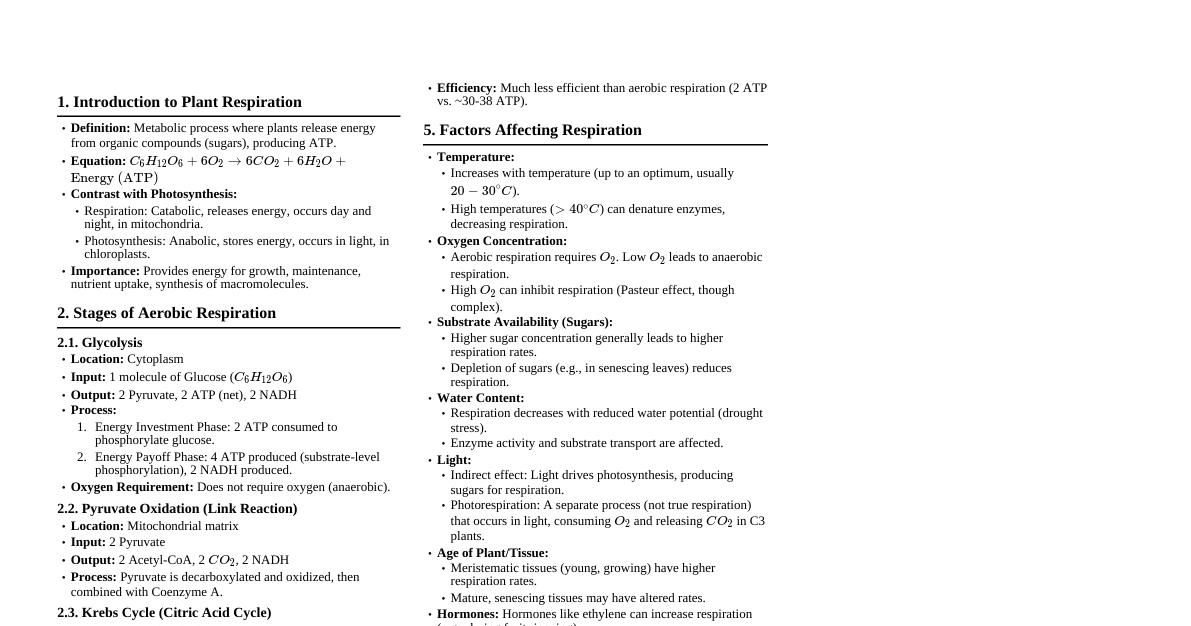
### Glycolysis Overview - **Definition:** Metabolic pathway that converts glucose into pyruvate. - **Location:** Cytoplasm of cells. - **Purpose:** Generates ATP, NADH, and intermediate products for other metabolic pathways. - **Phases:** 1. **Energy Investment Phase:** Consumes 2 ATP. 2. **Energy Payoff Phase:** Produces 4 ATP, 2 NADH, and 2 Pyruvate. - **Net Output per Glucose:** 2 ATP, 2 NADH, 2 Pyruvate. ### Energy Investment Phase 1. **Glucose Phosphorylation:** - **Enzyme:** Hexokinase (most tissues), Glucokinase (liver, pancreatic $\beta$-cells). - **Reaction:** Glucose + ATP $\rightarrow$ Glucose-6-Phosphate + ADP - **Irreversible:** Yes. - **Purpose:** Traps glucose in cell, lowers intracellular glucose concentration. 2. **Isomerization:** - **Enzyme:** Phosphoglucose Isomerase. - **Reaction:** Glucose-6-Phosphate $\rightleftharpoons$ Fructose-6-Phosphate - **Reversible:** Yes. 3. **Second Phosphorylation:** - **Enzyme:** Phosphofructokinase-1 (PFK-1). - **Reaction:** Fructose-6-Phosphate + ATP $\rightarrow$ Fructose-1,6-Bisphosphate + ADP - **Irreversible:** Yes. - **Key Regulatory Step:** PFK-1 is the most important regulatory enzyme in glycolysis. 4. **Cleavage:** - **Enzyme:** Aldolase. - **Reaction:** Fructose-1,6-Bisphosphate $\rightleftharpoons$ Dihydroxyacetone Phosphate (DHAP) + Glyceraldehyde-3-Phosphate (GAP) - **Reversible:** Yes. 5. **Isomerization:** - **Enzyme:** Triose Phosphate Isomerase. - **Reaction:** DHAP $\rightleftharpoons$ GAP - **Reversible:** Yes. (All DHAP is converted to GAP, so 2 molecules of GAP proceed). ### Energy Payoff Phase (per GAP molecule) 1. **Oxidation and Phosphorylation:** - **Enzyme:** Glyceraldehyde-3-Phosphate Dehydrogenase. - **Reaction:** GAP + NAD$^+$ + P$_i$ $\rightleftharpoons$ 1,3-Bisphosphoglycerate + NADH + H$^+$ - **Reversible:** Yes. - **Purpose:** Produces NADH (electron carrier). 2. **ATP Generation (Substrate-Level Phosphorylation):** - **Enzyme:** Phosphoglycerate Kinase. - **Reaction:** 1,3-Bisphosphoglycerate + ADP $\rightleftharpoons$ 3-Phosphoglycerate + ATP - **Reversible:** Yes. (First ATP produced). 3. **Phosphate Group Shift:** - **Enzyme:** Phosphoglycerate Mutase. - **Reaction:** 3-Phosphoglycerate $\rightleftharpoons$ 2-Phosphoglycerate - **Reversible:** Yes. 4. **Dehydration:** - **Enzyme:** Enolase. - **Reaction:** 2-Phosphoglycerate $\rightleftharpoons$ Phosphoenolpyruvate (PEP) + H$_2$O - **Reversible:** Yes. 5. **ATP Generation (Substrate-Level Phosphorylation):** - **Enzyme:** Pyruvate Kinase. - **Reaction:** PEP + ADP $\rightarrow$ Pyruvate + ATP - **Irreversible:** Yes. (Second ATP produced). ### Key Regulatory Enzymes Glycolysis is primarily regulated at its irreversible steps: 1. **Hexokinase/Glucokinase:** - **Hexokinase:** Inhibited by Glucose-6-Phosphate (product inhibition). Low $K_m$ for glucose. - **Glucokinase:** Induced by insulin. High $K_m$ for glucose (active only at high glucose levels, e.g., after a meal). Not inhibited by Glucose-6-Phosphate. 2. **Phosphofructokinase-1 (PFK-1):** - **Activators:** AMP, Fructose-2,6-Bisphosphate. - **Inhibitors:** ATP, Citrate, H$^+$ (low pH). - **Mechanism:** Fructose-2,6-Bisphosphate is synthesized by PFK-2/FBPase-2. High insulin activates PFK-2, increasing F-2,6-BP, thus activating PFK-1. High glucagon inactivates PFK-2, decreasing F-2,6-BP, thus inhibiting PFK-1. 3. **Pyruvate Kinase:** - **Activators:** Fructose-1,6-Bisphosphate (feed-forward activation). - **Inhibitors:** ATP, Acetyl-CoA, Alanine, long-chain fatty acids. - **Covalent Modification (Liver):** Phosphorylation by PKA (activated by glucagon) inactivates pyruvate kinase, slowing glycolysis. Dephosphorylation (by insulin) activates it. ### Fates of Pyruvate The fate of pyruvate depends on oxygen availability and cell type: 1. **Aerobic Conditions (Presence of O$_2$):** - Pyruvate enters the mitochondria. - Converted to Acetyl-CoA by Pyruvate Dehydrogenase Complex. - Acetyl-CoA enters the Citric Acid Cycle (Krebs Cycle) for further oxidation. 2. **Anaerobic Conditions (Absence of O$_2$):** - **Lactate Fermentation (Animals, some bacteria):** - **Enzyme:** Lactate Dehydrogenase. - **Reaction:** Pyruvate + NADH + H$^+$ $\rightleftharpoons$ Lactate + NAD$^+$ - **Purpose:** Regenerates NAD$^+$ for glycolysis to continue. - **Alcoholic Fermentation (Yeast, some bacteria):** - **Enzyme 1:** Pyruvate Decarboxylase (Pyruvate $\rightarrow$ Acetaldehyde + CO$_2$). - **Enzyme 2:** Alcohol Dehydrogenase (Acetaldehyde + NADH + H$^+$ $\rightarrow$ Ethanol + NAD$^+$). - **Purpose:** Regenerates NAD$^+$ for glycolysis to continue. ### Energetics - **ATP Consumed:** 2 (Hexokinase, PFK-1) - **ATP Produced:** 4 (2 from Phosphoglycerate Kinase, 2 from Pyruvate Kinase) - **Net ATP:** 2 ATP - **NADH Produced:** 2 (Glyceraldehyde-3-Phosphate Dehydrogenase) - **NADH Energy Yield:** Each NADH typically yields 2.5 ATP (via oxidative phosphorylation) - **Total ATP (Aerobic):** 2 (net from glycolysis) + 5 (from 2 NADH) = 7 ATP per glucose.