Unit 2: Planning & Management
Cheatsheet Content
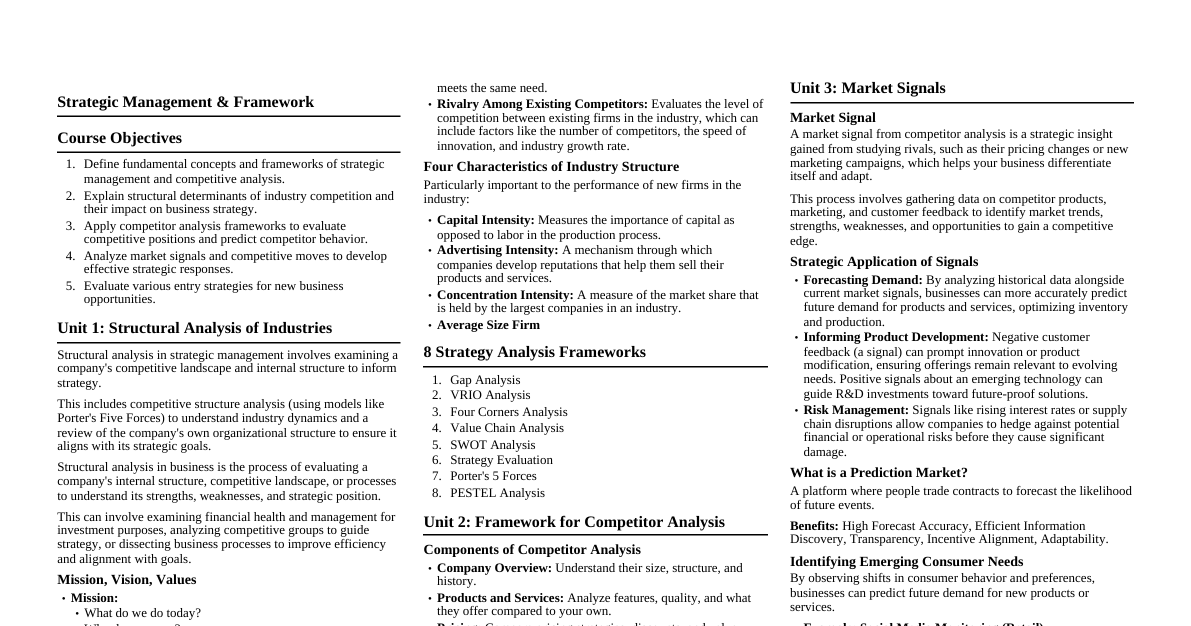
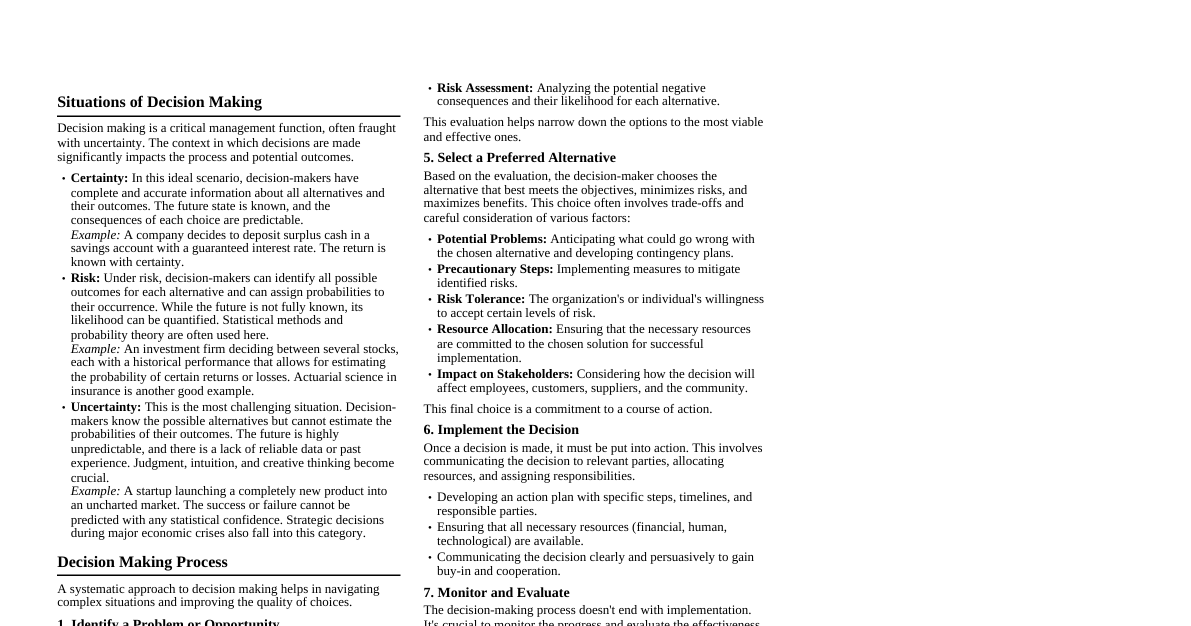
1.1 Concept of Planning Deciding in advance what to do, how to do it, when to do it, and who will do it. Key Features of Planning Feature Meaning (Short) Why Important (Short) 1. Goal-oriented Defines clear objectives. Ensures direction, basis for performance evaluation. 2. Future-oriented Forecasts future events, prepares for them. Reduces uncertainty, prepares for challenges. 3. Continuous Ongoing process, reviewed & updated. Keeps organization flexible & adaptable. 4. Decision-making Chooses best alternative from options. Optimal resource use, reduces risks. 5. Pervasive Done at all managerial levels. Ensures coordination, aligns efforts. 6. Intellectual process Requires analysis, creativity, judgment. Leads to high-quality decisions, avoids unrealistic plans. 1.2 Process of Planning Setting Objectives (SMART Goals): Define clear, Specific, Measurable, Achievable, Relevant, Time-bound targets. Developing Premises (Assumptions): Make assumptions about future conditions (economy, competition). Identifying Alternatives: List all possible courses of action. Evaluating Alternatives: Compare options based on cost, benefits, risk, feasibility. Selecting the Best Alternative: Choose option meeting objectives & minimizing risks. Formulating Action Plans: Create detailed procedures, policies, budgets, schedules. Implementing the Plan: Put plan into action, allocate resources, assign responsibilities. Monitoring & Reviewing: Track progress, compare performance, take corrective action. 1.3 Types of Planning A. Based on Scope / Level Corporate Planning: Top-level. Covers entire organization (mission, long-term goals, growth). Decisions: markets, products, M&A. Departmental / Functional Planning: Specific departments (Marketing, HR, Finance). Supports corporate plan, focuses on functional goals. Operational Planning: Lower-level, routine, day-to-day activities. Detailed schedules, work assignments, daily targets. B. Based on Time Long-term Planning (3-5 years): Strategic planning. Focuses on future direction, growth, major decisions. Long horizon, high uncertainty. Medium-term Planning (1-3 years): Tactical planning. Converts long-term strategies into actionable steps. Middle management level. Short-term Planning (up to 1 year): Operational planning. Immediate plans (months/year). Guides daily/weekly/monthly operations. C. Based on Use Single-use Plans: One-time situations/events. Not repeated. Forms: Budgets, Programmes. Standing Plans: Ongoing, used repeatedly. Guide routine activities, provide consistency. Types: Policies (general guidelines), Procedures (step-by-step methods), Rules (specific instructions). D. Based on Flexibility Formal Planning: Written, structured, well-organized. Specific format, rules, procedures. Detailed, covers objectives, strategies, policies, budgets. Informal Planning: Not written, in manager's mind. Flexible, changes easily. Used for small, daily decisions. 2. STRATEGIC MANAGEMENT 2.1 Concept Continuous process of formulating, implementing, and evaluating strategies to achieve organizational goals. Ensures adaptation to environmental changes & competitive advantage. 2.2 Types of Strategies Corporate Level Strategies: Growth/Expansion (diversification, M&A) Stability Retrenchment (divestment, turnaround) Combination Business Level Strategies: Cost leadership Differentiation Focus (niche) Functional Level Strategies: Marketing strategy HR strategy Financial strategy Production strategy 2.3 Elements of Strategic Management Vision & Mission Environmental Scanning (Internal: SWOT; External: PESTLE, Porter's 5 Forces) Strategy Formulation Strategy Implementation Strategy Evaluation & Control 3. DECISION-MAKING 3.1 Concept Process of choosing the best option from available alternatives. Essence of planning. 3.2 Process of Decision-Making Identify the Problem: Recognize the gap between current & expected situation. Analyze the Problem: Gather facts, data, reasons why problem exists. Develop Alternatives: Identify possible solutions (creativity, brainstorming). Evaluate Alternatives: Compare options (cost, feasibility, risks, benefits). Choose the Best Alternative: Select most suitable & practical option. Implement the Decision: Put into action, allocate resources, assign responsibilities. Review the Results: Monitor outcomes, make adjustments if ineffective. 3.3 Simon's Model of Decision-Making Introduced bounded rationality (managers cannot make perfectly logical decisions due to limited time, information, resources). Stages: Intelligence: Recognize & diagnose problem, collect information. Design: Develop alternative solutions, evaluate feasibility & consequences. Choice: Select most suitable alternative based on analysis. Implementation (later added): Put chosen alternative into practice, evaluate success. 3.4 Group Decision-Making Decision-making by a team. Advantages: $\checkmark$ More information & ideas $\checkmark$ Increased creativity $\checkmark$ Diversity of viewpoints $\checkmark$ Better acceptance & ownership $\checkmark$ Improved understanding Disadvantages: $\times$ Time-consuming $\times$ Possibility of conflicts $\times$ "Groupthink" $\times$ Responsibility unclear Techniques: Brainstorming: Free flow of ideas. Delphi Technique: Anonymous expert opinions. Nominal Group Technique: Individuals think separately, then discuss. Consensus Decision-Making: Everyone agrees & supports final decision. 4. MANAGEMENT BY OBJECTIVES (MBO) 4.1 Concept Developed by Peter Drucker. Goal-oriented system where managers & employees jointly set performance objectives. Increases participation, motivation, accountability. 4.2 Process of MBO Setting Organizational Goals (Top management). Setting Individual Goals (Jointly by managers & employees). Aligning Goals with Organizational Strategy. Developing Action Plans. Monitoring Progress (Regular feedback). Performance Evaluation & Feedback. Rewarding Achievement. 5. Styles of Management Style Key Feature When Useful Autocratic Manager decides alone. Emergencies, employees lack skill. Democratic Participation in decisions. Creativity & motivation required. Laissez-Faire Maximum freedom to employees. Employees are experts & self-motivated. Paternalistic Manager acts like a guardian. Family businesses, valuing relationships. Transformational Inspires employees with vision. Innovation & change environments. Transactional Based on rewards & punishment. Routine & structured tasks. 6. McKinsey's 7-S Model Framework to analyze & improve organizational effectiveness. 7 elements must align. Hard Elements (easily identified): Strategy $\rightarrow$ Long-term plan. Structure $\rightarrow$ Hierarchy, reporting relationships. Systems $\rightarrow$ Procedures, rules, processes. Soft Elements (influence culture & behavior): Shared Values $\rightarrow$ Core beliefs, guiding principles. Skills $\rightarrow$ Employee competencies, capabilities. Staff $\rightarrow$ People, recruitment, training. Style $\rightarrow$ Leadership approach, organizational culture. 7. Self-Management Ability to manage thoughts, emotions, time, actions to achieve goals effectively. Components: Self-Awareness: Knowing strengths, weaknesses, emotions. Self-Regulation: Controlling impulses, responding thoughtfully. Time Management: Prioritizing tasks, avoiding procrastination. Goal Setting: Defining SMART goals, systematic work. Stress Management: Using coping strategies. Motivation: Staying driven & persistent. Accountability: Taking responsibility for results. Benefits: $\checkmark$ Higher productivity $\checkmark$ Better decision-making $\checkmark$ Reduced stress & burnout $\checkmark$ Improved confidence & discipline $\checkmark$ Enhanced personal & professional growth