Electron Transport Chain
Cheatsheet Content
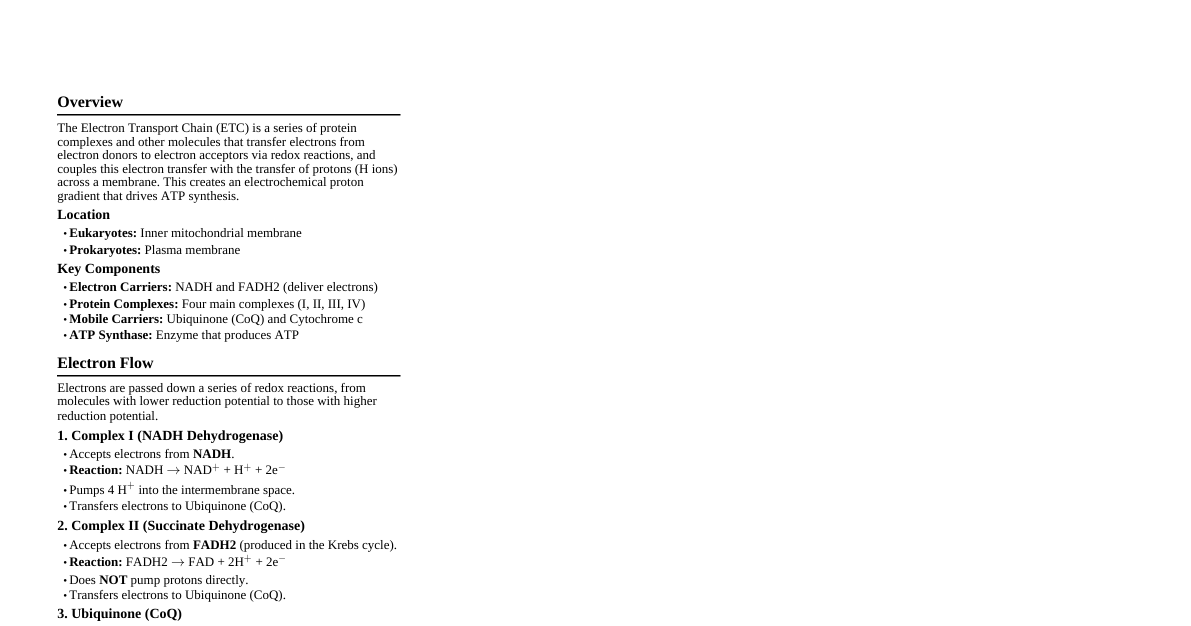
### Overview of Electron Transport Chain (ETC) - **Purpose:** To generate ATP through oxidative phosphorylation. - **Location:** Inner mitochondrial membrane (eukaryotes), plasma membrane (prokaryotes). - **Key Components:** A series of protein complexes (I, II, III, IV), mobile electron carriers (Ubiquinone, Cytochrome c), and ATP synthase. - **Process:** Electrons from NADH and FADH2 are passed down a chain of protein complexes, releasing energy used to pump protons across a membrane, creating a proton gradient. This gradient drives ATP synthesis. ### Electron Donors: NADH and FADH2 - **NADH:** Donates electrons to Complex I. - Generated primarily from Glycolysis, Pyruvate Oxidation, and the Krebs Cycle. - High energy yield: 1 NADH $\approx$ 2.5 ATP. - **FADH2:** Donates electrons to Complex II. - Generated from the Krebs Cycle (succinate dehydrogenase). - Lower energy yield: 1 FADH2 $\approx$ 1.5 ATP. ### ETC Complexes - **Complex I (NADH Dehydrogenase):** - Accepts electrons from NADH. - Pumps 4 H+ into intermembrane space. - Transfers electrons to Ubiquinone (Q). - **Complex II (Succinate Dehydrogenase):** - Accepts electrons from FADH2 (part of Krebs Cycle). - DOES NOT pump protons. - Transfers electrons to Ubiquinone (Q). - **Ubiquinone (Q / Coenzyme Q):** - Lipid-soluble mobile carrier. - Transfers electrons from Complex I and II to Complex III. - **Complex III (Cytochrome bc1 complex):** - Accepts electrons from Ubiquinone. - Pumps 4 H+ into intermembrane space. - Transfers electrons to Cytochrome c. - **Cytochrome c:** - Water-soluble mobile carrier. - Transfers electrons from Complex III to Complex IV. - **Complex IV (Cytochrome c Oxidase):** - Accepts electrons from Cytochrome c. - Pumps 2 H+ into intermembrane space. - Transfers electrons to the final electron acceptor, Oxygen ($O_2$). ### Proton Gradient (Chemiosmosis) - **Establishment:** The pumping of protons (H+) by Complexes I, III, and IV creates a high concentration of protons in the intermembrane space and a low concentration in the mitochondrial matrix. - **Electrochemical Gradient:** This creates both a pH gradient and an electrical potential difference across the inner mitochondrial membrane, referred to as the proton-motive force. ### ATP Synthase - **Mechanism:** Protons flow back into the mitochondrial matrix through ATP synthase, a molecular motor. - **Function:** The energy from this proton flow drives the rotation of the F0 subunit, which in turn causes conformational changes in the F1 subunit, synthesizing ATP from ADP and Pi. - **Oxidative Phosphorylation:** This process of ATP synthesis, coupled to electron transport, is called oxidative phosphorylation. ### Final Electron Acceptor - **Oxygen ($O_2$):** At the end of the ETC, electrons are transferred to molecular oxygen. - **Water Formation:** Oxygen is reduced to form water ($H_2O$), which is essential for removing depleted electrons and maintaining the flow of the ETC. $$ \frac{1}{2} O_2 + 2e^- + 2H^+ \rightarrow H_2O $$ ### ETC Inhibitors & Uncouplers - **Inhibitors:** Block electron flow at specific complexes, halting ATP synthesis. - **Rotenone:** Inhibits Complex I. - **Cyanide, Carbon Monoxide:** Inhibit Complex IV. - **Uncouplers:** Dissipate the proton gradient without allowing ATP synthesis. - **DNP (2,4-dinitrophenol):** Makes the inner mitochondrial membrane permeable to protons, bypassing ATP synthase. Energy is released as heat instead of being captured as ATP.