Electron Transport Chain
Cheatsheet Content
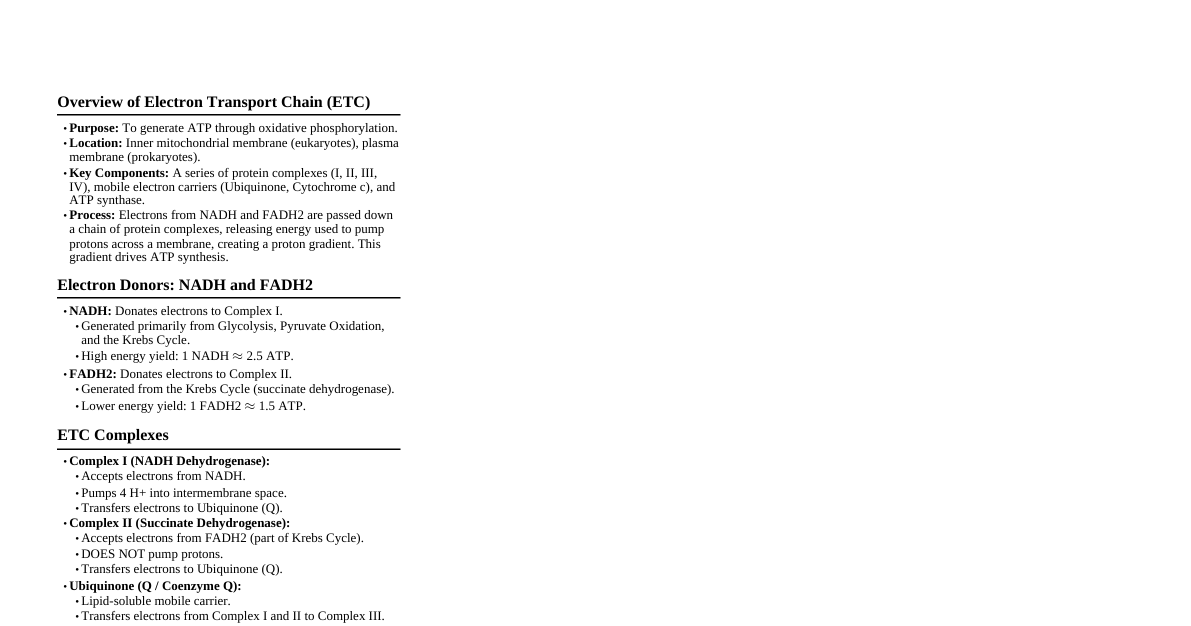
### Overview The Electron Transport Chain (ETC) is a series of protein complexes and other molecules that transfer electrons from electron donors to electron acceptors via redox reactions, and couples this electron transfer with the transfer of protons (H ions) across a membrane. This creates an electrochemical proton gradient that drives ATP synthesis. #### Location - **Eukaryotes:** Inner mitochondrial membrane - **Prokaryotes:** Plasma membrane #### Key Components - **Electron Carriers:** NADH and FADH2 (deliver electrons) - **Protein Complexes:** Four main complexes (I, II, III, IV) - **Mobile Carriers:** Ubiquinone (CoQ) and Cytochrome c - **ATP Synthase:** Enzyme that produces ATP ### Electron Flow Electrons are passed down a series of redox reactions, from molecules with lower reduction potential to those with higher reduction potential. #### 1. Complex I (NADH Dehydrogenase) - Accepts electrons from **NADH**. - **Reaction:** NADH $\rightarrow$ NAD$^+$ + H$^+$ + 2e$^-$ - Pumps 4 H$^+$ into the intermembrane space. - Transfers electrons to Ubiquinone (CoQ). #### 2. Complex II (Succinate Dehydrogenase) - Accepts electrons from **FADH2** (produced in the Krebs cycle). - **Reaction:** FADH2 $\rightarrow$ FAD + 2H$^+$ + 2e$^-$ - Does **NOT** pump protons directly. - Transfers electrons to Ubiquinone (CoQ). #### 3. Ubiquinone (CoQ) - Lipid-soluble mobile electron carrier. - Collects electrons from Complexes I and II. - Transfers electrons to Complex III. #### 4. Complex III (Cytochrome bc1 Complex) - Accepts electrons from Ubiquinone (CoQ). - Pumps 4 H$^+$ into the intermembrane space. - Transfers electrons to Cytochrome c. #### 5. Cytochrome c - Small, water-soluble mobile electron carrier. - Transfers electrons from Complex III to Complex IV. #### 6. Complex IV (Cytochrome c Oxidase) - Accepts electrons from Cytochrome c. - Pumps 2 H$^+$ into the intermembrane space. - Transfers electrons to the final electron acceptor, **Oxygen (O2)**. - **Reaction:** 1/2 O2 + 2H$^+$ + 2e$^-$ $\rightarrow$ H2O ### Proton Gradient (Chemiosmosis) The pumping of protons (H$^+$) from the mitochondrial matrix to the intermembrane space creates: - **Proton Motive Force:** A combination of a pH gradient (more acidic in intermembrane space) and an electrical potential gradient (more positive in intermembrane space). - This stored energy is then used to synthesize ATP. ### ATP Synthesis (Oxidative Phosphorylation) #### ATP Synthase - A large enzyme complex embedded in the inner mitochondrial membrane. - Protons flow back into the mitochondrial matrix through ATP Synthase, down their electrochemical gradient. - This flow drives the rotation of the ATP Synthase rotor, which catalyzes the phosphorylation of ADP to ATP. - **Reaction:** ADP + Pi $\rightarrow$ ATP #### ATP Yield - **NADH:** Typically generates 2.5 ATP (due to pumping 10 H$^+$) - **FADH2:** Typically generates 1.5 ATP (due to pumping 6 H$^+$) ### ETC Inhibitors | Inhibitor | Target Complex | Effect | |------------------|----------------|----------------------------------------| | Rotenone, Amytal | Complex I | Blocks electron transfer from NADH | | Antimycin A | Complex III | Blocks electron transfer from CoQ to Cyt c | | Cyanide, CO | Complex IV | Blocks electron transfer to O2 | | Oligomycin | ATP Synthase | Blocks proton flow through ATP Synthase | ### Uncouplers - Compounds that dissipate the proton gradient by making the inner mitochondrial membrane permeable to protons. - Electron transport continues, but ATP synthesis decreases or stops. - Energy is released as heat. - **Example:** Dinitrophenol (DNP)