Polynomials Class 10 CBSE
Shared 5/16/2026•17 views
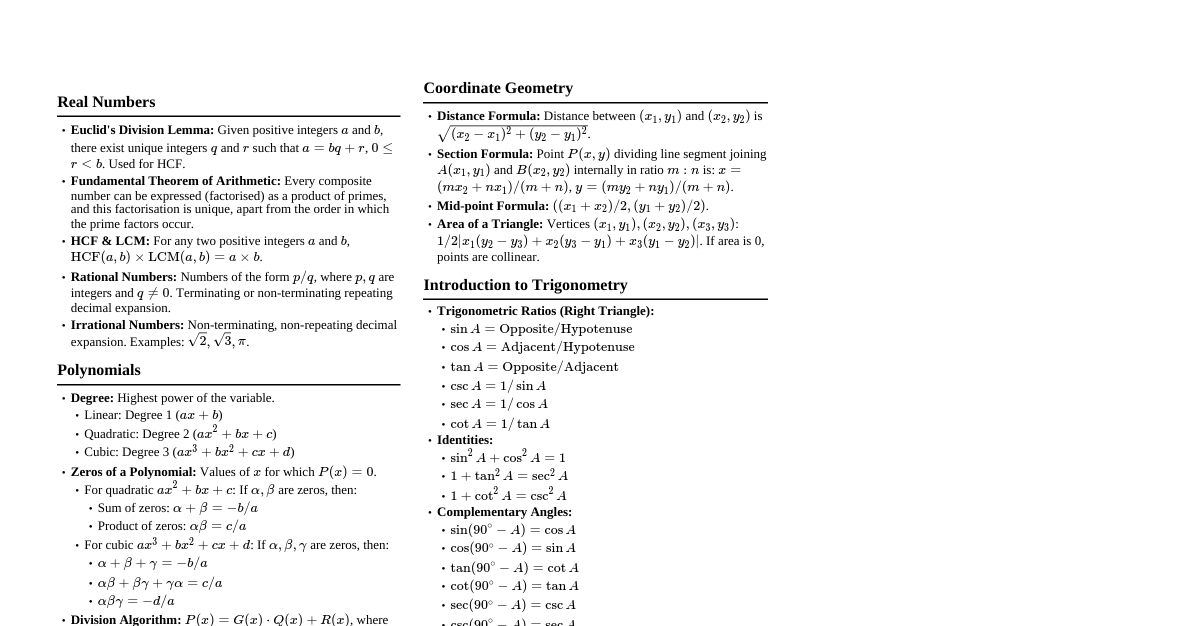
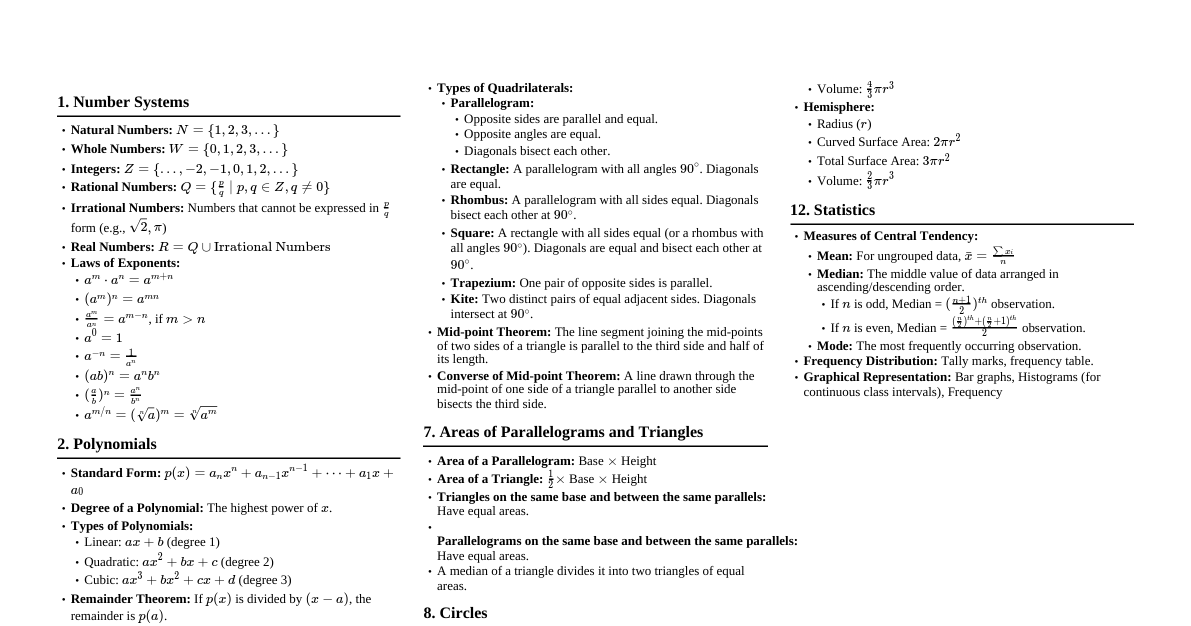
### Introduction to Polynomials - **Definition:** An algebraic expression of the form $P(x) = a_n x^n + a_{n-1} x^{n-1} + ... + a_1 x + a_0$, where $a_n, a_{n-1}, ..., a_0$ are real numbers and $a_n \neq 0$, and $n$ is a non-negative integer. - **Degree of a Polynomial:** The highest power of the variable in a polynomial. - Example: In $5x^3 - 2x + 7$, the degree is 3. - **Types of Polynomials (based on degree):** - **Linear Polynomial:** Degree 1 (e.g., $ax + b$, $a \neq 0$) - **Quadratic Polynomial:** Degree 2 (e.g., $ax^2 + bx + c$, $a \neq 0$) - **Cubic Polynomial:** Degree 3 (e.g., $ax^3 + bx^2 + cx + d$, $a \neq 0$) - **Types of Polynomials (based on terms):** - **Monomial:** 1 term (e.g., $5x$) - **Binomial:** 2 terms (e.g., $2x + 3$) - **Trinomial:** 3 terms (e.g., $x^2 + 2x + 1$) ### Zeros of a Polynomial - **Definition:** A real number $k$ is a zero of a polynomial $P(x)$ if $P(k) = 0$. - **Geometrical Meaning:** - The zeros of a polynomial $P(x)$ are the x-coordinates of the points where the graph $y = P(x)$ intersects the x-axis. - **Linear Polynomial ($ax+b$):** Has exactly one zero. Graph is a straight line intersecting the x-axis at one point. - **Quadratic Polynomial ($ax^2+bx+c$):** Has at most two zeros. Graph is a parabola. - Intersects x-axis at two distinct points (two distinct zeros). - Touches x-axis at exactly one point (two equal zeros). - Does not intersect x-axis (no real zeros). - **Cubic Polynomial ($ax^3+bx^2+cx+d$):** Has at most three zeros. ### Relation between Zeros and Coefficients #### For a Quadratic Polynomial ($ax^2 + bx + c$, $a \neq 0$) Let $\alpha$ and $\beta$ be the zeros. - **Sum of Zeros:** $\alpha + \beta = -\frac{b}{a} = -\frac{\text{Coefficient of } x}{\text{Coefficient of } x^2}$ - **Product of Zeros:** $\alpha \beta = \frac{c}{a} = \frac{\text{Constant term}}{\text{Coefficient of } x^2}$ - **Forming a Quadratic Polynomial:** If $\alpha$ and $\beta$ are the zeros, the polynomial can be written as $k[x^2 - (\alpha + \beta)x + \alpha \beta]$, where $k$ is any non-zero real number. #### For a Cubic Polynomial ($ax^3 + bx^2 + cx + d$, $a \neq 0$) Let $\alpha$, $\beta$, and $\gamma$ be the zeros. - **Sum of Zeros:** $\alpha + \beta + \gamma = -\frac{b}{a} = -\frac{\text{Coefficient of } x^2}{\text{Coefficient of } x^3}$ - **Sum of Products of Zeros taken two at a time:** $\alpha \beta + \beta \gamma + \gamma \alpha = \frac{c}{a} = \frac{\text{Coefficient of } x}{\text{Coefficient of } x^3}$ - **Product of Zeros:** $\alpha \beta \gamma = -\frac{d}{a} = -\frac{\text{Constant term}}{\text{Coefficient of } x^3}$ ### Division Algorithm for Polynomials - If $P(x)$ and $G(x)$ are two polynomials with $G(x) \neq 0$, then we can find polynomials $Q(x)$ (quotient) and $R(x)$ (remainder) such that: $$P(x) = G(x) \cdot Q(x) + R(x)$$ where $R(x) = 0$ or $\text{degree of } R(x) < \text{degree of } G(x)$. - **Key Use:** If $R(x) = 0$, then $G(x)$ is a factor of $P(x)$. - **Finding Zeros:** If we know some zeros of a polynomial, we can use the division algorithm to find the remaining zeros. - Example: If $\alpha$ is a zero, then $(x-\alpha)$ is a factor. Divide $P(x)$ by $(x-\alpha)$ to get a lower-degree polynomial. ### Important Algebraic Identities - $(a+b)^2 = a^2 + 2ab + b^2$ - $(a-b)^2 = a^2 - 2ab + b^2$ - $a^2 - b^2 = (a-b)(a+b)$ - $(x+a)(x+b) = x^2 + (a+b)x + ab$ - $(a+b)^3 = a^3 + b^3 + 3ab(a+b)$ - $(a-b)^3 = a^3 - b^3 - 3ab(a-b)$ - $a^3 + b^3 = (a+b)(a^2 - ab + b^2)$ - $a^3 - b^3 = (a-b)(a^2 + ab + b^2)$ - $(a+b+c)^2 = a^2 + b^2 + c^2 + 2ab + 2bc + 2ca$