BITSAT Math Cheat Sheet
Cheatsheet Content
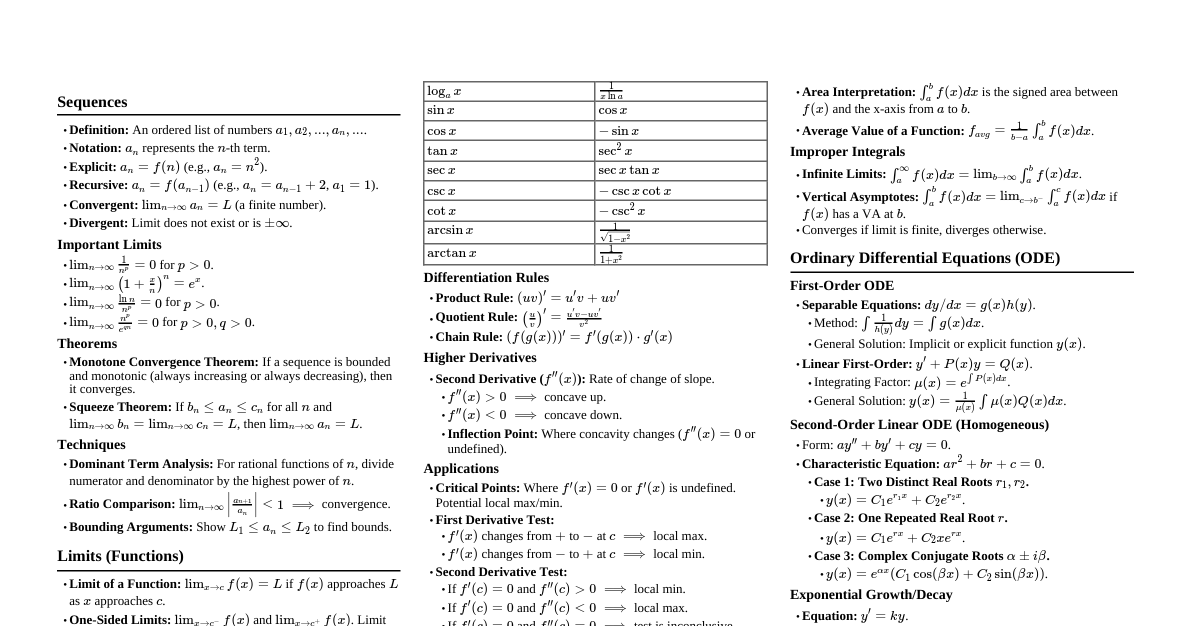
### Algebra: Quadratic Equations - **Standard Form:** $ax^2 + bx + c = 0$, where $a \neq 0$. - **Discriminant:** $D = b^2 - 4ac$. - $D > 0$: Two distinct real roots. - $D = 0$: Two equal real roots. - $D ### Algebra: Progressions #### Arithmetic Progression (AP) - **$n$-th term:** $a_n = a + (n-1)d$. - **Sum of $n$ terms:** $S_n = \frac{n}{2}(2a + (n-1)d) = \frac{n}{2}(a + a_n)$. - **Arithmetic Mean (A.M.):** If $a, A, b$ are in AP, then $A = \frac{a+b}{2}$. #### Geometric Progression (GP) - **$n$-th term:** $a_n = ar^{n-1}$. - **Sum of $n$ terms:** $S_n = \frac{a(r^n - 1)}{r-1}$ for $r \neq 1$. - **Sum to infinity ($|r| ### Algebra: Permutations & Combinations - **Factorial:** $n! = n \times (n-1) \times \dots \times 2 \times 1$; $0! = 1$. - **Permutations ($P(n,r)$ or $^nP_r$):** Arrangement of $r$ items from $n$ distinct items. $P(n,r) = \frac{n!}{(n-r)!}$. - **Combinations ($C(n,r)$ or $^nC_r$):** Selection of $r$ items from $n$ distinct items. $C(n,r) = \frac{n!}{r!(n-r)!}$. - **Properties:** - $^nC_r = ^nC_{n-r}$. - $^nC_r + ^nC_{r-1} = ^{n+1}C_r$. - $^nC_n = 1$, $^nC_0 = 1$. ### Algebra: Binomial Theorem - **For positive integer $n$:** $(x+y)^n = \sum_{k=0}^n {^nC_k x^{n-k} y^k} = ^nC_0 x^n + ^nC_1 x^{n-1}y + \dots + ^nC_n y^n$. - **General Term ($T_{r+1}$):** $T_{r+1} = {^nC_r x^{n-r} y^r}$. - **Number of terms:** $n+1$. - **Middle Term(s):** - If $n$ is even, one middle term: $T_{n/2 + 1}$. - If $n$ is odd, two middle terms: $T_{(n+1)/2}$ and $T_{(n+3)/2}$. - **Sum of binomial coefficients:** $\sum_{k=0}^n {^nC_k} = 2^n$. - **Alternating sum:** $\sum_{k=0}^n {(-1)^k ^nC_k} = 0$. ### Algebra: Logarithms - **Definition:** If $a^x = N$, then $\log_a N = x$ (where $a > 0, a \neq 1, N > 0$). - **Properties:** - $\log_a (MN) = \log_a M + \log_a N$. - $\log_a (\frac{M}{N}) = \log_a M - \log_a N$. - $\log_a (M^p) = p \log_a M$. - $\log_a a = 1$. - $\log_a 1 = 0$. - **Change of Base:** $\log_a N = \frac{\log_b N}{\log_b a}$. - $\log_a b = \frac{1}{\log_b a}$. - $a^{\log_a N} = N$. ### Algebra: Matrices & Determinants #### Matrices - **Order:** $m \times n$ (rows $\times$ columns). - **Addition/Subtraction:** Element-wise (same order required). - **Scalar Multiplication:** $k[a_{ij}] = [ka_{ij}]$. - **Matrix Multiplication:** $(AB)_{ij} = \sum_k A_{ik}B_{kj}$. (Number of columns in A = Number of rows in B). - **Transpose ($A^T$):** $(A^T)_{ij} = A_{ji}$. - $(A^T)^T = A$. - $(A+B)^T = A^T + B^T$. - $(kA)^T = kA^T$. - $(AB)^T = B^T A^T$. - **Symmetric Matrix:** $A^T = A$. - **Skew-Symmetric Matrix:** $A^T = -A$. - **Inverse ($A^{-1}$):** $AA^{-1} = A^{-1}A = I$. - $A^{-1} = \frac{1}{\det(A)} \text{adj}(A)$. - $(AB)^{-1} = B^{-1}A^{-1}$. - **Adjoint of a Matrix ($\text{adj}(A)$):** Transpose of the cofactor matrix. #### Determinants - **For a $2 \times 2$ matrix:** $A = \begin{pmatrix} a & b \\ c & d \end{pmatrix}$, $\det(A) = ad - bc$. - **For a $3 \times 3$ matrix:** $A = \begin{pmatrix} a_{11} & a_{12} & a_{13} \\ a_{21} & a_{22} & a_{23} \\ a_{31} & a_{32} & a_{33} \end{pmatrix}$, $\det(A) = a_{11}(a_{22}a_{33} - a_{23}a_{32}) - a_{12}(a_{21}a_{33} - a_{23}a_{31}) + a_{13}(a_{21}a_{32} - a_{22}a_{31})$. - **Properties:** - $\det(A^T) = \det(A)$. - $\det(AB) = \det(A)\det(B)$. - $\det(kA) = k^n \det(A)$ for $n \times n$ matrix. - If two rows/columns are identical or proportional, $\det(A) = 0$. - If a row/column is all zeros, $\det(A) = 0$. - **Singular Matrix:** $\det(A) = 0$. (Inverse does not exist). - **Non-Singular Matrix:** $\det(A) \neq 0$. (Inverse exists). - **Cramer's Rule (for system $Ax=B$):** $x_i = \frac{\det(A_i)}{\det(A)}$, where $A_i$ is matrix $A$ with $i$-th column replaced by $B$. ### Trigonometry: Basic Identities - $\sin^2 \theta + \cos^2 \theta = 1$. - $1 + \tan^2 \theta = \sec^2 \theta$. - $1 + \cot^2 \theta = \csc^2 \theta$. - $\tan \theta = \frac{\sin \theta}{\cos \theta}$. - $\cot \theta = \frac{\cos \theta}{\sin \theta}$. ### Trigonometry: Compound Angles - $\sin(A \pm B) = \sin A \cos B \pm \cos A \sin B$. - $\cos(A \pm B) = \cos A \cos B \mp \sin A \sin B$. - $\tan(A \pm B) = \frac{\tan A \pm \tan B}{1 \mp \tan A \tan B}$. - $\cot(A \pm B) = \frac{\cot A \cot B \mp 1}{\cot B \pm \cot A}$. ### Trigonometry: Multiple & Sub-multiple Angles - $\sin 2A = 2 \sin A \cos A = \frac{2 \tan A}{1 + \tan^2 A}$. - $\cos 2A = \cos^2 A - \sin^2 A = 2 \cos^2 A - 1 = 1 - 2 \sin^2 A = \frac{1 - \tan^2 A}{1 + \tan^2 A}$. - $\tan 2A = \frac{2 \tan A}{1 - \tan^2 A}$. - $\sin 3A = 3 \sin A - 4 \sin^3 A$. - $\cos 3A = 4 \cos^3 A - 3 \cos A$. - $\tan 3A = \frac{3 \tan A - \tan^3 A}{1 - 3 \tan^2 A}$. ### Trigonometry: Transformation Formulas #### Product to Sum/Difference - $2 \sin A \cos B = \sin(A+B) + \sin(A-B)$. - $2 \cos A \sin B = \sin(A+B) - \sin(A-B)$. - $2 \cos A \cos B = \cos(A+B) + \cos(A-B)$. - $2 \sin A \sin B = \cos(A-B) - \cos(A+B)$. #### Sum/Difference to Product - $\sin C + \sin D = 2 \sin(\frac{C+D}{2}) \cos(\frac{C-D}{2})$. - $\sin C - \sin D = 2 \cos(\frac{C+D}{2}) \sin(\frac{C-D}{2})$. - $\cos C + \cos D = 2 \cos(\frac{C+D}{2}) \cos(\frac{C-D}{2})$. - $\cos C - \cos D = -2 \sin(\frac{C+D}{2}) \sin(\frac{C-D}{2})$. ### Trigonometry: Inverse Functions - $\sin^{-1} x + \cos^{-1} x = \frac{\pi}{2}$. - $\tan^{-1} x + \cot^{-1} x = \frac{\pi}{2}$. - $\sec^{-1} x + \csc^{-1} x = \frac{\pi}{2}$. - $\tan^{-1} x + \tan^{-1} y = \tan^{-1} (\frac{x+y}{1-xy})$. - $\tan^{-1} x - \tan^{-1} y = \tan^{-1} (\frac{x-y}{1+xy})$. - $2 \tan^{-1} x = \tan^{-1} (\frac{2x}{1-x^2}) = \sin^{-1} (\frac{2x}{1+x^2}) = \cos^{-1} (\frac{1-x^2}{1+x^2})$. ### Trigonometry: Properties of Triangles - **Sine Rule:** $\frac{a}{\sin A} = \frac{b}{\sin B} = \frac{c}{\sin C} = 2R$. (R = circumradius) - **Cosine Rule:** - $a^2 = b^2 + c^2 - 2bc \cos A$. - $\cos A = \frac{b^2+c^2-a^2}{2bc}$. - **Area of Triangle ($\Delta$):** - $\Delta = \frac{1}{2}ab \sin C = \frac{1}{2}bc \sin A = \frac{1}{2}ca \sin B$. - $\Delta = \sqrt{s(s-a)(s-b)(s-c)}$ (Heron's Formula), where $s = \frac{a+b+c}{2}$. - $\Delta = \frac{abc}{4R}$. - $\Delta = rs$ (r = inradius). ### Coordinate Geometry: Straight Lines - **Distance Formula:** $D = \sqrt{(x_2-x_1)^2 + (y_2-y_1)^2}$. - **Section Formula:** - Internal division: $(\frac{m x_2 + n x_1}{m+n}, \frac{m y_2 + n y_1}{m+n})$. - Midpoint: $(\frac{x_1+x_2}{2}, \frac{y_1+y_2}{2})$. - **Slope ($m$):** $m = \frac{y_2-y_1}{x_2-x_1} = \tan \theta$. - **Equation of a Line:** - **Slope-intercept form:** $y = mx + c$. - **Point-slope form:** $y - y_1 = m(x - x_1)$. - **Two-point form:** $y - y_1 = \frac{y_2-y_1}{x_2-x_1}(x - x_1)$. - **Intercept form:** $\frac{x}{a} + \frac{y}{b} = 1$. - **Normal form:** $x \cos \alpha + y \sin \alpha = p$. - **General form:** $Ax + By + C = 0$. - **Angle between two lines:** $\tan \theta = \left| \frac{m_1 - m_2}{1 + m_1 m_2} \right|$. - Parallel lines: $m_1 = m_2$. - Perpendicular lines: $m_1 m_2 = -1$. - **Distance from a point $(x_1, y_1)$ to a line $Ax+By+C=0$:** $D = \frac{|Ax_1 + By_1 + C|}{\sqrt{A^2+B^2}}$. - **Area of Triangle** with vertices $(x_1, y_1), (x_2, y_2), (x_3, y_3)$: $\frac{1}{2} |x_1(y_2-y_3) + x_2(y_3-y_1) + x_3(y_1-y_2)|$. ### Coordinate Geometry: Circles - **Standard Equation:** $(x-h)^2 + (y-k)^2 = r^2$. (Center $(h,k)$, radius $r$). - **General Equation:** $x^2 + y^2 + 2gx + 2fy + c = 0$. - Center: $(-g, -f)$. - Radius: $\sqrt{g^2 + f^2 - c}$. - **Parametric Form:** $x = h + r \cos \theta$, $y = k + r \sin \theta$. - **Tangent at $(x_1, y_1)$:** $xx_1 + yy_1 + g(x+x_1) + f(y+y_1) + c = 0$. - **Condition for Tangency (line $y=mx+c$ to $x^2+y^2=a^2$):** $c^2 = a^2(1+m^2)$. ### Coordinate Geometry: Parabola - **Standard Equation:** $y^2 = 4ax$. - Vertex: $(0,0)$. Focus: $(a,0)$. Directrix: $x = -a$. - Axis: $y=0$. Latus Rectum: $4a$. - **Other forms:** $y^2 = -4ax$, $x^2 = 4ay$, $x^2 = -4ay$. - **Parametric Form ($y^2=4ax$):** $(at^2, 2at)$. - **Tangent at $(x_1, y_1)$ to $y^2=4ax$:** $yy_1 = 2a(x+x_1)$. ### Coordinate Geometry: Ellipse - **Standard Equation:** $\frac{x^2}{a^2} + \frac{y^2}{b^2} = 1$ (where $a > b$). - Center: $(0,0)$. - Foci: $(\pm ae, 0)$. - Vertices: $(\pm a, 0)$. Co-vertices: $(0, \pm b)$. - Eccentricity ($e$): $b^2 = a^2(1-e^2)$, $e = \sqrt{1 - \frac{b^2}{a^2}}$. - Directrices: $x = \pm \frac{a}{e}$. - Length of Latus Rectum: $\frac{2b^2}{a}$. - **Parametric Form:** $(a \cos \theta, b \sin \theta)$. - **Tangent at $(x_1, y_1)$:** $\frac{xx_1}{a^2} + \frac{yy_1}{b^2} = 1$. ### Coordinate Geometry: Hyperbola - **Standard Equation:** $\frac{x^2}{a^2} - \frac{y^2}{b^2} = 1$. - Center: $(0,0)$. - Foci: $(\pm ae, 0)$. - Vertices: $(\pm a, 0)$. - Eccentricity ($e$): $b^2 = a^2(e^2-1)$, $e = \sqrt{1 + \frac{b^2}{a^2}}$. - Directrices: $x = \pm \frac{a}{e}$. - Length of Latus Rectum: $\frac{2b^2}{a}$. - **Conjugate Hyperbola:** $\frac{y^2}{b^2} - \frac{x^2}{a^2} = 1$. - **Parametric Form:** $(a \sec \theta, b \tan \theta)$. - **Tangent at $(x_1, y_1)$:** $\frac{xx_1}{a^2} - \frac{yy_1}{b^2} = 1$. ### Coordinate Geometry: 3D Geometry #### Direction Cosines & Ratios - **Direction Cosines ($l, m, n$):** $\cos \alpha, \cos \beta, \cos \gamma$. - $l^2 + m^2 + n^2 = 1$. - **Direction Ratios ($a, b, c$):** Proportional to direction cosines. - $l = \frac{a}{\sqrt{a^2+b^2+c^2}}$, etc. - **Angle between two lines:** $\cos \theta = |l_1l_2 + m_1m_2 + n_1n_2|$. #### Straight Line in Space - **Equation of line through $(x_1, y_1, z_1)$ with DRs $(a, b, c)$:** - **Vector Form:** $\vec{r} = \vec{a} + \lambda \vec{b}$. - **Cartesian Form:** $\frac{x-x_1}{a} = \frac{y-y_1}{b} = \frac{z-z_1}{c}$. - **Equation of line through $(x_1, y_1, z_1)$ and $(x_2, y_2, z_2)$:** - **Vector Form:** $\vec{r} = \vec{a} + \lambda (\vec{b} - \vec{a})$. - **Cartesian Form:** $\frac{x-x_1}{x_2-x_1} = \frac{y-y_1}{y_2-y_1} = \frac{z-z_1}{z_2-z_1}$. - **Shortest distance between two skew lines:** $\vec{r} = \vec{a_1} + \lambda \vec{b_1}$ and $\vec{r} = \vec{a_2} + \mu \vec{b_2}$. $SD = \left| \frac{(\vec{a_2} - \vec{a_1}) \cdot (\vec{b_1} \times \vec{b_2})}{|\vec{b_1} \times \vec{b_2}|} \right|$. #### Plane - **Equation of a plane:** - **General Form:** $Ax + By + Cz + D = 0$. (Normal vector $\vec{n} = A\hat{i} + B\hat{j} + C\hat{k}$). - **Normal Form:** $lx + my + nz = p$. - **Intercept Form:** $\frac{x}{a} + \frac{y}{b} + \frac{z}{c} = 1$. - **Through a point $(x_1, y_1, z_1)$ and normal $\vec{n} = A\hat{i} + B\hat{j} + C\hat{k}$:** $A(x-x_1) + B(y-y_1) + C(z-z_1) = 0$. - **Distance from a point $(x_1, y_1, z_1)$ to plane $Ax+By+Cz+D=0$:** $D = \frac{|Ax_1 + By_1 + Cz_1 + D|}{\sqrt{A^2+B^2+C^2}}$. - **Angle between two planes:** $\cos \theta = \left| \frac{A_1A_2 + B_1B_2 + C_1C_2}{\sqrt{A_1^2+B_1^2+C_1^2}\sqrt{A_2^2+B_2^2+C_2^2}} \right|$. ### Calculus: Functions & Limits #### Functions - **Domain:** Set of all possible input values for which the function is defined. - **Range:** Set of all possible output values of the function. - **Types of Functions:** - **One-one (Injective):** If $f(x_1) = f(x_2) \implies x_1 = x_2$. - **Onto (Surjective):** For every $y$ in codomain, there exists $x$ in domain such that $f(x) = y$. - **Bijective:** Both one-one and onto. (Has an inverse). - **Even Function:** $f(-x) = f(x)$. (Symmetric about y-axis). - **Odd Function:** $f(-x) = -f(x)$. (Symmetric about origin). - **Periodic Function:** $f(x+T) = f(x)$ for some $T > 0$. (Smallest such $T$ is period). - **Composition of Functions:** $(f \circ g)(x) = f(g(x))$. #### Limits - **Definition:** $\lim_{x \to a} f(x) = L$ if for every $\epsilon > 0$, there exists $\delta > 0$ such that $0 ### Calculus: Continuity & Differentiability #### Continuity - A function $f(x)$ is continuous at $x=a$ if $\lim_{x \to a^-} f(x) = \lim_{x \to a^+} f(x) = f(a)$. #### Differentiability - A function $f(x)$ is differentiable at $x=a$ if $\lim_{h \to 0} \frac{f(a+h) - f(a)}{h}$ exists. - This limit is called the derivative of $f(x)$ at $x=a$, denoted $f'(a)$. - If a function is differentiable at a point, it is continuous at that point. The converse is not true. ### Calculus: Differentiation #### Basic Derivatives - $\frac{d}{dx}(c) = 0$. - $\frac{d}{dx}(x^n) = nx^{n-1}$. - $\frac{d}{dx}(e^x) = e^x$. - $\frac{d}{dx}(a^x) = a^x \ln a$. - $\frac{d}{dx}(\ln x) = \frac{1}{x}$. - $\frac{d}{dx}(\log_a x) = \frac{1}{x \ln a}$. - $\frac{d}{dx}(\sin x) = \cos x$. - $\frac{d}{dx}(\cos x) = -\sin x$. - $\frac{d}{dx}(\tan x) = \sec^2 x$. - $\frac{d}{dx}(\cot x) = -\csc^2 x$. - $\frac{d}{dx}(\sec x) = \sec x \tan x$. - $\frac{d}{dx}(\csc x) = -\csc x \cot x$. - $\frac{d}{dx}(\sin^{-1} x) = \frac{1}{\sqrt{1-x^2}}$. - $\frac{d}{dx}(\cos^{-1} x) = -\frac{1}{\sqrt{1-x^2}}$. - $\frac{d}{dx}(\tan^{-1} x) = \frac{1}{1+x^2}$. #### Rules of Differentiation - **Sum/Difference Rule:** $\frac{d}{dx}(u \pm v) = \frac{du}{dx} \pm \frac{dv}{dx}$. - **Product Rule:** $\frac{d}{dx}(uv) = u \frac{dv}{dx} + v \frac{du}{dx}$. - **Quotient Rule:** $\frac{d}{dx}(\frac{u}{v}) = \frac{v \frac{du}{dx} - u \frac{dv}{dx}}{v^2}$. - **Chain Rule:** $\frac{dy}{dx} = \frac{dy}{du} \frac{du}{dx}$. - **Implicit Differentiation:** Differentiate both sides w.r.t. $x$, treating $y$ as a function of $x$. - **Parametric Differentiation:** If $x=f(t), y=g(t)$, then $\frac{dy}{dx} = \frac{dy/dt}{dx/dt}$. ### Calculus: Applications of Derivatives - **Rate of Change:** If $y = f(x)$, then $\frac{dy}{dx}$ is the rate of change of $y$ w.r.t. $x$. - **Tangents and Normals:** - Slope of tangent at $(x_1, y_1)$: $m_T = (\frac{dy}{dx})_{(x_1, y_1)}$. - Equation of tangent: $y - y_1 = m_T(x - x_1)$. - Slope of normal: $m_N = -\frac{1}{m_T}$. - Equation of normal: $y - y_1 = m_N(x - x_1)$. - **Increasing/Decreasing Functions:** - $f'(x) > 0$: $f(x)$ is increasing. - $f'(x) 0$: local minimum at $x=c$. - $f''(c) = 0$: test fails, use first derivative test. - **Rolle's Theorem:** If $f(x)$ is continuous on $[a,b]$, differentiable on $(a,b)$, and $f(a)=f(b)$, then there exists $c \in (a,b)$ such that $f'(c)=0$. - **Mean Value Theorem (Lagrange's):** If $f(x)$ is continuous on $[a,b]$ and differentiable on $(a,b)$, then there exists $c \in (a,b)$ such that $f'(c) = \frac{f(b)-f(a)}{b-a}$. ### Calculus: Indefinite Integration #### Basic Formulas - $\int x^n dx = \frac{x^{n+1}}{n+1} + C$ ($n \neq -1$). - $\int \frac{1}{x} dx = \ln|x| + C$. - $\int e^x dx = e^x + C$. - $\int a^x dx = \frac{a^x}{\ln a} + C$. - $\int \sin x dx = -\cos x + C$. - $\int \cos x dx = \sin x + C$. - $\int \sec^2 x dx = \tan x + C$. - $\int \csc^2 x dx = -\cot x + C$. - $\int \sec x \tan x dx = \sec x + C$. - $\int \csc x \cot x dx = -\csc x + C$. - $\int \frac{1}{\sqrt{a^2-x^2}} dx = \sin^{-1}(\frac{x}{a}) + C$. - $\int \frac{1}{a^2+x^2} dx = \frac{1}{a} \tan^{-1}(\frac{x}{a}) + C$. - $\int \frac{1}{x\sqrt{x^2-a^2}} dx = \frac{1}{a} \sec^{-1}(\frac{x}{a}) + C$. - $\int \frac{1}{x^2-a^2} dx = \frac{1}{2a} \ln|\frac{x-a}{x+a}| + C$. - $\int \frac{1}{a^2-x^2} dx = \frac{1}{2a} \ln|\frac{a+x}{a-x}| + C$. - $\int \frac{1}{\sqrt{x^2 \pm a^2}} dx = \ln|x + \sqrt{x^2 \pm a^2}| + C$. #### Integration Methods - **Substitution Method:** $\int f(g(x))g'(x)dx = \int f(u)du$ by substituting $u=g(x)$. - **Integration by Parts:** $\int u dv = uv - \int v du$. (Choose $u$ using ILATE rule: Inverse, Log, Algebra, Trig, Exp). ### Calculus: Definite Integration - **Fundamental Theorem of Calculus:** $\int_a^b f(x) dx = F(b) - F(a)$, where $F'(x) = f(x)$. - **Properties:** - $\int_a^b f(x) dx = -\int_b^a f(x) dx$. - $\int_a^b f(x) dx = \int_a^c f(x) dx + \int_c^b f(x) dx$. - $\int_0^a f(x) dx = \int_0^a f(a-x) dx$. - $\int_a^b f(x) dx = \int_a^b f(a+b-x) dx$. - $\int_{-a}^a f(x) dx = 2 \int_0^a f(x) dx$ if $f(x)$ is even. - $\int_{-a}^a f(x) dx = 0$ if $f(x)$ is odd. ### Calculus: Differential Equations - **Order:** Highest order derivative in the equation. - **Degree:** Power of the highest order derivative (after making it a polynomial). - **Methods of Solving First Order, First Degree DEs:** - **Variable Separable:** $\frac{dy}{dx} = f(x)g(y) \implies \int \frac{dy}{g(y)} = \int f(x)dx$. - **Homogeneous:** $\frac{dy}{dx} = f(\frac{y}{x})$. Substitute $y=vx \implies \frac{dy}{dx} = v + x \frac{dv}{dx}$. - **Linear Differential Equation:** $\frac{dy}{dx} + Py = Q$. - Integrating Factor (I.F.): $e^{\int P dx}$. - Solution: $y \cdot (\text{I.F.}) = \int Q \cdot (\text{I.F.}) dx + C$. ### Calculus: Area Under Curves - **Area bounded by $y=f(x)$, x-axis, $x=a$, $x=b$:** $\int_a^b |f(x)| dx$. - **Area bounded by $x=g(y)$, y-axis, $y=c$, $y=d$:** $\int_c^d |g(y)| dy$. - **Area between two curves $y=f(x)$ and $y=g(x)$ from $x=a$ to $x=b$:** $\int_a^b |f(x) - g(x)| dx$. ### Vectors: Algebra - **Vector:** Quantity with magnitude and direction. - **Position Vector:** $\vec{r} = x\hat{i} + y\hat{j} + z\hat{k}$. - **Magnitude:** $|\vec{r}| = \sqrt{x^2+y^2+z^2}$. - **Unit Vector:** $\hat{r} = \frac{\vec{r}}{|\vec{r}|}$. - **Vector Addition:** $\vec{a} + \vec{b} = (a_1+b_1)\hat{i} + (a_2+b_2)\hat{j} + (a_3+b_3)\hat{k}$. - **Scalar Multiplication:** $k\vec{a} = (ka_1)\hat{i} + (ka_2)\hat{j} + (ka_3)\hat{k}$. ### Vectors: Dot Product (Scalar Product) - $\vec{a} \cdot \vec{b} = |\vec{a}| |\vec{b}| \cos \theta$. - If $\vec{a} = a_1\hat{i} + a_2\hat{j} + a_3\hat{k}$ and $\vec{b} = b_1\hat{i} + b_2\hat{j} + b_3\hat{k}$: $\vec{a} \cdot \vec{b} = a_1b_1 + a_2b_2 + a_3b_3$. - **Properties:** - $\vec{a} \cdot \vec{a} = |\vec{a}|^2$. - If $\vec{a} \perp \vec{b}$, then $\vec{a} \cdot \vec{b} = 0$. - $\hat{i} \cdot \hat{i} = \hat{j} \cdot \hat{j} = \hat{k} \cdot \hat{k} = 1$. - $\hat{i} \cdot \hat{j} = \hat{j} \cdot \hat{k} = \hat{k} \cdot \hat{i} = 0$. - **Projection of $\vec{a}$ on $\vec{b}$:** $\frac{\vec{a} \cdot \vec{b}}{|\vec{b}|}$. ### Vectors: Cross Product (Vector Product) - $\vec{a} \times \vec{b} = |\vec{a}| |\vec{b}| \sin \theta \hat{n}$, where $\hat{n}$ is unit vector perpendicular to both $\vec{a}$ and $\vec{b}$. - $\vec{a} \times \vec{b} = \begin{vmatrix} \hat{i} & \hat{j} & \hat{k} \\ a_1 & a_2 & a_3 \\ b_1 & b_2 & b_3 \end{vmatrix}$. - **Properties:** - $\vec{a} \times \vec{b} = -(\vec{b} \times \vec{a})$. - If $\vec{a} \parallel \vec{b}$, then $\vec{a} \times \vec{b} = \vec{0}$. - $\hat{i} \times \hat{i} = \hat{j} \times \hat{j} = \hat{k} \times \hat{k} = \vec{0}$. - $\hat{i} \times \hat{j} = \hat{k}$, $\hat{j} \times \hat{k} = \hat{i}$, $\hat{k} \times \hat{i} = \hat{j}$. - **Area of Parallelogram:** $|\vec{a} \times \vec{b}|$. - **Area of Triangle:** $\frac{1}{2} |\vec{a} \times \vec{b}|$. ### Vectors: Scalar Triple Product (Box Product) - $[\vec{a} \vec{b} \vec{c}] = \vec{a} \cdot (\vec{b} \times \vec{c}) = \begin{vmatrix} a_1 & a_2 & a_3 \\ b_1 & b_2 & b_3 \\ c_1 & c_2 & c_3 \end{vmatrix}$. - **Geometric Interpretation:** Volume of parallelepiped with $\vec{a}, \vec{b}, \vec{c}$ as adjacent edges. - **Properties:** - $[\vec{a} \vec{b} \vec{c}] = [\vec{b} \vec{c} \vec{a}] = [\vec{c} \vec{a} \vec{b}]$. - If any two vectors are collinear or coplanar, STP is 0. ### Vectors: Vector Triple Product - $\vec{a} \times (\vec{b} \times \vec{c}) = (\vec{a} \cdot \vec{c})\vec{b} - (\vec{a} \cdot \vec{b})\vec{c}$. (BAC - CAB rule) ### Probability & Statistics #### Probability - **Probability of an event E:** $P(E) = \frac{\text{Number of favorable outcomes}}{\text{Total number of outcomes}}$. - **Complementary Event:** $P(E') = 1 - P(E)$. - **Addition Theorem:** $P(A \cup B) = P(A) + P(B) - P(A \cap B)$. - For mutually exclusive events: $P(A \cup B) = P(A) + P(B)$. - **Conditional Probability:** $P(A|B) = \frac{P(A \cap B)}{P(B)}$, where $P(B) \neq 0$. - **Multiplication Theorem:** $P(A \cap B) = P(A) P(B|A) = P(B) P(A|B)$. - For independent events: $P(A \cap B) = P(A) P(B)$. - **Bayes' Theorem:** $P(E_i|A) = \frac{P(A|E_i)P(E_i)}{\sum_{j=1}^n P(A|E_j)P(E_j)}$. #### Random Variables & Distributions - **Binomial Distribution:** $P(X=k) = {^nC_k p^k (1-p)^{n-k}}$. - Mean: $np$. - Variance: $np(1-p)$. #### Measures of Central Tendency - **Mean ($\bar{x}$):** $\frac{\sum x_i}{n}$ or $\frac{\sum f_i x_i}{\sum f_i}$. - **Median:** Middle value of ordered data. - **Mode:** Most frequent value. #### Measures of Dispersion - **Variance ($\sigma^2$):** $\frac{\sum (x_i - \bar{x})^2}{n}$ or $\frac{\sum f_i (x_i - \bar{x})^2}{\sum f_i}$. - **Standard Deviation ($\sigma$):** $\sqrt{\text{Variance}}$.