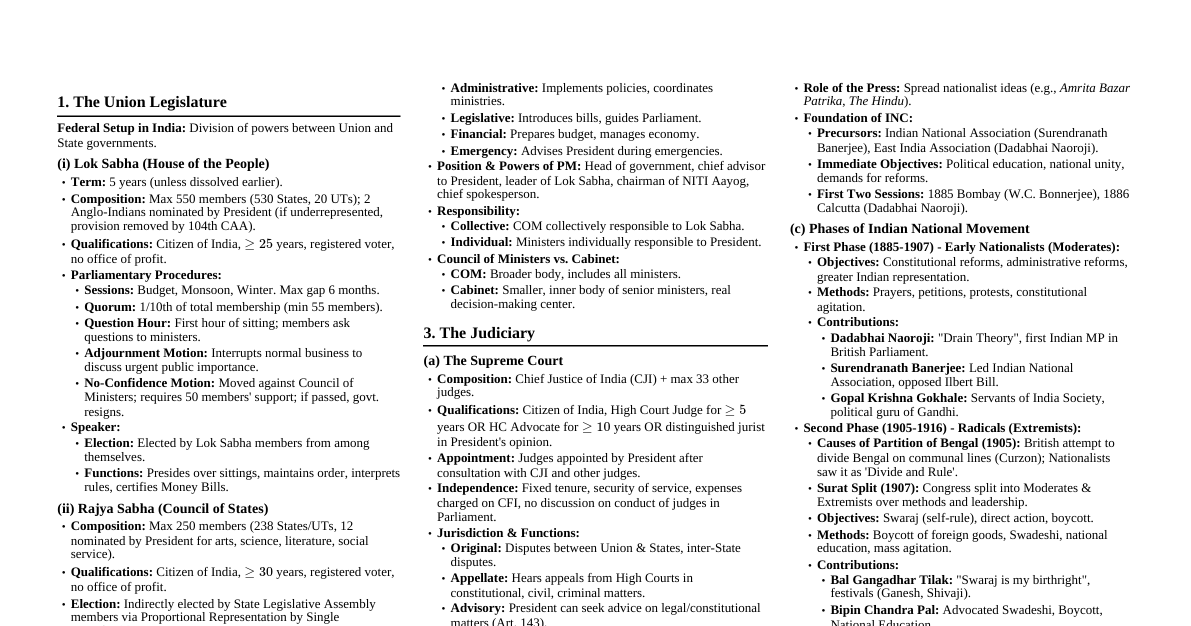
Union Legislature Cheatsheet
Cheatsheet Content
I. Federal Setup in India India is a "Union of States" (Article 1), which implies: Indian Federation is not a result of an agreement among states. States have no right to secede from the federation. It is a quasi-federal system, a blend of federal and unitary features. II. Federal Features of the Indian Constitution Dual Polity: Separate Union and State governments. Written Constitution: Clearly defines powers and structure. Division of Powers: Seventh Schedule (Union, State, Concurrent Lists). Supremacy of the Constitution: Supreme law of the land. Rigid Constitution: Requires special procedure for amendment. Independent Judiciary: Supreme Court acts as interpreter and guardian of the Constitution. Bicameralism: Two houses in Parliament (Lok Sabha & Rajya Sabha) representing people and states, respectively. III. Unitary Features of the Indian Constitution Strong Centre: Union List has more subjects; Centre can legislate on Concurrent List. Single Constitution: For both Union and States (except J&K, which had its own Constitution until 2019). Single Citizenship: All citizens are citizens of India, not of individual states. Flexibility of the Constitution: Large parts can be amended by simple majority. Integrated Judiciary: Single hierarchy of courts, with Supreme Court at the top. Appointment of Governor: Appointed by the President, acts as Centre's agent in states. All-India Services: IAS, IPS, IFS recruited by Centre, serve in states. Emergency Provisions: Centre can assume full control during emergencies (Articles 352, 356, 360). Parliament's power to form new states or alter boundaries: Article 3. IV. The Union Legislature (Parliament) Article 79: Parliament consists of the President, Lok Sabha, and Rajya Sabha. It is a bicameral legislature. V. Lok Sabha (House of the People) A. Composition Maximum Strength: 550 members . 530 from States (direct election). 20 from Union Territories (direct election). (Originally, 2 nominated Anglo-Indians, abolished by 104th Amendment Act, 2019). Elections: Universal Adult Franchise (18+ years). Seats are allotted to States on the basis of population. B. Qualifications for Membership (Article 84) Citizen of India. Not less than 25 years of age. Must possess other qualifications prescribed by Parliament (e.g., enrolled as an elector). C. Term Normal term: 5 years from the date of its first meeting. Can be dissolved earlier by the President on the advice of the Council of Ministers. Term can be extended by Parliament during a National Emergency for 1 year at a time, but not beyond 6 months after emergency ceases. D. Vacation of Seat (Article 101) Disqualification: If a person incurs disqualifications mentioned in Article 102 (e.g., office of profit, unsound mind, undischarged insolvent, not a citizen of India, disqualified under any law made by Parliament). Resignation: Member resigns by writing to the Speaker/Chairman. Absence: Absent for 60 days without permission. Double Membership: Cannot be a member of both Houses or both Parliament and State Legislature. Anti-defection Law: Disqualified if voluntarily gives up membership of political party or votes against party whip (Tenth Schedule). E. Speaker of the Lok Sabha Election: Elected by Lok Sabha members from amongst themselves at its first sitting after general elections. Term: Holds office till the first meeting of the next Lok Sabha. Removal: By a resolution passed by a majority of all the then members of the Lok Sabha, after 14 days' notice. F. Deputy Speaker Elected by Lok Sabha from amongst its members after the Speaker's election. Performs Speaker's duties when the office is vacant or Speaker is absent. G. Powers and Functions of Speaker Presides over the sittings of the Lok Sabha. Maintains order and decorum in the House. Adjourns the House or suspends meeting in absence of quorum. Casts a casting vote in case of a tie. Decides whether a bill is a Money Bill (his decision is final). Decides on disqualification of members under the Anti-defection Law. Presides over the joint sitting of both Houses of Parliament. Acts as the ex-officio Chairman of the Business Advisory Committee, Rules Committee, and General Purposes Committee. VI. Rajya Sabha (Council of States) A. Composition Maximum Strength: 250 members . 238 representatives of States and Union Territories (indirect election). 12 nominated by the President (from fields of art, literature, science, social service). B. Election of Members Elected by the elected members of the State Legislative Assemblies. Method: Proportional Representation by means of Single Transferable Vote. C. Qualifications for Membership (Article 84) Citizen of India. Not less than 30 years of age. Must possess other qualifications prescribed by Parliament (e.g., enrolled as an elector in the state/UT from which seeking election). D. Term A permanent body , not subject to dissolution. One-third of its members retire every 2nd year . Members have a term of 6 years . E. Presiding Officers Chairman: The Vice-President of India is the ex-officio Chairman of Rajya Sabha. Deputy Chairman: Elected by Rajya Sabha members from amongst themselves. VII. Parliamentary Procedure A. Sessions of Parliament There are usually three sessions in a year: Budget Session: February-May (longest). Monsoon Session: July-September. Winter Session: November-December (shortest). The maximum gap between two sessions cannot be more than six months . Summoning: President summons each House of Parliament to meet. Prorogation: President terminates a session (but not the House itself). Dissolution: Only Lok Sabha can be dissolved by the President on PM's advice or if no party has a majority. B. Quorum for the Session (Article 100) Minimum number of members required to be present to conduct business. 1/10th of the total strength of the House (including the presiding officer). If there is no quorum, the presiding officer either adjourns the House or suspends the meeting. C. Question Hour The first hour of every parliamentary sitting. Members ask questions to ministers to seek information and hold the government accountable. Types of questions: Starred: Oral answer, supplementary questions allowed. Unstarred: Written answer, no supplementary questions. Short Notice: Asked with less than 10 days' notice, oral answer. D. Zero Hour Starts immediately after Question Hour and lasts until the agenda for the day. Members can raise matters of public importance without prior notice. An Indian innovation, not mentioned in the Rules of Procedure. E. Motions of the Parliament Adjournment Motion: To draw attention to a definite matter of urgent public importance (needs 50 members' support in Lok Sabha). No-Confidence Motion: Moved only in Lok Sabha, against the Council of Ministers (needs 50 members' support). If passed, PM and COMs resign. Censure Motion: Moved against a specific minister or group of ministers for specific policies/actions. Calling Attention Motion: To call attention of a minister to a matter of urgent public importance. Cut Motion: Moved to reduce a demand for grant (part of budget discussion). F. End of the Session A session ends by prorogation (by President) or dissolution (of Lok Sabha by President). VIII. Powers and Functions of the Union Parliament A. Legislative Powers Makes laws on subjects in the Union List and Concurrent List . Can legislate on State List subjects under specific conditions (e.g., national interest, emergency, President's Rule, request by states). Has residuary powers (subjects not in any list). Can initiate and pass Ordinary Bills, Money Bills, Financial Bills, and Constitutional Amendment Bills. B. Financial Powers Enacts the Union Budget: Authorizes government expenditure and taxation. Approves proposals for raising loans. Supervises public expenditure through committees like Public Accounts Committee, Estimates Committee. No tax can be levied or collected, and no expenditure can be incurred without parliamentary approval. C. Judicial Powers Can impeach the President (Article 61). Can recommend removal of judges of Supreme Court and High Courts, Chief Election Commissioner, CAG. Can punish for contempt of Parliament. D. Electoral Powers Elects the President (along with State Legislative Assemblies). Elects the Vice-President . Elects its own presiding officers (Speaker, Deputy Speaker, Deputy Chairman). E. Powers of Amendment of the Constitution (Article 368) Can amend the Constitution (some provisions by simple majority, others by special majority, and some by special majority + state ratification). F. Powers to Control Executive By asking questions (Question Hour). By moving motions (e.g., No-Confidence Motion, Censure Motion). By discussing policies and bills. Through parliamentary committees. Budgetary control (demands for grants, cut motions). IX. Exclusive or Special Powers of Lok Sabha Money Bills: Can only be introduced in Lok Sabha. Rajya Sabha has limited powers (can delay for 14 days, suggest amendments but Lok Sabha is not bound). No-Confidence Motion: Can only be moved and passed in Lok Sabha against the Council of Ministers. Dominant role in passing the annual budget and other financial legislation. X. Exclusive or Special Powers of Rajya Sabha Article 249: Power to declare that it is necessary in the national interest for Parliament to make laws on a subject enumerated in the State List. Article 312: Power to create new All India Services . Can initiate a resolution for the removal of the Vice-President (effective only if passed by Rajya Sabha with an absolute majority).