Principles of Management (MBA-
Cheatsheet Content
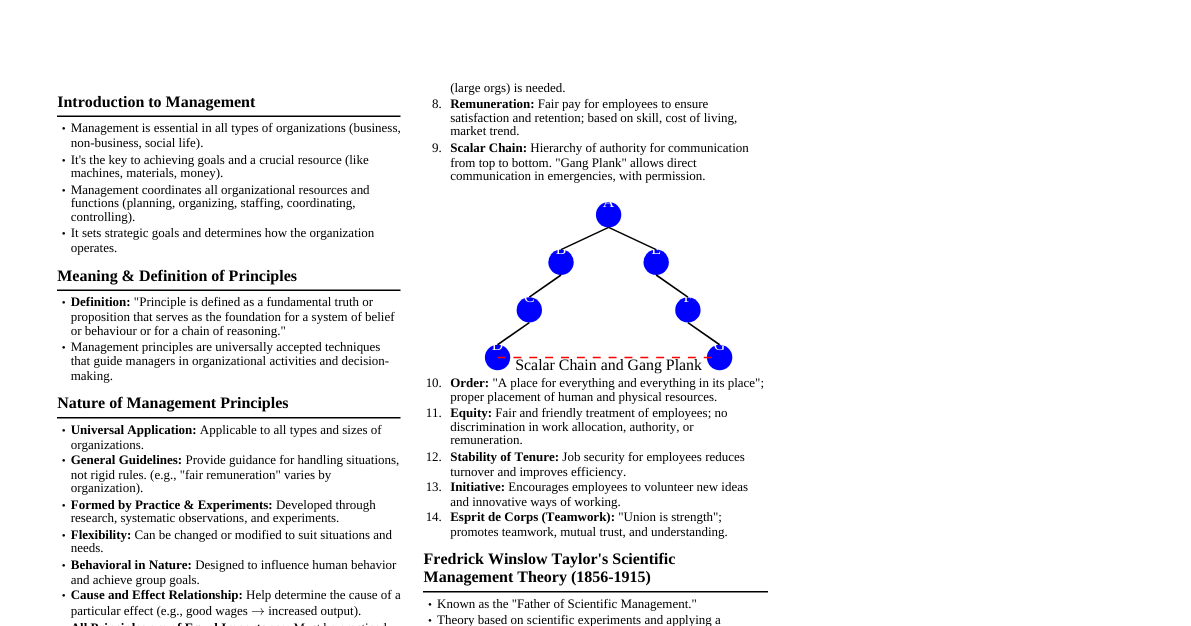
### MBA101: Principles & Practices of Management This cheatsheet provides a concise overview of core management concepts, theories, and practices, focusing on key roles, skills, and functions essential for effective and efficient achievement of goals. ### Unit I: Introduction to Management - **Definition & Scope**: Management is the process of getting work done through others, involving planning, organizing, activating, and controlling to achieve definite goals using human and material resources. It's a universal process in all organized social and economic activities. - **Conceptualizations of Management**: - **As a Noun**: Refers to all personnel responsible for getting things done through others (e.g., CEOs, supervisors). - **As a Process**: Describes the functions a manager performs (planning, organizing, staffing, directing, coordinating, controlling). - **As an Activity**: Involves accomplishing tasks through others' efforts (interpersonal, decisional, informative activities). - **As a Group**: Refers to all individuals engaged in managerial activities at various levels. - **As a Discipline**: A body of knowledge, practice, and subject of study, encompassing managerial principles. - **Managerial Roles & Skills**: - **Interpersonal**: Figurehead, Leader, Liaison. - **Informational**: Monitor, Disseminator, Spokesperson. - **Decisional**: Entrepreneur, Disturbance Handler, Resource Allocator, Negotiator. - **Managerial Ethics**: Need, importance, classification, and ethical dilemmas. - **Corporate Social Responsibility (CSR)**: Concept, need, tools, and strategies. - **Evolution of Management Thought**: - **Scientific Management**: F.W. Taylor (Father of Scientific Management). Focuses on enhancing worker productivity through scientific techniques (e.g., work study, standardization, scientific selection, functional foremanship, differential piece-rate system, mental revolution). - **General Administrative Theories**: Henri Fayol (Father of Management) and Max Weber (Bureaucracy). - **Fayol's Contributions**: Identified six business activities (technical, commercial, financial, security, accounting, managerial) and five management elements (forecasting & planning, organizing, command, coordination, control). - **Fayol's 14 Principles of Management**: 1. **Division of Work**: Specialization for efficiency. 2. **Authority & Responsibility**: Parity between power and accountability. 3. **Discipline**: Observance of rules and respect. 4. **Unity of Command**: One subordinate, one superior. 5. **Unity of Direction**: One plan for activities with the same objective. 6. **Subordination of Individual Interest to Group Interest**: Collective good prevails. 7. **Remuneration of Personnel**: Fair payment for satisfaction. 8. **Centralization**: Degree to which decision-making power is concentrated. 9. **Scalar Chain**: Hierarchy of authority from top to lowest ranks. 10. **Order**: Systematic arrangement of people and materials. 11. **Equity**: Fairness, kindliness, and justice. 12. **Stability of Tenure of Personnel**: Minimize employee turnover. 13. **Initiative**: Encourage subordinates to propose and execute plans. 14. **Esprit de Corps**: Promote team spirit and cooperation. - **Weber's Bureaucracy**: Ideal organization with division of labor, hierarchy, rules, and impersonal relations. - **Quantitative Approach**: Uses mathematical models and scientific techniques (e.g., operations research, linear programming) for decision-making. - **Behavioral Approach**: Focuses on human element at work, understanding employee actions and motivations (e.g., Hawthorne Studies). - **Systems Approach**: Views organization as an open system interacting with its environment, with interdependent parts working towards goals. - **Contingency Approach**: States that there is no one universally applicable management principle; effective management depends on the situation. ### Unit II: Planning - **Definition**: Deciding in advance what to do, when to do, how to do, and who is to do it. It is "thinking before doing." - **Nature of Planning**: - **Primary Function**: Foremost management function. - **Focuses on Objectives**: Determines goals and means to achieve them. - **Function of all Managers**: Performed at all levels, with top management dedicating more time. - **Intellectual Process**: Involves creative thinking and imagination. - **Continuous Process**: Ongoing and never-ending. - **Dynamic**: Flexible and changes with the business environment. - **Ensures Efficiency, Economy, Accuracy**: Aims for optimal resource utilization and minimal cost. - **Forecasting**: Predicts future trends. - **Linking Factor**: Links current actions to future objectives. - **Types of Business Plans**: 1. **Mission**: Basic reason/idea behind setting up an organization. 2. **Objectives/Goals**: Ends towards which activity is aimed. 3. **Strategies**: Comprehensive plans to achieve objectives, considering competitors. 4. **Policies**: Guides to action, defining decision-making limits. 5. **Procedures**: Chronological sequences of required actions. 6. **Programs**: Sequences of activities to implement policies and achieve objectives. 7. **Budgets**: Quantitative statements of expected results (revenue, costs). 8. **Rules**: Specific actions to be taken or not taken. - **Planning Process**: 1. **Being Aware of Opportunities**: Identify internal and external opportunities, strengths, and weaknesses. 2. **Establishing Objectives**: Set overall and subordinate unit objectives (long-term and short-term). 3. **Developing Premises**: Establish assumptions (forecasts, policies) on which planning is based. 4. **Determining Alternative Courses**: Search for and examine various options. 5. **Evaluating Alternative Courses**: Weigh pros and cons of each alternative (profitability, risk, resource requirements). 6. **Selecting a Course**: Choose the best alternative or combination. 7. **Formulating Derivative Plans**: Develop subsidiary plans for different departments. 8. **Quantifying Plans by Budgeting**: Translate plans into numerical budgets. 9. **Coordination of Short and Long Range Plans**: Ensure alignment between immediate and long-term goals. 10. **Controlling the Plans**: Monitor progress, identify shortcomings, and take corrective measures. - **Management by Objectives (MBO)**: - **Definition**: A dynamic system integrating company goals with managers' need to contribute and develop, focusing on results. - **Features**: 1. **Participation & Interaction**: Superiors and subordinates jointly formulate objectives. 2. **Jointly Setting Goals**: Mutual effort in setting targets. 3. **Mutually Devise Methodology**: Discussion on methods and training needs. 4. **Review of Progress**: Regular monitoring of performance. 5. **Support from Top Management**: Essential for success. 6. **Result-Oriented**: Focuses on outcomes, not just means. 7. **System of Information**: Required for implementation. - **Process**: Preliminary objective setting → Identification of key results → Determination of subordinate objectives → Revision of job description → Matching goals & resource allocation → Recycling objectives → Establishing checkpoints → Review & appraisal of performance → Counseling. - **Benefits**: Improved performance, clarified organizational action, team spirit, maximum human resource utilization, better decision-making, basis for organizational change, effective controls & appraisal, improved communication, no role ambiguity, motivation, career development, result-based performance evaluation. - **Limitations**: Lack of top management support, resentful attitude of subordinates, failure to teach MBO philosophy, difficulties in quantifying goals, emphasis on short-run objectives, time-consuming, pressure on employees, lack of adequate skills/training, poor integration, inflexibility, not a substitute for success, limited application, long gestation period, lack of follow-up. ### Unit III: Organizing - **Concept**: The process of defining and grouping activities and establishing authority relationships to achieve organizational goals. - **Nature/Characteristics**: 1. **Division of Work**: Tasks are divided for specialization. 2. **Coordination**: Ensures all efforts align towards common objectives. 3. **Plurality of Persons**: Requires a group of individuals. 4. **Common Objectives**: All efforts directed towards shared goals. 5. **Well-defined Authority & Responsibility**: Clear roles and accountability. 6. **Superior-Subordinate Relationship**: Defines reporting lines. 7. **Dynamic**: Adapts to changes in knowledge and environment. - **Types of Organization**: - **Formal Organization**: Defined authority, responsibility, and relationships, bound by rules. - **Principles**: Division of work, Span of Control, Unity of Command, Scalar Principle. - **Informal Organization**: Arises from common interests, tastes, and relations; based on mutual goodwill. - **Process of Organizing**: 1. **Fixing Objectives**: Establish goals. 2. **Identifying Activities**: Determine tasks needed to achieve objectives. 3. **Grouping Activities**: Combine similar tasks into departments. 4. **Defining Responsibility**: Assign tasks to individuals. 5. **Delegation of Authority**: Grant power to make decisions. 6. **Defining Inter-relationship**: Clarify reporting lines. 7. **Providing Requirements**: Ensure employees have necessary resources. 8. **Coordinating Efforts**: Harmonize all activities. - **Organizational Structure**: Establishes relationships among personnel, defining posts, authority, and responsibility. - **Elements**: Objectives & plans, specialization, standardization, coordination, centralization/decentralization, environment, staffing. - **Factors Affecting Structure**: Strategy, technology (mass, continuous, unit production), people, tasks (skill variety, identity, significance, autonomy, feedback), decisions, informal organization, environment. - **Types of Structure**: 1. **Functional Organization**: Groups activities by major functions (e.g., marketing, finance). 2. **Divisional Organization**: Groups activities by product, service, geography, or customer. 3. **Line Organization**: Authority flows top-down in a direct chain of command. 4. **Line and Staff Organization**: Combines line authority with specialized staff advice. - **Conflict between Line and Staff**: Arises from differing viewpoints, perceived interference, lack of authority for staff, and staff's lack of accountability. - **Ways to Avoid Line-Staff Conflict**: Clear authority limits, line department consideration of staff advice, staff operating within policies, mutual understanding. - **Delegation**: Assigning authority and responsibility to a subordinate. - **Features**: Process, ongoing, art (not science), delegation of authority (not accountability), necessary organizational activity, various forms (top-down, bottom-up, lateral). - **Process**: Determining goals → Define responsibility → Define authority → Motivation of subordinates → Holding accountability → Training of subordinates → Establishing control. - **Importance**: Relief to top managers, development of managers & subordinates, better/faster decision-making, specialization, job satisfaction, improved interpersonal relationships. - **Principles**: Authority, responsibility & accountability; parity of authority & responsibility; scalar chain; completeness; unity of command; absoluteness of responsibility; delegation by results; delegate within defined limits. - **Reasons for Failure**: Superiors' reluctance (wanting to do personally, insecurity, retaining power, lack of confidence in subordinates, unwilling to set control standards), subordinates' reluctance (lack of confidence, fear of mistakes, lack of incentives, absence of access to resources, convenience), organizational factors (size, centralization). - **Making Delegation Effective**: Accept need for delegation, develop confidence in subordinates, effective communication, motivation, effective control system, choose right person, freedom to subordinates, clarity of tasks, matching job with abilities, open communication, monitoring critical deviations, develop trust. - **Decentralization**: Passing authority to make decisions to the lowest possible level. - **Importance**: Reduces burden on top managers, develops subordinates, faster decisions, promotes diversification, promotes motivation, flexibility, better communication, control. - **Limitations**: Difficulty in coordination & control, costly, adaptability issues, lack of uniformity, dependence on lower-level managers' ability. - **Factors Affecting Decentralization**: External (environment, government regulation, market features, trade unions) and Internal (company size, cost control, management philosophy, history, functional area, subordinates' ability, growth rate, communication system, control system). - **Process**: Initially centralized, then decentralize operating authority, but retain centralization for planning, organizing, coordination, motivation, and control. - **Coordination**: Harmonizing activities of different people/groups to achieve common purpose. - **Features**: Dynamic & continuous, applies to group efforts, integrates & harmonizes diversified efforts, basic responsibility of managers, essence of management, maintains system, conscious action, avoids interruptions. - **Objectives**: Harmony of goals, total accomplishment, economy & efficiency, good social relations. - **Principles**: Direct control, early start, reciprocity, continuity, flexibility, span of management, unity of command. - **Types**: Vertical, horizontal, internal, external. - **Techniques**: Scalar chain, rules & procedures, plans & goals, information system, lateral relationships, slack resources, cooperation, independent units, committees, managerial integrators. - **Limitations**: Increased specialization, high interdependence, different approaches to problems, uncertainty about future, lack of skill, informal groups. - **Coordination as Essence of Management**: Affects planning, organizing, staffing, directing, motivating, and controlling. ### Modern Management Techniques - **Business Process Reengineering (BPR)**: - **Definition**: Fundamentally rethinking and redesigning business processes to achieve dramatic improvements in performance measures like cost, quality, service, and speed. - **Focus**: Holistic, on entire processes, not just incremental improvements. - **Principles**: Organize around outcomes, identify & prioritize processes, integrate information processing, treat dispersed resources as centralized, link parallel activities, build control into process, capture information at source. - **Features**: Combined jobs, workers making decisions, reduced checks/controls, reduced reconciliation, case manager point of contact. - **Advantages**: Customer focus, cost advantages, long-term strategic view, overcomes short-sightedness, reduces complexity. - **Criticisms**: Perceived as incremental, often seen as cost-cutting, requires strong commitment, processes not always redesigned. - **Influence on Systems Development**: Greater automation, use of IT/IS. - **Business Outsourcing (BPO)**: - **Definition**: Contracting specific business functions to a third-party service provider. - **Categories**: - **Back Office Outsourcing**: Internal functions (e.g., HR, finance). - **Front Office Outsourcing**: Customer-related services (e.g., contact centers). - **Offshore/Nearshore Outsourcing**: Outsourcing outside/nearby country. - **Knowledge Process Outsourcing (KPO)**: - **Definition**: Outsourcing core information-related business activities requiring advanced analytical and technical skills. - **Examples**: IP research, equity/market research, legal/medical services, training, R&D. - **Benchmarking**: - **Definition**: Comparing a process/method against industry standards or best practices to identify improvements. - **Elements**: Continuous, systematic, implementation-focused, best practice. - **E-Business Management**: - **Definition**: Managing electronic business transactions, applying ICT to all business activities. - **Concerns**: Security (unauthorized access, data integrity), privacy & confidentiality, authenticity (proving identity), non-repudiation (proof of transaction), access control, availability. - **Total Quality Management (TQM)**: - **Definition**: Customer-focused management system involving all employees in continual improvement, using strategy, data, and communication. - **Elements**: Customer-focused, total employee involvement, process-centered, integrated system, strategic & systematic approach, continual improvement, fact-based decision making, communications. - **Process**: Understanding customer needs → Planning → Process management → Process improvement → Total participation. - **McKinsey's 7-S Approach**: - **Definition**: Tool to analyze organizational design based on 7 interconnected internal elements for effectiveness. - **Elements**: - **Hard Ss**: Strategy, Structure, Systems (easier to identify and manage). - **Soft Ss**: Style, Staff, Skills, Shared Values (harder to manage, foundation of competitive advantage). - **Uses**: Facilitate organizational change, implement new strategy, identify how areas may change.