Earth
Cheatsheet Content
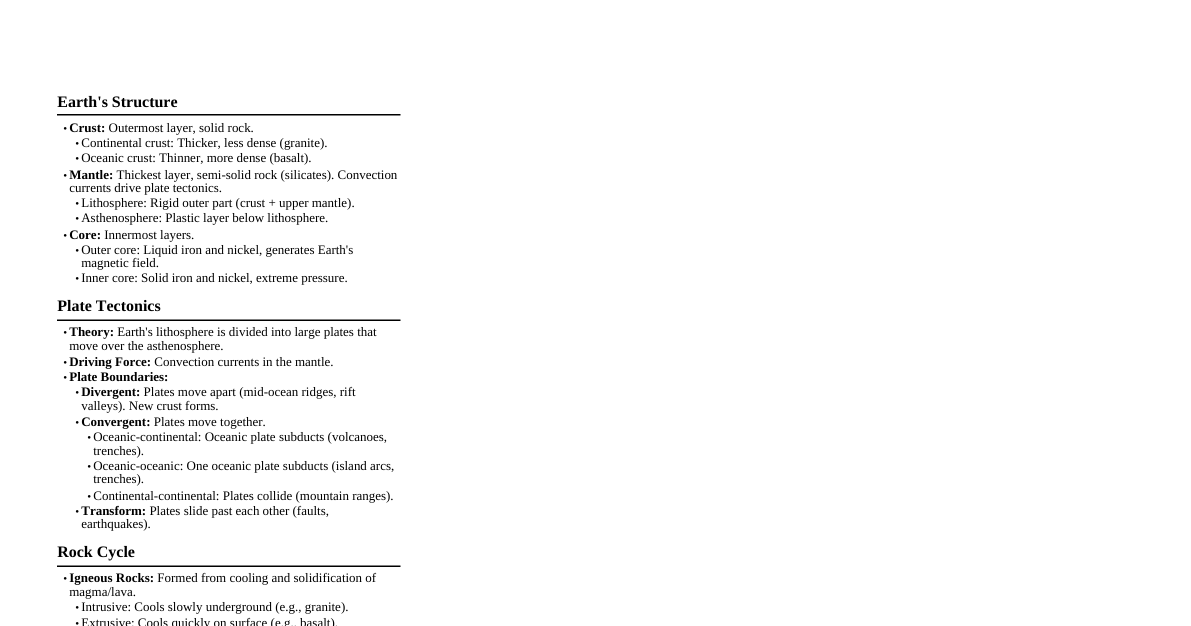
### Earth's Interior The Earth is composed of several layers, from the outermost crust to the innermost core. #### 1. Layers by Composition - **Crust:** - Outermost solid layer. - **Continental Crust:** Thicker (30-70 km), less dense, rich in granite. - **Oceanic Crust:** Thinner (5-10 km), more dense, rich in basalt. - **Mantle:** - Largest layer (approx. 2900 km thick). - Composed mainly of silicate rocks rich in iron and magnesium. - Behaves as a viscous fluid over long periods due to high temperatures and pressures (convection currents drive plate tectonics). - **Core:** - Innermost layer, primarily iron and nickel. - **Outer Core:** Liquid, responsible for Earth's magnetic field due to convection. - **Inner Core:** Solid, despite higher temperatures, due to immense pressure. #### 2. Layers by Physical State - **Lithosphere:** - Rigid outer layer, includes the crust and uppermost solid mantle. - Divided into tectonic plates. - **Asthenosphere:** - Part of the upper mantle, below the lithosphere. - Semi-fluid, ductile layer where convection currents occur, allowing tectonic plates to move. - **Mesosphere:** - Lower mantle, more rigid than the asthenosphere but still hot. - **Outer Core:** Liquid - **Inner Core:** Solid ### Types of Rocks Rocks are naturally occurring solid aggregates of one or more minerals. There are three main types: #### 1. Igneous Rocks - Formed from the cooling and solidification of molten magma or lava. - **Intrusive (Plutonic):** - Formed when magma cools slowly beneath the Earth's surface. - Large crystals (e.g., Granite, Gabbro). - **Extrusive (Volcanic):** - Formed when lava cools rapidly on the Earth's surface. - Small or no crystals (e.g., Basalt, Obsidian, Pumice). #### 2. Sedimentary Rocks - Formed from the accumulation and compaction of sediments (weathered rock fragments, organic matter, or chemical precipitates). - Often layered (stratification). - **Clastic:** - Formed from fragments of pre-existing rocks (e.g., Sandstone, Shale, Conglomerate). - **Organic:** - Formed from the remains of plants and animals (e.g., Coal, Limestone from shells). - **Chemical:** - Formed by precipitation of minerals from water solutions (e.g., Rock Salt, Gypsum, Chert). #### 3. Metamorphic Rocks - Formed when existing rocks (igneous, sedimentary, or other metamorphic rocks) are subjected to intense heat, pressure, or chemical alteration. - **Foliated:** - Minerals are aligned in parallel layers due to differential stress (e.g., Slate, Schist, Gneiss). - **Non-Foliated:** - Minerals do not show a parallel alignment (e.g., Marble from Limestone, Quartzite from Sandstone). ### The Rock Cycle The Rock Cycle describes the processes through which rocks are continuously transformed from one type to another. 1. **Magma** cools and solidifies to form **Igneous Rocks**. 2. **Igneous Rocks** (or any other rock type) are uplifted, weathered, and eroded to form **Sediments**. 3. **Sediments** are compacted and cemented to form **Sedimentary Rocks**. 4. **Sedimentary Rocks** (or Igneous Rocks) are subjected to heat and pressure to form **Metamorphic Rocks**. 5. **Metamorphic Rocks** can melt to form **Magma** again, completing the cycle. 6. Any rock type can be uplifted and exposed to weathering and erosion, or buried and subjected to heat and pressure. ### Plate Tectonics & Earthquakes #### 1. Plate Tectonics - Theory explaining the large-scale motion of Earth's lithosphere. - Driven by convection currents in the mantle. - **Types of Plate Boundaries:** - **Divergent:** Plates move apart (e.g., Mid-Ocean Ridges, Rift Valleys). New crust is formed. - **Convergent:** Plates move towards each other. - **Oceanic-Continental:** Oceanic plate subducts under continental plate (e.g., Andes Mountains, volcanic arcs). - **Oceanic-Oceanic:** One oceanic plate subducts under another (e.g., Island Arcs, deep sea trenches). - **Continental-Continental:** Plates collide and crumple (e.g., Himalayas). - **Transform:** Plates slide past each other horizontally (e.g., San Andreas Fault). Crust is neither created nor destroyed. #### 2. Earthquakes - Sudden release of energy in the Earth's crust that creates seismic waves. - **Causes:** Primarily occur along plate boundaries due to the buildup and sudden release of stress. - **Seismic Waves:** - **P-waves (Primary):** Fastest, compressional (push-pull), travel through solids and liquids. - **S-waves (Secondary):** Slower, shear (side-to-side), travel only through solids. - **Surface Waves:** Travel along the Earth's surface, cause most damage. - **Magnitude:** Measured by the Richter scale or Moment Magnitude Scale (logarithmic). - **Intensity:** Measured by the Modified Mercalli Intensity Scale (describes effects at a given location).