Alternative Current (AC)
Cheatsheet Content
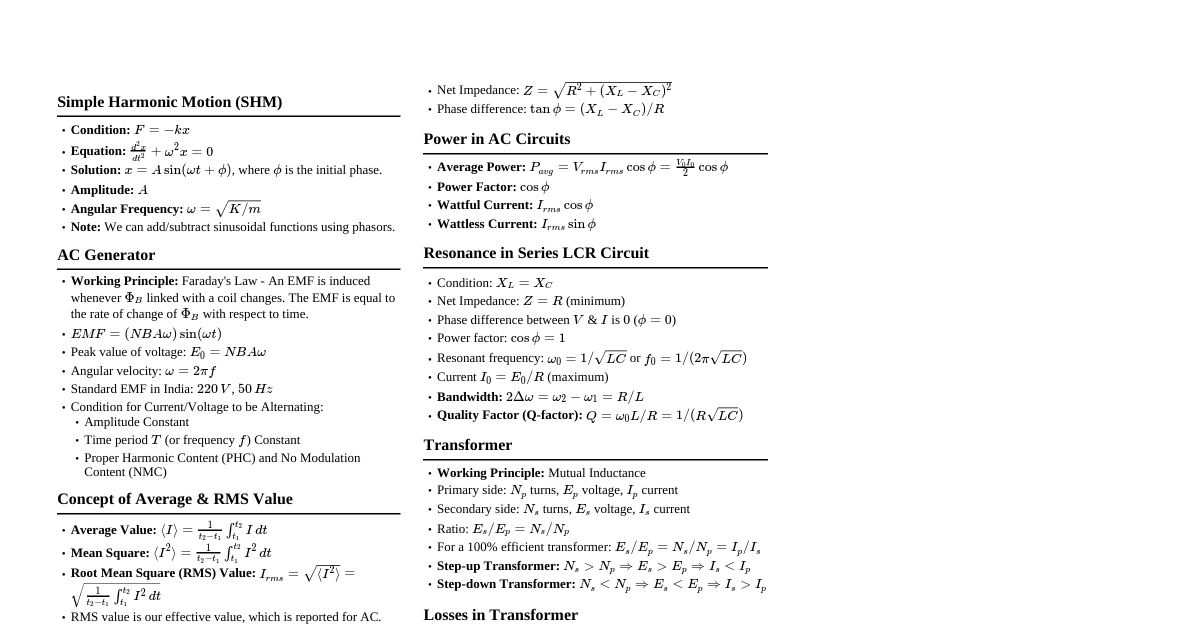
Alternating Current (AC) Current whose magnitude changes continuously and direction reverses periodically. Instantaneous AC: $I = I_0 \sin(\omega t + \phi)$ Instantaneous Voltage: $V = V_0 \sin(\omega t + \phi)$ $I_0, V_0$: Peak current/voltage $\omega = 2\pi f = \frac{2\pi}{T}$: Angular frequency $f$: Frequency, $T$: Time period $\phi$: Phase angle Mean or Average Value of AC Average over one full cycle is zero. Calculated over half cycle. For current: $I_{avg} = \frac{2I_0}{\pi} \approx 0.637 I_0$ For voltage: $V_{avg} = \frac{2V_0}{\pi} \approx 0.637 V_0$ Root Mean Square (RMS) Value of AC Effective value of AC, equivalent to DC that produces the same heat in a resistor. For current: $I_{rms} = \frac{I_0}{\sqrt{2}} \approx 0.707 I_0$ For voltage: $V_{rms} = \frac{V_0}{\sqrt{2}} \approx 0.707 V_0$ Most AC meters read RMS values. AC Circuit with a Resistor (R) Voltage and current are in phase. $V = V_0 \sin(\omega t)$ $I = I_0 \sin(\omega t)$ Ohm's Law: $V_0 = I_0 R$ or $V_{rms} = I_{rms} R$ Power: $P = V_{rms} I_{rms} = I_{rms}^2 R = \frac{V_{rms}^2}{R}$ AC Circuit with an Inductor (L) Current lags voltage by $\frac{\pi}{2}$ (or $90^\circ$). $V = V_0 \sin(\omega t)$ $I = I_0 \sin(\omega t - \frac{\pi}{2})$ Inductive Reactance: $X_L = \omega L = 2\pi f L$ (Unit: $\Omega$) $V_0 = I_0 X_L$ or $V_{rms} = I_{rms} X_L$ Average power consumed: $P_{avg} = 0$ (ideal inductor) AC Circuit with a Capacitor (C) Current leads voltage by $\frac{\pi}{2}$ (or $90^\circ$). $V = V_0 \sin(\omega t)$ $I = I_0 \sin(\omega t + \frac{\pi}{2})$ Capacitive Reactance: $X_C = \frac{1}{\omega C} = \frac{1}{2\pi f C}$ (Unit: $\Omega$) $V_0 = I_0 X_C$ or $V_{rms} = I_{rms} X_C$ Average power consumed: $P_{avg} = 0$ (ideal capacitor) Series RLC Circuit Impedance (Z): Total effective opposition to current flow. $$Z = \sqrt{R^2 + (X_L - X_C)^2}$$ Peak Current: $I_0 = \frac{V_0}{Z}$ RMS Current: $I_{rms} = \frac{V_{rms}}{Z}$ Phase Angle ($\phi$): Angle by which voltage leads current. $$\tan \phi = \frac{X_L - X_C}{R}$$ If $X_L > X_C$, circuit is inductive, current lags voltage. If $X_C > X_L$, circuit is capacitive, current leads voltage. If $X_L = X_C$, circuit is purely resistive, current and voltage are in phase. Resonance in RLC Circuit Occurs when $X_L = X_C$. Resonant Frequency: $f_r = \frac{1}{2\pi\sqrt{LC}}$ or $\omega_r = \frac{1}{\sqrt{LC}}$ At resonance: Impedance is minimum: $Z = R$ Current is maximum: $I_0 = V_0/R$ Phase angle $\phi = 0^\circ$ Circuit behaves purely resistively. Quality Factor (Q-factor) Measures the sharpness of resonance. $Q = \frac{\omega_r L}{R} = \frac{1}{\omega_r C R} = \frac{1}{R}\sqrt{\frac{L}{C}}$ Higher Q-factor means sharper resonance and better selectivity. Power in AC Circuits Instantaneous Power: $P = VI$ Average Power (True Power): $P_{avg} = V_{rms} I_{rms} \cos \phi$ Power Factor ($\cos \phi$): $$\cos \phi = \frac{R}{Z}$$ It indicates how much of the apparent power is actually consumed. Apparent Power: $S = V_{rms} I_{rms}$ (Unit: VA) Reactive Power: $Q = V_{rms} I_{rms} \sin \phi$ (Unit: VAR) Power Triangle: $S^2 = P_{avg}^2 + Q^2$ LC Oscillations Energy oscillates between inductor (magnetic) and capacitor (electric). Angular Frequency: $\omega = \frac{1}{\sqrt{LC}}$ Charge on capacitor: $q(t) = Q_0 \cos(\omega t + \phi)$ Current in inductor: $I(t) = - \omega Q_0 \sin(\omega t + \phi)$ Total energy in LC circuit remains constant: $U = \frac{1}{2}CV^2 + \frac{1}{2}LI^2 = \frac{1}{2}\frac{Q_0^2}{C}$ Transformers Device to change AC voltage levels using mutual induction. Turns Ratio: $\frac{V_S}{V_P} = \frac{N_S}{N_P}$ For an ideal transformer: $V_P I_P = V_S I_S$ $$\frac{I_P}{I_S} = \frac{N_S}{N_P}$$ $V_P, I_P, N_P$: Primary voltage, current, turns $V_S, I_S, N_S$: Secondary voltage, current, turns Step-up transformer: $N_S > N_P \implies V_S > V_P$ Step-down transformer: $N_S