Thermal Physics Cheat Sheet
Cheatsheet Content
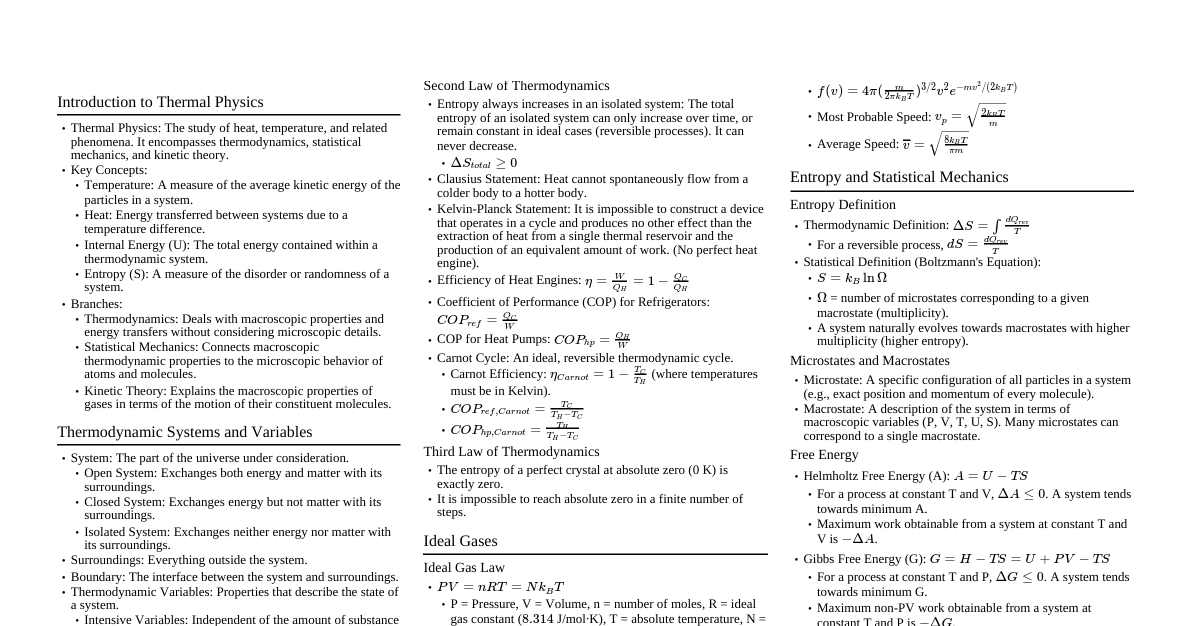
### Thermal Expansion - **Linear Expansion:** $\Delta L = L_0 \alpha \Delta T$ - $\alpha$: coefficient of linear expansion ($^\circ C^{-1}$ or $K^{-1}$) - **Area Expansion:** $\Delta A = A_0 \beta \Delta T \approx A_0 (2\alpha) \Delta T$ - $\beta$: coefficient of area expansion - **Volume Expansion:** $\Delta V = V_0 \gamma \Delta T \approx V_0 (3\alpha) \Delta T$ - $\gamma$: coefficient of volume expansion - **Density Change:** $\rho' = \rho_0 (1 - \gamma \Delta T)$ - **Anomalous Expansion of Water:** Max density at $4^\circ C$. Volume decreases from $0^\circ C$ to $4^\circ C$, then increases. - **Bimetallic Strip:** Bends towards the metal with lower $\alpha$. - **Pendulum Clock:** If $\alpha$ increases, period $T$ increases ($\Delta T = T_0 \alpha \Delta T / 2$), clock runs slow. - **Thermal Stress:** $Y \alpha \Delta T$, where $Y$ is Young's modulus. - **Liquid Expansion in a Container:** Apparent expansion $\Delta V_{app} = V_0 (\gamma_{liquid} - \gamma_{container}) \Delta T$. #### Question Variations & Traps: - **Relative Expansion:** Difference in length/volume for two materials. - **Hole Expansion:** A hole in a plate expands as if it were made of the same material. - **Combined Expansion:** Problems involving different materials joined together. - **Volume of a Sphere/Cube:** Remember $\gamma = 3\alpha$. - **Buoyancy:** Hot liquids are less dense, so buoyant force changes with temperature. ### Calorimetry & Heat Transfer - **Specific Heat Capacity (c):** $Q = mc\Delta T$ - Units: $J kg^{-1} K^{-1}$ or $cal g^{-1} ^\circ C^{-1}$ - **Latent Heat (L):** $Q = mL$ - **Latent Heat of Fusion ($L_f$):** Solid to Liquid. - **Latent Heat of Vaporization ($L_v$):** Liquid to Gas. - **Water Equivalent (W):** $W = m_c c_c$ (mass of water with same heat capacity as calorimeter). - **Principle of Calorimetry:** Heat lost = Heat gained (assuming isolated system). - $\sum m_i c_i \Delta T_i + \sum m_j L_j = 0$ - **Heat Transfer Mechanisms:** - **Conduction:** $Q/t = kA\Delta T / L$ - **Thermal Conductivity (k):** High for metals. - **Thermal Resistance ($R_{th}$):** $L / (kA)$. For series, $R_{eq} = R_1 + R_2 + ...$; For parallel, $1/R_{eq} = 1/R_1 + 1/R_2 + ...$ - **Temperature Gradient:** $\Delta T / L$. - **Convection:** Heat transfer by mass movement of fluid. - **Newton's Law of Cooling:** $Q/t = hA(T_s - T_\infty)$ (for forced convection). - **Radiation:** $P = \epsilon \sigma A T^4$ (Stefan-Boltzmann Law) - $\epsilon$: Emissivity (0 to 1, 1 for black body). - $\sigma$: Stefan-Boltzmann constant ($5.67 \times 10^{-8} W m^{-2} K^{-4}$). - **Net Radiation Loss:** $P_{net} = \epsilon \sigma A (T^4 - T_0^4)$ (body at $T$, surroundings at $T_0$). - **Wien's Displacement Law:** $\lambda_m T = b$ (b is Wien's constant, $2.898 \times 10^{-3} m K$). - **Kirchhoff's Law:** Good absorbers are good emitters ($\epsilon = a$). #### Question Variations & Traps: - **Phase Changes:** Do not forget latent heat. Ensure all ice melts or all steam condenses before calculating final temperature. - **Mixed System:** Calculate heat required to bring each component to a common intermediate temperature (e.g., $0^\circ C$ or $100^\circ C$) then apply calorimetry. - **Series/Parallel Conduction:** Analogous to electrical circuits. - **Newton's Law of Cooling:** $dT/dt = -k(T - T_s)$. This is an approximation for small temperature differences. - **Radiation:** Careful with absolute temperature ($K$). #### Topper-Level Shortcuts: - **Calorimetry:** If a system has multiple components, assume a final temperature. If $Q_{total} > 0$, final temp is higher; if $Q_{total} ### Kinetic Theory of Gases (KTG) - **Assumptions:** Point particles, elastic collisions, no intermolecular forces, random motion. - **Pressure:** $P = (1/3) \rho \bar{v^2} = (1/3) (Nm/V) \bar{v^2}$ - $\bar{v^2}$: mean square speed. - **Kinetic Energy:** $KE_{avg} = (3/2) kT$ per molecule. - $k$: Boltzmann constant ($R/N_A$). - Total KE for N molecules: $N(3/2)kT = (3/2) nRT$. - **Different Speeds:** - **Root Mean Square Speed ($v_{rms}$):** $\sqrt{\bar{v^2}} = \sqrt{3RT/M} = \sqrt{3kT/m}$ - **Most Probable Speed ($v_p$):** $\sqrt{2RT/M} = \sqrt{2kT/m}$ - **Average Speed ($\bar{v}$):** $\sqrt{8RT/(\pi M)} = \sqrt{8kT/(\pi m)}$ - **Order:** $v_p ### Thermodynamics - **Zeroth Law:** If A is in thermal equilibrium with B, and B with C, then A is in thermal equilibrium with C. Defines temperature. - **First Law:** $\Delta U = Q - W$ - $\Delta U$: Change in internal energy (state function, depends only on initial/final states). - $Q$: Heat added to system. - $W$: Work done BY system. ($W = \int P dV$) - If work done ON system: $\Delta U = Q + W_{on}$. - **Thermodynamic Processes:** - **Isobaric (P=const):** $W = P\Delta V$. $Q = nC_P\Delta T$. - **Isochoric (V=const):** $W = 0$. $\Delta U = Q = nC_V\Delta T$. - **Isothermal (T=const):** $\Delta U = 0$. $Q = W = nRT \ln(V_f/V_i) = nRT \ln(P_i/P_f)$. - **Adiabatic (Q=0):** $\Delta U = -W$. $PV^\gamma = const$. $T V^{\gamma-1} = const$. $T^\gamma P^{1-\gamma} = const$. - $W = (P_i V_i - P_f V_f) / (\gamma - 1) = nR(T_i - T_f) / (\gamma - 1)$. - **Cyclic Process:** $\Delta U = 0$. $Q_{net} = W_{net}$. - **Second Law:** - **Kelvin-Planck:** No process is possible whose sole result is the absorption of heat from a reservoir and the complete conversion of the heat into work. - **Clausius:** No process is possible whose sole result is the transfer of heat from a colder object to a hotter object. - **Entropy (S):** Measure of disorder. - $\Delta S = \int dQ_{rev}/T$. - For reversible process: $\Delta S_{system} + \Delta S_{surroundings} = 0$. - For irreversible process: $\Delta S_{universe} > 0$. - Phase change: $\Delta S = mL/T$. - **Heat Engine:** $\eta = W/Q_H = 1 - Q_C/Q_H$. - **Carnot Engine (ideal):** $\eta_{Carnot} = 1 - T_C/T_H$. (Most efficient engine). $T_C, T_H$ in Kelvin. - **Refrigerator/Heat Pump:** - **Coefficient of Performance (COP) - Refrigerator:** $COP_R = Q_C/W = Q_C/(Q_H - Q_C)$. - **COP - Heat Pump:** $COP_{HP} = Q_H/W = Q_H/(Q_H - Q_C)$. - **Carnot Refrigerator/Heat Pump:** $COP_R = T_C/(T_H - T_C)$. $COP_{HP} = T_H/(T_H - T_C)$. - $COP_{HP} = COP_R + 1$. - **Third Law:** As temperature approaches absolute zero, the entropy of a system approaches a constant minimum value (often zero for a perfect crystal). #### Question Variations & Traps: - **Sign Conventions:** $Q$ is positive when added to system, $W$ is positive when done BY system. STICK TO ONE CONVENTION. - **Area under P-V curve:** Work done. Clockwise cycle: net work positive. Counter-clockwise: net work negative. - **Adiabatic vs. Isothermal:** Adiabatic curve is steeper than isothermal on P-V diagram. - **Efficiency of Real Engines:** Always less than Carnot efficiency. - **Entropy:** Often involves calculating changes for phase transitions and temperature changes. #### Topper-Level Shortcuts: - **Adiabatic work:** For $n$ moles, $W = nR\Delta T / (1-\gamma)$. Remember $\Delta T = T_{final} - T_{initial}$. - **P-V Diagram:** For complex cycles, break into simpler processes (isobaric, isochoric, etc.) and calculate work/heat for each. - **Carnot Cycle:** Understand the four steps: Isothermal expansion, Adiabatic expansion, Isothermal compression, Adiabatic compression. #### Visual Summaries: **Flowchart: Heat Transfer Mechanisms** ``` HEAT TRANSFER | +----- Conduction (Solids) | | | +----- Rate: Q/t = kAΔT/L | +----- Thermal Resistance (R = L/kA) | +----- Convection (Fluids) | | | +----- Mass movement of fluid | +----- Newton's Law of Cooling (Q/t = hAΔT) | +----- Radiation (Any medium, even vacuum) | +----- Stefan-Boltzmann (P = εσAT^4) +----- Wien's Displacement (λ_m T = b) +----- Kirchhoff's Law (Good Absorbers = Good Emitters) ``` **Relationship Map: KTG Parameters** ``` T (Temperature) | +--- KE_avg = (3/2)kT (per molecule) | +--- v_rms = sqrt(3RT/M) | +--- Internal Energy U = (f/2)nRT | | | +--- C_V = (f/2)R | +--- C_P = C_V + R = (f/2 + 1)R | +--- γ = C_P/C_V = 1 + 2/f | +--- Mean Free Path λ ~ T/P ``` **Mnemonic: First Law of Thermodynamics** - **Q**uick **U**nderstanding **W**orks: $\Delta U = Q - W$ - **Q**ueen (Heat IN = +ve) - **U**nder (Internal Energy, depends on T) - **W**orker (Work OUT = +ve)