Class 12 Maths Formulas
Cheatsheet Content
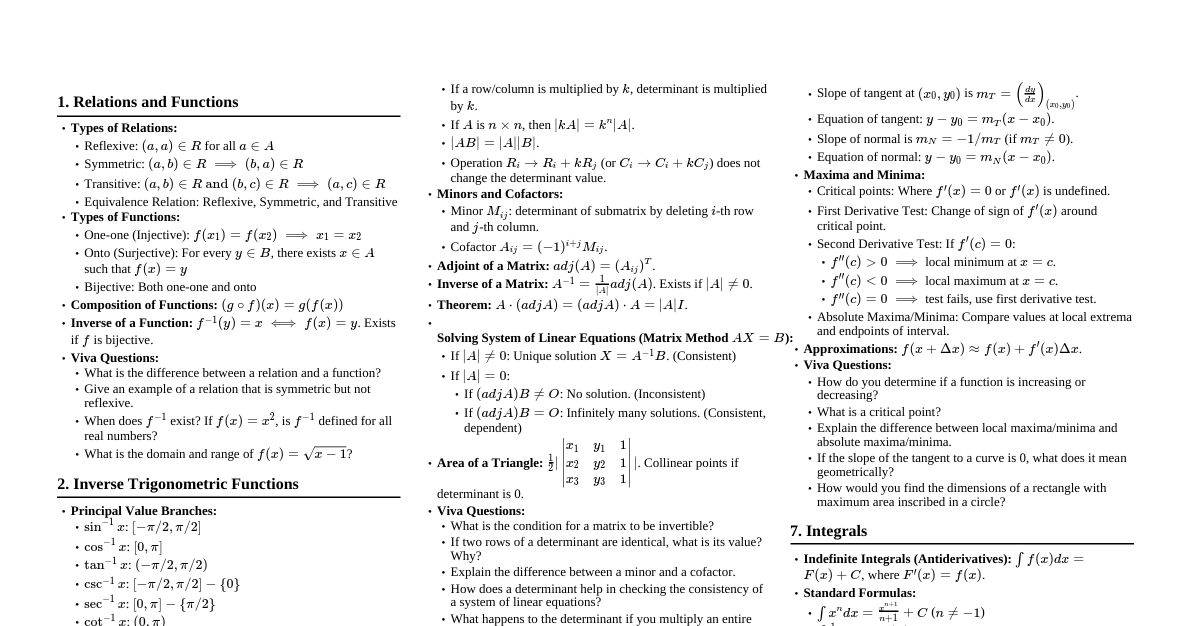
Relations and Functions Relation: A subset of $A \times B$. Types of Relations: Reflexive: $(a, a) \in R$ for all $a \in A$. Symmetric: $(a, b) \in R \implies (b, a) \in R$. Transitive: $(a, b) \in R$ and $(b, c) \in R \implies (a, c) \in R$. Equivalence Relation: Reflexive, Symmetric, and Transitive. Types of Functions: One-to-one (Injective): $f(x_1) = f(x_2) \implies x_1 = x_2$. Onto (Surjective): For every $y \in B$, there exists $x \in A$ such that $f(x) = y$. Bijective: Both one-to-one and onto. Composition of Functions: $(g \circ f)(x) = g(f(x))$. Inverse Function: $f^{-1}(y) = x \iff f(x) = y$. Exists if $f$ is bijective. Inverse Trigonometric Functions Principal Value Branches: $\sin^{-1} x$: $[-\frac{\pi}{2}, \frac{\pi}{2}]$ $\cos^{-1} x$: $[0, \pi]$ $\tan^{-1} x$: $(-\frac{\pi}{2}, \frac{\pi}{2})$ $\csc^{-1} x$: $[-\frac{\pi}{2}, \frac{\pi}{2}] - \{0\}$ $\sec^{-1} x$: $[0, \pi] - \{\frac{\pi}{2}\}$ $\cot^{-1} x$: $(0, \pi)$ Identities: $\sin^{-1} x + \cos^{-1} x = \frac{\pi}{2}$ $\tan^{-1} x + \cot^{-1} x = \frac{\pi}{2}$ $\csc^{-1} x + \sec^{-1} x = \frac{\pi}{2}$ $\tan^{-1} x + \tan^{-1} y = \tan^{-1} (\frac{x+y}{1-xy})$ $2 \tan^{-1} x = \sin^{-1} (\frac{2x}{1+x^2}) = \cos^{-1} (\frac{1-x^2}{1+x^2}) = \tan^{-1} (\frac{2x}{1-x^2})$ Matrices Order of a Matrix: $m \times n$ (rows $\times$ columns). Types of Matrices: Row, Column, Square, Diagonal, Scalar, Identity, Zero. Transpose of a Matrix: $A^T$ or $A'$. $(A^T)_{ij} = A_{ji}$. Symmetric Matrix: $A^T = A$. Skew-Symmetric Matrix: $A^T = -A$. (Diagonal elements are zero). Matrix Operations: Addition: $A+B$ (same order). Scalar Multiplication: $kA$. Multiplication: $AB$ defined if columns of A = rows of B. Properties of Matrix Addition: Commutative, Associative, Additive Identity, Additive Inverse. Properties of Matrix Multiplication: Associative, Distributive, Multiplicative Identity. Not commutative. Determinants Determinant of a $2 \times 2$ matrix: $|A| = \begin{vmatrix} a & b \\ c & d \end{vmatrix} = ad - bc$. Determinant of a $3 \times 3$ matrix: Using Sarrus rule or cofactor expansion. Properties of Determinants: $|A^T| = |A|$. If two rows/columns are identical or proportional, $|A|=0$. If a row/column is all zeros, $|A|=0$. Interchanging two rows/columns changes sign of $|A|$. Multiplying a row/column by $k$ multiplies $|A|$ by $k$. $|AB| = |A||B|$. Minors and Cofactors: Minor $M_{ij}$: Determinant of submatrix obtained by deleting $i$-th row and $j$-th column. Cofactor $A_{ij} = (-1)^{i+j} M_{ij}$. Adjoint of a Matrix: $adj(A) = (A_{ij})^T$. Inverse of a Matrix: $A^{-1} = \frac{1}{|A|} adj(A)$, if $|A| \neq 0$. System of Linear Equations: $AX=B \implies X = A^{-1}B$ (if $|A| \neq 0$). Continuity and Differentiability Continuity: A function $f(x)$ is continuous at $x=c$ if $\lim_{x \to c^-} f(x) = \lim_{x \to c^+} f(x) = f(c)$. Differentiability: A function $f(x)$ is differentiable at $x=c$ if $\lim_{h \to 0} \frac{f(c+h) - f(c)}{h}$ exists. (LHD = RHD) Derivatives of Standard Functions: $\frac{d}{dx}(x^n) = nx^{n-1}$ $\frac{d}{dx}(\sin x) = \cos x$ $\frac{d}{dx}(\cos x) = -\sin x$ $\frac{d}{dx}(\tan x) = \sec^2 x$ $\frac{d}{dx}(e^x) = e^x$ $\frac{d}{dx}(\log x) = \frac{1}{x}$ $\frac{d}{dx}(a^x) = a^x \log a$ Rules of Differentiation: Sum/Difference: $\frac{d}{dx}(u \pm v) = \frac{du}{dx} \pm \frac{dv}{dx}$ Product Rule: $\frac{d}{dx}(uv) = u\frac{dv}{dx} + v\frac{du}{dx}$ Quotient Rule: $\frac{d}{dx}(\frac{u}{v}) = \frac{v\frac{du}{dx} - u\frac{dv}{dx}}{v^2}$ Chain Rule: $\frac{dy}{dx} = \frac{dy}{du} \cdot \frac{du}{dx}$ Implicit Differentiation: Differentiating both sides of an equation with respect to $x$, treating $y$ as a function of $x$. Logarithmic Differentiation: Used for functions of the form $f(x)^{g(x)}$. Take $\log$ on both sides. Parametric Differentiation: If $x=f(t), y=g(t)$, then $\frac{dy}{dx} = \frac{dy/dt}{dx/dt}$. Applications of Derivatives Rate of Change: $\frac{dy}{dx}$ is the rate of change of $y$ with respect to $x$. Increasing/Decreasing Functions: $f'(x) > 0 \implies$ strictly increasing $f'(x) Tangents and Normals: Slope of tangent: $m_T = \frac{dy}{dx}$ at $(x_0, y_0)$. Equation of tangent: $y - y_0 = m_T (x - x_0)$. Slope of normal: $m_N = -\frac{1}{m_T}$ (if $m_T \neq 0$). Equation of normal: $y - y_0 = m_N (x - x_0)$. Maxima and Minima: First Derivative Test: Change of sign of $f'(x)$. Second Derivative Test: If $f'(c)=0$: $f''(c) $f''(c) > 0 \implies$ Local Minima at $x=c$. Integrals Indefinite Integration Formulas: $\int x^n dx = \frac{x^{n+1}}{n+1} + C$ ($n \neq -1$) $\int \frac{1}{x} dx = \log|x| + C$ $\int e^x dx = e^x + C$ $\int a^x dx = \frac{a^x}{\log a} + C$ $\int \sin x dx = -\cos x + C$ $\int \cos x dx = \sin x + C$ $\int \sec^2 x dx = \tan x + C$ $\int \csc^2 x dx = -\cot x + C$ $\int \sec x \tan x dx = \sec x + C$ $\int \csc x \cot x dx = -\csc x + C$ $\int \frac{1}{\sqrt{a^2-x^2}} dx = \sin^{-1}(\frac{x}{a}) + C$ $\int \frac{1}{a^2+x^2} dx = \frac{1}{a}\tan^{-1}(\frac{x}{a}) + C$ $\int \frac{1}{x\sqrt{x^2-a^2}} dx = \frac{1}{a}\sec^{-1}(\frac{x}{a}) + C$ $\int \tan x dx = \log|\sec x| + C$ $\int \cot x dx = \log|\sin x| + C$ $\int \sec x dx = \log|\sec x + \tan x| + C$ $\int \csc x dx = \log|\csc x - \cot x| + C$ Integration by Substitution: $\int f(g(x))g'(x)dx = \int f(t)dt$ where $t=g(x)$. Integration by Parts: $\int u v dx = u \int v dx - \int (\frac{du}{dx} \int v dx) dx$. (LIATE rule for choosing $u$) Partial Fractions: Decomposition of rational functions for easier integration. Definite Integral: $\int_a^b f(x) dx = F(b) - F(a)$, where $F(x)$ is antiderivative of $f(x)$. Properties of Definite Integrals: $\int_a^b f(x) dx = -\int_b^a f(x) dx$ $\int_a^b f(x) dx = \int_a^c f(x) dx + \int_c^b f(x) dx$ $\int_0^a f(x) dx = \int_0^a f(a-x) dx$ $\int_a^b f(x) dx = \int_a^b f(a+b-x) dx$ $\int_0^{2a} f(x) dx = 2\int_0^a f(x) dx$ if $f(2a-x)=f(x)$ $\int_0^{2a} f(x) dx = 0$ if $f(2a-x)=-f(x)$ $\int_{-a}^a f(x) dx = 2\int_0^a f(x) dx$ if $f$ is even ($f(-x)=f(x)$) $\int_{-a}^a f(x) dx = 0$ if $f$ is odd ($f(-x)=-f(x)$) Applications of Integrals Area under Simple Curves: Area bounded by $y=f(x)$, $x$-axis, $x=a$, $x=b$: $\int_a^b y dx$. Area bounded by $x=g(y)$, $y$-axis, $y=c$, $y=d$: $\int_c^d x dy$. Area between Two Curves: Area between $y=f(x)$ and $y=g(x)$ from $x=a$ to $x=b$: $\int_a^b |f(x) - g(x)| dx$. Differential Equations Order: Highest order derivative present. Degree: Highest power of the highest order derivative (when polynomial in derivatives). Methods of Solving: Variable Separable: $\frac{dy}{dx} = f(x)g(y) \implies \int \frac{dy}{g(y)} = \int f(x) dx$. Homogeneous Differential Equations: $\frac{dy}{dx} = F(\frac{y}{x})$. Substitute $y=vx \implies \frac{dy}{dx} = v + x\frac{dv}{dx}$. Linear Differential Equations: $\frac{dy}{dx} + Py = Q$ or $\frac{dx}{dy} + Px = Q$. Integrating Factor (IF): $e^{\int P dx}$. Solution: $y \cdot IF = \int (Q \cdot IF) dx + C$. Vector Algebra Vector: Quantity with magnitude and direction. Types of Vectors: Zero, Unit, Coinitial, Collinear, Equal. Position Vector: $\vec{OP} = x\hat{i} + y\hat{j} + z\hat{k}$. Magnitude $|\vec{OP}| = \sqrt{x^2+y^2+z^2}$. Vector Joining Two Points: $\vec{PQ} = (x_2-x_1)\hat{i} + (y_2-y_1)\hat{j} + (z_2-z_1)\hat{k}$. Scalar (Dot) Product: $\vec{a} \cdot \vec{b} = |\vec{a}||\vec{b}|\cos\theta$. $\vec{a} \cdot \vec{b} = a_1b_1 + a_2b_2 + a_3b_3$. $\vec{a} \cdot \vec{b} = 0 \iff \vec{a} \perp \vec{b}$. Vector (Cross) Product: $\vec{a} \times \vec{b} = |\vec{a}||\vec{b}|\sin\theta \hat{n}$. $\vec{a} \times \vec{b} = \begin{vmatrix} \hat{i} & \hat{j} & \hat{k} \\ a_1 & a_2 & a_3 \\ b_1 & b_2 & b_3 \end{vmatrix}$. $\vec{a} \times \vec{b} = \vec{0} \iff \vec{a} || \vec{b}$. Magnitude of $\vec{a} \times \vec{b}$ = Area of parallelogram with adjacent sides $\vec{a}, \vec{b}$. Scalar Triple Product: $[\vec{a}, \vec{b}, \vec{c}] = \vec{a} \cdot (\vec{b} \times \vec{c})$. Volume of parallelepiped. Three Dimensional Geometry Direction Cosines (DCs): $\cos\alpha, \cos\beta, \cos\gamma$ (or $l, m, n$). $l^2+m^2+n^2=1$. Direction Ratios (DRs): $a, b, c$. DCs are $\frac{a}{\sqrt{a^2+b^2+c^2}}$, etc. Equation of a Line: Vector Form: $\vec{r} = \vec{a} + \lambda\vec{b}$. Cartesian Form: $\frac{x-x_1}{a} = \frac{y-y_1}{b} = \frac{z-z_1}{c}$. Shortest Distance between Two Skew Lines: $\vec{r}_1 = \vec{a}_1 + \lambda\vec{b}_1$, $\vec{r}_2 = \vec{a}_2 + \mu\vec{b}_2$. $SD = \frac{|(\vec{b}_1 \times \vec{b}_2) \cdot (\vec{a}_2 - \vec{a}_1)|}{|\vec{b}_1 \times \vec{b}_2|}$. Equation of a Plane: Normal Form: $\vec{r} \cdot \hat{n} = d$. Cartesian Form (Normal Form): $lx + my + nz = p$. Plane passing through a point and perpendicular to a vector: $\vec{r} \cdot \vec{n} = \vec{a} \cdot \vec{n}$. Plane passing through three non-collinear points: $(\vec{r}-\vec{a}) \cdot [(\vec{b}-\vec{a}) \times (\vec{c}-\vec{a})] = 0$. Intercept Form: $\frac{x}{A} + \frac{y}{B} + \frac{z}{C} = 1$. Distance of a Point from a Plane: Point $P(\vec{\alpha})$, Plane $\vec{r} \cdot \vec{n} = d$. Distance $= \frac{|\vec{\alpha} \cdot \vec{n} - d|}{|\vec{n}|}$. Linear Programming Objective Function: $Z = ax + by$ (to be maximized or minimized). Constraints: Linear inequalities defining the feasible region. Feasible Region: The common region determined by all constraints. Feasible Solution: Points within or on the boundary of the feasible region. Optimal Solution: A feasible solution that gives the optimal value of the objective function. Corner Point Theorem: The optimal solution (if it exists) occurs at a corner point of the feasible region. Probability Conditional Probability: $P(E|F) = \frac{P(E \cap F)}{P(F)}$, where $P(F) \neq 0$. Multiplication Theorem: $P(E \cap F) = P(F)P(E|F) = P(E)P(F|E)$. Independent Events: $P(E \cap F) = P(E)P(F)$. Bayes' Theorem: $P(E_i|A) = \frac{P(E_i)P(A|E_i)}{\sum_{j=1}^n P(E_j)P(A|E_j)}$. Random Variable: A real-valued function whose domain is the sample space. Probability Distribution: A table/function listing all possible values of a random variable and their probabilities. Mean of a Random Variable: $E(X) = \sum x_i P(X=x_i)$. Variance of a Random Variable: $Var(X) = E(X^2) - [E(X)]^2 = \sum x_i^2 P(X=x_i) - (\sum x_i P(X=x_i))^2$. Binomial Distribution: $P(X=k) = \binom{n}{k} p^k (1-p)^{n-k}$. Mean: $np$. Variance: $np(1-p)$.