Halliday Physics Essentials
Cheatsheet Content
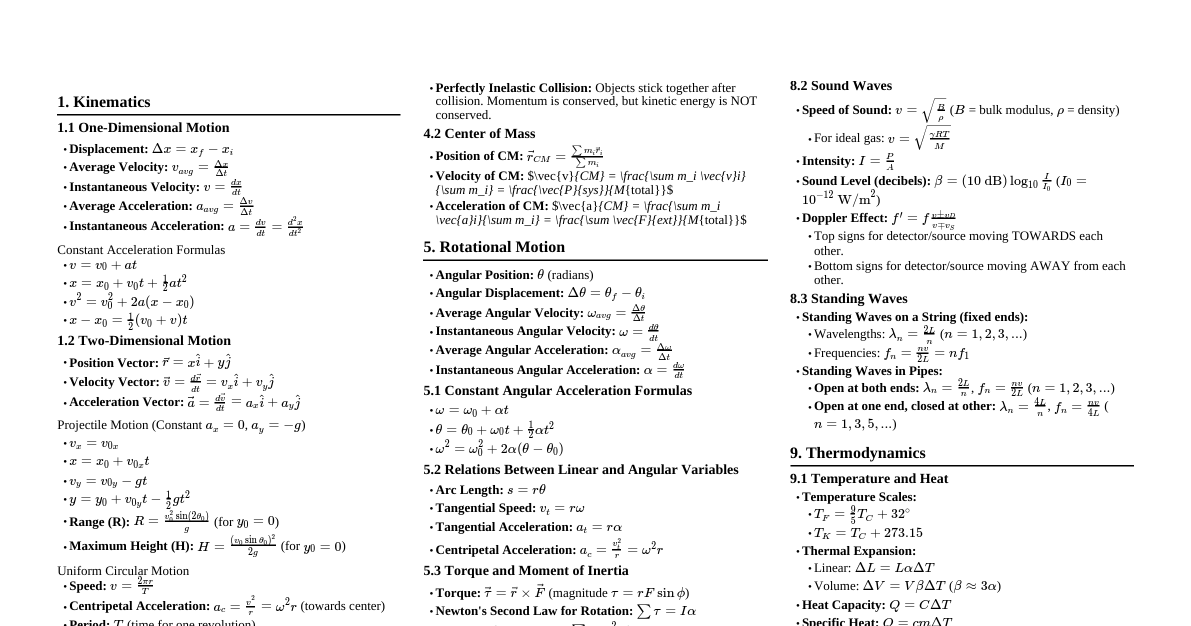
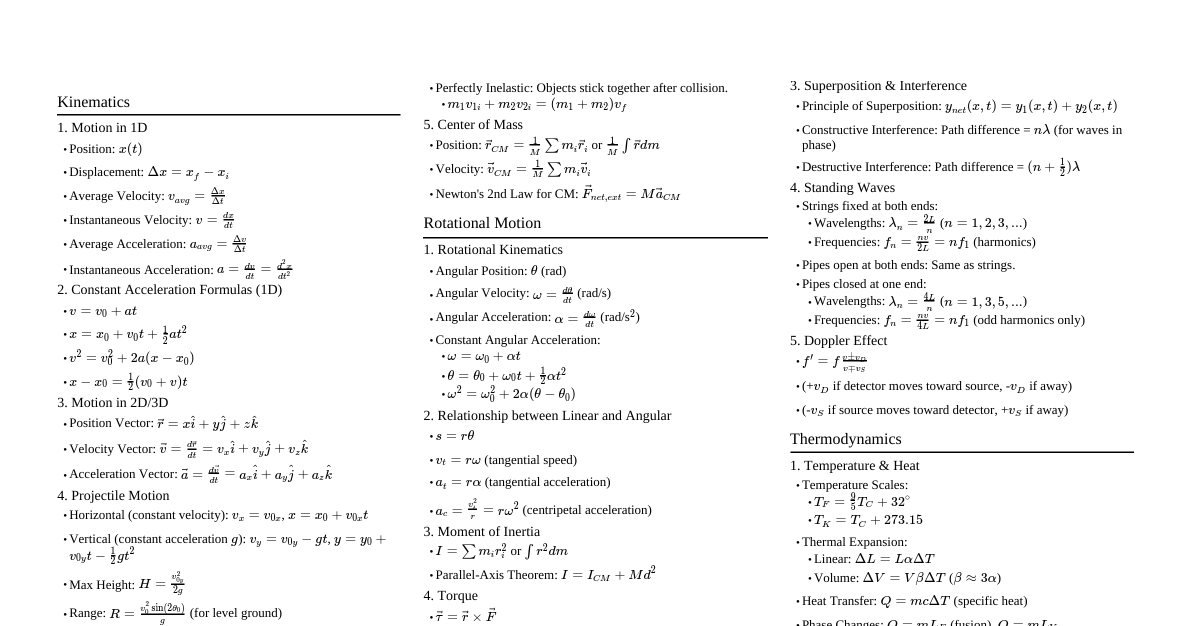
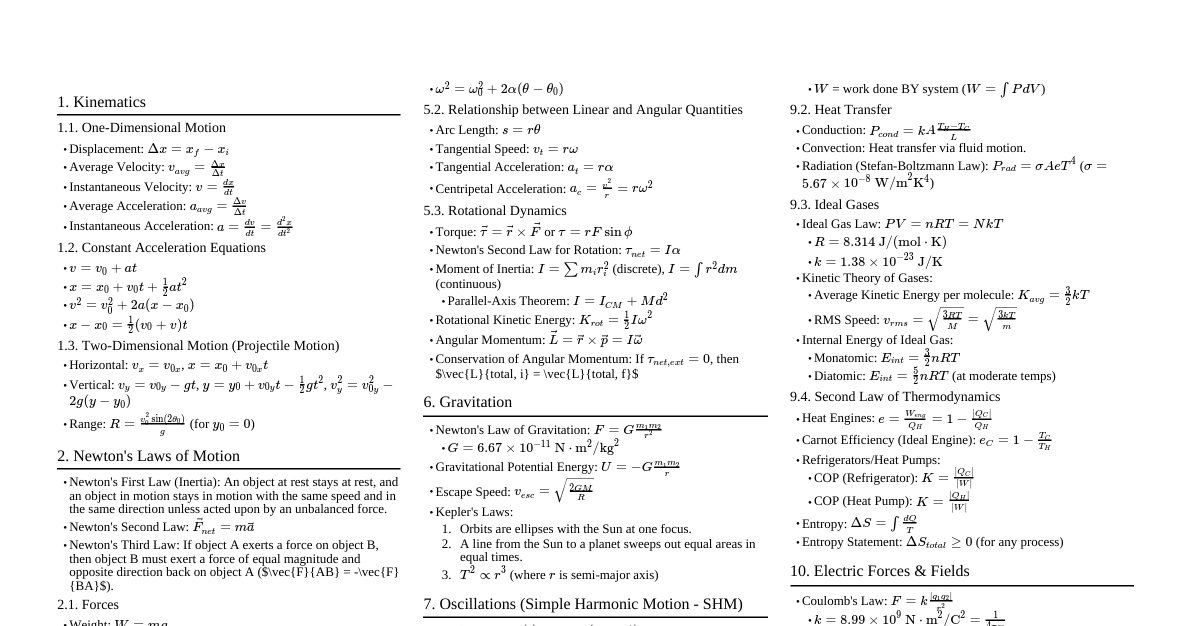
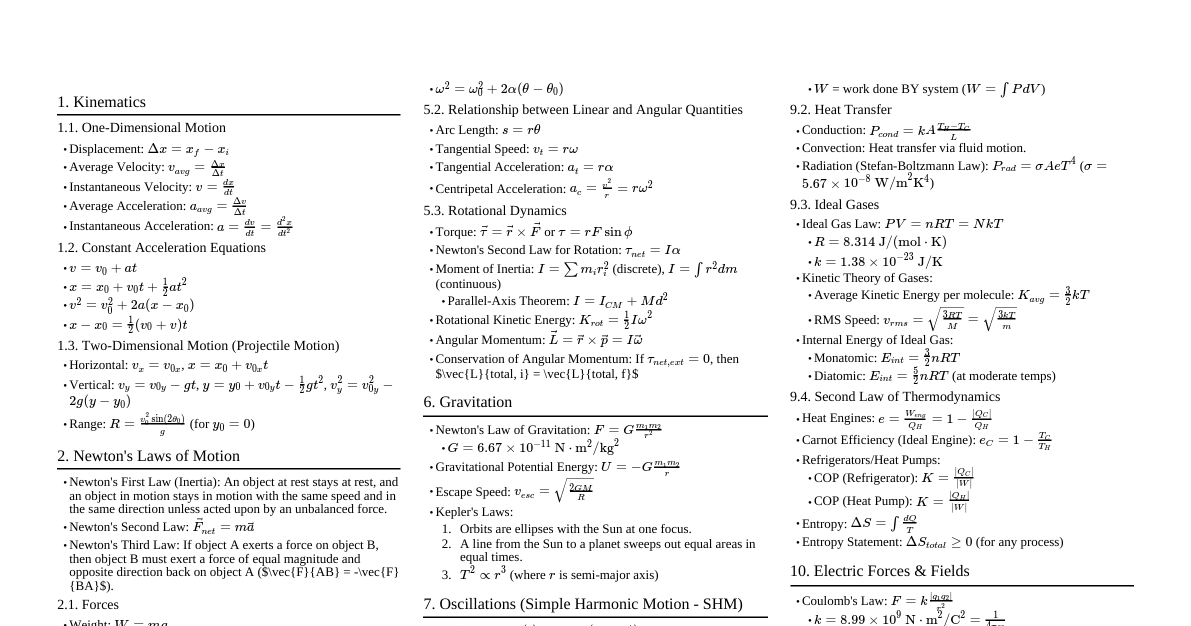
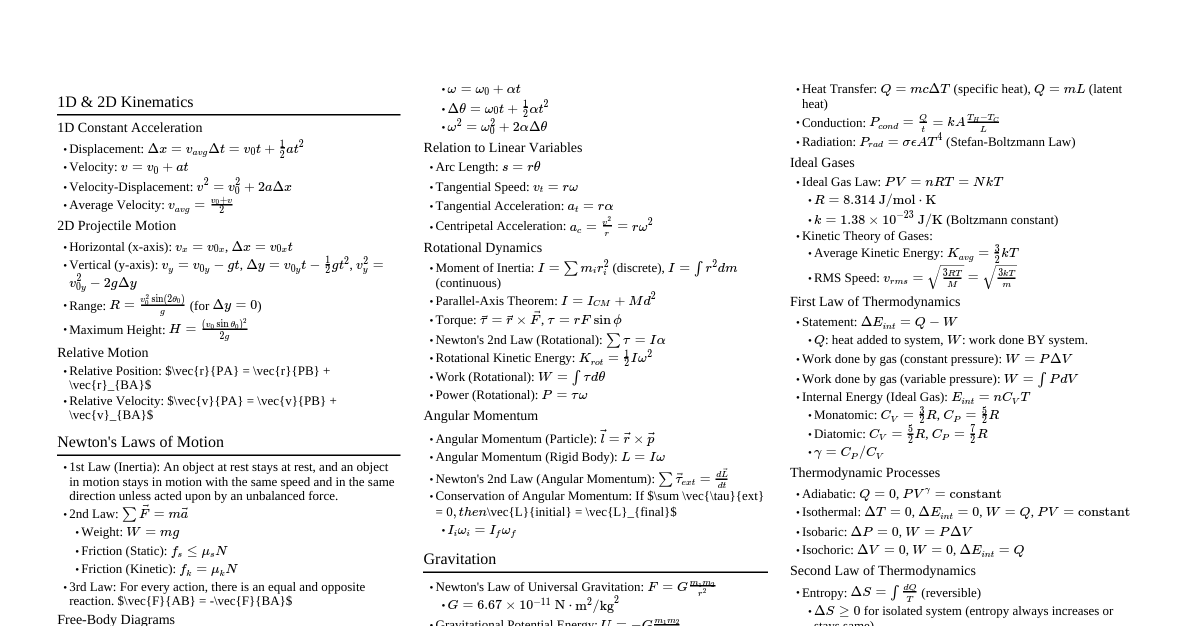
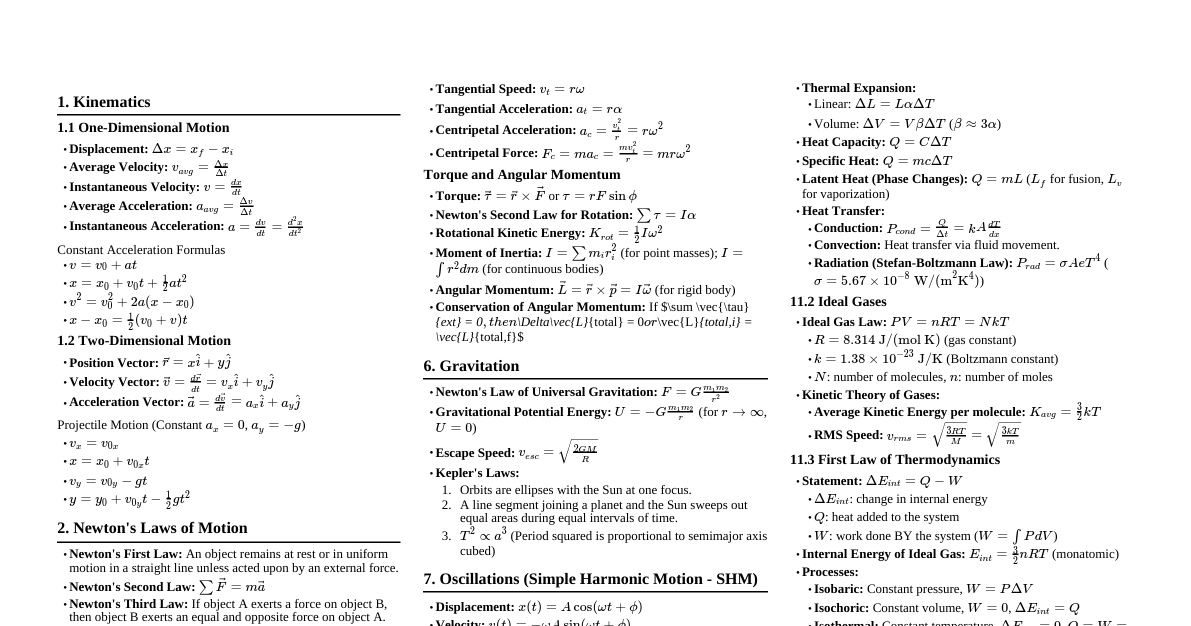
### Kinematics: 1D Motion - **Position:** $x(t)$ - **Displacement:** $\Delta x = x_f - x_i$ - **Average Velocity:** $v_{avg} = \frac{\Delta x}{\Delta t}$ - **Instantaneous Velocity:** $v = \frac{dx}{dt}$ - **Average Acceleration:** $a_{avg} = \frac{\Delta v}{\Delta t}$ - **Instantaneous Acceleration:** $a = \frac{dv}{dt} = \frac{d^2x}{dt^2}$ #### Constant Acceleration Equations - $v = v_0 + at$ - $x = x_0 + v_0t + \frac{1}{2}at^2$ - $v^2 = v_0^2 + 2a(x - x_0)$ - $x - x_0 = \frac{1}{2}(v_0 + v)t$ ### Kinematics: 2D & 3D Motion - **Position Vector:** $\vec{r} = x\hat{i} + y\hat{j} + z\hat{k}$ - **Velocity Vector:** $\vec{v} = \frac{d\vec{r}}{dt} = v_x\hat{i} + v_y\hat{j} + v_z\hat{k}$ - **Acceleration Vector:** $\vec{a} = \frac{d\vec{v}}{dt} = a_x\hat{i} + a_y\hat{j} + a_z\hat{k}$ #### Projectile Motion (Horizontal $a_x = 0$, Vertical $a_y = -g$) - **Horizontal:** $x = x_0 + (v_0 \cos\theta_0)t$ - **Vertical:** $y = y_0 + (v_0 \sin\theta_0)t - \frac{1}{2}gt^2$ - **Vertical Velocity:** $v_y = (v_0 \sin\theta_0) - gt$ - **Range:** $R = \frac{v_0^2 \sin(2\theta_0)}{g}$ (for $y_0 = 0$) #### Uniform Circular Motion - **Speed:** $v = \frac{2\pi r}{T}$ - **Centripetal Acceleration:** $a_c = \frac{v^2}{r} = \omega^2 r$ (directed towards center) ### Newton's Laws of Motion - **Newton's First Law:** An object at rest stays at rest, and an object in motion stays in motion with the same speed and in the same direction unless acted upon by an unbalanced force. (Law of Inertia) - **Newton's Second Law:** $\sum \vec{F} = m\vec{a}$ - Force: $\vec{F}$ (Newtons, N) - Mass: $m$ (kilograms, kg) - Acceleration: $\vec{a}$ (m/s$^2$) - **Newton's Third Law:** For every action, there is an equal and opposite reaction. $\vec{F}_{AB} = -\vec{F}_{BA}$ #### Types of Forces - **Weight:** $\vec{W} = m\vec{g}$ (magnitude $mg$) - **Normal Force:** $\vec{F}_N$ (perpendicular to surface) - **Tension:** $\vec{T}$ (along a rope/cable) - **Friction:** - **Static:** $f_s \le \mu_s F_N$ (prevents motion) - **Kinetic:** $f_k = \mu_k F_N$ (opposes motion) - $\mu_s > \mu_k$ ### Work and Energy - **Work (Constant Force):** $W = \vec{F} \cdot \vec{d} = Fd \cos\theta$ - **Work (Variable Force):** $W = \int \vec{F} \cdot d\vec{r}$ - **Kinetic Energy:** $K = \frac{1}{2}mv^2$ - **Work-Kinetic Energy Theorem:** $W_{net} = \Delta K$ - **Power:** $P = \frac{dW}{dt} = \vec{F} \cdot \vec{v}$ (Watts, W) #### Potential Energy - **Gravitational Potential Energy:** $U_g = mgy$ - **Elastic Potential Energy (Spring):** $U_s = \frac{1}{2}kx^2$ - **Conservative Force:** $W_c = -\Delta U$ - **Non-Conservative Force:** $W_{nc} = \Delta E_{mech} = \Delta K + \Delta U$ #### Conservation of Energy - **Mechanical Energy:** $E_{mech} = K + U$ - **Conservation of Mechanical Energy (only conservative forces):** $K_i + U_i = K_f + U_f$ - **Conservation of Total Energy:** $E_{total} = K + U + E_{int} = \text{constant}$ ### Momentum and Collisions - **Linear Momentum:** $\vec{p} = m\vec{v}$ - **Impulse:** $\vec{J} = \int \vec{F} dt = \Delta \vec{p}$ - **Impulse-Momentum Theorem:** $\vec{J} = \vec{p}_f - \vec{p}_i$ - **Conservation of Linear Momentum (isolated system):** $\sum \vec{p}_i = \sum \vec{p}_f$ #### Collisions - **Elastic Collision:** Both momentum and kinetic energy are conserved. - **Inelastic Collision:** Momentum is conserved, but kinetic energy is NOT conserved. - **Perfectly Inelastic Collision:** Objects stick together after collision. Momentum is conserved. #### Center of Mass - **Discrete Particles:** $\vec{r}_{CM} = \frac{1}{M}\sum m_i \vec{r}_i$ - **Continuous Body:** $\vec{r}_{CM} = \frac{1}{M}\int \vec{r} dm$ - **Velocity of CM:** $\vec{v}_{CM} = \frac{1}{M}\sum m_i \vec{v}_i$ - **Newton's Second Law for System:** $\sum \vec{F}_{ext} = M\vec{a}_{CM}$ ### Rotational Motion - **Angular Position:** $\theta$ (radians) - **Angular Displacement:** $\Delta\theta$ - **Average Angular Velocity:** $\omega_{avg} = \frac{\Delta\theta}{\Delta t}$ - **Instantaneous Angular Velocity:** $\omega = \frac{d\theta}{dt}$ - **Average Angular Acceleration:** $\alpha_{avg} = \frac{\Delta\omega}{\Delta t}$ - **Instantaneous Angular Acceleration:** $\alpha = \frac{d\omega}{dt}$ #### Constant Angular Acceleration Equations - $\omega = \omega_0 + \alpha t$ - $\theta = \theta_0 + \omega_0t + \frac{1}{2}\alpha t^2$ - $\omega^2 = \omega_0^2 + 2\alpha(\theta - \theta_0)$ #### Relationships between Linear and Angular Variables - Arc Length: $s = r\theta$ - Tangential Speed: $v_t = r\omega$ - Tangential Acceleration: $a_t = r\alpha$ - Centripetal Acceleration: $a_c = \frac{v^2}{r} = \omega^2 r$ - Total Acceleration: $\vec{a} = \vec{a}_t + \vec{a}_c$ ### Torque & Angular Momentum - **Torque:** $\vec{\tau} = \vec{r} \times \vec{F}$ (magnitude $\tau = rF\sin\phi$) - **Newton's Second Law for Rotation:** $\sum \tau = I\alpha$ - Moment of Inertia: $I = \sum m_i r_i^2$ (discrete), $I = \int r^2 dm$ (continuous) - Parallel-Axis Theorem: $I = I_{CM} + Md^2$ - **Rotational Kinetic Energy:** $K_{rot} = \frac{1}{2}I\omega^2$ - **Work done by Torque:** $W = \int \tau d\theta$ - **Power in Rotation:** $P = \tau\omega$ #### Angular Momentum - **Particle:** $\vec{L} = \vec{r} \times \vec{p} = m(\vec{r} \times \vec{v})$ - **Rigid Body:** $\vec{L} = I\vec{\omega}$ - **Newton's Second Law (Angular Form):** $\sum \vec{\tau}_{ext} = \frac{d\vec{L}}{dt}$ - **Conservation of Angular Momentum:** If $\sum \vec{\tau}_{ext} = 0$, then $\vec{L} = \text{constant}$ - $I_i\omega_i = I_f\omega_f$ ### Oscillations - **Simple Harmonic Motion (SHM):** - **Position:** $x(t) = A \cos(\omega t + \phi)$ - **Velocity:** $v(t) = -\omega A \sin(\omega t + \phi)$ - **Acceleration:** $a(t) = -\omega^2 A \cos(\omega t + \phi) = -\omega^2 x(t)$ - **Angular Frequency:** $\omega = \sqrt{\frac{k}{m}}$ (spring-mass system) - **Period:** $T = \frac{2\pi}{\omega} = 2\pi\sqrt{\frac{m}{k}}$ - **Frequency:** $f = \frac{1}{T} = \frac{\omega}{2\pi}$ - **Energy in SHM:** $E = \frac{1}{2}kA^2 = \frac{1}{2}mv^2 + \frac{1}{2}kx^2$ #### Pendulums - **Simple Pendulum (small angles):** $T = 2\pi\sqrt{\frac{L}{g}}$ - **Physical Pendulum:** $T = 2\pi\sqrt{\frac{I}{mgd}}$ ### Waves - **Wave Speed:** $v = \lambda f$ - **Transverse Wave on String:** $v = \sqrt{\frac{\tau}{\mu}}$ ($\tau$ = tension, $\mu$ = linear mass density) - **Sound Wave Speed:** $v = \sqrt{\frac{B}{\rho}}$ ($B$ = bulk modulus, $\rho$ = density) - **Intensity:** $I = \frac{P}{A}$ (Power/Area, W/m$^2$) - **Intensity Level (Decibels):** $\beta = (10 \text{ dB}) \log_{10}\left(\frac{I}{I_0}\right)$ where $I_0 = 10^{-12} \text{ W/m}^2$ #### Standing Waves - **On a String (fixed ends):** - Wavelengths: $\lambda_n = \frac{2L}{n}$, for $n = 1, 2, 3, \ldots$ - Frequencies: $f_n = n\frac{v}{2L} = nf_1$ - **In a Pipe (open at both ends):** Same as string - **In a Pipe (one end closed, one open):** - Wavelengths: $\lambda_n = \frac{4L}{n}$, for $n = 1, 3, 5, \ldots$ - Frequencies: $f_n = n\frac{v}{4L} = nf_1$ #### Doppler Effect - Observer moving towards source: $f' = f \left(\frac{v \pm v_D}{v \mp v_S}\right)$ - Use + for $v_D$ if detector moves towards source, - if away. - Use - for $v_S$ if source moves towards detector, + if away. ### Thermodynamics - **Temperature Scales:** - $T_F = \frac{9}{5}T_C + 32^\circ$ - $T_K = T_C + 273.15$ - **Thermal Expansion:** - Length: $\Delta L = L\alpha\Delta T$ - Volume: $\Delta V = V\beta\Delta T$ ($\beta \approx 3\alpha$) - **Heat Capacity & Latent Heat:** - $Q = mc\Delta T$ (sensible heat) - $Q = mL$ (latent heat for phase change) - **Heat Transfer:** - Conduction: $P_{cond} = kA\frac{T_H - T_C}{L}$ - Radiation: $P_{rad} = \sigma A e T^4$ (Stefan-Boltzmann Law) #### Ideal Gas Law - $PV = nRT = NkT$ - $R = 8.314 \text{ J/(mol}\cdot\text{K)}$ (universal gas constant) - $k = 1.38 \times 10^{-23} \text{ J/K}$ (Boltzmann constant) - $N_A = 6.022 \times 10^{23} \text{ mol}^{-1}$ (Avogadro's number) - **Kinetic Theory of Gases:** - Average Kinetic Energy per molecule: $K_{avg} = \frac{3}{2}kT$ - RMS Speed: $v_{rms} = \sqrt{\frac{3RT}{M}} = \sqrt{\frac{3kT}{m}}$ #### First Law of Thermodynamics - $\Delta E_{int} = Q - W$ - $Q$: Heat added to system - $W$: Work done BY system - For ideal gas: $\Delta E_{int} = nC_V\Delta T$ - **Work done by gas (isobaric):** $W = P\Delta V$ - **Work done by gas (isothermal):** $W = nRT \ln\left(\frac{V_f}{V_i}\right)$ #### Thermodynamic Processes - **Isobaric:** Constant pressure, $W = P\Delta V$ - **Isochoric (Isometric):** Constant volume, $W = 0$, $\Delta E_{int} = Q$ - **Isothermal:** Constant temperature, $\Delta E_{int} = 0$, $Q = W$ - **Adiabatic:** No heat exchange, $Q = 0$, $\Delta E_{int} = -W$ - $PV^\gamma = \text{constant}$ - $TV^{\gamma-1} = \text{constant}$ (for ideal gas) #### Second Law of Thermodynamics - **Entropy:** $\Delta S = \int \frac{dQ}{T}$ - **Entropy in Reversible Process:** $\Delta S = \frac{Q_{rev}}{T}$ - **Entropy of Isolated System:** $\Delta S \ge 0$ - **Heat Engines:** Efficiency $\epsilon = \frac{|W|}{|Q_H|} = 1 - \frac{|Q_C|}{|Q_H|}$ - **Carnot Engine (ideal):** $\epsilon_C = 1 - \frac{T_C}{T_H}$ - **Refrigerators/Heat Pumps:** Coefficient of Performance $K = \frac{|Q_C|}{|W|}$ - Carnot Refrigerator: $K_C = \frac{T_C}{T_H - T_C}$ ### Gravitation - **Newton's Law of Universal Gravitation:** $F = G\frac{m_1 m_2}{r^2}$ - $G = 6.67 \times 10^{-11} \text{ N}\cdot\text{m}^2/\text{kg}^2$ - **Gravitational Potential Energy:** $U = -G\frac{m_1 m_2}{r}$ (for $U=0$ at $r=\infty$) - **Escape Speed:** $v_{esc} = \sqrt{\frac{2GM}{R}}$ - **Kepler's Laws:** 1. Orbits are ellipses with the Sun at one focus. 2. A line joining a planet and the Sun sweeps out equal areas in equal times. 3. $T^2 \propto a^3$ (period squared proportional to semi-major axis cubed) - For circular orbit: $T^2 = \left(\frac{4\pi^2}{GM}\right)r^3$ ### Fluids - **Density:** $\rho = \frac{m}{V}$ - **Pressure:** $P = \frac{F}{A}$ (Pascals, Pa) - **Pressure in Fluid at Depth h:** $P = P_0 + \rho gh$ - **Pascal's Principle:** Pressure applied to an enclosed fluid is transmitted undiminished to every portion of the fluid and the walls of the containing vessel. - **Archimedes' Principle:** Buoyant Force $F_B = \rho_{fluid} V_{disp} g$ - **Equation of Continuity:** $A_1 v_1 = A_2 v_2$ (for incompressible fluid) - **Bernoulli's Equation:** $P + \frac{1}{2}\rho v^2 + \rho gy = \text{constant}$