Halliday Physics Essentials
Cheatsheet Content
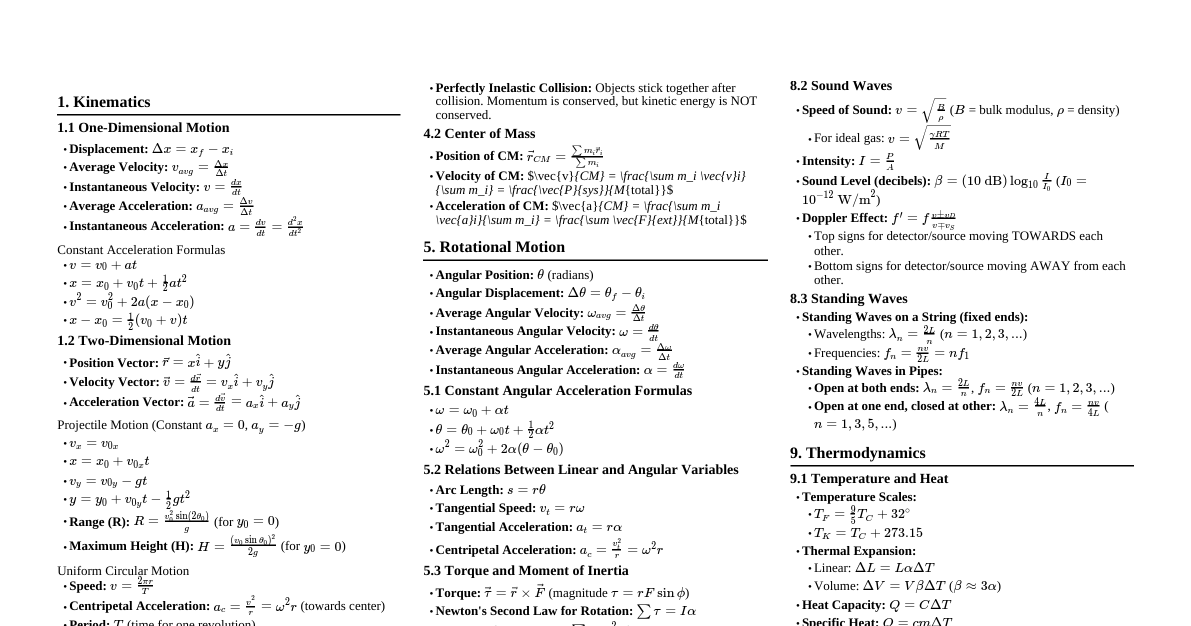
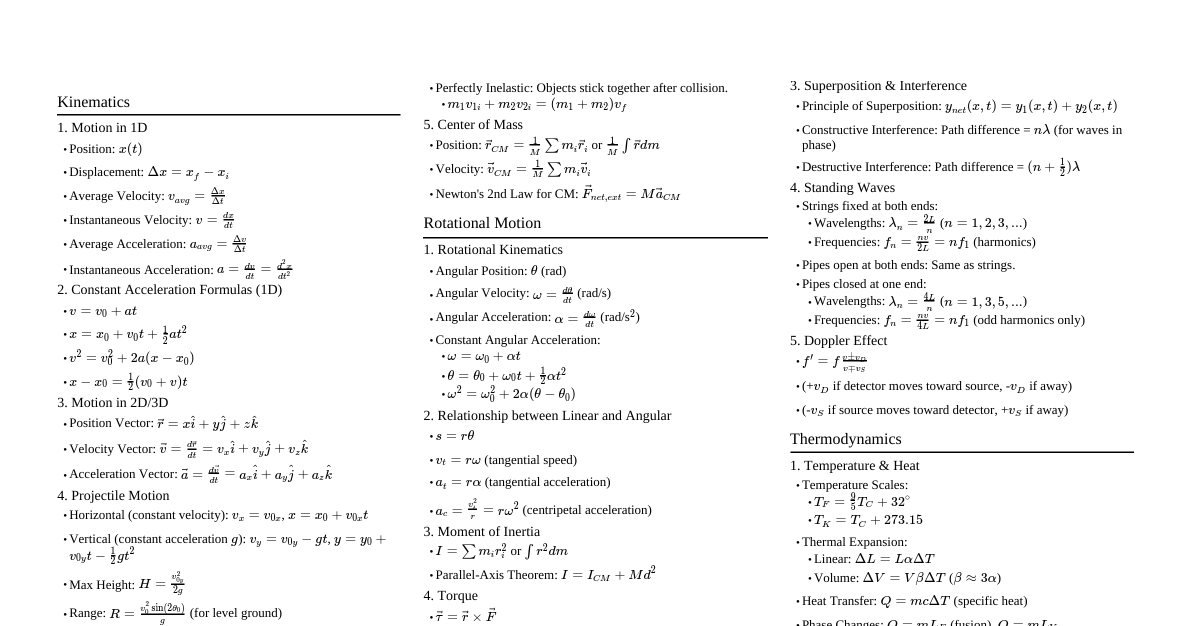
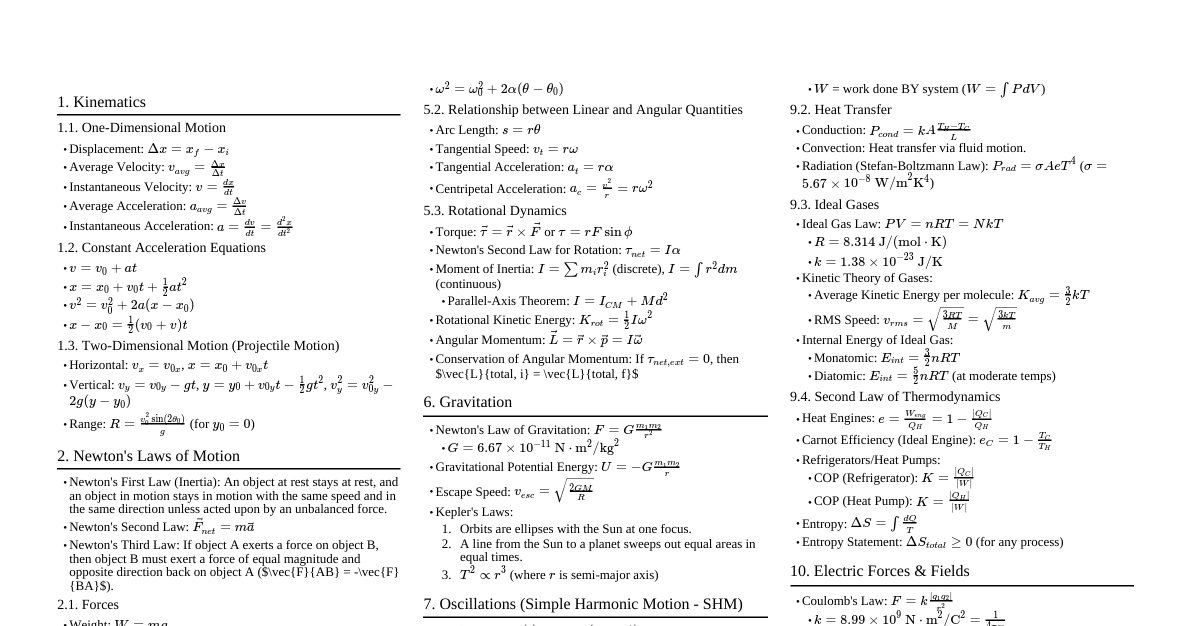
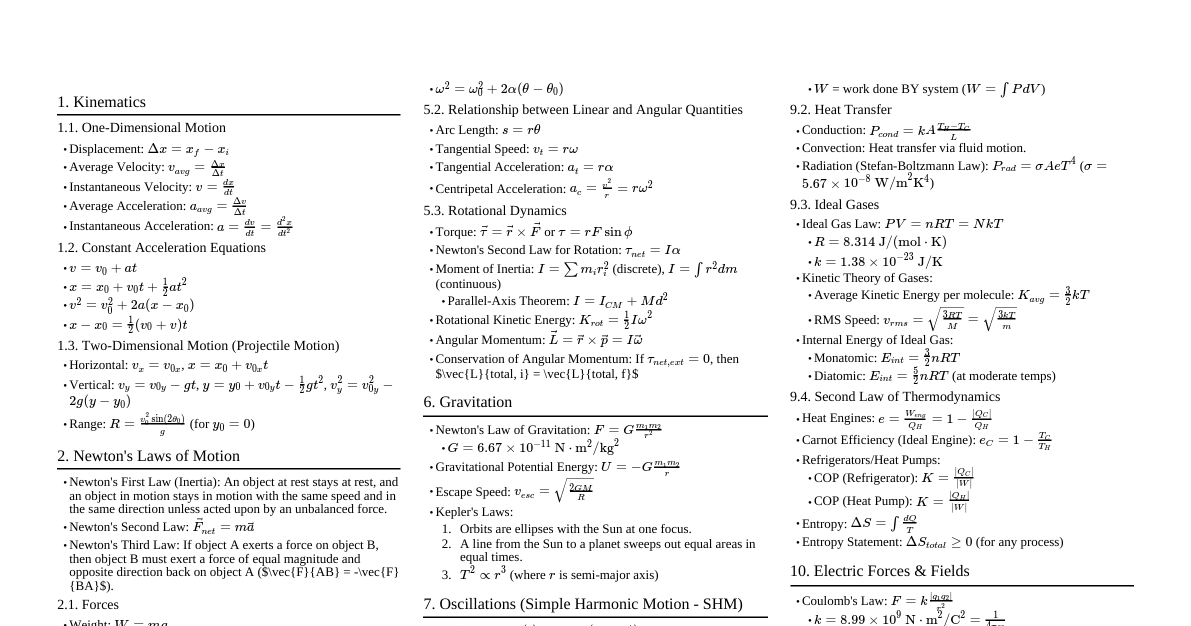
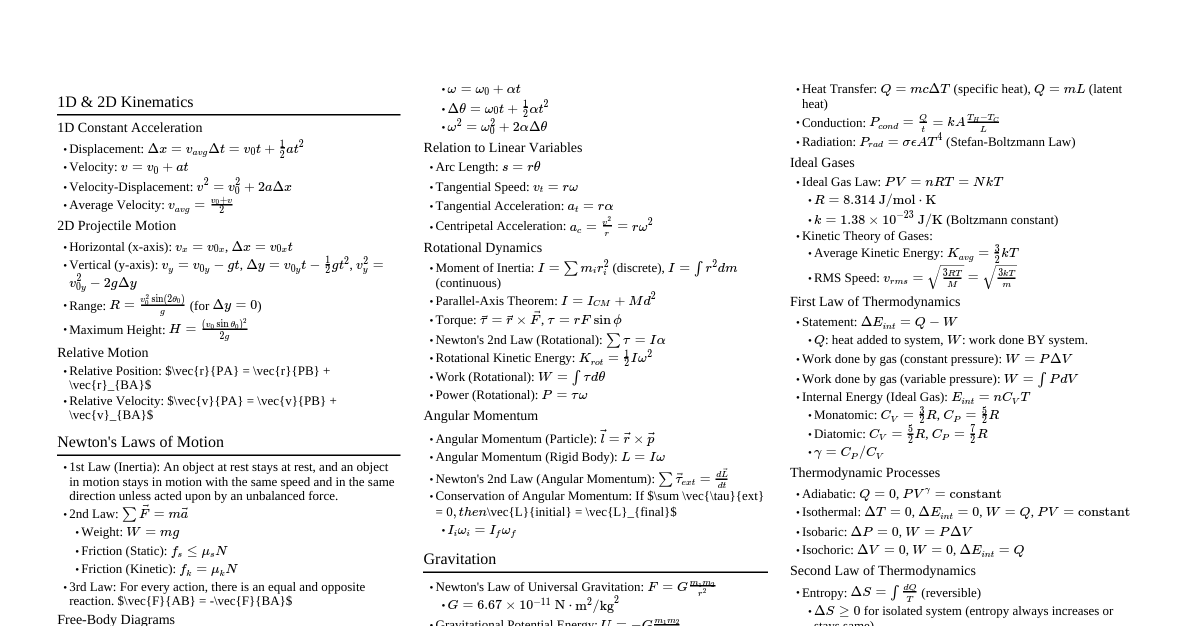
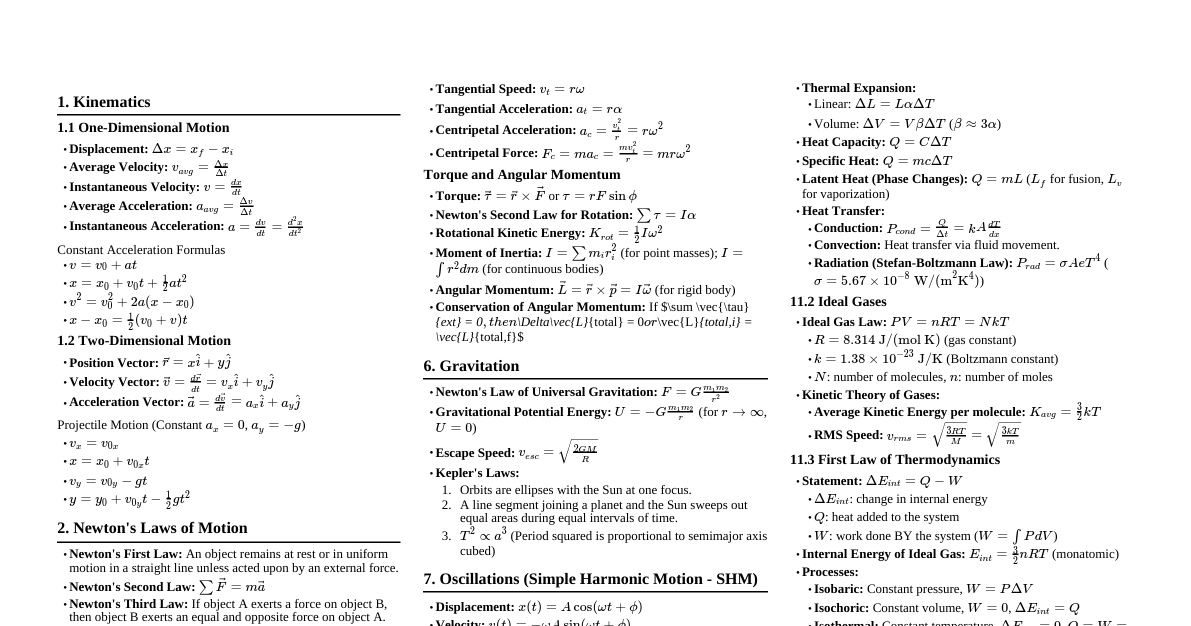
### 1. Kinematics (Motion) #### 1.1. One-Dimensional Motion - **Displacement:** $\Delta x = x_f - x_i$ - **Average Velocity:** $v_{avg} = \frac{\Delta x}{\Delta t}$ - **Instantaneous Velocity:** $v = \frac{dx}{dt}$ - **Average Acceleration:** $a_{avg} = \frac{\Delta v}{\Delta t}$ - **Instantaneous Acceleration:** $a = \frac{dv}{dt} = \frac{d^2x}{dt^2}$ #### 1.2. Constant Acceleration Equations - $v = v_0 + at$ - $x = x_0 + v_0 t + \frac{1}{2}at^2$ - $v^2 = v_0^2 + 2a(x - x_0)$ - $x - x_0 = \frac{1}{2}(v_0 + v)t$ #### 1.3. Two-Dimensional Motion (Projectile Motion) - **Position Vector:** $\vec{r} = x\hat{i} + y\hat{j}$ - **Velocity Vector:** $\vec{v} = v_x\hat{i} + v_y\hat{j}$ - **Acceleration Vector:** $\vec{a} = a_x\hat{i} + a_y\hat{j}$ - **For projectile motion (neglecting air resistance):** - $a_x = 0$, $a_y = -g$ - $v_x = v_{0x}$ - $x = x_0 + v_{0x}t$ - $v_y = v_{0y} - gt$ - $y = y_0 + v_{0y}t - \frac{1}{2}gt^2$ - **Range (R):** $R = \frac{v_0^2 \sin(2\theta_0)}{g}$ - **Max Height (H):** $H = \frac{(v_0 \sin\theta_0)^2}{2g}$ #### 1.4. Uniform Circular Motion - **Centripetal Acceleration:** $a_c = \frac{v^2}{r}$ (directed towards center) - **Period:** $T = \frac{2\pi r}{v}$ ### 2. Newton's Laws of Motion #### 2.1. Newton's First Law (Law of Inertia) - An object at rest stays at rest, and an object in motion stays in motion with the same speed and in the same direction unless acted upon by an unbalanced force. - **Inertial Reference Frame:** A frame where Newton's First Law holds. #### 2.2. Newton's Second Law - $\vec{F}_{net} = m\vec{a}$ - **Force:** A push or pull. Unit: Newton (N), $1 N = 1 \text{ kg} \cdot \text{m/s}^2$ - **Mass:** A measure of an object's inertia. - **Weight:** $W = mg$ (force due to gravity) #### 2.3. Newton's Third Law - If object A exerts a force on object B, then object B exerts a force of equal magnitude and opposite direction on object A. - $\vec{F}_{AB} = -\vec{F}_{BA}$ #### 2.4. Common Forces - **Normal Force ($F_N$):** Perpendicular to surface, preventing penetration. - **Tension ($T$):** Force transmitted through a rope or string. - **Friction ($f_s, f_k$):** Opposes motion. - **Static Friction:** $0 \le f_s \le \mu_s F_N$ (prevents motion) - **Kinetic Friction:** $f_k = \mu_k F_N$ (opposes motion when sliding) - $\mu_s \ge \mu_k$ ### 3. Work, Energy, and Power #### 3.1. Work - **Constant Force:** $W = \vec{F} \cdot \vec{d} = Fd \cos\phi$ - **Variable Force:** $W = \int \vec{F} \cdot d\vec{r}$ - **Work-Kinetic Energy Theorem:** $W_{net} = \Delta K = K_f - K_i$ - **Units:** Joule (J), $1 J = 1 \text{ N} \cdot \text{m}$ #### 3.2. Kinetic Energy - **Translational Kinetic Energy:** $K = \frac{1}{2}mv^2$ #### 3.3. Potential Energy - **Gravitational Potential Energy:** $U_g = mgh$ (near Earth's surface) - **Elastic Potential Energy (Spring):** $U_s = \frac{1}{2}kx^2$ (Hooke's Law: $F_s = -kx$) #### 3.4. Conservation of Energy - **Conservative Forces:** Work done is independent of path (e.g., gravity, spring force). - **Non-Conservative Forces:** Work done depends on path (e.g., friction, air resistance). - **Mechanical Energy:** $E_{mech} = K + U$ - **Conservation of Mechanical Energy (only conservative forces):** $K_i + U_i = K_f + U_f$ - **General Conservation of Energy:** $W_{nc} = \Delta E_{mech} = (K_f + U_f) - (K_i + U_i)$ - $W_{nc}$ is work done by non-conservative forces. #### 3.5. Power - **Average Power:** $P_{avg} = \frac{\Delta W}{\Delta t}$ - **Instantaneous Power:** $P = \frac{dW}{dt} = \vec{F} \cdot \vec{v}$ - **Units:** Watt (W), $1 W = 1 \text{ J/s}$ ### 4. Momentum and Collisions #### 4.1. Linear Momentum - **Momentum:** $\vec{p} = m\vec{v}$ - **Newton's Second Law (in terms of momentum):** $\vec{F}_{net} = \frac{d\vec{p}}{dt}$ #### 4.2. Impulse - **Impulse:** $\vec{J} = \int \vec{F} dt = \Delta \vec{p} = \vec{p}_f - \vec{p}_i$ - **Impulse-Momentum Theorem:** $\vec{J} = \Delta \vec{p}$ #### 4.3. Conservation of Linear Momentum - If no external net force acts on a system, the total linear momentum of the system remains constant. - $\vec{P}_{total, i} = \vec{P}_{total, f}$ - For a two-particle system: $m_1\vec{v}_{1i} + m_2\vec{v}_{2i} = m_1\vec{v}_{1f} + m_2\vec{v}_{2f}$ #### 4.4. Collisions - **Elastic Collision:** Both momentum and kinetic energy are conserved. - $m_1v_{1i} + m_2v_{2i} = m_1v_{1f} + m_2v_{2f}$ - $\frac{1}{2}m_1v_{1i}^2 + \frac{1}{2}m_2v_{2i}^2 = \frac{1}{2}m_1v_{1f}^2 + \frac{1}{2}m_2v_{2f}^2$ - **Inelastic Collision:** Momentum is conserved, but kinetic energy is NOT conserved. - **Perfectly Inelastic Collision:** Objects stick together after collision. - $m_1v_{1i} + m_2v_{2i} = (m_1 + m_2)V_f$ #### 4.5. Center of Mass - **Position:** $x_{CM} = \frac{\sum m_i x_i}{\sum m_i}$, $y_{CM} = \frac{\sum m_i y_i}{\sum m_i}$ - **Velocity:** $\vec{v}_{CM} = \frac{\sum m_i \vec{v}_i}{\sum m_i}$ - **Newton's Second Law for System:** $\vec{F}_{net, ext} = M_{total}\vec{a}_{CM}$ ### 5. Rotation #### 5.1. Rotational Kinematics - **Angular Position:** $\theta$ (radians) - **Angular Velocity:** $\omega = \frac{d\theta}{dt}$ - **Angular Acceleration:** $\alpha = \frac{d\omega}{dt}$ - **Constant Angular Acceleration Equations:** - $\omega = \omega_0 + \alpha t$ - $\theta = \theta_0 + \omega_0 t + \frac{1}{2}\alpha t^2$ - $\omega^2 = \omega_0^2 + 2\alpha(\theta - \theta_0)$ #### 5.2. Relationship Between Linear and Angular Variables - $s = r\theta$ (arc length) - $v_t = r\omega$ (tangential speed) - $a_t = r\alpha$ (tangential acceleration) - $a_c = r\omega^2 = \frac{v_t^2}{r}$ (centripetal acceleration) #### 5.3. Rotational Dynamics - **Torque:** $\vec{\tau} = \vec{r} \times \vec{F}$ (magnitude: $\tau = rF\sin\phi$) - **Newton's Second Law for Rotation:** $\vec{\tau}_{net} = I\vec{\alpha}$ - **Moment of Inertia ($I$):** Resistance to angular acceleration. - For a point mass: $I = mr^2$ - For extended objects, $I = \int r^2 dm$ (see table for common shapes) - **Parallel-Axis Theorem:** $I = I_{CM} + Md^2$ #### 5.4. Rotational Energy - **Rotational Kinetic Energy:** $K_{rot} = \frac{1}{2}I\omega^2$ - **Total Kinetic Energy (rolling):** $K_{total} = K_{trans} + K_{rot} = \frac{1}{2}Mv_{CM}^2 + \frac{1}{2}I_{CM}\omega^2$ - **Work done by Torque:** $W = \int \tau d\theta$ - **Power:** $P = \tau\omega$ #### 5.5. Angular Momentum - **Angular Momentum of a particle:** $\vec{l} = \vec{r} \times \vec{p} = \vec{r} \times m\vec{v}$ - **Angular Momentum of a rigid body:** $\vec{L} = I\vec{\omega}$ - **Newton's Second Law for Rotation (in terms of angular momentum):** $\vec{\tau}_{net} = \frac{d\vec{L}}{dt}$ - **Conservation of Angular Momentum:** If $\vec{\tau}_{net, ext} = 0$, then $\vec{L}_{total}$ is conserved. - $I_i\omega_i = I_f\omega_f$ ### 6. Gravitation - **Newton's Law of Universal Gravitation:** $F = G \frac{m_1 m_2}{r^2}$ - $G = 6.67 \times 10^{-11} \text{ N} \cdot \text{m}^2/\text{kg}^2$ - **Gravitational Acceleration:** $g = G \frac{M_E}{R_E^2}$ (at Earth's surface) - **Gravitational Potential Energy:** $U = -G \frac{m_1 m_2}{r}$ (relative to $U=0$ at $r=\infty$) - **Escape Speed:** $v_{esc} = \sqrt{\frac{2GM}{R}}$ - **Kepler's Laws:** 1. Law of Orbits: Planets orbit the Sun in ellipses with the Sun at one focus. 2. Law of Areas: A line connecting a planet to the Sun sweeps out equal areas in equal times. 3. Law of Periods: $T^2 \propto r^3$ (for circular orbits: $T^2 = (\frac{4\pi^2}{GM})r^3$) ### 7. Oscillations #### 7.1. Simple Harmonic Motion (SHM) - **Restoring Force:** $F = -kx$ (Hooke's Law) - **Position:** $x(t) = x_m \cos(\omega t + \phi)$ - $x_m$: amplitude, $\omega$: angular frequency, $\phi$: phase constant - **Velocity:** $v(t) = -\omega x_m \sin(\omega t + \phi)$ - **Acceleration:** $a(t) = -\omega^2 x_m \cos(\omega t + \phi) = -\omega^2 x(t)$ - **Angular Frequency:** $\omega = \sqrt{\frac{k}{m}}$ (mass-spring system) - **Period:** $T = \frac{2\pi}{\omega} = 2\pi\sqrt{\frac{m}{k}}$ - **Frequency:** $f = \frac{1}{T} = \frac{\omega}{2\pi}$ - **Energy in SHM:** $E = K + U = \frac{1}{2}mv^2 + \frac{1}{2}kx^2 = \frac{1}{2}kx_m^2 = \frac{1}{2}m\omega^2 x_m^2$ #### 7.2. Pendulums - **Simple Pendulum (small angles):** - Period: $T = 2\pi\sqrt{\frac{L}{g}}$ - **Physical Pendulum:** - Period: $T = 2\pi\sqrt{\frac{I}{mgd}}$ (I = moment of inertia, d = distance from pivot to CM) #### 7.3. Damped SHM - **Damping Force:** $\vec{F}_d = -b\vec{v}$ - **Equation of Motion:** $x(t) = x_m e^{-bt/2m} \cos(\omega' t + \phi)$ - **Angular Frequency:** $\omega' = \sqrt{\frac{k}{m} - \frac{b^2}{4m^2}}$ #### 7.4. Forced Oscillations & Resonance - **Driving Force:** $F_d = F_m \cos(\omega_d t)$ - **Resonance:** Occurs when driving frequency ($\omega_d$) approaches natural frequency ($\omega$). - Amplitude is maximized. ### 8. Waves #### 8.1. Transverse and Longitudinal Waves - **Transverse:** Oscillation perpendicular to wave propagation (e.g., light, waves on a string). - **Longitudinal:** Oscillation parallel to wave propagation (e.g., sound). #### 8.2. Wave Characteristics - **Wavelength ($\lambda$):** Distance between two consecutive crests/troughs. - **Period ($T$):** Time for one complete oscillation. - **Frequency ($f$):** Number of oscillations per unit time ($f=1/T$). - **Wave Speed:** $v = \lambda f = \frac{\omega}{k}$ - **Angular Wave Number:** $k = \frac{2\pi}{\lambda}$ - **Angular Frequency:** $\omega = \frac{2\pi}{T}$ #### 8.3. Wave Equation - **General Form:** $y(x,t) = y_m \sin(kx - \omega t + \phi)$ - $y_m$: amplitude #### 8.4. Waves on a String - **Wave Speed:** $v = \sqrt{\frac{\tau}{\mu}}$ ($\tau$: tension, $\mu$: linear mass density) - **Power Transmitted:** $P = \frac{1}{2}\mu v \omega^2 y_m^2$ #### 8.5. Sound Waves - **Speed of Sound:** - In a fluid: $v = \sqrt{\frac{B}{\rho}}$ ($B$: bulk modulus, $\rho$: density) - In a solid rod: $v = \sqrt{\frac{Y}{\rho}}$ ($Y$: Young's modulus) - In air (at $20^\circ C$): $v \approx 343 \text{ m/s}$ - **Intensity:** $I = \frac{P}{A}$ (Power per unit area) - **Inverse Square Law:** $I \propto \frac{1}{r^2}$ - **Sound Level (decibels):** $\beta = (10 \text{ dB}) \log_{10}\frac{I}{I_0}$ ($I_0 = 10^{-12} \text{ W/m}^2$) - **Doppler Effect:** $f' = f \frac{v \pm v_D}{v \mp v_S}$ - $v_D$: detector speed, $v_S$: source speed. - Top sign for "towards", bottom sign for "away". #### 8.6. Superposition and Interference - **Principle of Superposition:** Net displacement is sum of individual wave displacements. - **Constructive Interference:** Waves in phase, amplitudes add. - **Destructive Interference:** Waves out of phase, amplitudes subtract. #### 8.7. Standing Waves - **Nodes:** Points of zero displacement. - **Antinodes:** Points of maximum displacement. - **On a String (fixed at both ends):** - Wavelengths: $\lambda_n = \frac{2L}{n}$ ($n=1, 2, 3, ...$) - Frequencies: $f_n = \frac{nv}{2L} = n f_1$ (harmonics) - **In Organ Pipes:** - **Open at both ends:** Same as string. $\lambda_n = \frac{2L}{n}$, $f_n = \frac{nv}{2L}$ - **Closed at one end:** $\lambda_n = \frac{4L}{n}$ ($n=1, 3, 5, ...$ only odd harmonics) - $f_n = \frac{nv}{4L}$ ### 9. Thermodynamics #### 9.1. Temperature and Heat - **Temperature Scales:** - Celsius to Fahrenheit: $T_F = \frac{9}{5}T_C + 32^\circ$ - Celsius to Kelvin: $T_K = T_C + 273.15$ - **Thermal Expansion:** - Linear: $\Delta L = L\alpha\Delta T$ - Volume: $\Delta V = V\beta\Delta T$ ($\beta = 3\alpha$) - **Heat ($Q$):** Energy transferred due to temperature difference. - **Specific Heat:** $Q = cm\Delta T$ - **Latent Heat (Phase Change):** $Q = Lm$ ($L_F$: fusion, $L_V$: vaporization) - **Heat Transfer Mechanisms:** - **Conduction:** $P_{cond} = kA\frac{dT}{dx}$ ($k$: thermal conductivity) - **Convection:** Heat transfer via fluid motion. - **Radiation:** $P_{rad} = \sigma \epsilon A T^4$ (Stefan-Boltzmann Law, $\sigma = 5.67 \times 10^{-8} \text{ W/m}^2 \cdot \text{K}^4$, $\epsilon$: emissivity) #### 9.2. First Law of Thermodynamics - **Internal Energy ($E_{int}$):** Sum of microscopic energies. - **First Law:** $\Delta E_{int} = Q - W$ - $Q$: heat added to system - $W$: work done BY system (expansion: $W = \int P dV$) - **Work in P-V Diagram:** Area under P-V curve. - **Ideal Gas:** $PV = nRT = NkT$ - $R = 8.31 \text{ J/mol} \cdot \text{K}$ (gas constant) - $k = 1.38 \times 10^{-23} \text{ J/K}$ (Boltzmann constant) - **Internal Energy of Monatomic Ideal Gas:** $E_{int} = \frac{3}{2}nRT$ #### 9.3. Heat Capacities of Ideal Gases - **Constant Volume ($C_V$):** $Q = nC_V\Delta T$, $W=0$, $\Delta E_{int} = nC_V\Delta T$ - For monatomic ideal gas: $C_V = \frac{3}{2}R$ - **Constant Pressure ($C_P$):** $Q = nC_P\Delta T$, $W = P\Delta V = nR\Delta T$ - $C_P = C_V + R$ - For monatomic ideal gas: $C_P = \frac{5}{2}R$ - **Adiabatic Process ($Q=0$):** $PV^\gamma = \text{constant}$, $T V^{\gamma-1} = \text{constant}$ - $\gamma = C_P/C_V$ #### 9.4. Second Law of Thermodynamics - **Entropy ($S$):** Measure of disorder. - **Second Law:** The entropy of an isolated system never decreases. It either increases or remains constant. - $\Delta S \ge 0$ for isolated systems. - **Change in Entropy:** $\Delta S = \int \frac{dQ}{T}$ (for reversible processes) - **Heat Engines:** Convert heat to work. - Efficiency: $\epsilon = \frac{|W|}{|Q_H|} = 1 - \frac{|Q_C|}{|Q_H|}$ - **Carnot Engine (ideal):** $\epsilon_C = 1 - \frac{T_C}{T_H}$ - **Refrigerators/Heat Pumps:** Use work to transfer heat. - **Coefficient of Performance (COP):** - Refrigerator: $K = \frac{|Q_C|}{|W|}$ - Heat Pump: $K = \frac{|Q_H|}{|W|}$ - **Carnot COP:** $K_{C,ref} = \frac{T_C}{T_H - T_C}$, $K_{C,HP} = \frac{T_H}{T_H - T_C}$