New sheet - 11/01 21:31
Cheatsheet Content
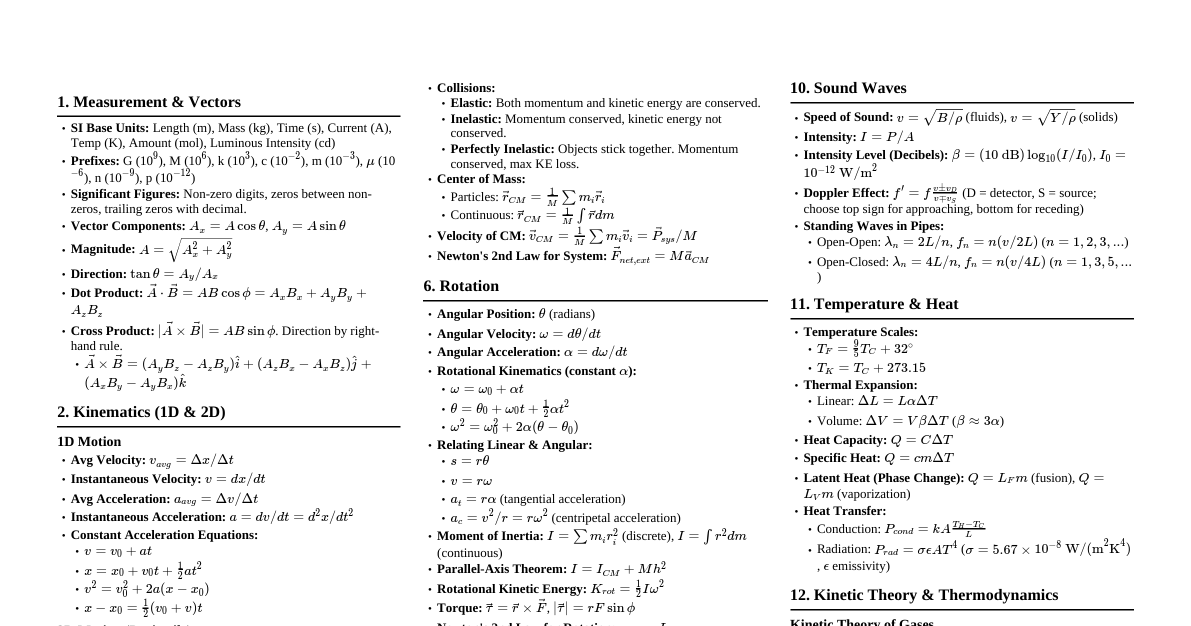
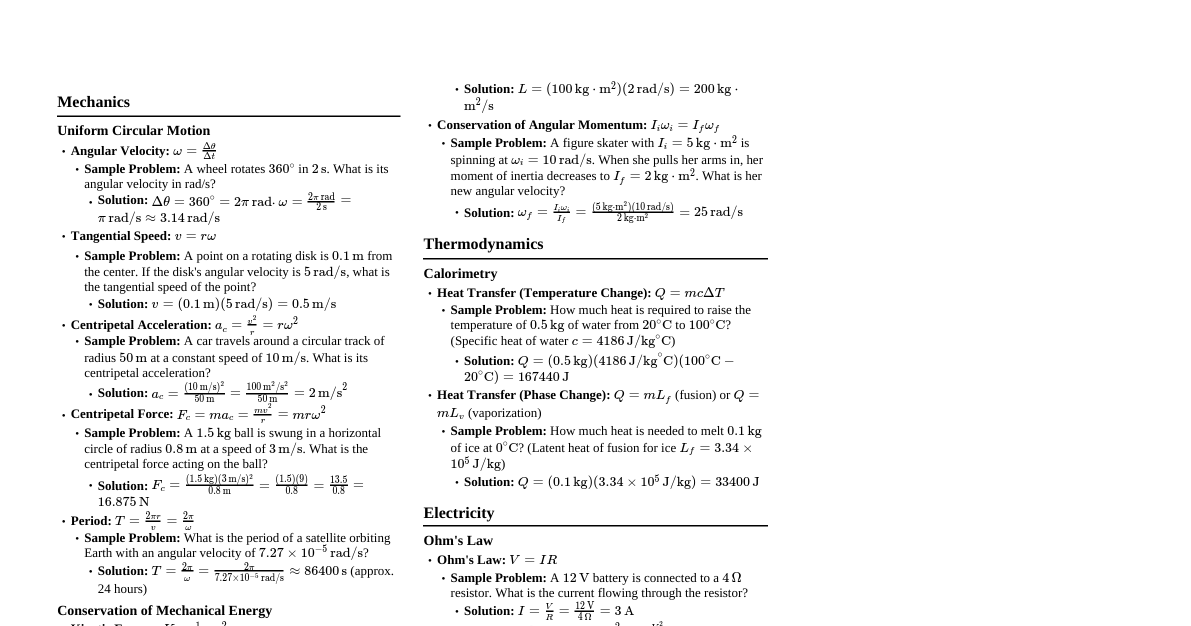
Circular Dynamics: Kinematics 1. Angular Displacement ($\theta$) Defined as $s/r$, where $s$ is arc length and $r$ is radius. Direction determined by the Right-hand thumb rule . 2. Angular Velocity ($\omega$) $$\omega = \frac{d\theta}{dt} = \frac{\text{Angular displacement}}{\text{Time}}$$ For one complete revolution: $\omega = \frac{2\pi}{T}$ Relation with frequency: $\omega = 2\pi\nu$ Average angular velocity: $\omega_{avg} = \frac{\theta_2 - \theta_1}{t_2 - t_1}$ 3. Angular Acceleration ($\alpha$) $$\alpha = \frac{d\omega}{dt} = \frac{d^2\theta}{dt^2}$$ Average value: $\alpha_{avg} = \frac{\omega_f - \omega_i}{t_f - t_i}$ Constant $\alpha$ equations: $\omega_f = \omega_i + \alpha t$ $\theta = \omega_i t + \frac{1}{2}\alpha t^2$ $\omega_f^2 - \omega_i^2 = 2\alpha\theta$ Integral form: $\omega_f - \omega_i = \int \alpha dt$ Relation Chain (Calculus) Differentiation: $\theta \rightarrow \omega \rightarrow \alpha$ Integration: $\alpha \rightarrow \omega \rightarrow \theta$ Linear and Angular Relations Velocity: $\vec{v} = \vec{\omega} \times \vec{r}$ Tangential acceleration: $\vec{a_t} = \vec{\alpha} \times \vec{r}$, scalar magnitude $a_t = r\alpha = \frac{dv}{dt}$ Centripetal (radial/normal) acceleration: $a_c = r\omega^2 = v\omega = \frac{v^2}{r}$ Other names: $a_c$ = radial or normal acceleration. Uniform Circular Motion (UCM) $|\vec{v}| = \text{constant}$ $a_t = 0$ Change in velocity: $2v \sin(\theta/2)$ Resultant (vector sum) of velocities: $2v \cos(\theta/2)$ Net acceleration: $a_{net} = a_c$ (since $a_t=0$) Non-Uniform Circular Motion (NUCM) Both $a_c$ and $a_t$ are present. Net acceleration: $a_{net} = \sqrt{a_c^2 + a_t^2}$ Condition for circular motion: At least one force component must act toward the center. If translational acceleration also present in car: $$\mu_s mg = \sqrt{\left(\frac{mv^2}{r}\right)^2 + \left(m\frac{dv}{dt}\right)^2}$$ Steps for Solving Circular Dynamics Problems Draw circular path and locate center. Resolve forces along radial and tangential directions. Apply $F = ma$ separately along each axis. Identify conditions for UCM or NUCM. Use relation chain $\theta \leftrightarrow \omega \leftrightarrow \alpha$ and $v, a_t, a_c$ accordingly. Circular Dynamics (Applications) Bending of Cyclist When a cyclist bends while turning, the normal force $N$ and friction provide the necessary centripetal force. $N \sin\theta = \frac{mv^2}{r}$ $N \cos\theta = mg$ $\tan\theta = \frac{v^2}{rg}$ $v = \sqrt{rg \tan\theta}$ Conical Pendulum - Key Formulas A mass $m$ attached to a string of length $L$ and pivoted at a point, swings in a horizontal circle. $T \cos\theta = mg$ $T \sin\theta = mr\omega^2$ $\tan\theta = \frac{r\omega^2}{g} = \frac{v^2}{rg}$ $v = \sqrt{rg \tan\theta}$ Period: $T = 2\pi\sqrt{\frac{r}{g \tan\theta}}$ If string length is $L$: $T = 2\pi\sqrt{\frac{L \cos\theta}{g}}$ Simple Pendulum (at point of oscillation) At any point in its swing, the tension $T$ and gravity $mg$ act on the bob. $T - mg \cos\theta = \frac{mv^2}{r}$ (radial component) $mg \sin\theta = ma_t$ (tangential component) Turning of Car on Level Road (Friction Required) For a car to turn on a level road, static friction provides the centripetal force. $mg = N$ $f_s = \frac{mv^2}{r}$ At limiting condition: $f_s = \mu_s N = \mu_s mg$ Maximum safe speed: $v_{max} = \sqrt{\mu_s rg}$ Banking of Roads (Without friction) Roads are banked at an angle $\theta$ to allow cars to turn without relying on friction. $N \sin\theta = \frac{mv^2}{r}$ $N \cos\theta = mg$ $\tan\theta = \frac{v^2}{rg}$ Optimal speed: $v_{max} = \sqrt{rg \tan\theta}$ Banking of Roads (With friction) When friction is present on a banked road, the range of safe speeds is wider. $N \cos\theta + f_s \sin\theta = mg$ $N \sin\theta + f_s \cos\theta = \frac{mv^2}{r}$ Maximum speed (friction up the incline): $v_{max} = \sqrt{rg \frac{\tan\theta + \mu_s}{1 - \mu_s \tan\theta}}$ Minimum speed (friction down the incline): $v_{min} = \sqrt{rg \frac{\tan\theta - \mu_s}{1 + \mu_s \tan\theta}}$ Objective trick: Replace $\mu_s \rightarrow -\mu_s$ for min value formula. Banking of Aeroplanes (Aerodynamic Lift) An aeroplane banks to turn, with the lift force providing the centripetal force. Lift $L$: Aerodynamic lift $L \sin\theta = \frac{mv^2}{r}$ $L \cos\theta = mg$ $v = \sqrt{rg \tan\theta}$ Bowl Problem (car/bank inside bowl) Similar to banking of roads, but often expressed in terms of angular velocity. $mr\omega^2 = N \sin\theta + \mu_s N \cos\theta$ $N \cos\theta = mg + \mu_s N \sin\theta$ Angular velocity: $\omega = \sqrt{\frac{g(\sin\theta + \mu_s \cos\theta)}{r(\cos\theta - \mu_s \sin\theta)}}$ $\omega_{max} = \sqrt{\frac{g(\tan\theta + \mu_s)}{r(1 - \mu_s \tan\theta)}}$ $\omega_{min} = \sqrt{\frac{g(\tan\theta - \mu_s)}{r(1 + \mu_s \tan\theta)}}$ If frictionless: $\omega = \sqrt{\frac{g \tan\theta}{r}}$ Car Turning on a Circular Track (with Constant Tangential Acceleration) A car moving on a circular track with tangential acceleration $\frac{dv}{dt}$ is held by friction providing both motion and grip. Centripetal force: $F_c = \frac{mv^2}{R}$ Tangential force: $F_t = m\frac{dv}{dt}$ Resultant friction: $f = m\sqrt{\left(\frac{v^2}{R}\right)^2 + \left(\frac{dv}{dt}\right)^2}$ Limiting friction: $f_{max} = \mu_s mg$ Condition for no skidding: $m\sqrt{\left(\frac{v^2}{R}\right)^2 + \left(\frac{dv}{dt}\right)^2} \leq \mu_s mg$ If exceeded, the car skids outward. Pseudo Force Newton's laws aren't valid when the observer is also accelerated and observes any motion. To make Newton's laws work for an accelerated observer, a fake force (pseudo force) needs to be added. Pseudo force always acts in the direction opposite to the acceleration of the observer. Pseudo Force Formula $\vec{F}_{pseudo} = -M_{body} \times \vec{A}_{NIF}$ Where: $\vec{F}_{pseudo}$: pseudo force $M_{body}$: mass of the object $\vec{A}_{NIF}$: acceleration of the non-inertial frame (observer's frame) Key Note Pseudo force is always constructed in the direction opposite to the acceleration of the observer's non-inertial frame. Elevator Problems When lift moves upward: $N = m(g+a)$ Normal force increases; apparent weight is more. When lift moves downward: $N = m(g-a)$ Normal force decreases; apparent weight is less.