Class 11 Physics Numericals
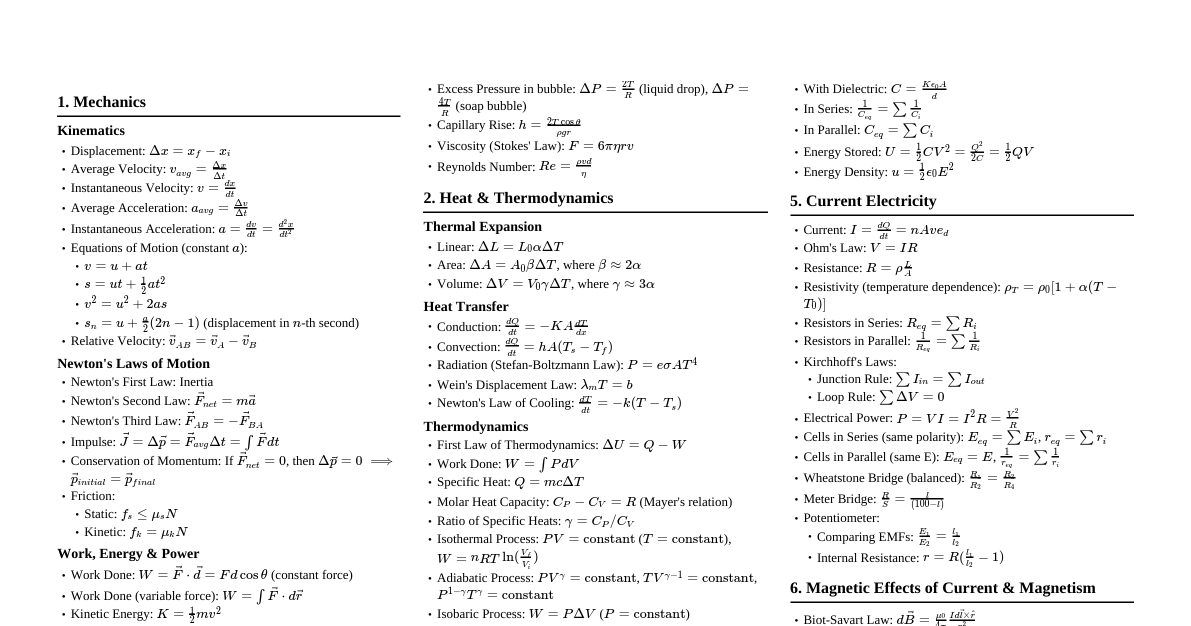
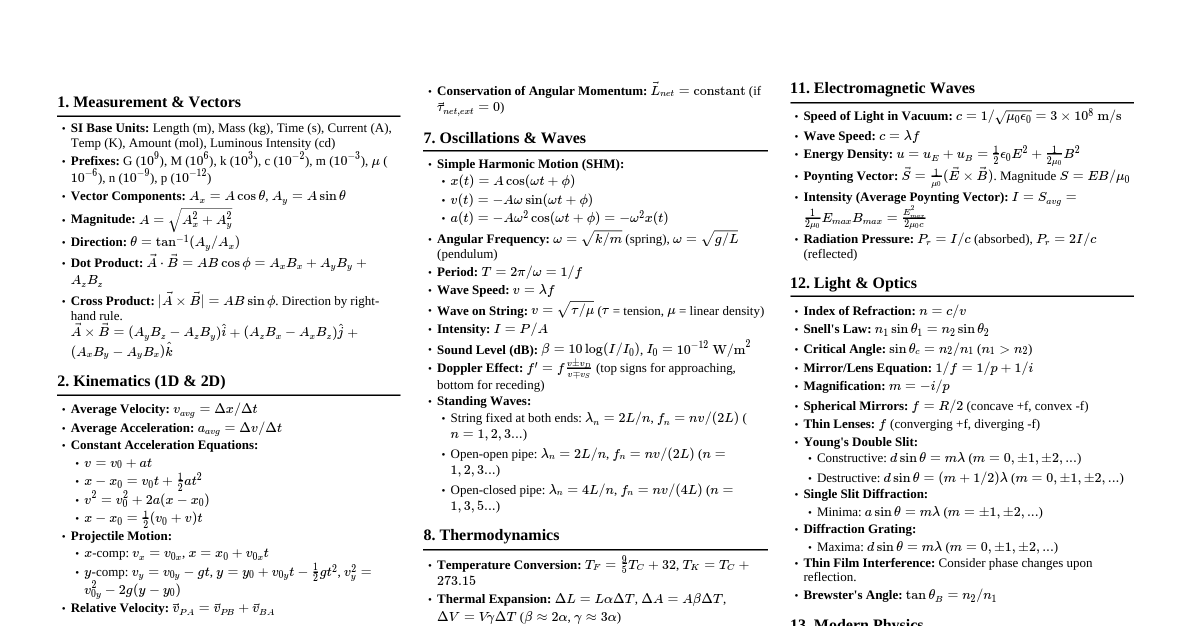
Cheatsheet Content
### Kinematics - Numerical Problems 1. A car starts from rest and accelerates uniformly at $2.0 \text{ m/s}^2$ for $10 \text{ s}$. It then travels at constant velocity for $20 \text{ s}$ and finally decelerates uniformly at $4.0 \text{ m/s}^2$ until it stops. Calculate the total distance covered by the car. 2. A stone is dropped from the top of a tower $100 \text{ m}$ high. At the same instant, another stone is projected vertically upwards from the ground with a velocity of $25 \text{ m/s}$. When and where will the two stones meet? (Take $g = 9.8 \text{ m/s}^2$). 3. A projectile is fired with an initial velocity of $50 \text{ m/s}$ at an angle of $37^\circ$ above the horizontal. Calculate: a) The time of flight. b) The maximum height reached. c) The horizontal range. d) The velocity of the projectile $2 \text{ s}$ after projection. (Take $\sin 37^\circ = 0.6$, $\cos 37^\circ = 0.8$, $g = 10 \text{ m/s}^2$). 4. A particle moves along a straight line such that its displacement $x$ at time $t$ is given by $x = 2t^3 - 9t^2 + 12t + 1 \text{ m}$. a) Find the time when the velocity of the particle is zero. b) Find the position and acceleration of the particle at that time. c) Calculate the total distance traveled by the particle in the first $3 \text{ s}$. 5. A helicopter rises from the ground with an upward acceleration of $3 \text{ m/s}^2$. At a height of $150 \text{ m}$, a packet is dropped from the helicopter. Calculate: a) The velocity of the packet just after it is dropped. b) The time taken by the packet to reach the ground. c) The velocity with which the packet hits the ground. (Take $g = 10 \text{ m/s}^2$). 6. An object is thrown vertically upwards with a velocity of $20 \text{ m/s}$. After $1 \text{ s}$, another object is thrown vertically upwards from the same point with a velocity of $25 \text{ m/s}$. Find when and where the two objects will meet. (Take $g = 10 \text{ m/s}^2$). 7. A boat is moving at $10 \text{ km/h}$ relative to the water. The river flows at $3 \text{ km/h}$ eastward. If the boat heads $30^\circ$ north of east, what is its velocity relative to the ground? 8. A car travels half the distance with speed $v_1$ and the other half with speed $v_2$. What is its average speed? 9. A car travels with speed $v_1$ for half the time and with speed $v_2$ for the other half of the time. What is its average speed? 10. A particle is projected from the ground with an initial velocity of $u$ at an angle $\theta$ with the horizontal. At what angle with the horizontal is its velocity when it is at its maximum height? 11. A bomb is dropped from an airplane flying horizontally with a velocity of $720 \text{ km/h}$ at a height of $980 \text{ m}$. Calculate the time taken by the bomb to reach the ground and the horizontal distance it travels. (Take $g = 9.8 \text{ m/s}^2$). 12. A stone is thrown horizontally with a velocity of $15 \text{ m/s}$ from the top of a tower. If it hits the ground at a horizontal distance of $45 \text{ m}$ from the base of the tower, find the height of the tower. (Take $g = 10 \text{ m/s}^2$). 13. A ball is thrown from the top of a $60 \text{ m}$ high building with a velocity of $20 \text{ m/s}$ at an angle of $30^\circ$ above the horizontal. Calculate the time taken to hit the ground and the horizontal distance covered. (Take $g = 10 \text{ m/s}^2$). 14. A projectile has the same range $R$ for two angles of projection $\alpha$ and $90^\circ - \alpha$. If $t_1$ and $t_2$ are the times of flight for the two cases, prove that $t_1 t_2 = \frac{2R}{g}$. 15. A train starts from rest with a constant acceleration $\alpha$. After time $t_1$, it attains a velocity $v$. It then travels with constant velocity $v$ for time $t_2$. Then it decelerates with a constant deceleration $\beta$ and stops in time $t_3$. Find the total distance covered. 16. A particle moves in a circle of radius $R$ with constant speed $v$. What is the magnitude of the average acceleration when the particle completes half a revolution? 17. A man can swim at $4 \text{ km/h}$ in still water. He wants to cross a river $1 \text{ km}$ wide flowing at $3 \text{ km/h}$. a) In what direction should he swim to reach a point directly opposite on the other bank? b) How long will it take him to cross the river in this case? c) If he swims perpendicular to the current, how long will it take him and where will he land on the other bank? 18. A car accelerates from rest at $2 \text{ m/s}^2$ for $20 \text{ s}$, then maintains constant speed for $1 \text{ min}$, and finally decelerates at $3 \text{ m/s}^2$ until it stops. Find the total distance covered. 19. A body is dropped from a height $h$. Simultaneously, another body is projected upwards from the ground with a velocity $u$. If they meet at a height $h/2$, what is the velocity $u$? 20. A particle moves along a straight line with constant acceleration. If its velocity at $t = 0 \text{ s}$ is $10 \text{ m/s}$ and at $t = 4 \text{ s}$ is $20 \text{ m/s}$, find its displacement during the 4th second. 21. A projectile is launched from ground level with an initial velocity of $u$. The angle of projection is $\alpha$. If at the highest point of its trajectory, the speed of the projectile is $u/2$, what is the angle of projection $\alpha$? 22. A car is moving at $30 \text{ m/s}$. The driver applies the brakes and the car decelerates uniformly at $5 \text{ m/s}^2$. a) How long does it take for the car to stop? b) How far does it travel before stopping? 23. A ball is thrown vertically upwards with a velocity of $30 \text{ m/s}$. Calculate the total time it remains in the air and the maximum height it reaches. (Take $g = 10 \text{ m/s}^2$). 24. A swimmer can swim with a speed of $6 \text{ km/h}$ in still water. If he swims in a river flowing at $8 \text{ km/h}$, what is his resultant speed when he swims: a) Downstream? b) Upstream? c) Across the river perpendicular to the current? 25. A particle starts from rest and moves with an acceleration $a = (3t^2 + 2t + 1) \text{ m/s}^2$. Find its velocity and displacement after $2 \text{ s}$. 26. A projectile is given an initial velocity of $(2\hat{i} + 3\hat{j}) \text{ m/s}$. Find the equation of its trajectory. (Take $g = 10 \text{ m/s}^2$). 27. Two trains, each $100 \text{ m}$ long, are moving on parallel tracks. One is moving at $72 \text{ km/h}$ and the other at $54 \text{ km/h}$. Calculate the time taken for them to cross each other if they are moving: a) In the same direction. b) In opposite directions. 28. A helicopter is ascending vertically with a speed of $5 \text{ m/s}$. At a height of $100 \text{ m}$ above the ground, a package is dropped. How much time does the package take to reach the ground? (Take $g = 10 \text{ m/s}^2$). 29. A cricket ball is thrown at a speed of $28 \text{ m/s}$ in a direction $30^\circ$ above the horizontal. Calculate: a) The maximum height. b) The time taken by the ball to return to the same level. c) The distance from the thrower to where the ball lands. (Take $g = 9.8 \text{ m/s}^2$). 30. The position of a particle is given by $\vec{r} = (3t\hat{i} - 2t^2\hat{j} + 4\hat{k}) \text{ m}$. a) Find the velocity and acceleration of the particle. b) Find the magnitude of the velocity and acceleration at $t = 2 \text{ s}$. 31. A bullet fired from a rifle travels horizontally at $400 \text{ m/s}$. If the rifle is aimed at a target $200 \text{ m}$ away, how far below the aiming point will the bullet strike the target? (Take $g = 10 \text{ m/s}^2$). 32. A passenger in a moving train tosses a coin which falls behind him. It implies that the train is: a) Accelerating b) Moving with uniform speed c) Decelerating d) In a circular motion. Justify your answer with a numerical example. 33. A particle moves in the XY-plane with a constant acceleration of $1.5 \text{ m/s}^2$ in the direction making an angle of $37^\circ$ with the X-axis. At $t=0$, the particle is at the origin and its velocity is $8 \text{ m/s}$ along the X-axis. Find the velocity and position of the particle at $t=4 \text{ s}$. (Take $\sin 37^\circ = 0.6$, $\cos 37^\circ = 0.8$). 34. A person walks up a stationary escalator in $90 \text{ s}$. If the escalator moves and the person stands on it, he is carried up in $60 \text{ s}$. How much time would it take him to walk up the moving escalator? 35. A hot air balloon is rising vertically with a constant velocity of $10 \text{ m/s}$. When it is at a height of $75 \text{ m}$ from the ground, a stone is dropped from it. After how much time will the stone reach the ground? (Take $g = 10 \text{ m/s}^2$). 36. A ball is projected from the ground with a velocity of $15 \text{ m/s}$. The angle of projection is $60^\circ$ above the horizontal. At what two times is the ball at a height of $5 \text{ m}$? (Take $g = 10 \text{ m/s}^2$). 37. A body travels $20 \text{ m}$ in the 2nd second and $28 \text{ m}$ in the 4th second. How much distance will it travel in the 6th second? Assume uniform acceleration. 38. A particle starts from origin at $t=0$ with a velocity $5.0\hat{i} \text{ m/s}$ and moves in x-y plane under action of a force which produces a constant acceleration of $(3.0\hat{i} + 2.0\hat{j}) \text{ m/s}^2$. a) What is the y-coordinate of the particle at the instant its x-coordinate is $84 \text{ m}$? b) What is the speed of the particle at this time? 39. A swimmer wishes to cross a $500 \text{ m}$ wide river flowing at $5 \text{ km/h}$. His speed with respect to still water is $3 \text{ km/h}$. a) If he heads perpendicular to the current, how long does it take him to cross the river and how far downstream does he land? b) If he wants to reach a point directly opposite, in what direction should he swim and how long would it take? 40. A stone is thrown with a velocity of $10 \text{ m/s}$ at an angle of $45^\circ$ with the horizontal. Calculate the radius of curvature of its path at the highest point. (Take $g = 10 \text{ m/s}^2$). 41. A train moving at $20 \text{ m/s}$ applies brakes and comes to rest in $10 \text{ s}$. Calculate the deceleration and the distance traveled before coming to rest. 42. A particle starts from rest and moves with uniform acceleration. In the first $5 \text{ s}$, it travels $25 \text{ m}$. In the next $5 \text{ s}$, it travels $75 \text{ m}$. Find the acceleration of the particle and its velocity at the end of $10 \text{ s}$. 43. A projectile is fired at an angle $\theta$ with the horizontal with an initial speed $u$. What is the change in velocity when it reaches the highest point? 44. A car accelerates from rest at $2 \text{ m/s}^2$ for $10 \text{ s}$, then moves at constant velocity for $15 \text{ s}$, and then decelerates at $4 \text{ m/s}^2$ until it stops. Find the total displacement. 45. A body is projected vertically upwards. If $t_1$ and $t_2$ are the times at which it is at a height $h$ above the point of projection while ascending and descending respectively, show that $h = \frac{1}{2}g t_1 t_2$. 46. An airplane flies $400 \text{ km}$ north and $300 \text{ km}$ east in $1 \text{ hour}$. What is its average velocity? 47. A car moves from A to B at $40 \text{ km/h}$ and returns from B to A at $60 \text{ km/h}$. Calculate the average speed and average velocity for the entire journey. 48. A particle moves such that its velocity $v$ varies with position $x$ as $v = k\sqrt{x}$, where $k$ is a constant. If at $t=0$, $x=0$, find the displacement of the particle as a function of time. 49. A ball is dropped from a height $h$. It rebounds to a height $h/2$. What fraction of its kinetic energy is lost during the impact? 50. A projectile is fired horizontally from a height $H$ with a velocity $V$. At what distance from the foot of the tower will it strike the ground? (Take $g = 9.8 \text{ m/s}^2$). #### Answers to Kinematics Problems 1. $350 \text{ m}$ 2. $4 \text{ s}$, $21.6 \text{ m}$ from the ground 3. a) $6 \text{ s}$ b) $45 \text{ m}$ c) $240 \text{ m}$ d) $(40\hat{i} + 10\hat{j}) \text{ m/s}$ 4. a) $1 \text{ s}$ and $2 \text{ s}$ b) At $t=1 \text{ s}$, $x=6 \text{ m}$ and $a=-6 \text{ m/s}^2$. At $t=2 \text{ s}$, $x=5 \text{ m}$ and $a=6 \text{ m/s}^2$. c) $10 \text{ m}$ 5. a) $30 \text{ m/s}$ upwards b) $9.48 \text{ s}$ c) $64.8 \text{ m/s}$ downwards 6. $3 \text{ s}$ after the first object is thrown, $15 \text{ m}$ from the ground 7. Magnitude: $12.1 \text{ km/h}$, Direction: $19.2^\circ$ North of East 8. $\frac{2v_1 v_2}{v_1 + v_2}$ 9. $\frac{v_1 + v_2}{2}$ 10. $0^\circ$ 11. $14.14 \text{ s}$, $2828 \text{ m}$ 12. $45 \text{ m}$ 13. $5.77 \text{ s}$, $100 \text{ m}$ 14. Proof 15. $\frac{1}{2}v(t_1 + t_2 + t_3)$ or $v^2(\frac{1}{2\alpha} + \frac{1}{\beta}) + v t_2$ 16. $\frac{2v^2}{\pi R}$ 17. a) $48.6^\circ$ upstream from the perpendicular b) $20 \text{ min}$ c) $15 \text{ min}$, $750 \text{ m}$ downstream 18. $1900 \text{ m}$ 19. $u = \sqrt{gh}$ 20. $18.5 \text{ m}$ 21. $60^\circ$ 22. a) $6 \text{ s}$ b) $90 \text{ m}$ 23. $6 \text{ s}$, $45 \text{ m}$ 24. a) $14 \text{ km/h}$ b) $2 \text{ km/h}$ c) $10 \text{ km/h}$ 25. $v = 14 \text{ m/s}$, $s = 18 \text{ m}$ 26. $y = 1.5x - 1.25x^2$ 27. a) $24 \text{ s}$ b) $4.76 \text{ s}$ 28. $5 \text{ s}$ 29. a) $10 \text{ m}$ b) $2.86 \text{ s}$ c) $68.5 \text{ m}$ 30. a) $\vec{v} = (3\hat{i} - 4t\hat{j}) \text{ m/s}$, $\vec{a} = -4\hat{j} \text{ m/s}^2$ b) $v = 8.54 \text{ m/s}$, $a = 4 \text{ m/s}^2$ 31. $1.25 \text{ m}$ 32. a) Accelerating. The coin has inertia and tends to maintain its velocity. If the train accelerates, the point where the coin was tossed moves forward faster than the coin, so it falls behind. Example: Train accelerates at $1 \text{ m/s}^2$. Coin has initial horizontal velocity of train. In $1 \text{ s}$, coin travels $v_x \times 1 \text{ m}$, train travels $v_x \times 1 \text{ m} + 0.5 \times 1 \text{ m}^2 = v_x + 0.5 \text{ m}$. So coin falls $0.5 \text{ m}$ behind. 33. $\vec{v} = (12.8\hat{i} + 3.6\hat{j}) \text{ m/s}$, $\vec{r} = (41.6\hat{i} + 14.4\hat{j}) \text{ m}$ 34. $36 \text{ s}$ 35. $5 \text{ s}$ 36. $1.73 \text{ s}$ and $0.8 \text{ s}$ 37. $36 \text{ m}$ 38. a) $y = 28 \text{ m}$ b) $29 \text{ m/s}$ 39. a) Time = $360 \text{ s}$ (or $6 \text{ min}$), Downstream distance = $500 \text{ m}$ b) $53.1^\circ$ upstream from perpendicular, Time = $450 \text{ s}$ (or $7.5 \text{ min}$) 40. $5 \text{ m}$ 41. Deceleration = $2 \text{ m/s}^2$, Distance = $100 \text{ m}$ 42. $2 \text{ m/s}^2$, $20 \text{ m/s}$ 43. $u \sin\theta$ downwards 44. $525 \text{ m}$ 45. Proof 46. $500 \text{ km/h}$ at $36.87^\circ$ East of North 47. Average speed = $48 \text{ km/h}$, Average velocity = $0 \text{ km/h}$ 48. $x = \frac{k^2}{4}t^2$ 49. $50\%$ 50. $V\sqrt{\frac{2H}{g}}$ ### Laws of Motion - Numerical Problems 1. A block of mass $5 \text{ kg}$ is pulled across a horizontal surface by a rope with a force of $20 \text{ N}$. If the coefficient of kinetic friction between the block and the surface is $0.2$, calculate the acceleration of the block. (Take $g = 10 \text{ m/s}^2$). 2. Two blocks of masses $m_1 = 2 \text{ kg}$ and $m_2 = 3 \text{ kg}$ are connected by a massless string passing over a frictionless pulley. Calculate the acceleration of the system and the tension in the string. (Take $g = 10 \text{ m/s}^2$). 3. A monkey of mass $40 \text{ kg}$ climbs on a rope which can withstand a maximum tension of $600 \text{ N}$. In which of the following cases will the rope break? a) The monkey climbs up with an acceleration of $6 \text{ m/s}^2$. b) The monkey climbs down with an acceleration of $4 \text{ m/s}^2$. c) The monkey climbs up with a uniform speed of $5 \text{ m/s}$. d) The monkey falls freely under gravity. (Take $g = 10 \text{ m/s}^2$). 4. A $50 \text{ kg}$ man is standing on a weighing machine in a lift. What will be the reading of the weighing machine when: a) The lift is ascending with an acceleration of $2 \text{ m/s}^2$? b) The lift is descending with an acceleration of $3 \text{ m/s}^2$? c) The lift is moving with a uniform velocity of $5 \text{ m/s}$ upwards? d) The lift is falling freely? (Take $g = 10 \text{ m/s}^2$). 5. A block of mass $M$ is placed on a rough horizontal surface. A force $F$ is applied at an angle $\theta$ with the horizontal. If the coefficient of static friction is $\mu_s$, what is the minimum force $F$ required to move the block? 6. A bullet of mass $20 \text{ g}$ is fired from a gun of mass $5 \text{ kg}$ with a muzzle velocity of $400 \text{ m/s}$. Calculate the recoil velocity of the gun. 7. A $10 \text{ kg}$ block is placed on a horizontal surface. The coefficient of static friction is $0.5$ and the coefficient of kinetic friction is $0.3$. A horizontal force of $40 \text{ N}$ is applied to the block. a) Will the block move? b) If it moves, what is its acceleration? (Take $g = 10 \text{ m/s}^2$). 8. A car of mass $1200 \text{ kg}$ is moving at $72 \text{ km/h}$ around a circular track of radius $100 \text{ m}$. What is the minimum coefficient of static friction required between the tires and the road to prevent skidding? (Take $g = 10 \text{ m/s}^2$). 9. A particle of mass $m$ is moving in a horizontal circle of radius $r$ with a constant speed $v$. What is the magnitude and direction of the net force acting on the particle? 10. A body of mass $m$ is suspended from a spring balance in a lift. The balance shows $W_1$ when the lift is stationary and $W_2$ when it is moving upwards with constant acceleration $a$. Find $a$ in terms of $W_1$ and $W_2$. 11. A block of mass $m$ is connected to another block of mass $2m$ by a light string. The $m$ block is on a smooth horizontal table and the string passes over a frictionless pulley at the edge of the table. The $2m$ block hangs vertically. Calculate the acceleration of the system and the tension in the string. 12. A force $\vec{F} = (6\hat{i} - 8\hat{j} + 10\hat{k}) \text{ N}$ produces an acceleration of $1 \text{ m/s}^2$ in a body. What is the mass of the body? 13. A $5 \text{ kg}$ block is at rest on an inclined plane making an angle of $30^\circ$ with the horizontal. The coefficient of static friction is $0.6$. Will the block slide down? If not, what is the minimum force required to move it up the plane? (Take $g = 10 \text{ m/s}^2$, $\sin 30^\circ = 0.5$, $\cos 30^\circ = 0.866$). 14. A chain of mass $M$ and length $L$ is held such that one-third of its length hangs over the edge of a table. What is the work done to pull the hanging part onto the table? 15. A $10 \text{ g}$ bullet traveling horizontally with a velocity of $100 \text{ m/s}$ strikes a wooden block and comes to rest in $0.01 \text{ s}$. Calculate the average force exerted by the block on the bullet. 16. A block of mass $m$ is placed on a wedge of mass $M$. The wedge is placed on a smooth horizontal surface. What horizontal force must be applied to the wedge so that the block does not slide down the wedge? The angle of inclination of the wedge is $\theta$. 17. A car of mass $1500 \text{ kg}$ is moving at $15 \text{ m/s}$. If the coefficient of kinetic friction between the tires and the road is $0.5$, what is the stopping distance? (Take $g = 10 \text{ m/s}^2$). 18. A body of mass $2 \text{ kg}$ is acted upon by a force which varies with time $t$ as $\vec{F} = (4t\hat{i} + 6t^2\hat{j}) \text{ N}$. Find the velocity of the body at $t=2 \text{ s}$ if it starts from rest. 19. A block of mass $m$ is being pulled by a constant force $F$ on a horizontal surface. The coefficient of kinetic friction is $\mu_k$. If the force $F$ is applied at an angle $\theta$ above the horizontal, what is the acceleration of the block? 20. A person is trying to push a $50 \text{ kg}$ box on a rough horizontal floor. The coefficient of static friction is $0.4$. What is the minimum force he must apply to just start moving the box? (Take $g = 10 \text{ m/s}^2$). 21. A particle of mass $0.5 \text{ kg}$ is moving in a circular path of radius $1 \text{ m}$ with a uniform speed of $2 \text{ m/s}$. Calculate the centripetal force acting on it. 22. A $20 \text{ g}$ bullet passes through a $2 \text{ cm}$ thick plank and its velocity reduces from $100 \text{ m/s}$ to $80 \text{ m/s}$. Find the average resistance offered by the plank. 23. A block of mass $M$ is suspended by a string from the ceiling of a car. When the car accelerates horizontally with acceleration $a$, the string makes an angle $\theta$ with the vertical. Show that $\tan\theta = a/g$. 24. A machine gun fires $20 \text{ g}$ bullets at a rate of $10$ bullets per second with a speed of $500 \text{ m/s}$. What force is required to hold the gun in position? 25. A block of mass $m$ is connected to a spring with spring constant $k$. The block is pulled by a force $F$ and held at rest. What is the extension of the spring? 26. A hockey player is trying to hit a $150 \text{ g}$ hockey ball. The stick exerts a force of $100 \text{ N}$ on the ball for $0.1 \text{ s}$. What is the velocity imparted to the ball? 27. A car takes a turn of radius $30 \text{ m}$ with a speed of $54 \text{ km/h}$. What is the minimum coefficient of friction required to prevent the car from skidding? (Take $g = 10 \text{ m/s}^2$). 28. A block of mass $m$ slides down an inclined plane of angle $\theta$ with constant velocity. What is the coefficient of kinetic friction between the block and the plane? 29. A block of mass $2 \text{ kg}$ is placed on a long frictionless table. A horizontal force $F$ varying with time $t$ as $F = 4t \text{ N}$ is applied to the block. Find the velocity of the block after $3 \text{ s}$. 30. A body of mass $10 \text{ kg}$ is moving with a velocity of $10 \text{ m/s}$. A force of $20 \text{ N}$ is applied on it for $5 \text{ s}$ in the direction of motion. What will be its final velocity? 31. A block of mass $1 \text{ kg}$ is suspended by a string from the ceiling. A bullet of mass $10 \text{ g}$ moving with $200 \text{ m/s}$ hits the block and gets embedded in it. What is the velocity of the combined system immediately after impact? 32. A uniform rope of length $L$ and mass $M$ is placed on a frictionless table such that a part of its length $l$ hangs over the edge. What force is required to pull the hanging part back onto the table? 33. A body of mass $m$ is moving in a vertical circle of radius $r$. What is the minimum velocity required at the lowest point so that it completes the circle? 34. A $50 \text{ kg}$ block rests on a horizontal surface. A rope is attached to it and pulled at an angle of $30^\circ$ above the horizontal. If the tension in the rope is $100 \text{ N}$, and the coefficient of kinetic friction is $0.2$, find the acceleration of the block. (Take $g = 10 \text{ m/s}^2$, $\sin 30^\circ = 0.5$, $\cos 30^\circ = 0.866$). 35. A boy is standing on a weighing machine placed inside a lift. When the lift is stationary, the machine reads $60 \text{ kgf}$. If the lift starts moving downwards with an acceleration of $1.5 \text{ m/s}^2$, what will be the reading of the weighing machine? (Take $g = 10 \text{ m/s}^2$). 36. A $2 \text{ kg}$ block is pushed up an inclined plane of angle $30^\circ$ with a constant force of $30 \text{ N}$ parallel to the plane. The coefficient of kinetic friction is $0.1$. Find the acceleration of the block. (Take $g = 10 \text{ m/s}^2$). 37. A body of mass $20 \text{ kg}$ is moving with a velocity of $20 \text{ m/s}$. A force of $100 \text{ N}$ is applied to it in the opposite direction of motion. How long will it take for the body to stop? 38. A block of mass $m$ is kept on a horizontal table. The coefficient of static friction is $\mu_s$. What is the maximum horizontal force that can be applied to the block without moving it? 39. A simple pendulum of length $1 \text{ m}$ has a bob of mass $200 \text{ g}$. It is displaced by $60^\circ$ from the vertical and released. What is the speed of the bob at the lowest point of its path? (Take $g = 10 \text{ m/s}^2$). 40. Two masses $m_1 = 5 \text{ kg}$ and $m_2 = 10 \text{ kg}$ are connected by a light string and placed on a frictionless horizontal table. A force of $30 \text{ N}$ is applied to $m_2$. Calculate the acceleration of the system and the tension in the string. 41. A block of mass $M$ is pulled by a string with a force $F$ making an angle $\theta$ with the horizontal. The coefficient of friction is $\mu$. What is the acceleration of the block? 42. A system consists of two blocks of masses $3 \text{ kg}$ and $5 \text{ kg}$ connected by a light string passing over a frictionless pulley. What is the acceleration of the blocks when they are released? (Take $g = 10 \text{ m/s}^2$). 43. A train of mass $2000 \text{ kg}$ is moving at $10 \text{ m/s}$. A constant braking force of $4000 \text{ N}$ is applied. How far does the train travel before coming to rest? 44. A bullet of mass $0.05 \text{ kg}$ moving with a speed of $500 \text{ m/s}$ penetrates $10 \text{ cm}$ into a wooden block. What is the average resistive force exerted by the block? 45. A block of mass $m$ is resting on a horizontal surface. The coefficient of static friction is $\mu_s$. A horizontal force $F$ is applied to the block. If $F = \mu_s mg/2$, what is the frictional force acting on the block? 46. A car is moving on a banked road. The radius of curvature of the road is $R$, and the angle of banking is $\theta$. What is the optimum speed for the car so that there is no reliance on friction? 47. A block of mass $m$ is released from rest at the top of a smooth inclined plane of angle $\theta$ and height $h$. What is its speed when it reaches the bottom of the plane? 48. A block of mass $M$ is placed on a smooth horizontal surface. A bullet of mass $m$ moving horizontally with velocity $v$ strikes the block and gets embedded in it. What is the velocity of the combined system after impact? 49. A $5 \text{ kg}$ block is pressed against a vertical wall by a horizontal force of $100 \text{ N}$. The coefficient of static friction between the block and the wall is $0.6$. Can the block be held in equilibrium? If so, what is the friction force acting on it? (Take $g = 10 \text{ m/s}^2$). 50. A body of mass $4 \text{ kg}$ is moving with a velocity of $10 \text{ m/s}$. It is subjected to a force of $20 \text{ N}$ for $10 \text{ s}$ perpendicular to its initial direction of motion. Find the final velocity of the body. #### Answers to Laws of Motion Problems 1. $2 \text{ m/s}^2$ 2. $4 \text{ m/s}^2$, $28 \text{ N}$ 3. a) Rope breaks ($T = 640 \text{ N}$) 4. a) $600 \text{ N}$ b) $350 \text{ N}$ c) $500 \text{ N}$ d) $0 \text{ N}$ 5. $\frac{\mu_s Mg}{\cos\theta + \mu_s \sin\theta}$ 6. $1.6 \text{ m/s}$ 7. a) No, $F_{applied} (40 \text{ N}) < F_{s,max} (50 \text{ N})$ b) Block will not move, so acceleration is $0 \text{ m/s}^2$. If applied force was $>50 \text{ N}$, then acceleration would be $1 \text{ m/s}^2$ (for $F=80 N$, $a=5 \text{ m/s}^2$). 8. $0.4$ 9. $\frac{mv^2}{r}$, towards the center of the circle 10. $a = g\frac{W_2 - W_1}{W_1}$ 11. $a = \frac{2g}{3}$, $T = \frac{2mg}{3}$ 12. $14.14 \text{ kg}$ 13. No, $\tan 30^\circ (0.577) < \mu_s (0.6)$. Force required to move up = $28.3 \text{ N}$ 14. $\frac{MgL}{18}$ 15. $200 \text{ N}$ 16. $a = g\tan\theta$, $F_{wedge} = (M+m)g\tan\theta$ 17. $22.5 \text{ m}$ 18. $\vec{v} = (8\hat{i} + 16\hat{j}) \text{ m/s}$ 19. $a = \frac{F\cos\theta - \mu_k(mg - F\sin\theta)}{m}$ 20. $200 \text{ N}$ 21. $2 \text{ N}$ 22. $9000 \text{ N}$ 23. Proof 24. $200 \text{ N}$ 25. $x = F/k$ 26. $66.67 \text{ m/s}$ 27. $0.75$ 28. $\mu_k = \tan\theta$ 29. $9 \text{ m/s}$ 30. $20 \text{ m/s}$ 31. $1.98 \text{ m/s}$ 32. $\frac{Mgl}{L}$ 33. $\sqrt{5gr}$ 34. $0.6 \text{ m/s}^2$ 35. $51 \text{ kgf}$ 36. $4.0 \text{ m/s}^2$ 37. $4 \text{ s}$ 38. $\mu_s mg$ 39. $\sqrt{10} \text{ m/s}$ or $3.16 \text{ m/s}$ 40. $a = 2 \text{ m/s}^2$, $T = 10 \text{ N}$ 41. $a = \frac{F\cos\theta - \mu(Mg - F\sin\theta)}{M}$ 42. $2.5 \text{ m/s}^2$ 43. $50 \text{ m}$ 44. $12500 \text{ N}$ 45. $\mu_s mg/2$ 46. $\sqrt{Rg\tan\theta}$ 47. $\sqrt{2gh}$ 48. $\frac{mv}{M+m}$ 49. Yes, friction force = $50 \text{ N}$ (since $F_{s,max} = 60 \text{ N}$) 50. $22.36 \text{ m/s}$ at $63.4^\circ$ to the initial direction ### Work, Energy & Power - Numerical Problems 1. A force $\vec{F} = (3\hat{i} + 4\hat{j}) \text{ N}$ acts on a particle. The particle moves from position $\vec{r_1} = (2\hat{i} + 5\hat{j}) \text{ m}$ to $\vec{r_2} = (4\hat{i} + 2\hat{j}) \text{ m}$. Calculate the work done by the force. 2. A block of mass $2 \text{ kg}$ is dropped from a height of $10 \text{ m}$. What is its kinetic energy just before it hits the ground? (Take $g = 10 \text{ m/s}^2$). 3. A pump is required to lift $600 \text{ kg}$ of water per minute from a well $25 \text{ m}$ deep and eject it with a speed of $10 \text{ m/s}$. Calculate the power required by the pump. (Take $g = 10 \text{ m/s}^2$). 4. A spring has a spring constant of $200 \text{ N/m}$. How much work is required to stretch it by $10 \text{ cm}$ from its equilibrium position? 5. A body of mass $5 \text{ kg}$ is thrown vertically upwards with an initial velocity of $10 \text{ m/s}$. Find its kinetic energy and potential energy at a height of $3 \text{ m}$ from the ground. (Take $g = 10 \text{ m/s}^2$). 6. A car of mass $1000 \text{ kg}$ accelerates from rest to $30 \text{ m/s}$ in $10 \text{ s}$. Calculate the average power developed by the engine. 7. A bullet of mass $20 \text{ g}$ moving with a speed of $500 \text{ m/s}$ strikes a target and comes to rest after penetrating $10 \text{ cm}$. Calculate the average resistive force exerted by the target. 8. A block of mass $4 \text{ kg}$ is pulled along a horizontal surface by a force of $20 \text{ N}$ acting at an angle of $30^\circ$ above the horizontal. If the block moves $5 \text{ m}$ and the coefficient of kinetic friction is $0.2$, calculate the work done by: a) The applied force. b) The frictional force. c) The net force. (Take $g = 10 \text{ m/s}^2$, $\sin 30^\circ = 0.5$, $\cos 30^\circ = 0.866$). 9. A particle is moved from $(0,0)$ to $(a,a)$ under a force $\vec{F} = (3x^2\hat{i} + 2y\hat{j}) \text{ N}$. Calculate the work done. 10. A body of mass $1 \text{ kg}$ is allowed to fall from a height of $20 \text{ m}$. Find its mechanical energy at the midpoint of its fall. (Take $g = 10 \text{ m/s}^2$). 11. A $10 \text{ kg}$ mass is pulled up a smooth inclined plane of angle $30^\circ$ by a force of $100 \text{ N}$ parallel to the plane. If the mass moves $5 \text{ m}$ up the plane, calculate the work done by: a) The applied force. b) Gravity. c) The normal reaction. (Take $g = 10 \text{ m/s}^2$). 12. A block of mass $m$ is released from rest at a height $h$ on a frictionless inclined plane. Using the work-energy theorem, find its velocity at the bottom of the plane. 13. A $5 \text{ kg}$ object is pushed across a horizontal surface by a constant force of $20 \text{ N}$. If the coefficient of kinetic friction is $0.2$, calculate the work done by the net force if the object moves $10 \text{ m}$. (Take $g = 10 \text{ m/s}^2$). 14. A man pushes a wall with a force of $200 \text{ N}$. What is the work done by him? 15. An engine pumps water continuously through a hose. Water leaves the hose with a velocity $v$ and $m$ is the mass per unit length of the water jet. What is the rate at which kinetic energy is imparted to water? 16. A particle of mass $m$ is moving in a circular path of radius $r$ with uniform speed $v$. What is the work done by the centripetal force in half a revolution? 17. A $0.5 \text{ kg}$ ball is thrown vertically upwards with an initial velocity of $10 \text{ m/s}$. Calculate its speed when its potential energy is equal to its kinetic energy. (Take $g = 10 \text{ m/s}^2$). 18. A block of mass $m$ is moving with velocity $v$. It collides with another block of mass $M$ at rest. If the collision is perfectly inelastic, what is the loss in kinetic energy? 19. A force $F = (2x+3) \text{ N}$ acts on a particle. If the particle moves from $x=0$ to $x=2 \text{ m}$, calculate the work done. 20. A $60 \text{ kg}$ person climbs a flight of stairs $5 \text{ m}$ high in $10 \text{ s}$. Calculate the power developed by the person. (Take $g = 10 \text{ m/s}^2$). 21. A body of mass $2 \text{ kg}$ is dropped from a height $h$. If it hits the ground with a velocity of $15 \text{ m/s}$, calculate the height $h$. (Take $g = 10 \text{ m/s}^2$). 22. A spring is stretched by $x$. The work done is $W_1$. If it is stretched further by $x$, what is the additional work done ($W_2$)? 23. A $10 \text{ kg}$ block is pulled up an inclined plane of angle $30^\circ$ by a constant force $F$ such that its acceleration is $2 \text{ m/s}^2$. If the coefficient of kinetic friction is $0.2$, and the block moves $5 \text{ m}$, calculate the work done by the applied force. (Take $g = 10 \text{ m/s}^2$). 24. A car of mass $1200 \text{ kg}$ can accelerate from $10 \text{ m/s}$ to $20 \text{ m/s}$ in $5 \text{ s}$. Calculate the average power required. 25. A block of mass $m$ is slowly lifted by a distance $h$ by a string. What is the work done by the string? 26. A force of $10 \text{ N}$ acts on a $2 \text{ kg}$ mass for $4 \text{ s}$. If the mass starts from rest, calculate the change in kinetic energy. 27. A ball of mass $0.1 \text{ kg}$ is dropped from a height of $10 \text{ m}$. It hits the ground and rebounds to a height of $5 \text{ m}$. What is the energy lost during the impact? (Take $g = 10 \text{ m/s}^2$). 28. A particle is subjected to a force $F = -kx$. Show that this force is conservative. 29. A body of mass $M$ is moving with velocity $V$. Another body of mass $m$ is moving with velocity $v$. If they have the same kinetic energy, what is the ratio of their momenta? 30. A $5 \text{ kg}$ block is moving at $4 \text{ m/s}$. It collides elastically with a stationary $3 \text{ kg}$ block. Calculate the velocities of both blocks after the collision. 31. A $100 \text{ W}$ bulb is switched on for $5 \text{ hours}$. How much energy is consumed in joules? 32. A body of mass $m$ is projected vertically upwards with a velocity $u$. Use the work-energy theorem to find the maximum height reached. 33. A constant force of $50 \text{ N}$ acts on a body of mass $2 \text{ kg}$ initially at rest. Calculate the power developed by the force at the end of $4 \text{ s}$. 34. A block of mass $m$ is pulled up an inclined plane by a force $F$ such that it moves with constant velocity. The angle of inclination is $\theta$ and the coefficient of kinetic friction is $\mu_k$. Calculate the power delivered by the force $F$ if the block moves a distance $d$ in time $t$. 35. A particle of mass $1 \text{ kg}$ is moving along a circular path of radius $1 \text{ m}$. Its speed increases from $1 \text{ m/s}$ to $3 \text{ m/s}$ in $2 \text{ s}$. Calculate the average power delivered to the particle. 36. A $2 \text{ kg}$ block slides down an inclined plane of angle $30^\circ$ from a height of $5 \text{ m}$. If the coefficient of kinetic friction is $0.2$, calculate the work done by friction. (Take $g = 10 \text{ m/s}^2$). 37. A body of mass $2 \text{ kg}$ is dropped from a height of $20 \text{ m}$. Plot a graph showing the variation of its kinetic energy, potential energy, and total mechanical energy with height. (Assume $g=10 \text{ m/s}^2$). 38. A $50 \text{ kg}$ object is lifted to a height of $10 \text{ m}$ by a crane in $5 \text{ s}$. Calculate the power of the crane. (Take $g = 10 \text{ m/s}^2$). 39. A bullet of mass $m$ moving with velocity $v$ pierces a wooden block of thickness $x$. If it loses half of its kinetic energy, what will be its velocity after emerging from the block? 40. A variable force $F = (6x - 2) \text{ N}$ acts on a particle. Calculate the work done when the particle moves from $x=1 \text{ m}$ to $x=3 \text{ m}$. 41. A block of mass $M$ is attached to a string and whirled in a vertical circle of radius $R$. What is the difference in tension in the string at the lowest and highest points of the circle? 42. A person cycles up a hill of gradient $1$ in $20$ (i.e., $\sin\theta = 1/20$) with a speed of $6 \text{ km/h}$. The mass of the cycle and the person is $100 \text{ kg}$. The resistance to motion is $20 \text{ N}$. Calculate the power of the person. (Take $g = 10 \text{ m/s}^2$). 43. A $2 \text{ kg}$ block is moving at $10 \text{ m/s}$. It collides with a spring of spring constant $1000 \text{ N/m}$. What is the maximum compression of the spring? 44. A body of mass $m$ is moving in a circular path. If its kinetic energy doubles, what is the percentage change in its linear momentum? 45. A $20 \text{ kg}$ mass is suspended by a rope. A horizontal force is applied to it such that the rope makes an angle of $30^\circ$ with the vertical. Calculate the work done by the horizontal force in displacing the mass to this position. (Take $g = 10 \text{ m/s}^2$). 46. A car requires $100 \text{ hp}$ to maintain a constant speed of $20 \text{ m/s}$. What is the resistive force acting on the car? (Take $1 \text{ hp} = 746 \text{ W}$). 47. A $5 \text{ kg}$ block is at rest on a horizontal surface. A horizontal force $F$ is applied to it. The work done by this force is $40 \text{ J}$ over a distance of $2 \text{ m}$. What is the magnitude of the force $F$? 48. A particle of mass $m$ is projected with velocity $v$ at an angle $\theta$ with the horizontal. What is the work done by gravity during the time the particle reaches its maximum height? 49. A $10 \text{ kg}$ mass falls from a height of $10 \text{ m}$ and rebounds to a height of $8 \text{ m}$. Calculate the impulse imparted by the ground to the mass. (Take $g = 10 \text{ m/s}^2$). 50. A $5 \text{ kg}$ block is pulled up an inclined plane of angle $37^\circ$ by a force of $70 \text{ N}$ parallel to the plane. The coefficient of kinetic friction is $0.2$. If the block moves $4 \text{ m}$ up the plane, calculate the change in its kinetic energy. (Take $g = 10 \text{ m/s}^2$, $\sin 37^\circ = 0.6$, $\cos 37^\circ = 0.8$). #### Answers to Work, Energy & Power Problems 1. $-6 \text{ J}$ 2. $200 \text{ J}$ 3. $2750 \text{ W}$ 4. $1 \text{ J}$ 5. $KE = 100 \text{ J}$, $PE = 150 \text{ J}$ 6. $45000 \text{ W}$ or $45 \text{ kW}$ 7. $25000 \text{ N}$ 8. a) $86.6 \text{ J}$ b) $-34.64 \text{ J}$ c) $51.96 \text{ J}$ 9. $a^3 + a^2 \text{ J}$ 10. $200 \text{ J}$ 11. a) $500 \text{ J}$ b) $-250 \text{ J}$ c) $0 \text{ J}$ 12. $v = \sqrt{2gh}$ 13. $80 \text{ J}$ 14. $0 \text{ J}$ 15. $\frac{1}{2} \lambda v^3$ 16. $0 \text{ J}$ 17. $7.07 \text{ m/s}$ 18. $\frac{1}{2}\frac{mM}{m+M}v^2$ 19. $10 \text{ J}$ 20. $300 \text{ W}$ 21. $11.25 \text{ m}$ 22. $3W_1$ 23. $700 \text{ J}$ 24. $36000 \text{ W}$ or $36 \text{ kW}$ 25. $mgh$ 26. $200 \text{ J}$ 27. $5 \text{ J}$ 28. Proof (Work done is independent of path) 29. $\sqrt{\frac{M}{m}}$ 30. $v_1' = -1 \text{ m/s}$, $v_2' = 5 \text{ m/s}$ 31. $1.8 \times 10^6 \text{ J}$ 32. $h = \frac{u^2}{2g}$ 33. $2500 \text{ W}$ 34. $P = \frac{mgd(\sin\theta + \mu_k\cos\theta)}{t}$ 35. $4 \text{ W}$ 36. $-17.32 \text{ J}$ 37. Graph showing $KE$ increasing, $PE$ decreasing, $TE$ constant. 38. $1000 \text{ W}$ 39. $v/\sqrt{2}$ 40. $20 \text{ J}$ 41. $6Mg$ 42. $156 \text{ W}$ 43. $0.2 \text{ m}$ 44. $41.4\%$ increase 45. $146.4 \text{ J}$ 46. $3730 \text{ N}$ 47. $20 \text{ N}$ 48. $-mgh_{max}$ 49. $170.7 \text{ Ns}$ 50. $60 \text{ J}$ ### Motion of System of Particles & Rigid Body - Numerical Problems 1. Three particles of masses $1 \text{ kg}$, $2 \text{ kg}$, and $3 \text{ kg}$ are placed at the corners of an equilateral triangle of side $1 \text{ m}$. Find the coordinates of the center of mass if the $1 \text{ kg}$ mass is at $(0,0)$, $2 \text{ kg}$ at $(1,0)$, and $3 \text{ kg}$ at $(0.5, \sqrt{3}/2)$. 2. A uniform rod of length $L$ and mass $M$ is pivoted at one end. Calculate its moment of inertia about the pivot. 3. A solid sphere of mass $M$ and radius $R$ rolls down an inclined plane without slipping. What fraction of its total energy is rotational kinetic energy? 4. A particle of mass $m$ is projected with velocity $v$ at an angle $\theta$ with the horizontal. Find its angular momentum about the point of projection when it is at its maximum height. 5. Two particles of masses $2 \text{ kg}$ and $3 \text{ kg}$ are moving with velocities $3\hat{i} \text{ m/s}$ and $2\hat{j} \text{ m/s}$ respectively. Find the velocity of their center of mass. 6. A disc of mass $M$ and radius $R$ is rotating about its axis with an angular speed $\omega$. What is its rotational kinetic energy? 7. A solid cylinder of mass $10 \text{ kg}$ and radius $0.5 \text{ m}$ is rotating about its axis with an angular velocity of $10 \text{ rad/s}$. Calculate its angular momentum. 8. A wheel of moment of inertia $2 \text{ kg m}^2$ is rotating at $100 \text{ rpm}$. What is the torque required to stop it in $10 \text{ s}$? 9. A uniform rod of mass $M$ and length $L$ is at rest on a frictionless horizontal table. A bullet of mass $m$ moving with velocity $v$ strikes the rod perpendicularly at one end and gets embedded in it. Find the angular velocity of the system immediately after impact. 10. A solid sphere, a hollow sphere, a solid cylinder, and a hollow cylinder, all of the same mass and radius, roll down an inclined plane from rest. Which one will reach the bottom first? 11. A particle of mass $m$ is moving with a constant velocity $\vec{v}$. Find its angular momentum about a point whose position vector is $\vec{r}$ relative to the particle's path. 12. A car of mass $1200 \text{ kg}$ has its center of mass $1.2 \text{ m}$ from the front axle and $1.8 \text{ m}$ from the rear axle. Calculate the force exerted by the ground on each front wheel and each rear wheel. (Take $g = 10 \text{ m/s}^2$). 13. A uniform disc of mass $M$ and radius $R$ is rotating about an axis passing through its center and perpendicular to its plane with angular velocity $\omega$. If a particle of mass $m$ is gently placed at its rim, what is the new angular velocity of the system? 14. A drum of radius $R$ and moment of inertia $I$ is rotating about its axis. A rope is wound around it. If a force $F$ is applied tangentially to the rope, what is the angular acceleration of the drum? 15. A uniform rod of length $l$ is hinged at one end and released from rest in a horizontal position. What is its angular velocity when it becomes vertical? 16. A solid sphere of mass $M$ and radius $R$ is rotating with an angular velocity $\omega$. If the radius of the sphere suddenly contracts to $R/2$, what will be its new angular velocity? (Assume no external torque). 17. A particle of mass $2 \text{ kg}$ is located at $(3\hat{i} + 2\hat{j}) \text{ m}$ and is moving with a velocity of $(4\hat{i} - 5\hat{j}) \text{ m/s}$. Find its angular momentum about the origin. 18. A wheel has a moment of inertia $I$. It is given an initial angular velocity $\omega_0$. If it experiences a constant retarding torque $\tau$, how long will it take to stop? 19. A body of mass $2 \text{ kg}$ is moving with a velocity of $10 \text{ m/s}$. It collides with another body of mass $3 \text{ kg}$ moving with a velocity of $5 \text{ m/s}$ in the same direction. If the collision is perfectly inelastic, find the velocity of the combined mass and the loss in kinetic energy. 20. A uniform circular disc of radius $R$ has a circular hole of radius $R/2$ cut out from its center. What is the moment of inertia of the remaining disc about an axis passing through its center and perpendicular to its plane? Assume mass per unit area is $\sigma$. 21. A uniform rod of mass $M$ and length $L$ is suspended from one end. What is its moment of inertia about a horizontal axis passing through its center of mass and perpendicular to its length? 22. A solid cylinder of mass $M$ and radius $R$ rolls without slipping on a horizontal surface with a velocity $v$. What is its total kinetic energy? 23. A particle of mass $m$ is projected at an angle $\theta$ with the horizontal with initial velocity $u$. Find the torque due to gravity about the point of projection when the particle is at its highest point. 24. A disc is rotating with an angular velocity of $20 \text{ rad/s}$. If a child sits on its edge, the angular velocity decreases to $15 \text{ rad/s}$. If the mass of the disc is $100 \text{ kg}$ and its radius is $2 \text{ m}$, find the mass of the child. 25. A particle of mass $m$ is moving in a straight line $y = mx + c$. What is its angular momentum about the origin? 26. A ballet dancer spins about a vertical axis with angular speed $\omega_1$ with her arms outstretched. When she folds her arms, her moment of inertia decreases by $25\%$. What is her new angular speed? 27. A uniform rod of length $2L$ and mass $M$ is bent in the middle such that the angle between its two halves is $90^\circ$. What is its moment of inertia about an axis passing through the bend point and perpendicular to the plane of the rod? 28. A solid sphere of mass $M$ and radius $R$ rolls without slipping on a horizontal surface. If its center of mass has a speed $v$, what is its angular momentum about the point of contact with the ground? 29. A block of mass $m$ is attached to a string and whirled in a vertical circle of radius $R$. What is the minimum speed at the highest point for the string not to slacken? 30. A Merry-Go-Round of radius $2 \text{ m}$ and moment of inertia $100 \text{ kg m}^2$ is rotating at $10 \text{ rpm}$. A person of mass $50 \text{ kg}$ jumps onto the edge of the Merry-Go-Round. What is the new angular velocity? 31. A particle of mass $m$ is moving in a circular path of radius $r$ with angular velocity $\omega$. What is the magnitude of its angular momentum? 32. The moment of inertia of a body about a given axis is $2 \text{ kg m}^2$. Initially, the body is at rest. A torque of $10 \text{ Nm}$ acts on it for $5 \text{ s}$. Calculate the angular displacement of the body. 33. A uniform disc of mass $M$ and radius $R$ is undergoing pure rolling motion. What is the ratio of its rotational kinetic energy to its translational kinetic energy? 34. A bullet of mass $m$ is fired horizontally with velocity $v$ into a block of mass $M$ suspended by a long string. The bullet gets embedded in the block. Calculate the maximum height to which the block rises. 35. A solid sphere, solid cylinder, and a ring, all of same mass and radius, roll down an inclined plane without slipping. Arrange them in increasing order of their accelerations. 36. A uniform rod of mass $M$ and length $L$ is pivoted at its center. What is its moment of inertia about the pivot? 37. A particle of mass $m$ is moving with a velocity $\vec{v} = (3\hat{i} + 4\hat{j}) \text{ m/s}$ at a position $\vec{r} = (2\hat{i} - \hat{j}) \text{ m}$. Find its angular momentum about the origin. (Take $m=1 \text{ kg}$). 38. A wheel starts from rest and accelerates uniformly to an angular velocity of $10 \text{ rad/s}$ in $5 \text{ s}$. What is its angular acceleration? 39. A uniform rod of mass $M$ and length $L$ is hinged at one end and a force $F$ is applied perpendicular to its free end. What is the angular acceleration of the rod? 40. A solid cylinder rolls without slipping on a horizontal surface. Its center of mass is moving with velocity $v$. What is the work done by friction? 41. A particle of mass $m$ is moving with velocity $v$. A force $F$ acts on it. If $\vec{F}$ is perpendicular to $\vec{v}$, what happens to its kinetic energy and angular momentum? 42. A uniform rod of mass $M$ and length $L$ is released from rest in a vertical position with its lower end resting on a smooth horizontal surface. Describe the motion of its center of mass. 43. A door of width $1 \text{ m}$ can be rotated about its hinges. A force of $10 \text{ N}$ is applied at the outer edge, making an angle of $30^\circ$ with the plane of the door. Calculate the torque produced. 44. A mass $M$ is distributed uniformly over a thin circular ring of radius $R$. What is its moment of inertia about an axis passing through its center and perpendicular to its plane? 45. Two particles of masses $m_1$ and $m_2$ are separated by a distance $r$. What is the position of their center of mass from $m_1$? 46. A uniform disc of radius $R$ and mass $M$ is rotating about an axis passing through its center and perpendicular to its plane. It is brought to rest by a constant torque in time $t$. What is the angular impulse of the torque? 47. A solid sphere of mass $M$ and radius $R$ is rotating about its diameter. What is its moment of inertia? 48. A particle of mass $2 \text{ kg}$ is moving with a velocity of $5 \text{ m/s}$ along the X-axis. It collides with another particle of mass $3 \text{ kg}$ moving with a velocity of $2 \text{ m/s}$ along the Y-axis. After collision, they stick together. Find the velocity of the combined mass. 49. A uniform rod of mass $M$ and length $L$ is kept on a smooth horizontal table. If it is hit by an impulse $J$ at one end perpendicular to its length, what is the initial angular velocity of the rod? 50. A rigid body is rotating about a fixed axis. If its angular velocity is doubled, what happens to its rotational kinetic energy and angular momentum? #### Answers to Motion of System of Particles & Rigid Body Problems 1. $x_{CM} = 0.5 \text{ m}$, $y_{CM} = 0.2165 \text{ m}$ 2. $\frac{1}{3}ML^2$ 3. $\frac{2}{7}$ 4. $\frac{mu^3 \sin^2\theta \cos\theta}{2g}$ 5. $\vec{v}_{CM} = (1.2\hat{i} + 1.2\hat{j}) \text{ m/s}$ 6. $\frac{1}{2}I\omega^2 = \frac{1}{4}MR^2\omega^2$ 7. $25 \text{ kg m}^2/\text{s}$ 8. $2.09 \text{ Nm}$ 9. $\frac{3mv}{(M+3m)L}$ 10. Solid sphere (moment of inertia is smallest) 11. $\vec{L} = m(\vec{r} \times \vec{v})$ 12. Front wheels: $3600 \text{ N}$ each, Rear wheels: $2400 \text{ N}$ each 13. $\omega' = \frac{M\omega}{M+2m}$ 14. $\alpha = \frac{FR}{I}$ 15. $\sqrt{\frac{3g}{L}}$ 16. $4\omega$ 17. $-23\hat{k} \text{ kg m}^2/\text{s}$ 18. $t = \frac{I\omega_0}{\tau}$ 19. $v_{final} = 7 \text{ m/s}$, Loss in KE = $7.5 \text{ J}$ 20. $\frac{15}{32}MR^2$ (where $M$ is mass of original disc) or $\frac{15}{32}\pi\sigma R^4$ 21. $\frac{1}{12}ML^2$ 22. $\frac{3}{4}Mv^2$ 23. $-mgh_{max}\hat{k}$ (where $h_{max} = u^2\sin^2\theta/(2g)$) 24. $20 \text{ kg}$ 25. $mcv_x\hat{k}$ (if $y=c$ and $v_x$ along x-axis) or more generally $\vec{L} = \vec{r} \times m\vec{v}$ 26. $\frac{4}{3}\omega_1$ 27. $\frac{2}{3}ML^2$ 28. $\frac{7}{5}MRv$ 29. $\sqrt{gR}$ 30. $5.7 \text{ rpm}$ 31. $mr^2\omega$ 32. $62.5 \text{ rad}$ 33. $1:2$ 34. $h = \frac{1}{2g}\left(\frac{mv}{M+m}\right)^2$ 35. Ring, Solid Cylinder, Solid Sphere 36. $\frac{1}{12}ML^2$ 37. $11\hat{k} \text{ kg m}^2/\text{s}$ 38. $2 \text{ rad/s}^2$ 39. $\frac{3F}{ML}$ 40. Zero 41. Kinetic energy remains constant, angular momentum's magnitude may change if $r$ changes. 42. It falls such that its horizontal position remains constant (no horizontal force). 43. $5 \text{ Nm}$ 44. $MR^2$ 45. $\frac{m_2 r}{m_1 + m_2}$ 46. $\frac{1}{2}M R^2 \omega_{initial}$ 47. $\frac{2}{5}MR^2$ 48. $(2\hat{i} + 1.2\hat{j}) \text{ m/s}$ 49. $\frac{6J}{ML}$ 50. Rotational kinetic energy becomes 4 times, angular momentum becomes 2 times. ### Gravitation - Numerical Problems 1. Calculate the force of attraction between two point masses of $10 \text{ kg}$ and $20 \text{ kg}$ separated by a distance of $0.5 \text{ m}$. (Take $G = 6.67 \times 10^{-11} \text{ Nm}^2/\text{kg}^2$). 2. A satellite is orbiting the Earth at a height of $3600 \text{ km}$ above the Earth's surface. Calculate its orbital speed. (Given: Mass of Earth $M_E = 6 \times 10^{24} \text{ kg}$, Radius of Earth $R_E = 6400 \text{ km}$, $G = 6.67 \times 10^{-11} \text{ Nm}^2/\text{kg}^2$). 3. What is the value of acceleration due to gravity at a height of $R_E$ from the surface of the Earth, where $R_E$ is the radius of the Earth? (Take $g = 9.8 \text{ m/s}^2$ on the surface). 4. Calculate the escape velocity for a body from the Earth's surface. (Given: $M_E = 6 \times 10^{24} \text{ kg}$, $R_E = 6.4 \times 10^6 \text{ m}$, $G = 6.67 \times 10^{-11} \text{ Nm}^2/\text{kg}^2$). 5. Two particles of masses $m$ and $2m$ are placed at a distance $r$. Where should a third particle of mass $3m$ be placed such that the net gravitational force on it is zero? 6. A geostationary satellite orbits the Earth at a height of approximately $36000 \text{ km}$ above the surface. What is its orbital period? 7. Calculate the gravitational potential energy of a $100 \text{ kg}$ satellite orbiting the Earth at a height of $1000 \text{ km}$ above the surface. (Given: $M_E = 6 \times 10^{24} \text{ kg}$, $R_E = 6.4 \times 10^6 \text{ m}$, $G = 6.67 \times 10^{-11} \text{ Nm}^2/\text{kg}^2$). 8. If the Earth suddenly shrinks to half its present radius without any change in its mass, what will be the new duration of a day? (Present duration = $24 \text{ hours}$). 9. A body is dropped from a height $h$ from the surface of the Earth. If $h = R_E$, what is its velocity when it hits the Earth's surface? (Neglect air resistance, $g = 9.8 \text{ m/s}^2$). 10. What is the ratio of the escape velocity from the Earth to the escape velocity from a planet whose radius is twice that of Earth and mean density is the same as Earth? 11. A planet has twice the density of Earth but the same radius. What is the acceleration due to gravity on its surface compared to Earth? 12. A satellite of mass $m$ orbits the Earth in a circular orbit of radius $r$. What is its total energy? 13. Three point masses, each of mass $m$, are placed at the vertices of an equilateral triangle of side $a$. What is the gravitational potential energy of the system? 14. A body weighs $W$ on the surface of the Earth. What will it weigh at a height $h = R_E/2$ from the Earth's surface? 15. What is the maximum height to which a rocket can be fired if its initial velocity is $3 \text{ km/s}$? (Neglect air resistance, $R_E = 6400 \text{ km}$, $g = 9.8 \text{ m/s}^2$). 16. Two stars of masses $M$ and $2M$ separated by a distance $d$ revolve about their common center of mass. Find the period of revolution. 17. If the distance between the Earth and the Sun were halved, what would be the duration of the year? 18. Calculate the minimum energy required to launch a satellite of mass $200 \text{ kg}$ from the Earth's surface into a circular orbit at a height of $2R_E$. (Given $R_E = 6.4 \times 10^6 \text{ m}$, $g = 9.8 \text{ m/s}^2$). 19. A particle is placed at the center of a thin uniform spherical shell of mass $M$ and radius $R$. What is the gravitational force on the particle? 20. What is the acceleration due to gravity at a depth $d = R_E/3$ below the Earth's surface? (Take $g = 9.8 \text{ m/s}^2$ on the surface). 21. A body is thrown with a velocity $v_e/2$ from the Earth's surface, where $v_e$ is the escape velocity. What is the maximum height reached by the body? 22. Two satellites $A$ and $B$ of the same mass are orbiting the Earth at heights $R_E$ and $3R_E$ respectively. What is the ratio of their orbital velocities? 23. A planet has a mass $M/2$ and radius $R/2$, where $M$ and $R$ are the mass and radius of Earth. What is the escape velocity from the surface of this planet in terms of Earth's escape velocity $v_e$? 24. A satellite of mass $m$ revolves around the Earth in a circular orbit at a height $h$ from the surface. Calculate the change in its potential energy when it moves to an orbit of height $2h$. 25. What is the work done to move a body of mass $m$ from the surface of the Earth to infinity? 26. A hollow sphere of mass $M$ and radius $R$ has a small hole. A particle of mass $m$ is dropped from a height $R$ above the hole. What is the speed of the particle when it reaches the center of the sphere? 27. A body is projected vertically upwards from the surface of the Earth with a velocity $u$. If $u = \sqrt{gR_E}$, calculate the maximum height attained. 28. The planet Mars has a mass $0.11$ times that of Earth and a radius $0.53$ times that of Earth. What is the acceleration due to gravity on the surface of Mars compared to Earth? 29. A satellite of mass $100 \text{ kg}$ is orbiting the Earth at a height of $2R_E$. Calculate the kinetic energy of the satellite. (Given $R_E = 6.4 \times 10^6 \text{ m}$, $g = 9.8 \text{ m/s}^2$). 30. A body is taken from the Earth's surface to a height $h = 2R_E$. What is the change in gravitational potential energy? 31. If the Earth stops rotating, what will be the effect on the weight of a body at the equator? 32. The radius of orbit of a geostationary satellite is $R$. What is the period of a satellite orbiting at a radius of $R/4$? 33. A block of mass $m$ is placed on a planet of mass $M$ and radius $R$. What is the normal force exerted by the planet on the block? 34. What is the gravitational potential at a point $P$ due to a point mass $M$ at a distance $r$? 35. A satellite is launched into a circular orbit at a height $h$ above the Earth's surface. What is the minimum energy required to escape from this orbit? 36. Two particles of masses $m_1$ and $m_2$ are initially at rest at an infinite distance apart. They attract each other due to gravity. What is their relative velocity when their separation is $r$? 37. A uniform spherical shell of mass $M$ and radius $R$. What is the gravitational field intensity at a point outside the shell at distance $r > R$ and inside the shell $r ### Solids (Properties of Matter) - Numerical Problems 1. A steel wire of length $2.0 \text{ m}$ and cross-sectional area $1.0 \times 10^{-6} \text{ m}^2$ is stretched by a force of $100 \text{ N}$. If the Young's modulus for steel is $2.0 \times 10^{11} \text{ N/m}^2$, calculate the elongation of the wire. 2. A copper wire of length $3.0 \text{ m}$ and diameter $0.5 \text{ mm}$ extends by $1.2 \text{ mm}$ when a load is applied. Calculate the strain in the wire. 3. An aluminum rod has a Young's modulus of $7.0 \times 10^{10} \text{ N/m}^2$. If the rod is $1.0 \text{ m}$ long and has a cross-sectional area of $2.0 \times 10^{-4} \text{ m}^2$, what force is required to stretch it by $0.1 \text{ mm}$? 4. A cube of aluminum of side $10 \text{ cm}$ is subjected to a shearing force of $1000 \text{ N}$. The top face is displaced by $0.02 \text{ mm}$ with respect to the bottom face. Calculate the shear modulus of aluminum. 5. A spherical ball contracts by $0.01\%$ when subjected to a pressure of $100 \text{ atm}$. Calculate the bulk modulus of the material of the ball. (Take $1 \text{ atm} = 1.013 \times 10^5 \text{ Pa}$). 6. A wire of length $L$, radius $r$ is fixed at one end and a mass $M$ is suspended from the other end. If the Young's modulus is $Y$, calculate the increase in length of the wire. 7. A solid sphere of radius $R$ is made of a material whose bulk modulus is $K$. If it is subjected to a uniform pressure $P$, what is the fractional decrease in its radius? 8. A steel rod of length $1.5 \text{ m}$ and diameter $2 \text{ cm}$ is subjected to a tensile force of $50 \text{ kN}$. Calculate the stress in the rod. 9. A rubber band has an initial length of $10 \text{ cm}$. When a $100 \text{ g}$ mass is suspended from it, its length becomes $12 \text{ cm}$. Calculate the strain. 10. A $4 \text{ m}$ long steel wire of cross-sectional area $2 \times 10^{-5} \text{ m}^2$ is stretched by $2 \text{ mm}$. Calculate the elastic potential energy stored in the wire. (Young's modulus of steel $= 2 \times 10^{11} \text{ N/m}^2$). 11. A wire of length $L$ and area of cross-section $A$ is stretched by a force $F$. The extension produced is $e$. If the wire material's Young's modulus is $Y$, prove that the work done in stretching the wire is $\frac{1}{2}Fe$. 12. The breaking stress of a material is $10^8 \text{ N/m}^2$. A wire of this material has a diameter of $2 \text{ mm}$. What is the maximum load it can withstand? 13. Two wires of the same material and same length have radii $r_1$ and $r_2$. They are stretched by the same force. What is the ratio of the elongations produced in them? 14. A steel cable of radius $1.5 \text{ cm}$ supports a chairlift carrying $10$ people with an average mass of $70 \text{ kg}$ each. What is the stress in the cable? (Take $g = 10 \text{ m/s}^2$). 15. A liquid is compressed in a cylinder by a piston. The volume of the liquid decreases by $0.01\%$ when the pressure is increased by $10^7 \text{ Pa}$. Calculate the bulk modulus of the liquid. 16. A metal rod of length $L$ and cross-sectional area $A$ is heated by $\Delta T$. If $\alpha$ is the coefficient of linear expansion, and $Y$ is the Young's modulus, what is the force developed in the rod if its expansion is prevented? 17. A $0.2 \text{ kg}$ mass is attached to one end of a wire $0.5 \text{ m}$ long and whirled in a vertical circle. The area of cross-section of the wire is $10^{-6} \text{ m}^2$. If the maximum tension in the wire is $100 \text{ N}$, what is the maximum stress in the wire? 18. A copper cube of side $1 \text{ cm}$ is subjected to a tangential force of $1000 \text{ N}$ on its upper face. The lower face is fixed. If the shear modulus of copper is $4.2 \times 10^{10} \text{ N/m}^2$, find the displacement of the upper face. 19. A wire of length $L$ is fixed at both ends. Its Young's modulus is $Y$. When it is stretched by a force $F$, what is the stress developed? 20. A rubber ball is taken to a depth of $1 \text{ km}$ in a sea. If its volume decreases by $0.05\%$, what is the bulk modulus of rubber? (Density of seawater $= 10^3 \text{ kg/m}^3$, $g = 10 \text{ m/s}^2$). 21. Two wires of equal length and cross-section are made of materials whose Young's moduli are $Y_1$ and $Y_2$. They are joined end-to-end and a force $F$ is applied. What is the total elongation? 22. A steel wire of length $1.0 \text{ m}$ and area $1.0 \times 10^{-6} \text{ m}^2$ is stretched by $1.0 \text{ mm}$. If the elastic limit is $2.0 \times 10^8 \text{ N/m}^2$, and Young's modulus is $2.0 \times 10^{11} \text{ N/m}^2$, what is the force required? Is this force within the elastic limit? 23. A metallic rod has a length $L_0$ at $0^\circ \text{C}$ and a coefficient of linear expansion $\alpha$. If the Young's modulus is $Y$, what is the energy stored per unit volume when it is heated to $T^\circ \text{C}$ and prevented from expanding? 24. A $5 \text{ kg}$ mass is suspended from a wire of length $4 \text{ m}$ and diameter $0.5 \text{ mm}$. If the Young's modulus of the wire is $2 \times 10^{11} \text{ N/m}^2$, calculate the extension produced. (Take $g = 10 \text{ m/s}^2$). 25. A square brass plate of side $1.0 \text{ m}$ and thickness $0.5 \text{ cm}$ is subjected to a shearing force of $500 \text{ N}$. If the shear modulus for brass is $3.5 \times 10^{10} \text{ N/m}^2$, what is the lateral displacement of the upper edge relative to the lower edge? 26. A wire of length $L$ and radius $r$ is stretched by a force $F$. The work done is $W$. If the same force is applied to a wire of the same material but length $2L$ and radius $2r$, what is the work done? 27. A rod of length $1 \text{ m}$ and Young's modulus $2 \times 10^{11} \text{ N/m}^2$ has a cross-sectional area of $10^{-4} \text{ m}^2$. What is the energy stored in the rod if it is stretched by $0.5 \text{ mm}$? 28. The pressure of a medium is changed from $1.01 \times 10^5 \text{ Pa}$ to $1.165 \times 10^5 \text{ Pa}$ and volume changes by $10\%$ at constant temperature. Calculate the bulk modulus of the medium. 29. A steel wire of length $2 \text{ m}$ and diameter $0.5 \text{ mm}$ is stretched by $1 \text{ mm}$ by a certain load. What is the stress in the wire? (Young's modulus of steel $= 2 \times 10^{11} \text{ N/m}^2$). 30. A cube of gelatin of side $10 \text{ cm}$ is subjected to a shearing force of $200 \text{ N}$ on its upper surface. The top surface moves $1 \text{ cm}$ relative to the bottom surface. Calculate the shear modulus of gelatin. 31. A long wire is suspended from the ceiling and a mass $m$ is attached to its lower end. The increase in length is $l$. The elastic potential energy stored in the wire is $E$. If the mass is removed, how much work is done by the wire? 32. A uniform rod of length $L$, mass $M$, and cross-sectional area $A$ is suspended vertically. What is the elongation of the rod due to its own weight? (Young's modulus $Y$). 33. A wire is stretched by $1 \text{ mm}$ when a force of $10 \text{ N}$ is applied. What is the work done if it is stretched by $2 \text{ mm}$? 34. A steel wire of length $2 \text{ m}$ has a cross-sectional area of $0.1 \text{ cm}^2$. It is suspended from a rigid support and a $20 \text{ kg}$ mass is attached to its free end. Find the extension produced. (Young's modulus of steel $= 2 \times 10^{11} \text{ N/m}^2$, $g = 10 \text{ m/s}^2$). 35. A metal cube is subjected to a uniform pressure $P$. If the fractional decrease in its volume is $\frac{\Delta V}{V}$, what is the bulk modulus of the metal? 36. A wire elongates by $l$ when a load $W$ is suspended from it. If the elastic limit is not exceeded, prove that the energy stored in the wire is $\frac{1}{2}Wl$. 37. A brass rod of length $1.0 \text{ m}$ and cross-sectional area $1.0 \text{ cm}^2$ is subjected to a tensile force of $5.0 \text{ kN}$. If Young's modulus for brass is $1.0 \times 10^{11} \text{ N/m}^2$, calculate the elongation. 38. A $2 \text{ kg}$ mass is attached to a spring with spring constant $100 \text{ N/m}$. What is the extension produced in the spring? (Take $g = 10 \text{ m/s}^2$). 39. A wire of length $L$ and radius $r$ is pulled by a force $F$. The Young's modulus of the material is $Y$. What is the energy density stored in the wire? 40. Two wires $A$ and $B$ are of the same material. Their lengths are in the ratio $1:2$ and their diameters are in the ratio $2:1$. If they are stretched by the same force, what is the ratio of their elongations? 41. A spherical object of volume $V$ is subjected to a pressure $P$. If its volume decreases by $\Delta V$, what is the compressibility of the material? 42. A steel wire of length $1.5 \text{ m}$ and diameter $1.0 \text{ mm}$ is fixed at one end and a $5 \text{ kg}$ mass is suspended from the other end. Calculate the stress and strain in the wire. (Young's modulus $= 2.0 \times 10^{11} \text{ N/m}^2$, $g = 10 \text{ m/s}^2$). 43. A copper rod of length $2 \text{ m}$ and cross-sectional area $2 \text{ cm}^2$ is heated from $20^\circ \text{C}$ to $70^\circ \text{C}$. If its expansion is prevented, calculate the thermal stress developed. ($\alpha = 1.7 \times 10^{-5} /^\circ\text{C}$, $Y = 1.1 \times 10^{11} \text{ N/m}^2$). 44. A hollow cylindrical pipe of length $2 \text{ m}$, outer radius $5 \text{ cm}$, and inner radius $4 \text{ cm}$ is subjected to a tensile force of $100 \text{ kN}$. Calculate the stress in the pipe. 45. A wire is stretched such that its length increases by $0.1\%$. What is the elastic potential energy stored per unit volume? (Young's modulus $= 2.0 \times 10^{11} \text{ N/m}^2$). 46. A force of $100 \text{ N}$ is applied to a wire of length $1 \text{ m}$ and cross-sectional area $1 \text{ mm}^2$. The elongation produced is $0.1 \text{ mm}$. Calculate the Young's modulus of the material. 47. A body of mass $20 \text{ kg}$ is suspended from a wire of radius $1 \text{ mm}$. What is the maximum length of the wire that can be used so that the stress in the wire does not exceed the breaking stress of $2 \times 10^8 \text{ N/m}^2$? (Take $g = 10 \text{ m/s}^2$). 48. A spherical body of volume $V$ is made of a material with bulk modulus $K$. If it is subjected to a pressure $P$, what is the change in its volume? 49. Two wires of steel and copper of the same length and cross-sectional area are stretched by the same force. If $Y_{steel} = 2Y_{copper}$, what is the ratio of their elongations? 50. A wire of length $L$ and radius $r$ is suspended vertically from a rigid support. A mass $M$ is attached to the free end. The stress in the wire is $\sigma$. If the wire breaks when the stress reaches $S_{max}$, what is the maximum mass that can be attached? #### Answers to Solids (Properties of Matter) Problems 1. $1.0 \text{ mm}$ 2. $4 \times 10^{-4}$ 3. $14 \text{ N}$ 4. $5 \times 10^9 \text{ N/m}^2$ 5. $1.013 \times 10^9 \text{ N/m}^2$ 6. $\frac{MgL}{\pi r^2 Y}$ 7. $\frac{P}{3K}$ 8. $1.59 \times 10^8 \text{ N/m}^2$ 9. $0.2$ 10. $0.4 \text{ J}$ 11. Proof 12. $314.16 \text{ N}$ 13. $\frac{e_1}{e_2} = \frac{r_2^2}{r_1^2}$ 14. $9.9 \times 10^6 \text{ N/m}^2$ 15. $10^9 \text{ Pa}$ 16. $Y A \alpha \Delta T$ 17. $10^8 \text{ N/m}^2$ 18. $2.38 \times 10^{-6} \text{ m}$ 19. $F/A$ 20. $1.96 \times 10^9 \text{ N/m}^2$ 21. $F L (\frac{1}{Y_1 A} + \frac{1}{Y_2 A})$ 22. $200 \text{ N}$, Yes 23. $\frac{1}{2}Y(\alpha T)^2$ 24. $2.55 \text{ mm}$ 25. $2.86 \times 10^{-7} \text{ m}$ 26. $W/2$ 27. $2.5 \text{ J}$ 28. $1.55 \times 10^5 \text{ Pa}$ 29. $4 \times 10^8 \text{ N/m}^2$ 30. $2 \times 10^4 \text{ N/m}^2$ 31. $E$ 32. $\frac{MgL}{2AY}$ 33. $40 \text{ J}$ 34. $2 \text{ mm}$ 35. $P / (\Delta V/V)$ 36. Proof 37. $0.5 \text{ mm}$ 38. $0.2 \text{ m}$ 39. $\frac{1}{2}Y(\frac{F}{AY})^2 = \frac{1}{2Y}(\frac{F}{A})^2$ 40. $2:8$ or $1:4$ 41. $\frac{1}{K} = \frac{1}{P} \frac{\Delta V}{V}$ 42. Stress $= 6.37 \times 10^7 \text{ N/m}^2$, Strain $= 3.18 \times 10^{-4}$ 43. $9.35 \times 10^7 \text{ N/m}^2$ 44. $2.2 \times 10^7 \text{ N/m}^2$ 45. $10^5 \text{ J/m}^3$ 46. $1.0 \times 10^{11} \text{ N/m}^2$ 47. $31.4 \text{ m}$ 48. $\Delta V = -\frac{PV}{K}$ 49. $1:2$ 50. $M_{max} = S_{max} A / g$