Circle and Trigonometry Formulas
Cheatsheet Content
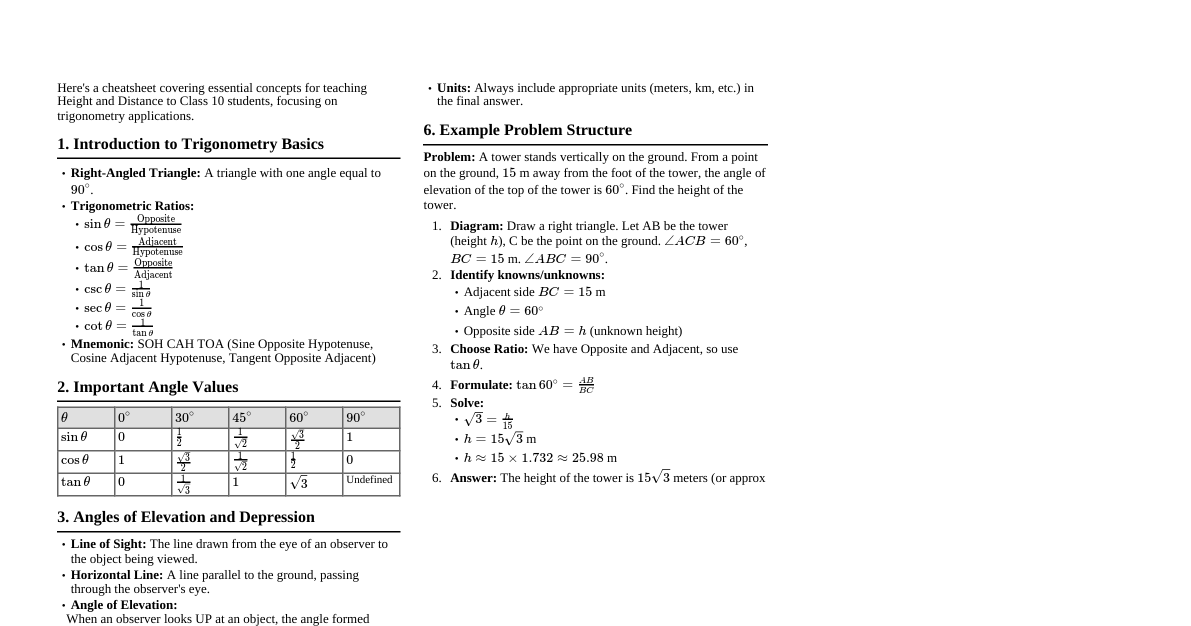
Circle Basic Definitions Radius ($r$): Distance from center to any point on the circle. Diameter ($d$): $d = 2r$. Circumference ($C$): $C = 2\pi r = \pi d$. Area ($A$): $A = \pi r^2$. Equations of a Circle Standard Form (Center $(h, k)$, Radius $r$): $(x - h)^2 + (y - k)^2 = r^2$. General Form: $x^2 + y^2 + 2gx + 2fy + c = 0$. Center: $(-g, -f)$. Radius: $\sqrt{g^2 + f^2 - c}$. Condition for a real circle: $g^2 + f^2 - c > 0$. Parametric Form: $x = h + r \cos \theta$, $y = k + r \sin \theta$. Circle passing through origin: $x^2 + y^2 + 2gx + 2fy = 0$. Circle with diameter endpoints $(x_1, y_1)$ and $(x_2, y_2)$: $(x - x_1)(x - x_2) + (y - y_1)(y - y_2) = 0$. Tangent and Normal to a Circle Equation of Tangent at $(x_1, y_1)$ to $x^2 + y^2 = r^2$: $x x_1 + y y_1 = r^2$. Equation of Tangent at $(x_1, y_1)$ to $x^2 + y^2 + 2gx + 2fy + c = 0$: $x x_1 + y y_1 + g(x + x_1) + f(y + y_1) + c = 0$. Condition for a line $y = mx + c'$ to be tangent to $x^2 + y^2 = r^2$: $c'^2 = r^2(1 + m^2)$. Length of Tangent from External Point $P(x_1, y_1)$ to $x^2 + y^2 + 2gx + 2fy + c = 0$: $\sqrt{S_1} = \sqrt{x_1^2 + y_1^2 + 2gx_1 + 2fy_1 + c}$. Equation of Normal at $(x_1, y_1)$ to $x^2 + y^2 = r^2$: $y x_1 - x y_1 = 0$ (passes through origin). Properties of Chords and Secants Length of Chord: $2\sqrt{r^2 - p^2}$, where $p$ is perpendicular distance from center to chord. Angle subtended by chord at center: $2\alpha$, where $\sin \alpha = \frac{\text{chord length}}{2r}$. Power of a Point: For a point $P(x_1, y_1)$ and circle $S=0$: If $P$ is outside, $S_1 > 0$. If $P$ is on, $S_1 = 0$. If $P$ is inside, $S_1 Trigonometry Basic Ratios (Right-Angled Triangle) $\sin \theta = \frac{\text{Opposite}}{\text{Hypotenuse}}$ $\cos \theta = \frac{\text{Adjacent}}{\text{Hypotenuse}}$ $\tan \theta = \frac{\text{Opposite}}{\text{Adjacent}} = \frac{\sin \theta}{\cos \theta}$ $\csc \theta = \frac{1}{\sin \theta}$ $\sec \theta = \frac{1}{\cos \theta}$ $\cot \theta = \frac{1}{\tan \theta}$ Fundamental Identities $\sin^2 \theta + \cos^2 \theta = 1$ $1 + \tan^2 \theta = \sec^2 \theta$ $1 + \cot^2 \theta = \csc^2 \theta$ Signs of Trigonometric Ratios (CAST Rule) Quadrant I (0 to $\pi/2$) II ($\pi/2$ to $\pi$) III ($\pi$ to $3\pi/2$) IV ($3\pi/2$ to $2\pi$) $\sin \theta$ + + - - $\cos \theta$ + - - + $\tan \theta$ + - + - Allied Angles $\sin(2n\pi + \theta) = \sin \theta$ $\cos(2n\pi + \theta) = \cos \theta$ $\sin(\pi - \theta) = \sin \theta$ $\cos(\pi - \theta) = -\cos \theta$ $\sin(\pi + \theta) = -\sin \theta$ $\cos(\pi + \theta) = -\cos \theta$ $\sin(2\pi - \theta) = -\sin \theta$ $\cos(2\pi - \theta) = \cos \theta$ $\sin(\pi/2 - \theta) = \cos \theta$ $\cos(\pi/2 - \theta) = \sin \theta$ $\sin(\pi/2 + \theta) = \cos \theta$ $\cos(\pi/2 + \theta) = -\sin \theta$ Compound Angle Formulas $\sin(A \pm B) = \sin A \cos B \pm \cos A \sin B$ $\cos(A \pm B) = \cos A \cos B \mp \sin A \sin B$ $\tan(A \pm B) = \frac{\tan A \pm \tan B}{1 \mp \tan A \tan B}$ $\cot(A \pm B) = \frac{\cot A \cot B \mp 1}{\cot B \pm \cot A}$ Multiple and Submultiple Angle Formulas $\sin 2A = 2 \sin A \cos A = \frac{2 \tan A}{1 + \tan^2 A}$ $\cos 2A = \cos^2 A - \sin^2 A = 2 \cos^2 A - 1 = 1 - 2 \sin^2 A = \frac{1 - \tan^2 A}{1 + \tan^2 A}$ $\tan 2A = \frac{2 \tan A}{1 - \tan^2 A}$ $\sin 3A = 3 \sin A - 4 \sin^3 A$ $\cos 3A = 4 \cos^3 A - 3 \cos A$ $\tan 3A = \frac{3 \tan A - \tan^3 A}{1 - 3 \tan^2 A}$ $\sin A = 2 \sin(A/2) \cos(A/2)$ $\cos A = \cos^2(A/2) - \sin^2(A/2)$ Transformation Formulas Product to Sum/Difference: $2 \sin A \cos B = \sin(A+B) + \sin(A-B)$ $2 \cos A \sin B = \sin(A+B) - \sin(A-B)$ $2 \cos A \cos B = \cos(A+B) + \cos(A-B)$ $2 \sin A \sin B = \cos(A-B) - \cos(A+B)$ Sum/Difference to Product: $\sin C + \sin D = 2 \sin\left(\frac{C+D}{2}\right) \cos\left(\frac{C-D}{2}\right)$ $\sin C - \sin D = 2 \cos\left(\frac{C+D}{2}\right) \sin\left(\frac{C-D}{2}\right)$ $\cos C + \cos D = 2 \cos\left(\frac{C+D}{2}\right) \cos\left(\frac{C-D}{2}\right)$ $\cos C - \cos D = -2 \sin\left(\frac{C+D}{2}\right) \sin\left(\frac{C-D}{2}\right)$ Conditional Identities (if $A+B+C = \pi$) $\sin A + \sin B + \sin C = 4 \cos(A/2) \cos(B/2) \cos(C/2)$ $\cos A + \cos B + \cos C = 1 + 4 \sin(A/2) \sin(B/2) \sin(C/2)$ $\tan A + \tan B + \tan C = \tan A \tan B \tan C$ $\cot A \cot B + \cot B \cot C + \cot C \cot A = 1$ General Solutions of Trigonometric Equations $\sin \theta = \sin \alpha \implies \theta = n\pi + (-1)^n \alpha$, where $n \in \mathbb{Z}$ $\cos \theta = \cos \alpha \implies \theta = 2n\pi \pm \alpha$, where $n \in \mathbb{Z}$ $\tan \theta = \tan \alpha \implies \theta = n\pi + \alpha$, where $n \in \mathbb{Z}$ $\sin^2 \theta = \sin^2 \alpha \implies \theta = n\pi \pm \alpha$, where $n \in \mathbb{Z}$ $\cos^2 \theta = \cos^2 \alpha \implies \theta = n\pi \pm \alpha$, where $n \in \mathbb{Z}$ $\tan^2 \theta = \tan^2 \alpha \implies \theta = n\pi \pm \alpha$, where $n \in \mathbb{Z}$