Research Methodologies & IPR
Cheatsheet Content
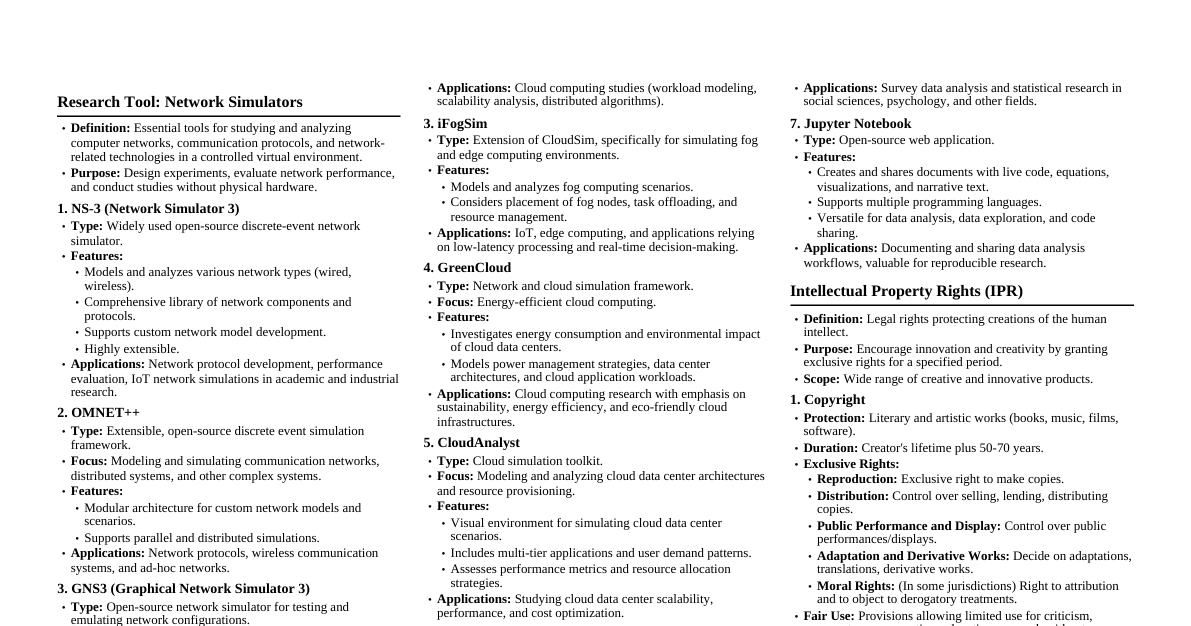
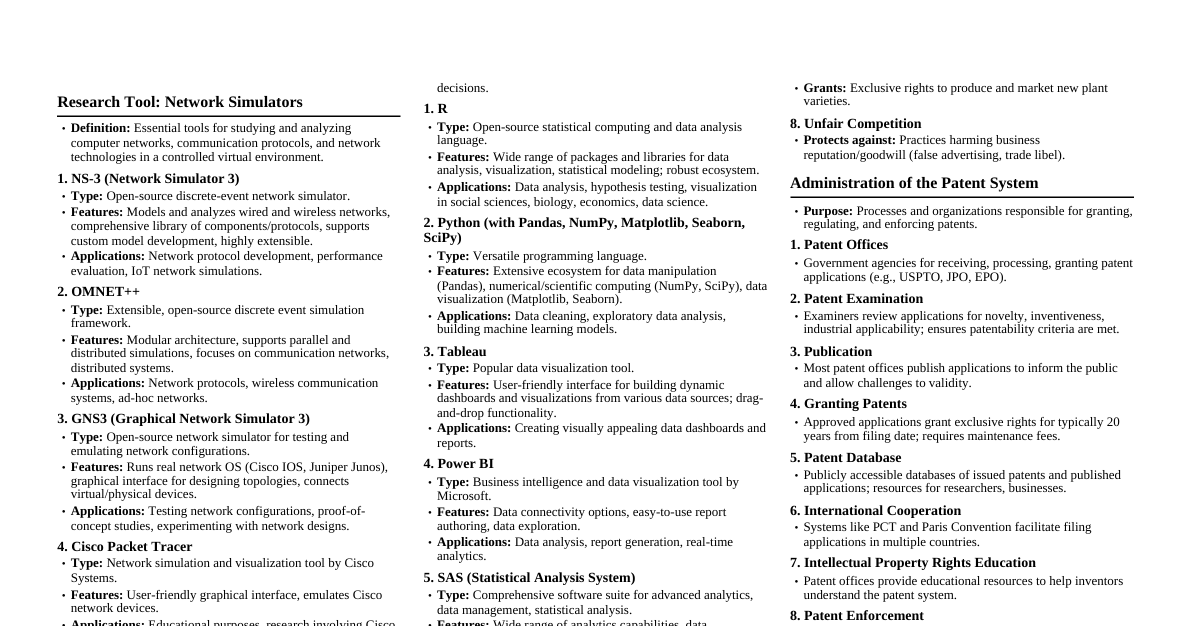
Research Tools: Network Simulators Definition: Essential tools for studying and analyzing computer networks and protocols in a controlled virtual environment without physical hardware. Benefits: Design experiments, evaluate network performance, conduct studies. 1. NS-3 (Network Simulator 3) Type: Open-source discrete-event network simulator. Features: Models and analyzes wired & wireless networks. Provides a comprehensive library of network components and protocols. Supports custom model development, highly extensible. Applications: Academic and industrial research, network protocol development, performance evaluation, IoT network simulations. 2. OMNeT++ Type: Extensible, open-source discrete event simulation framework. Features: Focuses on communication networks, distributed systems, and complex systems. Modular architecture, supports parallel and distributed simulations. Applications: Research for network protocols, wireless communication systems, ad-hoc networks. 3. GNS3 (Graphical Network Simulator 3) Type: Open-source network simulator for testing and emulating network configurations. Features: Runs real network operating systems (e.g., Cisco IOS, Juniper Junos). Graphical user interface for designing topologies and connecting virtual/physical devices. Applications: Network administration, testing network configurations, proof-of-concept studies, experimenting with network designs. 4. Cisco Packet Tracer Type: Network simulation and visualization tool by Cisco Systems. Features: User-friendly graphical interface for designing and simulating networks. Emulates Cisco network devices, practices network configurations. Applications: Educational purposes, network research involving Cisco equipment. 5. OPNET (Riverbed Modeler) Type: Network simulation and modeling tool. Features: Models and analyzes various network types (wired, wireless, mobile). Provides detailed performance analysis and visualization tools. Applications: Network research, performance evaluation, network design, optimization of communication networks. Research Tools: Cloud Simulators Definition: Crucial tools for investigating and analyzing cloud computing environments and applications. Benefits: Model and simulate cloud infrastructure, services, resource management; facilitate experimentation, performance evaluation, optimization. 1. CloudSim Type: Open-source, widely adopted cloud computing simulation framework. Features: Platform for modeling and simulating cloud infrastructure and services. Creates customized cloud scenarios, simulates deployment models (public, private, hybrid), evaluates performance metrics. Supports VM provisioning, resource allocation, workloads. Applications: Assess resource management strategies, investigate energy-efficient data centers, study cloud application performance. 2. SimGrid Type: Open-source simulation framework. Features: Used for cloud computing, distributed computing (grid, P2P networks). General-purpose environment for modeling distributed applications, resource management, communication protocols. Designed for high-performance simulations and parallel execution. Applications: Cloud computing studies, workload modeling, scalability analysis, evaluation of distributed algorithms. 3. iFogSim Type: Extension of CloudSim, specifically for simulating fog and edge computing environments. Features: Models and analyzes fog computing scenarios, considering fog node placement, task offloading, resource management. Valuable for IoT and edge computing research. Applications: Research related to IoT, edge computing, low-latency processing, real-time decision-making. 4. GreenCloud Type: Network and cloud simulation framework focusing on energy-efficient cloud computing. Features: Investigates energy consumption and environmental impact of cloud data centers. Models power management strategies, data center architectures, cloud application workloads. Applications: Cloud computing research emphasizing sustainability, energy efficiency, design of eco-friendly cloud infrastructures. 5. CloudAnalyst Type: Cloud simulation toolkit. Features: Models and analyzes cloud data center architectures and resource provisioning. Visual environment for simulating cloud data center scenarios (multi-tier applications, user demand patterns). Assesses performance metrics and resource allocation strategies. Applications: Study cloud data center scalability, performance, cost optimization. Research Tools: Data Analytics Tools Definition: Essential tools for exploring, analyzing, and interpreting data to derive meaningful insights and make informed decisions. Benefits: Processing, visualizing data, identifying trends, uncovering patterns. 1. R Type: Open-source statistical computing and data analysis language. Features: Wide range of packages and libraries for data analysis, visualization, statistical modeling. Known for robust statistical and data manipulation capabilities. Applications: Data analysis, hypothesis testing, visualization in social sciences, biology, economics, data science. 2. Python with Libraries (Pandas, NumPy, Matplotlib, Seaborn, SciPy) Type: Versatile programming language. Features: Extensive ecosystem for data manipulation (Pandas), numerical/scientific computing (NumPy, SciPy), data visualization (Matplotlib, Seaborn). Applications: Data cleaning, exploratory data analysis, building machine learning models. 3. Tableau Type: Popular data visualization tool. Features: Creates interactive and shareable data visualizations. User-friendly interface for dynamic dashboards. Drag-and-drop functionality. Applications: Creating visually appealing data dashboards and reports to communicate findings. 4. Power BI Type: Business intelligence and data visualization tool by Microsoft. Features: Connects to various data sources, creates interactive reports and dashboards. Known for data connectivity, easy-to-use report authoring, data exploration. Applications: Data analysis, report generation, real-time analytics. 5. SAS (Statistical Analysis System) Type: Comprehensive software suite for advanced analytics, data management, statistical analysis. Features: Wide range of analytics capabilities (data manipulation, statistical analysis, machine learning). Robust data integration and modeling. Applications: Data analysis, predictive modeling, statistical research in healthcare, finance, social sciences. 6. IBM SPSS (Statistical Package for the Social Sciences) Type: Software package for statistical analysis, data management, predictive modeling. Features: User-friendly interface for statistical analysis, data transformation, hypothesis testing. Variety of statistical procedures. Applications: Survey data analysis, statistical research in social sciences, psychology. 7. Jupyter Notebook Type: Open-source web application. Features: Creates and shares documents with live code, equations, visualizations, narrative text. Supports multiple programming languages. Versatile for data analysis, exploration, code sharing. Applications: Documenting and sharing data analysis workflows, reproducible research. Intellectual Property Rights (IPR) Definition: Legal rights protecting human intellect creations. Encourage innovation and creativity by granting exclusive rights for a specified period. Types of IPR Copyright: Protects literary and artistic works (books, music, films, software). Grants exclusive rights to reproduce, distribute, adapt for creator's lifetime + 50-70 years. Patents: Protects inventions, granting exclusive rights for a limited period (usually 20 years). Encourages disclosure, drives innovation. Common in technology, medicine, engineering. Trademarks: Protects distinctive signs/symbols distinguishing goods/services (brand names, logos, slogans). Helps consumers identify and trust products. Trade Secrets: Confidential, proprietary information giving competitive advantage (manufacturing processes, customer lists, formulas). Protected by keeping secret; no time limit. Industrial Designs: Protects visual design of objects (shape, color, ornamentation). Important where aesthetics are key (fashion, consumer electronics). Geographical Indications: Protects products associated with specific geographical origin, having qualities/reputation attributable to that place (e.g., Champagne). Plant Variety Protection: Protects new plant varieties from breeding. Ensures breeders have exclusive rights to produce/market new varieties. Unfair Competition: Protects against practices harming business reputation/goodwill (false advertising, trade libel, unethical practices). Administration of the Patent System Definition: Processes and organizations responsible for granting, regulating, and enforcing patents. Critical for promoting innovation, protecting IP, fostering economic growth. Key Aspects Patent Offices: Government agencies receiving, processing, granting patent applications. National (USPTO, JPO) and regional (EPO) offices. Patent Examination: Examiners review applications for novelty, inventiveness, industrial applicability. Ensures invention meets patentability criteria. Publication: Most patent offices publish applications after filing, informing public and allowing challenges to validity. Granting Patents: Approved applications grant inventor exclusive rights for a specified period (typically 20 years from filing). Requires maintenance fees. Patent Databases: Most offices maintain publicly accessible databases of issued patents and published applications, serving as resources for researchers, businesses, innovators. International Cooperation: Many countries participate in international systems (PCT, Paris Convention) to facilitate filing in multiple countries via single application. Intellectual Property Rights Education: Patent offices provide educational resources and support to help inventors/businesses understand the patent system. Patent Enforcement: Patent offices don't handle infringement cases. Enforcement is via legal system; patent holders pursue civil litigation. Patent Litigation: Disputes resolved through courts; patent holders seek injunctions, damages, other remedies. Complex, often involves expert testimony. International Patent Disputes: Common due to global commerce. Involve multiple jurisdictions and IP treaties. IPR Policy and Regulation: Governments shape patent policy/legislation, adapting to technological/economic landscapes. Balance innovation promotion and public interest. Post-Grant Proceedings: Some systems offer procedures to challenge granted patents (e.g., Inter Partes Review in US) allowing third parties to request validity review. Licensing and Transfer of Technology Definition: Common practices related to IPR, especially patents. Involve granting rights to use, make, or sell patented inventions under specific terms. Key Aspects Licensing: Legal permission from patent holder to licensee to use, make, sell patented invention. Via licensing agreements specifying terms, duration, royalties, restrictions. Facilitates widespread adoption and commercialization. Technology Transfer: Broader process of moving technology from one entity to another. Includes knowledge, skills, expertise, know-how, patents, trade secrets, other IP. Joint Ventures: Companies/organizations collaborate to jointly develop, utilize, commercialize patented technologies. Involves sharing rights, responsibilities, financial interests. Franchising: In technology, can be a form of licensing. Franchisors allow franchisees to operate using patented methods, systems, branding in exchange for fees/royalties. Cross-Licensing: Entities with different patent portfolios grant each other rights to use their patents. Prevents litigation, promotes innovation by allowing access to technologies. Copyright Scope Definition: Protects original literary and artistic works (books, music, films, software). Rights Included Reproduction: Exclusive right to reproduce work; others cannot copy without permission. Distribution: Control over distribution (selling, lending, distributing to public). Public Performance and Display: Control over public performances/displays (music, films, artwork). Adaptation and Derivative Works: Decide if others can create adaptations, translations, derivative works. Moral Rights: In some jurisdictions, authors have right to be attributed, object to derogatory treatments. Duration: Typically lifetime of author + 50-70 years, depending on country/work type. Fair Use: Provisions allow limited use for criticism, comment, news reporting, education, research without permission/payment. Licensing and Royalties: Copyright holders license works to others, allowing content use in exchange for fees/royalties. Understanding patent rights, licensing, and copyright is essential for inventors, creators, businesses, and stakeholders to navigate IP. Licensing and technology transfer facilitate dissemination of innovations, while copyright provides control and monetization of creative works.