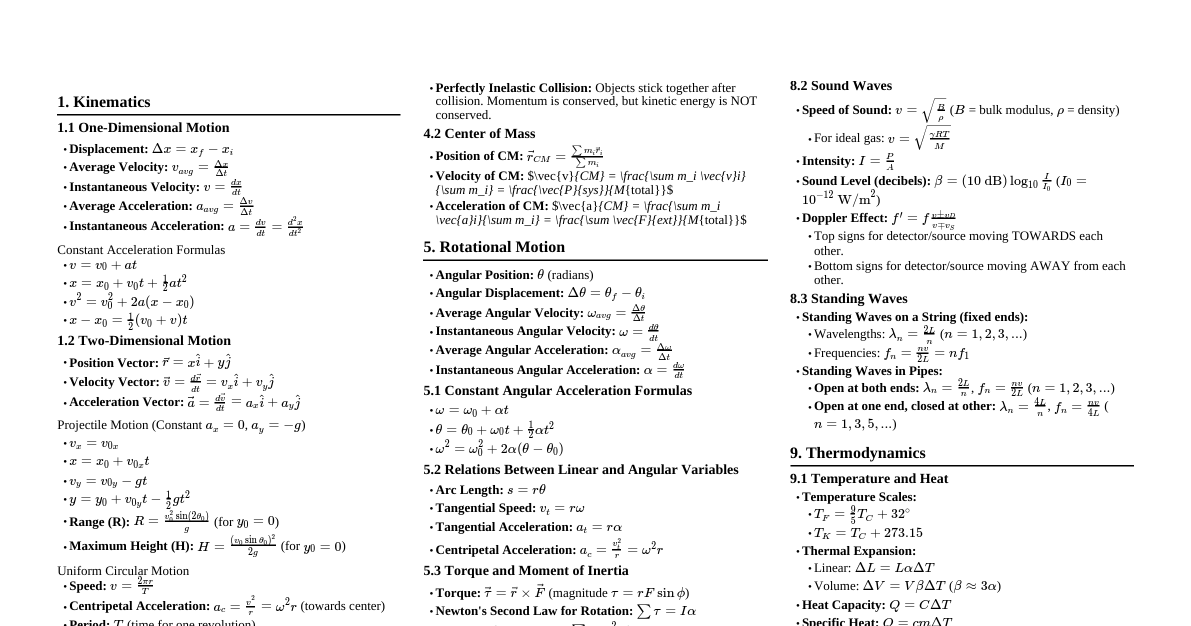
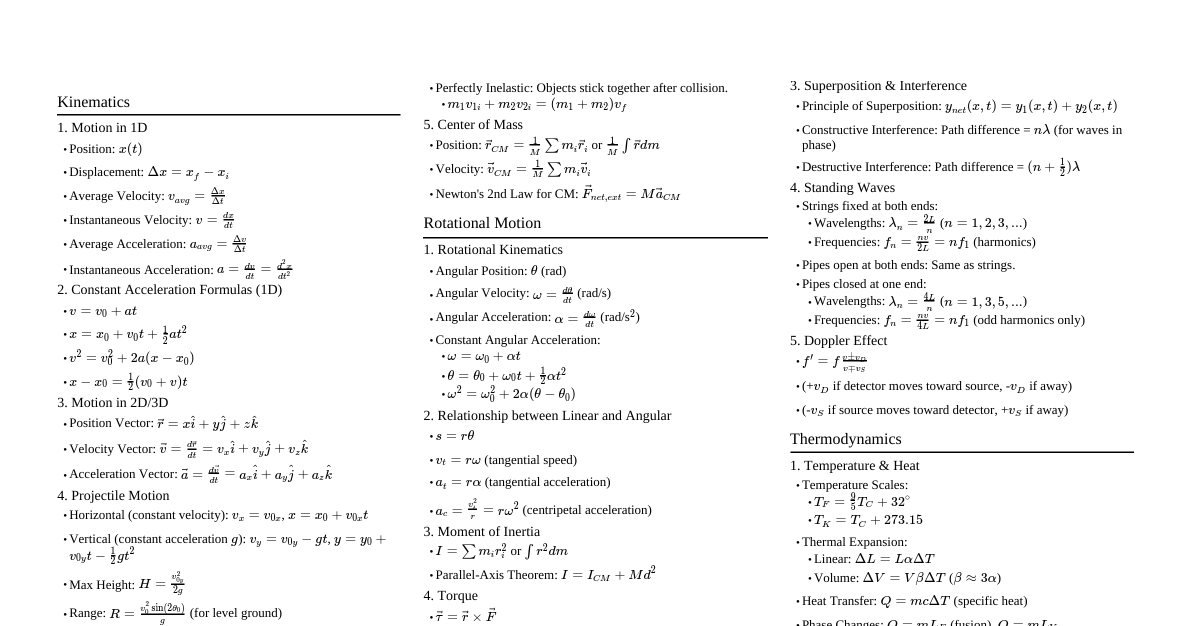
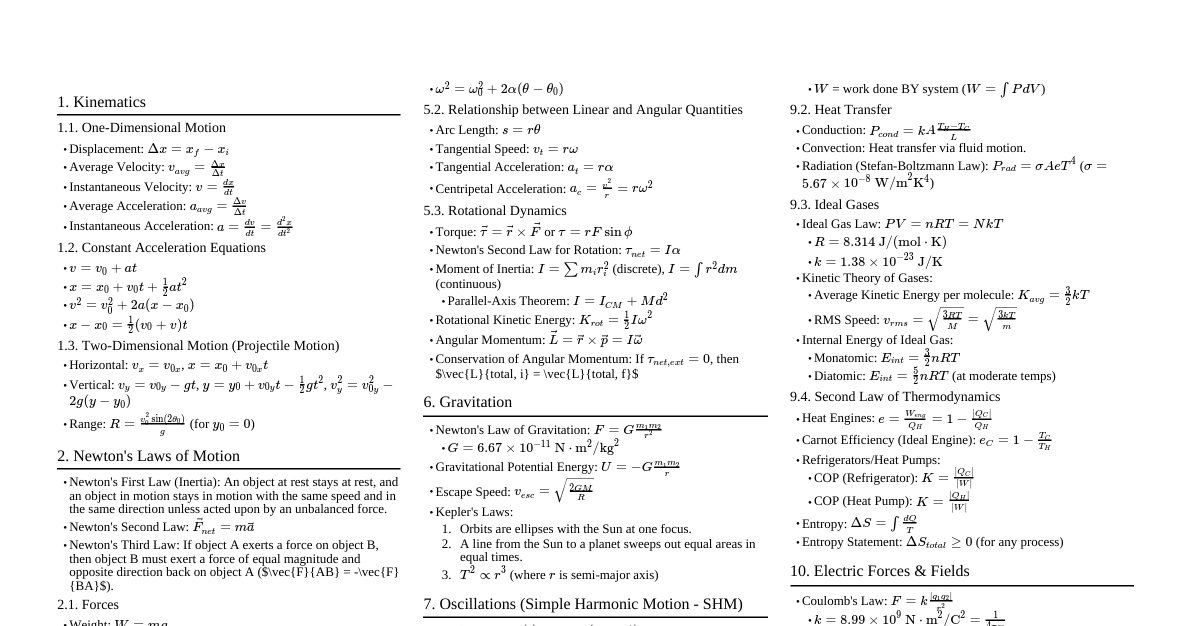
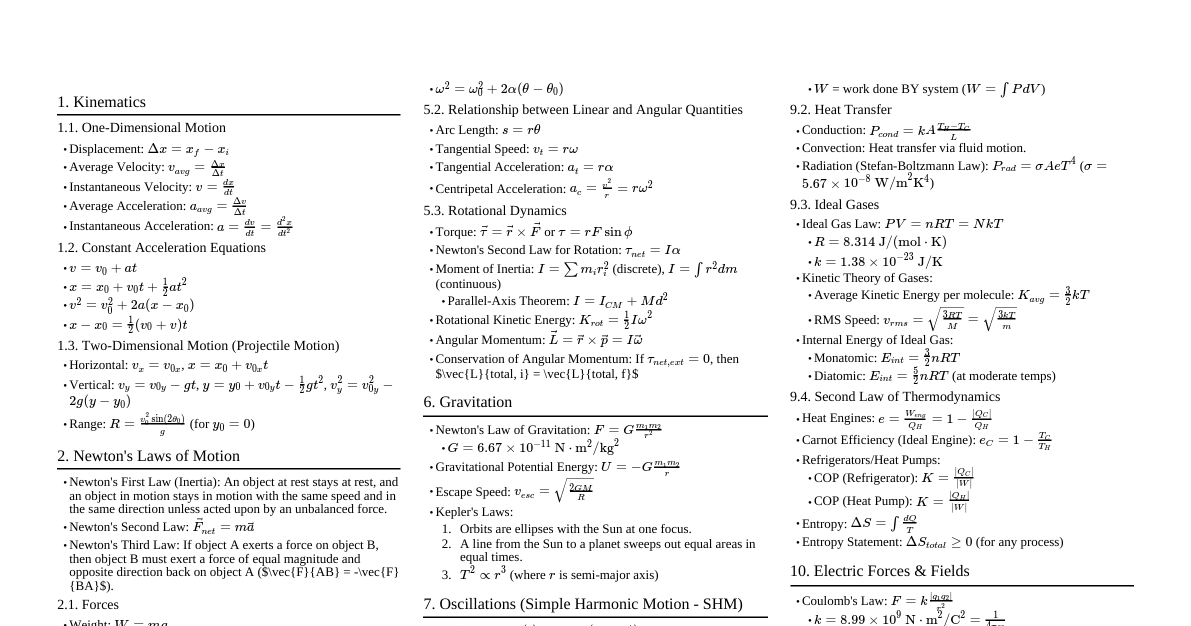
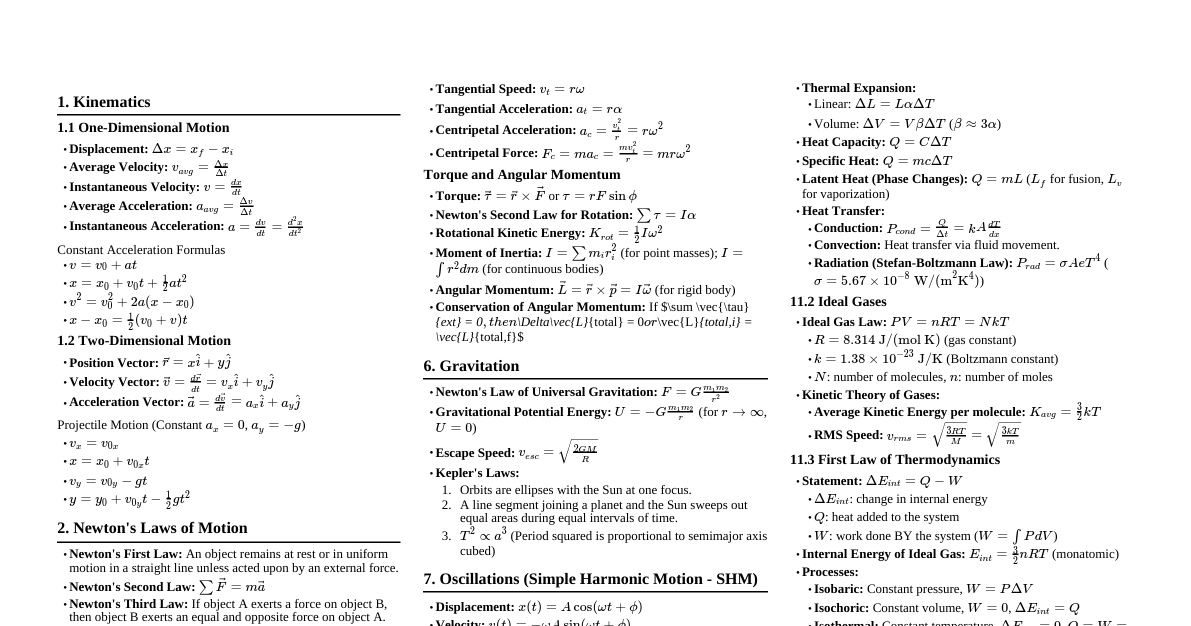
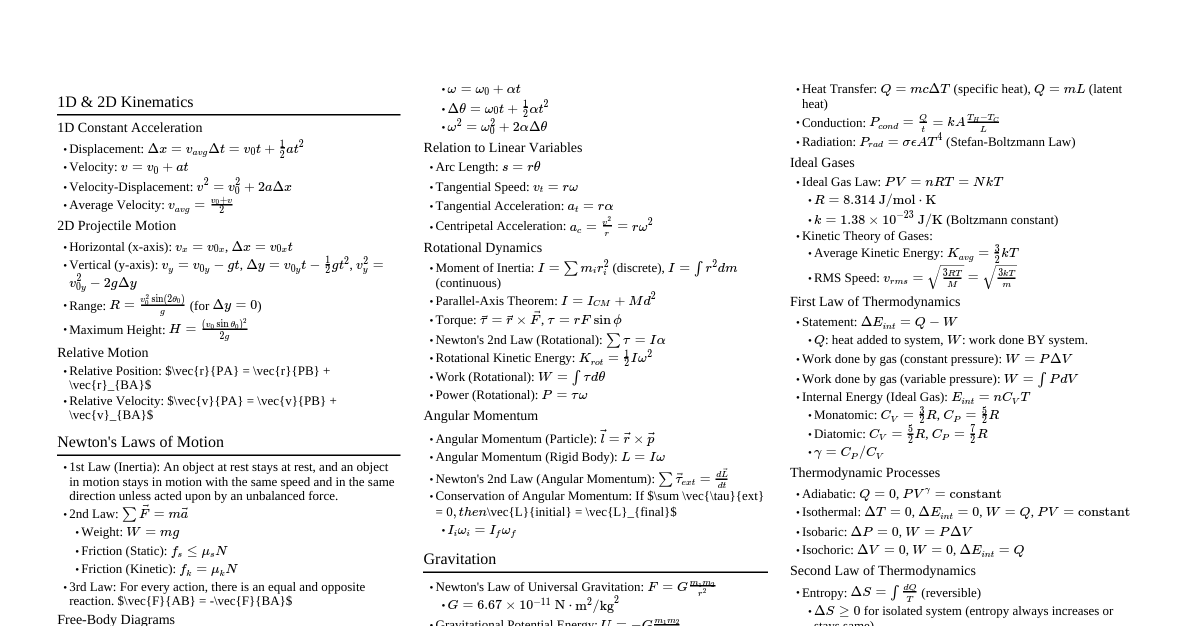
Halliday Physics Essentials
Shared 5/10/2026•1 views
### 1. Kinematics: Describing Motion #### 1.1. One-Dimensional Motion (1D) Kinematics is the branch of classical mechanics that describes the motion of points, bodies, and systems of bodies without considering the forces that cause them to move. - **Reference Frames and Coordinate Systems:** - Motion is always relative to a chosen **reference frame**. - A **coordinate system** (e.g., x-axis for 1D, x-y plane for 2D) defines the origin and positive directions. - **Position ($x$):** The location of an object with respect to the origin of a coordinate system. - Scalar quantity, but can be positive or negative depending on direction from origin. - Units: meters (m). - **Displacement ($\Delta x$):** The change in position of an object. It is a vector quantity, representing the straight-line distance and direction from the initial to the final position. - $\Delta x = x_f - x_i$ - Units: meters (m). - **Distance:** The total path length covered by an object during its motion. - Scalar quantity, always non-negative. - Units: meters (m). - Distance $\ge$ |displacement|. - **Average Velocity ($v_{avg}$):** The ratio of displacement to the time interval over which the displacement occurs. - $v_{avg} = \frac{\Delta x}{\Delta t} = \frac{x_f - x_i}{t_f - t_i}$ - Vector quantity, its direction is the same as the displacement. - Units: meters per second (m/s). - **Average Speed ($s_{avg}$):** The ratio of the total distance covered to the time interval. - $s_{avg} = \frac{\text{total distance}}{\Delta t}$ - Scalar quantity, always non-negative. - Units: meters per second (m/s). - Average speed $\ge$ |average velocity|. - **Instantaneous Velocity ($v$):** The velocity of an object at a specific instant in time. It is the limit of the average velocity as the time interval approaches zero. - $v = \frac{dx}{dt}$ (graphically, this is the slope of the position-time graph at that instant). - Vector quantity. - Units: meters per second (m/s). - **Average Acceleration ($a_{avg}$):** The ratio of the change in velocity to the time interval. - $a_{avg} = \frac{\Delta v}{\Delta t} = \frac{v_f - v_i}{t_f - t_i}$ - Vector quantity, its direction is the same as the change in velocity. - Units: meters per second squared (m/s$^2$). - **Instantaneous Acceleration ($a$):** The acceleration of an object at a specific instant in time. It is the limit of the average acceleration as the time interval approaches zero. - $a = \frac{dv}{dt} = \frac{d^2x}{dt^2}$ (graphically, this is the slope of the velocity-time graph at that instant). - Vector quantity. - Units: meters per second squared (m/s$^2$). ##### Constant Acceleration Equations (Kinematic Equations): These four equations are fundamental for analyzing motion when the acceleration 'a' is constant. They are derived from the definitions of velocity and acceleration through integration. 1. **Velocity as a function of time:** $v = v_0 + at$ - This equation relates final velocity to initial velocity, acceleration, and time. 2. **Position as a function of time:** $x = x_0 + v_0t + \frac{1}{2}at^2$ - This equation relates final position to initial position, initial velocity, acceleration, and time. 3. **Velocity as a function of displacement:** $v^2 = v_0^2 + 2a(x - x_0)$ - This equation is useful when time is not known or not required. 4. **Displacement as a function of average velocity:** $x - x_0 = \frac{1}{2}(v_0 + v)t$ - This equation is useful when acceleration is not known or not required. Where: - $x_0$: initial position at $t=0$ - $v_0$: initial velocity at $t=0$ - $x$: final position at time $t$ - $v$: final velocity at time $t$ - $a$: constant acceleration - $t$: time interval ##### Free Fall: A special case of 1D motion under constant acceleration, where the acceleration is due to gravity. - Near the Earth's surface, the acceleration due to gravity is approximately $g = 9.8 \text{ m/s}^2$, directed downwards. - When applying kinematic equations: - Choose a coordinate system (e.g., positive y-axis upward). - Set $a = -g$ (if positive y is upward) or $a = +g$ (if positive y is downward). - Air resistance is typically neglected in introductory problems. #### 1.2. Two and Three-Dimensional Motion (2D & 3D) Extending the concepts from 1D motion by using vector quantities and analyzing components independently. - **Position Vector:** Describes the location of an object in space. - $\vec{r} = x\hat{i} + y\hat{j} + z\hat{k}$ - $\hat{i}, \hat{j}, \hat{k}$ are unit vectors along the x, y, and z axes, respectively. - **Displacement Vector:** The change in the position vector. - $\Delta\vec{r} = \vec{r}_f - \vec{r}_i = (x_f - x_i)\hat{i} + (y_f - y_i)\hat{j} + (z_f - z_i)\hat{k}$ - **Velocity Vector:** The time derivative of the position vector. - $\vec{v} = \frac{d\vec{r}}{dt} = \frac{dx}{dt}\hat{i} + \frac{dy}{dt}\hat{j} + \frac{dz}{dt}\hat{k} = v_x\hat{i} + v_y\hat{j} + v_z\hat{k}$ - The magnitude of the velocity vector is the speed: $|\vec{v}| = \sqrt{v_x^2 + v_y^2 + v_z^2}$. - **Acceleration Vector:** The time derivative of the velocity vector. - $\vec{a} = \frac{d\vec{v}}{dt} = \frac{dv_x}{dt}\hat{i} + \frac{dv_y}{dt}\hat{j} + \frac{dv_z}{dt}\hat{k} = a_x\hat{i} + a_y\hat{j} + a_z\hat{k}$ - **Motion with Constant Acceleration (Vector Form):** - $\vec{v} = \vec{v}_0 + \vec{a}t$ - $\vec{r} = \vec{r}_0 + \vec{v}_0t + \frac{1}{2}\vec{a}t^2$ - These vector equations imply that the motion in each coordinate direction can be analyzed independently using the 1D kinematic equations. For example, $v_x = v_{0x} + a_xt$. ##### Relative Motion: The motion of an object can appear different to observers in different reference frames. - **Relative Velocity:** - $\vec{v}_{PA} = \vec{v}_{PB} + \vec{v}_{BA}$ - $\vec{v}_{PA}$: velocity of particle P as measured by observer A. - $\vec{v}_{PB}$: velocity of particle P as measured by observer B. - $\vec{v}_{BA}$: velocity of observer B as measured by observer A. - Note that $\vec{v}_{AB} = -\vec{v}_{BA}$. - **Relative Acceleration:** - $\vec{a}_{PA} = \vec{a}_{PB} + \vec{a}_{BA}$ - If the relative velocity between two frames is constant, then $\vec{a}_{BA} = 0$, and thus $\vec{a}_{PA} = \vec{a}_{PB}$. This means observers in different inertial frames measure the same acceleration for an object. ##### Projectile Motion: A classic example of 2D motion under constant acceleration, where an object is launched into the air and moves under the influence of gravity alone (neglecting air resistance). - **Assumptions:** - The acceleration due to gravity ($g$) is constant in magnitude and direction (downward). - Air resistance is negligible. - **Coordinate System:** Typically, the x-axis is horizontal and the y-axis is vertical (positive upward). - **Acceleration Components:** - $a_x = 0$ (no horizontal acceleration). - $a_y = -g$ (downward acceleration). - **Initial Velocity Components:** - If an object is launched with initial speed $v_0$ at an angle $\theta_0$ above the horizontal: - $v_{0x} = v_0 \cos\theta_0$ - $v_{0y} = v_0 \sin\theta_0$ - **Equations of Motion (using 1D kinematic equations for each component):** - **Horizontal Motion (Constant Velocity):** - $x = x_0 + (v_0 \cos\theta_0)t$ - $v_x = v_{0x} = v_0 \cos\theta_0$ - **Vertical Motion (Constant Acceleration):** - $y = y_0 + (v_0 \sin\theta_0)t - \frac{1}{2}gt^2$ - $v_y = v_0 \sin\theta_0 - gt$ - $v_y^2 = (v_0 \sin\theta_0)^2 - 2g(y - y_0)$ - **Key Quantities:** - **Time of Flight:** The total time the projectile is in the air. - **Maximum Height (H):** The highest point reached by the projectile, where the vertical velocity component ($v_y$) is momentarily zero. - $H = \frac{(v_0 \sin\theta_0)^2}{2g}$ (if launched from $y_0=0$). - **Range (R):** The horizontal distance traveled by the projectile when it returns to its launch height ($y=y_0$). - $R = \frac{v_0^2 \sin(2\theta_0)}{g}$ (if launched from $y_0=0$). - Maximum range occurs when $\theta_0 = 45^\circ$. - **Trajectory:** The parabolic path followed by the projectile. ##### Uniform Circular Motion: The motion of an object in a circular path at a constant speed. Even though the speed is constant, the velocity is continuously changing direction, so there is always an acceleration. - **Key Concepts:** - **Centripetal Acceleration ($a_c$):** Always directed towards the center of the circle. It is responsible for changing the direction of the velocity vector. - $a_c = \frac{v^2}{r} = r\omega^2$ - $v$: tangential speed (magnitude of velocity). - $r$: radius of the circular path. - $\omega$: angular speed. - **Period (T):** The time required for one complete revolution around the circle. - $T = \frac{2\pi r}{v} = \frac{2\pi}{\omega}$ - **Frequency (f):** The number of revolutions per unit time. - $f = \frac{1}{T}$ - **Angular Speed ($\omega$):** The rate of change of angular position. - $\omega = \frac{v}{r}$ (in radians per second, rad/s). - $\omega = 2\pi f$ - **Non-Uniform Circular Motion:** If the speed of the object is not constant, there is an additional component of acceleration called tangential acceleration. - **Tangential Acceleration ($a_t$):** Directed tangent to the circular path, responsible for changing the magnitude of the velocity (speed). - $a_t = \frac{dv}{dt}$ - **Total Acceleration:** The vector sum of the centripetal and tangential accelerations. - $\vec{a} = \vec{a}_c + \vec{a}_t$ - Magnitude: $a = \sqrt{a_c^2 + a_t^2}$ ### 2. Newton's Laws of Motion Newton's three laws of motion, along with his law of universal gravitation, form the bedrock of classical mechanics, describing the relationship between an object's motion and the forces acting upon it. - **Newton's First Law (Law of Inertia):** - "An object at rest stays at rest, and an object in motion stays in motion with the same speed and in the same direction unless acted upon by an unbalanced external force." - This law introduces the concept of **inertia** (the natural tendency of an object to resist changes in its state of motion). - It defines an **inertial reference frame** as one in which an object experiences no acceleration when no net force acts on it. - Mathematically, if $\sum \vec{F} = 0$, then $\vec{a} = 0$ (meaning $\vec{v}$ is constant). - **Newton's Second Law:** - "The net external force acting on an object is directly proportional to its acceleration and in the same direction as the acceleration. The constant of proportionality is the object's mass." - $\sum \vec{F} = m\vec{a}$ - $\sum \vec{F}$ (or $\vec{F}_{net}$): The vector sum of all external forces acting on the object. This is the **net force**. - $m$: The **inertial mass** of the object, a scalar quantity that quantifies its inertia (resistance to acceleration). Measured in kilograms (kg). - $\vec{a}$: The acceleration vector of the object. - **Units:** The SI unit for force is the **Newton (N)**, defined as $1 \text{ N} = 1 \text{ kg}\cdot\text{m/s}^2$. - **Component Form:** This vector equation can be broken down into components along chosen coordinate axes: - $\sum F_x = ma_x$ - $\sum F_y = ma_y$ - $\sum F_z = ma_z$ - **More Fundamental Form (Momentum):** Newton's Second Law can also be expressed in terms of momentum (see Section 4.1): $\sum \vec{F} = \frac{d\vec{p}}{dt}$. This form is more general as it applies even when mass changes (e.g., a rocket expelling fuel). - **Newton's Third Law:** - "If object A exerts a force on object B, then object B exerts a force of equal magnitude and opposite direction on object A." - $\vec{F}_{AB} = -\vec{F}_{BA}$ - **Key Characteristic:** Action-reaction pairs always act on *different* objects. They never cancel each other out because they don't act on the same body. - Example: When you push against a wall, the wall pushes back on you with an equal and opposite force. #### 2.1. Common Forces To apply Newton's laws effectively, it's crucial to identify and understand the various types of forces. - **Gravitational Force (Weight, $\vec{F}_g$ or $\vec{W}$):** - The attractive force exerted by a large celestial body (like Earth) on an object near its surface. - Magnitude: $F_g = mg$ - $m$: mass of the object. - $g$: acceleration due to gravity, approximately $9.8 \text{ m/s}^2$ near Earth's surface. - Direction: Always downwards, towards the center of the Earth. - **Gravitational Mass:** The mass 'm' in $F_g=mg$ is the gravitational mass, which is experimentally found to be equivalent to the inertial mass 'm' in $\sum F = ma$. This equivalence is a cornerstone of Einstein's General Relativity. - **Normal Force ($\vec{F}_N$ or $N$):** - The force exerted by a surface on an object in contact with it, acting perpendicular to the surface. - It is a contact force that prevents objects from penetrating the surface. - Its magnitude is not fixed; it adjusts itself to counteract forces pushing the object into the surface. - Example: For an object on a horizontal surface, $N = mg$ if no other vertical forces are present. On an inclined plane, $N = mg\cos\theta$. - **Tension Force ($\vec{T}$):** - The pulling force transmitted axially through a flexible connector like a string, rope, cable, or chain when it is taut. - Acts along the length of the connector, away from the object it is pulling. - For an ideal string (massless and inextensible): - Tension is uniform throughout its length. - It only pulls; it cannot push. - **Friction Force ($\vec{f}$):** - A contact force that opposes relative motion or the tendency of relative motion between two surfaces in contact. - **Origin:** Arises from microscopic irregularities and attractive forces between atoms on the surfaces. - **Static Friction ($f_s$):** Acts when objects are at rest relative to each other, opposing the initiation of motion. - Its magnitude varies: $0 \le f_s \le \mu_s F_N$ - $\mu_s$: **coefficient of static friction**, a dimensionless constant that depends on the properties of the two surfaces in contact. - The static friction force will match the applied force up to its maximum value ($\mu_s F_N$). Once the applied force exceeds this maximum, the object begins to move. - **Kinetic Friction ($f_k$):** Acts when objects are sliding past each other, opposing the ongoing motion. - Its magnitude is generally constant: $f_k = \mu_k F_N$ - $\mu_k$: **coefficient of kinetic friction**, usually less than $\mu_s$ ($\mu_k ### 3. Work & Energy The concepts of work and energy provide a powerful alternative approach to solving problems in mechanics, especially when forces are variable or paths are complex, as they often simplify calculations by dealing with scalar quantities. #### 3.1. Work - **Definition of Work (W):** In physics, work is done when a force causes a displacement of an object. It is a scalar quantity and represents the transfer of energy. - **Work by a Constant Force:** When a constant force $\vec{F}$ acts on an object, causing a displacement $\Delta\vec{r}$, the work done by that force is: - $W = \vec{F} \cdot \Delta\vec{r} = F |\Delta\vec{r}| \cos\theta$ - $\theta$: The angle between the force vector $\vec{F}$ and the displacement vector $\Delta\vec{r}$. - **Interpretation of $\theta$:** - If $\theta = 0^\circ$ (force in direction of displacement), $\cos\theta = 1$, $W = F|\Delta\vec{r}|$ (positive work, energy transferred to object). - If $\theta = 90^\circ$ (force perpendicular to displacement), $\cos\theta = 0$, $W = 0$ (no work done by this force). - If $\theta = 180^\circ$ (force opposite to displacement), $\cos\theta = -1$, $W = -F|\Delta\vec{r}|$ (negative work, energy removed from object). - **Work by a Variable Force (1D):** If the force varies with position, work is calculated by integrating the force over the displacement. - $W = \int_{x_i}^{x_f} F(x) dx$ - Graphically, this is the area under the Force vs. Position (F-x) curve. - **Work by a Variable Force (General 3D):** For a force that varies in magnitude and/or direction along a path. - $W = \int_{path} \vec{F} \cdot d\vec{s}$ - $d\vec{s}$: infinitesimal displacement vector along the path. - **Units of Work:** The SI unit for work is the **Joule (J)**, defined as $1 \text{ J} = 1 \text{ N}\cdot\text{m}$. - **Net Work ($W_{net}$ or $W_{total}$):** The algebraic sum of the work done by all forces acting on an object. #### 3.2. Kinetic Energy - **Definition of Kinetic Energy (K):** The energy an object possesses due to its motion. It is a scalar quantity and is always non-negative. - $K = \frac{1}{2}mv^2$ - $m$: mass of the object. - $v$: speed of the object. - **Units of Kinetic Energy:** Joules (J). - **Work-Kinetic Energy Theorem:** This fundamental theorem states that the net work done on an object by all forces acting on it equals the change in its kinetic energy. - $W_{net} = \Delta K = K_f - K_i$ - This theorem provides a direct link between force, displacement, and changes in speed. #### 3.3. Potential Energy - **Definition of Potential Energy (U):** Energy stored in a system due to the configuration or position of its components. Potential energy is defined *only* for conservative forces. - Potential energy is a scalar quantity. - The absolute value of potential energy is not physically significant; only *changes* in potential energy ($\Delta U$) are meaningful. A reference point where $U=0$ must be chosen. - **Relation to Conservative Forces:** The change in potential energy is the negative of the work done by the corresponding conservative force. - $\Delta U = -W_c$ - This means $W_c = U_i - U_f$. - **Gravitational Potential Energy:** - **Near Earth's Surface:** $U_g = mgh$ - $m$: mass of the object. - $g$: acceleration due to gravity. - $h$: vertical height of the object relative to a chosen reference level where $U_g=0$. - **General Gravitational Interaction:** For two masses $m_1$ and $m_2$ separated by a distance $r$. - $U_g = -G\frac{m_1m_2}{r}$ (This sets $U_g=0$ at $r=\infty$, which is the standard convention). - **Elastic Potential Energy (Spring Potential Energy):** - The energy stored in a spring (or other elastic material) when it is stretched or compressed from its equilibrium position. - $U_s = \frac{1}{2}kx^2$ - $k$: spring constant. - $x$: displacement from the spring's equilibrium position. (Note: $U_s$ is always positive because $x^2$ is always positive, indicating energy is stored whether stretched or compressed). ##### Conservative and Non-Conservative Forces: - **Conservative Force:** - A force is conservative if the work it does on an object moving between two points is independent of the path taken between those points. - Equivalently, the work done by a conservative force around any closed path is zero. - Examples: Gravitational force, ideal spring force, electrostatic force. - Associated with potential energy. - **Non-Conservative Force:** - A force is non-conservative if the work it does on an object moving between two points *depends* on the path taken. - Equivalently, the work done by a non-conservative force around a closed path is generally non-zero. - Examples: Friction, air resistance, applied force from an external agent, tension (in most cases). - Work done by non-conservative forces can change the total mechanical energy of a system, often converting it into other forms (e.g., heat). #### 3.4. Conservation of Energy One of the most fundamental principles in physics, stating that energy cannot be created or destroyed, only transformed from one form to another or transferred from one system to another. - **Mechanical Energy ($E_{mech}$):** The sum of the kinetic energy and all forms of potential energy in a system. - $E_{mech} = K + U$ - **Conservation of Mechanical Energy:** - If only conservative forces do work within a system (or if non-conservative forces do zero work), the total mechanical energy of the system remains constant. - $K_i + U_i = K_f + U_f$ - $\Delta E_{mech} = 0$ - This is a powerful problem-solving tool when conservative forces are dominant. - **General Conservation of Energy (with non-conservative forces):** - When non-conservative forces ($F_{nc}$) do work ($W_{nc}$) within a system, the total mechanical energy of the system is *not* conserved. Instead, the work done by non-conservative forces equals the change in the system's mechanical energy. - $W_{nc} = \Delta E_{mech} = (K_f + U_f) - (K_i + U_i)$ - This equation accounts for energy transformations into other forms (e.g., heat generated by friction, sound). - The total energy of an isolated system (including all forms: mechanical, thermal, chemical, nuclear, etc.) is always conserved. #### 3.5. Power - **Definition of Power (P):** The rate at which work is done or energy is transferred. It is a scalar quantity. - **Average Power:** - $P_{avg} = \frac{W}{\Delta t}$ - **Instantaneous Power:** - $P = \frac{dW}{dt}$ - **Power in terms of Force and Velocity:** For an object moving with velocity $\vec{v}$ under the influence of a force $\vec{F}$, the instantaneous power delivered by that force is: - $P = \vec{F} \cdot \vec{v}$ - **Units of Power:** The SI unit for power is the **Watt (W)**. - $1 \text{ Watt (W)} = 1 \text{ Joule per second (J/s)}$. - Other common units include horsepower ($1 \text{ hp} = 746 \text{ W}$) and kilowatt-hour (kWh), which is a unit of energy, not power ($1 \text{ kWh} = 3.6 \times 10^6 \text{ J}$). ### 4. Momentum & Collisions #### 4.1. Linear Momentum - **Definition of Linear Momentum ($\vec{p}$):** A vector quantity that quantifies the "quantity of motion" an object possesses. It is the product of an object's mass and its velocity. - $\vec{p} = m\vec{v}$ - $m$: mass of the object. - $\vec{v}$: velocity of the object. - Direction of $\vec{p}$ is the same as the direction of $\vec{v}$. - Units: kilograms-meters per second (kg$\cdot$m/s). - **Newton's Second Law (in terms of momentum):** The net external force acting on a system is equal to the rate of change of its total linear momentum. - $\sum \vec{F}_{ext} = \frac{d\vec{P}_{total}}{dt}$ - This is the most fundamental form of Newton's Second Law, as it holds true even when the mass of the system changes (e.g., a rocket expelling fuel). If mass is constant, it reduces to $\sum \vec{F} = m\vec{a}$. - **Impulse ($\vec{J}$):** The change in linear momentum of an object. It is a vector quantity. - $\vec{J} = \int_{t_i}^{t_f} \vec{F}_{net} dt = \Delta\vec{p} = \vec{p}_f - \vec{p}_i$ - Units: Newton-seconds (N$\cdot$s), which are equivalent to kg$\cdot$m/s. - **Impulse-Momentum Theorem:** $\vec{J} = \Delta\vec{p}$. This theorem states that the impulse imparted to an object equals the change in its momentum. - For a constant net force over a time interval $\Delta t$: $\vec{J} = \vec{F}_{avg}\Delta t$. - Graphically, impulse is the area under the Force vs. Time (F-t) curve. #### 4.2. Conservation of Linear Momentum - **Principle:** If the net external force acting on a system of particles is zero (i.e., the system is isolated), then the total linear momentum of the system remains constant. - $\vec{P}_{total, initial} = \vec{P}_{total, final}$ - $\sum (\vec{p}_i)_{initial} = \sum (\vec{p}_i)_{final}$ - $\sum (m_i\vec{v}_i)_{initial} = \sum (m_i\vec{v}_i)_{final}$ - **Conditions for Conservation:** - **Isolated System:** No external forces act on the system. - **Negligible External Forces:** If external forces are present but are very small compared to the internal forces during a short interaction (like a collision), momentum can be considered approximately conserved. - **Component-wise Conservation:** If external forces act only in certain directions (e.g., gravity acts vertically), momentum might still be conserved in the perpendicular directions (e.g., horizontally). - **Applications:** This principle is particularly useful for analyzing collisions and explosions, where large internal forces act for short durations. #### 4.3. Collisions - **Definition:** An event in which two or more objects exert forces on each other for a relatively short time. During a collision, internal forces are typically much larger than external forces, making linear momentum conservation a powerful tool. - **Key Principle for All Collisions:** Linear momentum is **always conserved** in any collision (provided the net external force on the system is negligible). - **Types of Collisions:** 1. **Elastic Collision:** - **Both** linear momentum and total kinetic energy are conserved. - Occurs between ideally hard objects that deform little and spring back perfectly to their original shape (e.g., billiard balls, subatomic particles). - **1D Elastic Collision (for two particles):** - Momentum Conservation: $m_1v_{1i} + m_2v_{2i} = m_1v_{1f} + m_2v_{2f}$ - Kinetic Energy Conservation: $\frac{1}{2}m_1v_{1i}^2 + \frac{1}{2}m_2v_{2i}^2 = \frac{1}{2}m_1v_{1f}^2 + \frac{1}{2}m_2v_{2f}^2$ - A useful derived relationship for 1D elastic collisions: $v_{1i} - v_{2i} = -(v_{1f} - v_{2f})$ (the relative speed of approach equals the relative speed of separation). 2. **Inelastic Collision:** - Linear momentum is conserved, but total kinetic energy is **NOT** conserved. - Some kinetic energy is transformed into other forms of energy (e.g., heat, sound, potential energy of deformation). 3. **Perfectly Inelastic Collision:** - A special type of inelastic collision where the colliding objects stick together after impact and move as a single unit with a common final velocity. - This type of collision results in the maximum possible loss of kinetic energy consistent with momentum conservation. - Momentum Conservation: $m_1v_{1i} + m_2v_{2i} = (m_1 + m_2)v_f$ - The loss of kinetic energy is often converted to heat or deformation work. #### 4.4. Center of Mass (CM) - **Definition:** The center of mass is a unique point that represents the average position of all the mass within a system. For many purposes, the entire mass of the system can be considered to be concentrated at its center of mass. - **Position of Center of Mass:** - **For a system of discrete particles:** - $\vec{r}_{CM} = \frac{\sum m_i \vec{r}_i}{\sum m_i} = \frac{m_1\vec{r}_1 + m_2\vec{r}_2 + ...}{M_{total}}$ - In component form: - $x_{CM} = \frac{\sum m_i x_i}{M_{total}}$ - $y_{CM} = \frac{\sum m_i y_i}{M_{total}}$ - $z_{CM} = \frac{\sum m_i z_i}{M_{total}}$ - $M_{total} = \sum m_i$ is the total mass of the system. - **For a continuous body:** - $\vec{r}_{CM} = \frac{1}{M_{total}} \int \vec{r} dm$ - The integral is taken over the entire volume of the body. - **Velocity of Center of Mass:** - $\vec{v}_{CM} = \frac{d\vec{r}_{CM}}{dt} = \frac{\sum m_i \vec{v}_i}{\sum m_i} = \frac{\vec{P}_{total}}{M_{total}}$ - If the total linear momentum of the system ($\vec{P}_{total}$) is conserved, then $\vec{v}_{CM}$ is constant. - **Acceleration of Center of Mass:** - $\vec{a}_{CM} = \frac{d\vec{v}_{CM}}{dt} = \frac{\sum m_i \vec{a}_i}{\sum m_i} = \frac{\sum \vec{F}_{ext}}{M_{total}}$ - This is a very powerful result: The center of mass of a system moves as if all the system's mass were concentrated at that point and all external forces were applied there. This simplifies the analysis of complex systems (e.g., the parabolic trajectory of a tossed wrench, even if it's rotating). ### 5. Rotational Motion Rotational motion describes the motion of rigid bodies about an axis, analogous to translational motion but using angular quantities. #### 5.1. Rotational Variables and Kinematics - **Angular Position ($\theta$):** - The angle of an object relative to a chosen reference line or direction. - Measured in **radians (rad)**. $1 \text{ revolution} = 360^\circ = 2\pi \text{ radians}$. - Relationship to arc length ($s$): $s = r\theta$ (where $r$ is the radius from the axis of rotation). - **Angular Displacement ($\Delta\theta$):** - The change in angular position: $\Delta\theta = \theta_f - \theta_i$. - **Average Angular Velocity ($\omega_{avg}$):** - $\omega_{avg} = \frac{\Delta\theta}{\Delta t}$ - **Instantaneous Angular Velocity ($\omega$):** - $\omega = \frac{d\theta}{dt}$ - Vector quantity; its direction is given by the **right-hand rule** (curl fingers in the direction of rotation, thumb points in the direction of $\omega$). - Units: radians per second (rad/s). - **Average Angular Acceleration ($\alpha_{avg}$):** - $\alpha_{avg} = \frac{\Delta\omega}{\Delta t}$ - **Instantaneous Angular Acceleration ($\alpha$):** - $\alpha = \frac{d\omega}{dt} = \frac{d^2\theta}{dt^2}$ - Vector quantity; its direction is the same as $\omega$ if speeding up, opposite if slowing down. - Units: radians per second squared (rad/s$^2$). ##### Constant Angular Acceleration Equations: These equations are directly analogous to the 1D constant linear acceleration equations, replacing linear variables with their angular counterparts. 1. $\omega = \omega_0 + \alpha t$ 2. $\theta = \theta_0 + \omega_0 t + \frac{1}{2}\alpha t^2$ 3. $\omega^2 = \omega_0^2 + 2\alpha(\theta - \theta_0)$ 4. $\theta - \theta_0 = \frac{1}{2}(\omega_0 + \omega)t$ #### 5.2. Relations Between Linear and Angular Variables For a point at a distance $r$ from the axis of rotation in a rotating rigid body: - **Tangential Speed ($v_t$):** The linear speed of the point, directed tangent to its circular path. - $v_t = r\omega$ - **Tangential Acceleration ($a_t$):** The component of linear acceleration tangent to the circular path. It changes the magnitude of the linear velocity (speed). - $a_t = r\alpha$ - **Centripetal (Radial) Acceleration ($a_c$):** The component of linear acceleration directed towards the center of the circular path. It changes the direction of the linear velocity. - $a_c = \frac{v_t^2}{r} = r\omega^2$ - **Total Linear Acceleration (for non-uniform circular motion):** The vector sum of the tangential and centripetal accelerations. - $\vec{a} = \vec{a}_t + \vec{a}_c$ - Magnitude: $a = \sqrt{a_t^2 + a_c^2}$ #### 5.3. Torque & Moment of Inertia - **Torque ($\vec{\tau}$):** The rotational equivalent of force. Torque causes angular acceleration. - Defined as the cross product of the position vector $\vec{r}$ (from the pivot/axis of rotation to the point where the force is applied) and the force vector $\vec{F}$. - $\vec{\tau} = \vec{r} \times \vec{F}$ - Magnitude: $\tau = rF\sin\phi = rF_{tangential} = r_{\perp}F$ - $\phi$: angle between $\vec{r}$ and $\vec{F}$. - $F_{tangential} = F\sin\phi$: the component of force perpendicular to $\vec{r}$. - $r_{\perp}$: the **lever arm** (perpendicular distance from the axis of rotation to the line of action of the force). - Direction: Given by the right-hand rule for cross products (or typically defined as positive for counter-clockwise rotation, negative for clockwise). - Units: Newton-meters (N$\cdot$m). - **Newton's Second Law for Rotation:** The net external torque acting on a rigid body is equal to the product of its moment of inertia and its angular acceleration. - $\sum \tau = I\alpha$ - **Moment of Inertia (I):** The rotational equivalent of mass. It is a measure of an object's resistance to changes in its angular velocity (angular acceleration). - Depends on the mass distribution of the object relative to the axis of rotation. - For a system of discrete point masses: $I = \sum m_i r_i^2$ (where $r_i$ is the perpendicular distance of mass $m_i$ from the axis of rotation). - For a continuous rigid body: $I = \int r^2 dm$ (the integral is taken over the entire mass of the body). - Units: kilograms-meter squared (kg$\cdot$m$^2$). - **Parallel Axis Theorem:** Used to find the moment of inertia about an axis parallel to an axis passing through the center of mass. - $I = I_{CM} + Md^2$ - $I_{CM}$: moment of inertia about an axis through the center of mass. - $M$: total mass of the object. - $d$: perpendicular distance between the two parallel axes. - **Common Moments of Inertia:** (Need to be memorized or looked up for specific shapes, e.g., solid cylinder $I = \frac{1}{2}MR^2$, thin hoop $I=MR^2$, solid sphere $I = \frac{2}{5}MR^2$). #### 5.4. Rotational Kinetic Energy - **Rotational Kinetic Energy:** The energy an object possesses due to its rotation. - $K_{rot} = \frac{1}{2}I\omega^2$ - **Total Kinetic Energy (for rolling without slipping):** - An object that is rolling without slipping has both translational kinetic energy (due to the motion of its center of mass) and rotational kinetic energy (due to its rotation about its center of mass). - $K_{total} = K_{trans} + K_{rot} = \frac{1}{2}Mv_{CM}^2 + \frac{1}{2}I_{CM}\omega^2$ - For rolling without slipping, there's a direct relationship between linear and angular speeds: $v_{CM} = R\omega$ (where $R$ is the radius of the rolling object). #### 5.5. Angular Momentum - **Angular Momentum of a Particle ($\vec{L}$):** - For a particle with linear momentum $\vec{p}$ at a position $\vec{r}$ relative to a chosen origin. - $\vec{L} = \vec{r} \times \vec{p} = \vec{r} \times (m\vec{v})$ - Magnitude: $L = rp\sin\phi = rmv\sin\phi = r_{\perp}mv$ (where $\phi$ is the angle between $\vec{r}$ and $\vec{p}$, and $r_{\perp}$ is the perpendicular distance from the origin to the line of action of $\vec{p}$). - **Angular Momentum of a Rigid Body (rotating about a fixed axis):** - $L = I\omega$ - **Newton's Second Law for Rotation (in terms of angular momentum):** - The net external torque acting on a system is equal to the rate of change of its total angular momentum. - $\sum \vec{\tau}_{ext} = \frac{d\vec{L}}{dt}$ - **Conservation of Angular Momentum:** - If the net external torque acting on a system is zero, its total angular momentum remains constant. - $\vec{L}_{initial} = \vec{L}_{final}$ - For a rigid body whose moment of inertia changes (e.g., a figure skater pulling in their arms): $I_i\omega_i = I_f\omega_f$. - This principle explains many phenomena, from the spinning of planets to the stability of gyroscopes. #### 5.6. Static Equilibrium - **Definition:** An object is in static equilibrium if it is at rest and remains at rest. This requires two conditions to be met: 1. **Translational Equilibrium:** The net external force acting on the object is zero. - $\sum \vec{F} = 0 \implies \sum F_x = 0, \sum F_y = 0, \sum F_z = 0$. 2. **Rotational Equilibrium:** The net external torque acting on the object about *any* pivot point is zero. - $\sum \vec{\tau} = 0$. - **Solving Static Equilibrium Problems:** 1. Draw an FBD, including all forces and their points of application. 2. Choose a convenient pivot point for calculating torques (often chosen at a point where an unknown force acts, to eliminate that force from the torque equation). 3. Apply the two equilibrium conditions (sum of forces = 0, sum of torques = 0). 4. Solve the resulting system of equations. ### 6. Gravitation #### 6.1. Newton's Law of Universal Gravitation - **Statement:** Every particle in the Universe attracts every other particle with a force that is directly proportional to the product of their masses and inversely proportional to the square of the distance between their centers. - **Formula:** $F = G\frac{m_1m_2}{r^2}$ - $G = 6.674 \times 10^{-11} \text{ N}\cdot\text{m}^2/\text{kg}^2$ (Universal Gravitational Constant). - $m_1, m_2$: masses of the two particles (or spherically symmetric objects). - $r$: distance between their centers. - **Direction:** The force is always attractive and acts along the line connecting the centers of the two masses. - **Principle of Superposition:** For a system of multiple masses, the net gravitational force on any one mass is the vector sum of the forces exerted by all other individual masses. #### 6.2. Gravitational Acceleration ($g$) - **Near Earth's Surface:** The acceleration due to gravity on objects near Earth's surface can be derived directly from Newton's Law of Gravitation. - The weight of an object is $F_g = mg$. - Equating this to the universal gravitational force: $mg = G\frac{M_E m}{R_E^2}$ - $g = G\frac{M_E}{R_E^2} \approx 9.8 \text{ m/s}^2$ - $M_E$: mass of Earth, $R_E$: radius of Earth. - **Variation with Altitude:** As altitude ($h$) above Earth's surface increases, the effective radius increases, and thus $g$ decreases. - $g(h) = G\frac{M_E}{(R_E+h)^2}$ - **Variation Inside a Planet:** For a uniform spherical planet, the acceleration due to gravity *inside* the planet (at a distance $r ### 7. Oscillations & Waves #### 7.1. Simple Harmonic Motion (SHM) - **Definition:** Simple Harmonic Motion (SHM) is a type of periodic motion where the restoring force (or torque) acting on an object is directly proportional to the object's displacement from its equilibrium position and acts in the opposite direction to the displacement. - This leads to a sinusoidal oscillation. - Mathematically described by the differential equation: $\frac{d^2x}{dt^2} + \omega^2 x = 0$. - **Restoring Force:** - The most common example is a mass attached to an ideal spring: $F = -kx$ (Hooke's Law). - $k$: spring constant (stiffness). - $x$: displacement from equilibrium. - The negative sign indicates the force always attempts to restore the object to equilibrium. - **Kinematic Equations for SHM:** - **Displacement as a function of time:** - $x(t) = x_m \cos(\omega t + \phi)$ - $x_m$: **Amplitude** (maximum displacement from equilibrium). - $\omega$: **Angular frequency** (in rad/s). Determines how fast the oscillation occurs. - $\phi$: **Phase constant** (or initial phase). Determined by the initial conditions ($x_0$ and $v_0$ at $t=0$). - **Velocity as a function of time:** - $v(t) = \frac{dx}{dt} = -\omega x_m \sin(\omega t + \phi)$ - Maximum speed: $v_{max} = \omega x_m$. Occurs at the equilibrium position ($x=0$). - **Acceleration as a function of time:** - $a(t) = \frac{dv}{dt} = -\omega^2 x_m \cos(\omega t + \phi) = -\omega^2 x(t)$ - Maximum acceleration: $a_{max} = \omega^2 x_m$. Occurs at the maximum displacement ($x=\pm x_m$). - **Angular Frequency, Period, and Frequency:** - **Angular Frequency ($\omega$):** For a mass-spring system: $\omega = \sqrt{\frac{k}{m}}$. - **Period (T):** The time for one complete oscillation. - $T = \frac{2\pi}{\omega} = 2\pi\sqrt{\frac{m}{k}}$ - **Frequency (f):** The number of oscillations per unit time. - $f = \frac{1}{T} = \frac{\omega}{2\pi}$ - **Simple Pendulum:** - Consists of a point mass (bob) suspended by a massless, inextensible string. - For **small angles of displacement** ($\theta ### 8. Thermodynamics Thermodynamics is the study of heat and its relation to other forms of energy and work. It describes how thermal energy is converted into other forms, and how it affects matter. #### 8.1. Temperature & Heat - **Temperature:** A fundamental property that determines the direction of heat flow (from higher to lower temperature). It is a measure of the average translational kinetic energy of the atoms or molecules in a substance. - **Temperature Scales:** - **Celsius ($^\circ C$):** Water freezes at $0^\circ C$ and boils at $100^\circ C$. - **Fahrenheit ($^\circ F$):** Water freezes at $32^\circ F$ and boils at $212^\circ F$. - **Kelvin (K):** The absolute temperature scale. $0 \text{ K}$ (absolute zero) is the theoretical temperature at which all atomic motion ceases. - **Conversions:** - $T_F = \frac{9}{5}T_C + 32^\circ$ - $T_C = \frac{5}{9}(T_F - 32^\circ)$ - $T_K = T_C + 273.15$ (Note: temperature differences are the same in Celsius and Kelvin: $\Delta T_C = \Delta T_K$). - **Thermal Expansion:** Most materials expand when heated and contract when cooled. - **Linear Expansion:** The change in length ($\Delta L$) of a material. - $\Delta L = L_0 \alpha \Delta T$ - $L_0$: original length. - $\alpha$: coefficient of linear expansion (material property). - **Area Expansion:** The change in area ($\Delta A$). - $\Delta A = A_0 (2\alpha) \Delta T$ - **Volume Expansion:** The change in volume ($\Delta V$). - $\Delta V = V_0 \beta \Delta T$ - $V_0$: original volume. - $\beta$: coefficient of volume expansion ($\beta \approx 3\alpha$ for isotropic solids). - **Anomalous Expansion of Water:** Water contracts as it is heated from $0^\circ C$ to $4^\circ C$, then expands above $4^\circ C$. This is vital for aquatic life. - **Heat (Q):** Energy transferred between systems or objects due to a temperature difference. - Units: Joule (J). Also, calorie (cal) and British Thermal Unit (BTU). - $1 \text{ cal} = 4.186 \text{ J}$ (energy to raise 1g of water by $1^\circ C$). - $1 \text{ Calorie (food Calorie)} = 1000 \text{ cal} = 1 \text{ kcal}$. - **Heat Capacity (C):** The amount of heat required to change the temperature of an entire object by $1^\circ C$ or $1 \text{ K}$. - $Q = C\Delta T$ - **Specific Heat (c):** The heat capacity per unit mass of a substance. It is an intrinsic property of the material. - $Q = cm\Delta T$ - For water: $c_{water} = 4186 \text{ J/(kg}\cdot\text{K)}$ or $1 \text{ cal/(g}\cdot^\circ\text{C)}$. - **Latent Heat (L):** The heat absorbed or released during a phase change (e.g., melting, boiling, freezing, condensation) at constant temperature. - $Q = Lm$ - $L_f$: latent heat of fusion (solid $\leftrightarrow$ liquid). - $L_v$: latent heat of vaporization (liquid $\leftrightarrow$ gas). - **Calorimetry:** The process of measuring heat exchange. In an isolated system, heat lost by hot objects equals heat gained by cold objects. - $\sum Q = 0$. ##### Mechanisms of Heat Transfer: 1. **Conduction:** Transfer of heat through direct contact between particles, without macroscopic movement of the material. - Occurs primarily in solids, where atoms vibrate and transfer energy to adjacent atoms. - Rate of heat conduction (Power): $P_{cond} = \frac{Q}{\Delta t} = kA\frac{T_H - T_C}{L}$ - $k$: thermal conductivity of the material (material property). - $A$: cross-sectional area through which heat flows. - $(T_H - T_C)/L$: temperature gradient across the material. - Good conductors (e.g., metals) have high $k$; good insulators (e.g., wood, air) have low $k$. 2. **Convection:** Transfer of heat by the macroscopic movement of a fluid (liquid or gas). - **Natural Convection:** Occurs due to density differences (hot fluid rises, cold fluid sinks). - **Forced Convection:** Involves external means (e.g., a fan, pump) to circulate the fluid. 3. **Radiation:** Transfer of heat by electromagnetic waves. - Does not require a medium and can occur through a vacuum. - All objects emit thermal radiation (infrared, visible light, etc.). - **Stefan-Boltzmann Law:** Describes the rate at which an object radiates energy. - $P_{rad} = \sigma\epsilon A T^4$ - $\sigma = 5.67 \times 10^{-8} \text{ W/(m}^2\cdot\text{K}^4)$ (Stefan-Boltzmann constant). - $\epsilon$: emissivity (dimensionless, $0 \le \epsilon \le 1$). $\epsilon=1$ for a perfect blackbody (perfect emitter and absorber). - $A$: surface area of the object. - $T$: absolute temperature of the object in Kelvin. - **Net Radiation Exchange:** An object at temperature $T$ in surroundings at $T_{sur}$ will have a net rate of energy exchange: - $P_{net} = \sigma\epsilon A (T^4 - T_{sur}^4)$. #### 8.2. First Law of Thermodynamics - **Definition:** The First Law of Thermodynamics is a statement of the conservation of energy, adapted for thermodynamic systems. - **Statement:** The change in the internal energy ($\Delta E_{int}$) of a closed thermodynamic system is equal to the heat ($Q$) added *to* the system minus the work ($W$) done *by* the system. - $\Delta E_{int} = Q - W$ - **Key Terms:** - **System:** The part of the universe being studied (e.g., a gas in a cylinder). - **Surroundings:** Everything outside the system. - **Internal Energy ($E_{int}$):** The total energy contained within a thermodynamic system, including the kinetic and potential energies of its constituent atoms and molecules. - It is a **state function**, meaning its change depends only on the initial and final states of the system, not on the path taken between them. - **Heat (Q):** Energy transferred between the system and surroundings due to a temperature difference. - **Sign Convention:** $Q > 0$ if heat is added *to* the system; $Q 0$ if work is done *by* the system (e.g., expansion of a gas); $W 0$), the gas does positive work. - If the volume contracts ($\Delta V ### 9. Electric Forces & Fields #### 9.1. Electric Charge - **Fundamental Property:** Electric charge is an intrinsic property of matter. - **Two Types of Charge:** - **Positive charge:** Carried by protons. - **Negative charge:** Carried by electrons. - **Interaction:** - Like charges repel each other (e.g., positive-positive, negative-negative). - Opposite charges attract each other (e.g., positive-negative). - **Quantization of Charge:** Electric charge exists in discrete fundamental units. - $q = ne$ - $n$: an integer ($\pm 1, \pm 2, \pm 3, ...$). - $e$: the **elementary charge**, the magnitude of charge on an electron or proton. - $e = 1.602 \times 10^{-19} \text{ C}$ (Coulombs). - **Conservation of Charge:** The total electric charge in an isolated system remains constant. Charge can be transferred from one object to another, but it cannot be created or destroyed. - **Conductors:** Materials in which some of the electrons (conduction electrons) are loosely bound to the atoms and are free to move throughout the material (e.g., metals like copper, silver, gold). - **Insulators:** Materials in which all electrons are tightly bound to atoms and are not free to move (e.g., rubber, glass, plastic). - **Semiconductors:** Materials with electrical properties between conductors and insulators; their conductivity can be controlled (e.g., silicon, germanium). - **Charging Objects:** - **By Friction (Triboelectric Effect):** Rubbing two different materials together can transfer electrons, leaving one positively charged and the other negatively charged. - **By Conduction (Contact):** When a charged object touches a neutral conductor, charge can transfer, leaving both objects with the same type of charge. - **By Induction:** A charged object brought near a neutral conductor can cause charge separation without direct contact. If the conductor is then grounded, it can be left with an opposite charge. #### 9.2. Coulomb's Law - **Statement:** The magnitude of the electrostatic force between two stationary point charges is directly proportional to the product of the magnitudes of the charges and inversely proportional to the square of the distance between them. - **Formula (Magnitude):** $F = k\frac{|q_1q_2|}{r^2}$ - $k$: **Coulomb's constant**. $k = 8.99 \times 10^9 \text{ N}\cdot\text{m}^2/\text{C}^2$. - $k$ is often written as $k = \frac{1}{4\pi\epsilon_0}$. - $\epsilon_0$: **permittivity of free space**. $\epsilon_0 = 8.85 \times 10^{-12} \text{ C}^2/(\text{N}\cdot\text{m}^2)$. - $q_1, q_2$: magnitudes of the point charges. - $r$: distance between the centers of the charges. - **Direction:** The force is attractive if the charges have opposite signs and repulsive if they have the same sign. The force acts along the line connecting the two charges. - **Vector Form:** $\vec{F}_{12} = k\frac{q_1q_2}{r^2}\hat{r}_{12}$ (where $\hat{r}_{12}$ is a unit vector pointing from $q_1$ to $q_2$). - **Principle of Superposition:** For a system of multiple point charges, the net electrostatic force on any one charge is the vector sum of the forces exerted by all other individual charges. #### 9.3. Electric Field ($\vec{E}$) - **Definition:** An electric field is a vector field that exists in the region around a charged object and exerts an electric force on any other charged object placed in that field. It is defined as the force per unit positive test charge. - $\vec{E} = \frac{\vec{F}}{q_0}$ - $q_0$: a small, positive test charge (ideally infinitesimal, so it doesn't disturb the source charge distribution). - Units: Newtons per Coulomb (N/C) or Volts per meter (V/m). - The direction of the electric field is the direction of the force that a positive test charge would experience. - **Electric Field of a Point Charge ($q$):** - $\vec{E} = k\frac{q}{r^2}\hat{r}$ - If $q$ is positive, $\vec{E}$ points radially outward from the charge. - If $q$ is negative, $\vec{E}$ points radially inward towards the charge. - **Electric Field of a System of Point Charges:** - The net electric field at a point is the vector sum of the electric fields produced by all individual charges (superposition principle). - $\vec{E}_{net} = \sum_i \vec{E}_i$ - **Electric Field of Continuous Charge Distributions:** - For extended objects, the charge can be considered as distributed continuously. The electric field is found by integrating the contributions from infinitesimal charge elements ($dq$). - $\vec{E} = \int d\vec{E} = \int k\frac{dq}{r^2}\hat{r}$ - **Linear Charge Density ($\lambda$):** Charge per unit length ($dq = \lambda dL$). - **Surface Charge Density ($\sigma$):** Charge per unit area ($dq = \sigma dA$). - **Volume Charge Density ($\rho$):** Charge per unit volume ($dq = \rho dV$). #### 9.4. Electric Field Lines (Lines of Force) - **Purpose:** A visual representation used to describe the electric field. - **Properties:** 1. The tangent to an electric field line at any point gives the direction of the electric field vector at that point. 2. The density of the lines (number of lines per unit area perpendicular to the lines) is proportional to the magnitude (strength) of the electric field. 3. Electric field lines originate on positive charges and terminate on negative charges (or extend to infinity). 4. Electric field lines never cross each other (because the field at any point has a unique direction). #### 9.5. Electric Dipole - **Definition:** An electric dipole consists of two equal and opposite charges ($+q$ and $-q$) separated by a small distance $d$. - **Electric Dipole Moment ($\vec{p}$):** A vector quantity that characterizes the dipole. - $\vec{p} = q\vec{d}$ - The direction of $\vec{p}$ is conventionally defined as pointing from the negative charge to the positive charge. - **Torque on a Dipole in an External Electric Field:** - When an electric dipole is placed in an external uniform electric field $\vec{E}$, it experiences a torque that tends to align the dipole moment with the field. - $\vec{\tau} = \vec{p} \times \vec{E}$ - Magnitude: $\tau = pE\sin\theta$ (where $\theta$ is the angle between $\vec{p}$ and $\vec{E}$). - **Potential Energy of a Dipole:** - The potential energy of an electric dipole in an external electric field. - $U = -\vec{p} \cdot \vec{E}$ - Minimum energy (stable equilibrium) occurs when $\vec{p}$ is parallel to $\vec{E}$ ($\theta=0^\circ$). - Maximum energy (unstable equilibrium) occurs when $\vec{p}$ is anti-parallel to $\vec{E}$ ($\theta=180^\circ$). ### 10. Gauss's Law #### 10.1. Electric Flux ($\Phi_E$) - **Definition:** Electric flux is a measure of the "flow" of an electric field through a surface. It quantifies how many electric field lines penetrate a given area. - It is a scalar quantity. - **For a Uniform Electric Field ($\vec{E}$) passing through a Flat Surface of Area $\vec{A}$:** - $\Phi_E = \vec{E} \cdot \vec{A} = EA\cos\theta$ - $\vec{A}$ is a vector whose magnitude is the area $A$ and whose direction is perpendicular (normal) to the surface. - $\theta$: The angle between the electric field vector $\vec{E}$ and the area vector $\vec{A}$. - If $\vec{E}$ is perpendicular to the surface ($\theta=0^\circ$), $\Phi_E = EA$. - If $\vec{E}$ is parallel to the surface ($\theta=90^\circ$), $\Phi_E = 0$. - **For a Non-Uniform Field or a Curved Surface:** - The total electric flux is calculated by integrating over the surface: - $\Phi_E = \int \vec{E} \cdot d\vec{A}$ - **Units:** Newton-meter squared per Coulomb (N$\cdot$m$^2$/C) or Volt-meter (V$\cdot$m). #### 10.2. Gauss's Law - **Statement:** The net electric flux through any closed surface (called a **Gaussian surface**) is directly proportional to the net electric charge enclosed within that surface. - **Formula:** $\Phi_E = \oint \vec{E} \cdot d\vec{A} = \frac{q_{enc}}{\epsilon_0}$ - $\oint$ indicates an integral over a closed surface. - $q_{enc}$: The net electric charge enclosed by the Gaussian surface. Charges outside the Gaussian surface do not contribute to the net flux through the surface. - $\epsilon_0$: Permittivity of free space. - **Significance:** - Gauss's Law is one of Maxwell's equations and is a fundamental law of electromagnetism. - It provides a powerful and often simpler method than Coulomb's Law for calculating electric fields, especially for charge distributions that possess a high degree of symmetry (spherical, cylindrical, or planar symmetry). - It implies that electric field lines must begin and end on charges (or extend to infinity), and that the number of lines leaving a positive charge is proportional to the magnitude of the charge. #### 10.3. Applications of Gauss's Law To effectively use Gauss's Law, one must choose a Gaussian surface that exploits the symmetry of the charge distribution. The key is to select a surface where the electric field is either constant and perpendicular to the surface, or parallel to the surface (so $\vec{E} \cdot d\vec{A} = 0$). - **Electric Field of an Isolated Point Charge:** - By choosing a spherical Gaussian surface centered on the charge, Gauss's Law easily yields Coulomb's Law for the electric field: $E = k\frac{q}{r^2}$. - **Electric Field of a Long, Uniformly Charged Line:** - For an infinitely long line of charge with uniform linear charge density $\lambda$. - Choose a cylindrical Gaussian surface coaxial with the line of charge. - Result: $E = \frac{\lambda}{2\pi\epsilon_0 r}$ - The electric field points radially outward from the line. - **Electric Field of an Infinite, Uniformly Charged Non-Conducting Sheet:** - For an infinitely large, flat, non-conducting sheet with uniform surface charge density $\sigma$. - Choose a cylindrical or box-shaped Gaussian surface that passes through the sheet. - Result: $E = \frac{\sigma}{2\epsilon_0}$ - The electric field is uniform, perpendicular to the sheet, and points away from a positive sheet. - **Electric Field Inside and Outside a Uniformly Charged Conducting Sphere:** - For a conducting sphere of radius $R$ with total charge $Q$. - **Outside the sphere ($r \ge R$):** The field is the same as if all the charge were concentrated at the center (like a point charge). $E = k\frac{Q}{r^2}$. - **Inside the sphere ($r ### 11. Electric Potential #### 11.1. Electric Potential Energy ($U_E$) - **Definition:** The potential energy associated with a charge's position in an electric field. It is a scalar quantity. - **Change in Potential Energy:** The change in electric potential energy ($\Delta U_E$) when a charge $q_0$ moves from point $i$ to point $f$ in an electric field is the negative of the work ($W$) done by the electric field on that charge. - $\Delta U_E = U_f - U_i = -W = -q_0 \int_i^f \vec{E} \cdot d\vec{s}$ - Since the electrostatic force is a conservative force, the work done by the electric field and thus the change in potential energy is independent of the path taken. - **For a Point Charge ($q_0$) moving in a Uniform Electric Field ($\vec{E}$):** - $\Delta U_E = -q_0 \vec{E} \cdot \Delta\vec{r}$ - If $\vec{E}$ is along the x-axis, $\Delta U_E = -q_0 E_x \Delta x$. - **Potential Energy of Two Point Charges:** The potential energy of a system of two point charges $q_1$ and $q_2$ separated by a distance $r$. - $U_E = k\frac{q_1q_2}{r}$ - This formula assumes that $U_E=0$ when the charges are infinitely far apart ($r=\infty$), which is the standard reference point. - If $q_1$ and $q_2$ have the same sign, $U_E$ is positive (repulsive interaction). - If $q_1$ and $q_2$ have opposite signs, $U_E$ is negative (attractive interaction). - **Potential Energy of a System of Multiple Point Charges:** The total potential energy of a system of charges is the sum of the potential energies for all unique pairs of charges. #### 11.2. Electric Potential (V) - **Definition:** Electric potential (often called voltage) is the electric potential energy per unit charge. It is a scalar quantity and is independent of the test charge $q_0$. - $V = \frac{U_E}{q_0}$ - Units: Volt (V) = Joule per Coulomb (J/C). - The concept of electric potential allows us to describe the "potential" for work to be done by the electric field at any point in space, regardless of whether a charge is actually present. - **Potential Difference ($\Delta V$ or $V_{ba}$):** The difference in electric potential between two points $a$ and $b$. - $\Delta V = V_f - V_i = -\int_i^f \vec{E} \cdot d\vec{s}$ - The electric potential at a point is often defined relative to a reference point where $V=0$. Common reference points are infinity (for isolated charges) or ground (for circuits). - **Electric Potential of a Point Charge ($q$):** - $V = k\frac{q}{r}$ - This formula assumes $V=0$ at $r=\infty$. - **Electric Potential of a System of Point Charges:** - The net potential at a point due to a system of charges is the algebraic sum of the potentials produced by all individual charges (superposition principle). - $V_{net} = \sum_i k\frac{q_i}{r_i}$ - **Electric Potential of Continuous Charge Distributions:** - $V = \int dV = \int k\frac{dq}{r}$ #### 11.3. Relation between Electric Field ($\vec{E}$) and Potential (V) - **From Potential to Field:** The electric field is the negative gradient of the electric potential. This means the electric field points in the direction of the steepest decrease in potential. - $\vec{E} = -\vec{\nabla}V$ - In Cartesian coordinates: $E_x = -\frac{\partial V}{\partial x}$, $E_y = -\frac{\partial V}{\partial y}$, $E_z = -\frac{\partial V}{\partial z}$. - For a 1D field: $E_x = -\frac{dV}{dx}$. - **From Field to Potential:** $\Delta V = -\int \vec{E} \cdot d\vec{s}$. - **Significance:** Electric field lines always point in the direction of decreasing electric potential. - **Equipotential Surfaces:** - Surfaces in space on which the electric potential is constant. - Electric field lines are always perpendicular to equipotential surfaces. - No work is done by the electric field when a charge moves along an equipotential surface (since $\Delta V = 0$). #### 11.4. Capacitance - **Capacitor:** A device designed to store electric charge and electric potential energy in an electric field. Typically consists of two conductors (plates) separated by an insulating material (dielectric). - **Capacitance (C):** A measure of a capacitor's ability to store charge for a given potential difference. It is the ratio of the magnitude of the charge ($Q$) on either conductor to the potential difference ($V$) between the conductors. - $C = \frac{Q}{V}$ - Units: Farad (F) = Coulomb per Volt (C/V). - 1 Farad is a very large unit; typical capacitances are in microfarads ($\mu F = 10^{-6} F$) or nanofarads ($nF = 10^{-9} F$). - **Parallel Plate Capacitor:** - The simplest type of capacitor, consisting of two parallel conducting plates of area $A$ separated by a distance $d$. - $C = \frac{\epsilon_0 A}{d}$ (in vacuum or air). - **Energy Stored in a Capacitor:** The electric potential energy stored in the electric field between the plates. - $U_E = \frac{1}{2}CV^2 = \frac{1}{2}\frac{Q^2}{C} = \frac{1}{2}QV$ - **Energy Density of Electric Field:** The energy stored per unit volume in any electric field. - $u_E = \frac{1}{2}\epsilon_0 E^2$ ##### Capacitors in Combinations: - **Capacitors in Parallel:** - When capacitors are connected in parallel, they are connected across the same potential difference ($V_{eq} = V_1 = V_2 = ...$). - The total charge stored is the sum of the charges on individual capacitors. - The equivalent capacitance is the sum of the individual capacitances. - $C_{eq} = \sum C_i = C_1 + C_2 + ...$ - **Capacitors in Series:** - When capacitors are connected in series, they have the same magnitude of charge ($Q_{eq} = Q_1 = Q_2 = ...$). - The total potential difference across the combination is the sum of the potential differences across individual capacitors. - The reciprocal of the equivalent capacitance is the sum of the reciprocals of the individual capacitances. - $\frac{1}{C_{eq}} = \sum \frac{1}{C_i} = \frac{1}{C_1} + \frac{1}{C_2} + ...$ #### 11.5. Dielectrics - **Dielectric:** An insulating material (non-conducting) inserted between the plates of a capacitor. - **Effect of Dielectric:** 1. **Increases Capacitance:** When a dielectric completely fills the space between the plates, the capacitance increases by a factor known as the dielectric constant ($\kappa$). - $C = \kappa C_{air}$ (where $C_{air}$ is capacitance with air or vacuum). 2. **Increases Maximum Operating Voltage:** Dielectric materials have a higher dielectric strength (maximum electric field they can withstand without breaking down) than air, allowing capacitors to be built for higher voltages. 3. **Reduces Electric Field:** For a given charge on the plates, the electric field within the dielectric is reduced by a factor of $\kappa$: $E = E_0/\kappa$. This is due to the polarization of the dielectric material. - $\kappa$: **Dielectric constant** (dimensionless, $\kappa > 1$). - $\epsilon = \kappa\epsilon_0$: **Permittivity of the dielectric material**. ### 12. Current & Resistance #### 12.1. Electric Current (I) - **Definition:** Electric current is the rate of flow of electric charge through a cross-sectional area of a conductor. - $I = \frac{dQ}{dt}$ - $dQ$: amount of charge passing through the area. - $dt$: time interval. - Units: Ampere (A) = Coulomb per second (C/s). - **Direction of Current:** Conventionally defined as the direction of flow of positive charge. In most conductors (like metals), the charge carriers are electrons (negative), so their physical motion is opposite to the conventional current direction. - **Current Density ($\vec{J}$):** A vector quantity that describes the current per unit cross-sectional area. Its direction is the direction of current flow. - $\vec{J} = nq\vec{v}_d$ - $n$: number of charge carriers per unit volume. - $q$: charge of each carrier (e.g., $-e$ for electrons). - $\vec{v}_d$: **drift velocity** (the average velocity of the charge carriers due to the electric field, typically very slow). - The total current through a surface is $I = \int \vec{J} \cdot d\vec{A}$. For a uniform current density perpendicular to the area, $I = JA$. #### 12.2. Resistance (R) - **Definition:** Resistance is the opposition to the flow of electric current offered by a material. It converts electrical energy into thermal energy. - **Ohm's Law:** For many materials (called **ohmic materials**), the current density is directly proportional to the electric field, or equivalently, the current is directly proportional to the applied voltage. - $V = IR$ - $V$: potential difference (voltage) across the material. - $I$: current flowing through the material. - $R$: resistance of the material. - Units: Ohm ($\Omega$) = Volt per Ampere (V/A). - Materials that do not follow Ohm's Law (e.g., diodes, transistors) are called **non-ohmic**. - **Resistivity ($\rho$):** An intrinsic material property that quantifies how strongly a material resists electric current. It does not depend on the material's geometry. - The resistance of a uniform conductor is given by: $R = \rho \frac{L}{A}$ - $L$: length of the conductor. - $A$: cross-sectional area of the conductor. - Units: Ohm-meter ($\Omega\cdot\text{m}$). - **Conductivity ($\sigma$):** The reciprocal of resistivity ($\sigma = 1/\rho$). It quantifies how easily a material conducts current. - **Temperature Dependence of Resistance:** - The resistivity (and thus resistance) of most materials changes with temperature. - $\rho - \rho_0 = \rho_0 \alpha(T - T_0)$ - $\rho_0$: resistivity at a reference temperature $T_0$. - $\alpha$: temperature coefficient of resistivity. - For metals, resistance generally increases with temperature (positive $\alpha$). - For semiconductors, resistance generally decreases with temperature (negative $\alpha$). - **Superconductors:** Materials that exhibit zero electrical resistance below a critical temperature. #### 12.3. Electrical Power - **Power (P):** The rate at which electrical energy is converted into other forms (e.g., thermal energy, light, mechanical energy) in an electrical circuit. - $P = IV$ - $I$: current flowing through the component. - $V$: potential difference across the component. - Using Ohm's Law ($V=IR$), this can also be expressed as: - $P = I^2R$ - $P = \frac{V^2}{R}$ - Units: Watt (W) = Joule per second (J/s). - In a resistor, this power is dissipated as heat, known as **Joule heating**. ##### Resistors in Combinations: - **Resistors in Series:** - Connected end-to-end, forming a single path for current. - The current is the same through each resistor ($I_{eq} = I_1 = I_2 = ...$). - The total potential difference across the combination is the sum of the potential differences across individual resistors ($V_{eq} = V_1 + V_2 + ...$). - The equivalent resistance is the sum of the individual resistances. - $R_{eq} = \sum R_i = R_1 + R_2 + ...$ - **Resistors in Parallel:** - Connected across the same two points, providing multiple paths for current. - The potential difference is the same across each resistor ($V_{eq} = V_1 = V_2 = ...$). - The total current entering the combination splits among the branches ($I_{eq} = I_1 + I_2 + ...$). - The reciprocal of the equivalent resistance is the sum of the reciprocals of the individual resistances. - $\frac{1}{R_{eq}} = \sum \frac{1}{R_i} = \frac{1}{R_1} + \frac{1}{R_2} + ...$ - For two resistors in parallel: $R_{eq} = \frac{R_1 R_2}{R_1 + R_2}$. - The equivalent resistance of parallel resistors is always less than the smallest individual resistance. ### 13. DC Circuits Direct Current (DC) circuits involve a constant flow of charge in one direction. #### 13.1. Electromotive Force (EMF, $\mathcal{E}$) - **Definition:** Not a true "force," but rather a potential difference generated by a source (like a battery, generator, or solar cell) that drives current in a circuit. It represents the work done per unit charge by the non-conservative force within the source. - Units: Volts (V). - **Ideal Voltage Source:** An ideal battery provides a constant EMF, $\mathcal{E}$, regardless of the current drawn. - **Real Batteries:** All real power sources have some internal resistance ($r$). - When current ($I$) flows through a real battery, there is a voltage drop across its internal resistance. - **Terminal Voltage ($V_{terminal}$):** The actual potential difference across the terminals of a real battery. - $V_{terminal} = \mathcal{E} - Ir$ (when current is flowing out of the positive terminal, i.e., battery is discharging). - If no current is drawn ($I=0$), $V_{terminal} = \mathcal{E}$. - If the battery is being charged (current flowing into the positive terminal), $V_{terminal} = \mathcal{E} + Ir$. #### 13.2. Kirchhoff's Laws These two fundamental laws are essential for analyzing complex circuits that cannot be simplified by simple series/parallel resistor combinations. 1. **Kirchhoff's Junction Rule (Current Rule):** - **Statement:** The sum of the currents entering any junction (node) in a circuit must equal the sum of the currents leaving that junction. - **Principle:** This law is a direct consequence of the **conservation of electric charge**. Charge cannot accumulate at a junction. - $\sum I_{in} = \sum I_{out}$ - Example: At a junction where $I_1$ enters and $I_2, I_3$ leave, $I_1 = I_2 + I_3$. 2. **Kirchhoff's Loop Rule (Voltage Rule):** - **Statement:** The algebraic sum of the changes in electric potential (voltage drops and gains) around any closed loop in a circuit must be zero. - **Principle:** This law is a direct consequence of the **conservation of energy**. When a charge completes a closed loop, it returns to its starting potential energy. - $\sum \Delta V = 0$ - **Applying the Loop Rule (Sign Conventions):** - **Choose a direction:** Pick a direction (clockwise or counter-clockwise) to traverse each loop. - **Resistor ($IR$):** - If traversing in the direction of current: potential drops, so change is $-IR$. - If traversing opposite to current: potential rises, so change is $+IR$. - **Battery ($\mathcal{E}$):** - If traversing from the negative terminal to the positive terminal: potential rises, so change is $+\mathcal{E}$. - If traversing from the positive terminal to the negative terminal: potential drops, so change is $-\mathcal{E}$. - **Solving Kirchhoff's Laws Problems:** 1. Assign a current direction (arbitrarily) to each branch. 2. Apply the junction rule at appropriate junctions (usually N-1 junctions for N junctions). 3. Apply the loop rule to independent loops (usually as many as needed to include all branches). 4. Solve the resulting system of linear equations for the unknown currents. (A negative sign for a current means its actual direction is opposite to the one assigned). #### 13.3. RC Circuits (Resistor-Capacitor Circuits) Circuits containing both resistors and capacitors, exhibiting time-dependent behavior as capacitors charge or discharge. - **Time Constant ($\tau$):** - The characteristic time required for the charge (or voltage/current) in an RC circuit to change by a factor of $e$ (approximately 63.2% of the way towards its final value). - $\tau = RC$ - Units: Seconds (s). - **Charging a Capacitor:** (Consider a capacitor connected in series with a resistor and a DC voltage source $\mathcal{E}$). - **Charge on capacitor:** $q(t) = Q_{max}(1 - e^{-t/RC})$ - $Q_{max} = C\mathcal{E}$ (the maximum charge the capacitor can hold). - **Current in circuit:** $I(t) = I_{max} e^{-t/RC} = \frac{\mathcal{E}}{R} e^{-t/RC}$ - The current is initially maximum and then decays exponentially to zero. - **Voltage across capacitor:** $V_C(t) = \frac{q(t)}{C} = \mathcal{E}(1 - e^{-t/RC})$ - The voltage across the capacitor rises exponentially from zero to $\mathcal{E}$. - **Voltage across resistor:** $V_R(t) = I(t)R = \mathcal{E} e^{-t/RC}$ - The voltage across the resistor is initially $\mathcal{E}$ and then decays exponentially to zero. - **Discharging a Capacitor:** (Consider a charged capacitor with initial charge $Q_0$ connected in series with a resistor, with no voltage source). - **Charge on capacitor:** $q(t) = Q_0 e^{-t/RC}$ - The charge decays exponentially from $Q_0$ to zero. - **Current in circuit:** $I(t) = -\frac{dQ}{dt} = \frac{Q_0}{RC} e^{-t/RC}$ (magnitude). - The current decays exponentially, with direction opposite to charging. - **Voltage across capacitor:** $V_C(t) = V_0 e^{-t/RC}$ - The voltage decays exponentially from $V_0 = Q_0/C$ to zero. ### 14. Magnetic Forces & Fields #### 14.1. Magnetic Fields ($\vec{B}$) - **Definition:** A magnetic field is a vector field that exists in the region of space around a moving electric charge, a current-carrying conductor, or a magnetic material (magnet). It exerts a magnetic force on other moving charges or magnetic materials. - Units: **Tesla (T)**. $1 \text{ Tesla} = 1 \text{ N/(A}\cdot\text{m})$. - Another common unit is the **Gauss (G)**: $1 \text{ T} = 10^4 \text{ G}$. - **Magnetic Field Lines:** - **Direction:** The direction of the magnetic field ($\vec{B}$) at any point is tangent to the magnetic field line at that point. - **Strength:** The density of the field lines (number of lines per unit area perpendicular to the lines) is proportional to the magnitude (strength) of the magnetic field. - **Closed Loops:** Magnetic field lines always form continuous closed loops; they never begin or end. This implies the non-existence of isolated magnetic poles (magnetic monopoles). - **North and South Poles:** Conventionally, magnetic field lines emerge from the North pole of a magnet and enter the South pole. #### 14.2. Magnetic Force on a Moving Charge - **Formula:** A charge $q$ moving with velocity $\vec{v}$ in a magnetic field $\vec{B}$ experiences a magnetic force $\vec{F}_B$. - $\vec{F}_B = q\vec{v} \times \vec{B}$ (Vector cross product). - Magnitude: $F_B = |q|vB\sin\phi$ - $\phi$: The angle between the velocity vector $\vec{v}$ and the magnetic field vector $\vec{B}$. - **Direction:** Determined by the **right-hand rule** for cross products. - Point fingers of your right hand in the direction of $\vec{v}$. - Curl your fingers towards the direction of $\vec{B}$. - Your thumb will point in the direction of $\vec{F}_B$ for a positive charge. - For a negative charge, the force is in the opposite direction to what the right-hand rule gives. - **Key Properties:** - The magnetic force is always perpendicular to both the velocity $\vec{v}$ and the magnetic field $\vec{B}$. - The magnetic force does no work on the charge, because $\vec{F}_B$ is always perpendicular to $\vec{v}$. Therefore, magnetic forces do not change the kinetic energy or speed of a charged particle. - If $\vec{v}$ is parallel or anti-parallel to $\vec{B}$ ($\phi = 0^\circ$ or $180^\circ$), then $F_B = 0$. - If $\vec{v}$ is perpendicular to $\vec{B}$ ($\phi = 90^\circ$), then $F_B = |q|vB$ (maximum force). - **Combined Electric and Magnetic Forces (Lorentz Force):** - If both an electric field $\vec{E}$ and a magnetic field $\vec{B}$ are present, the total force on a charge $q$ is the vector sum of the electric and magnetic forces. - $\vec{F} = q\vec{E} + q\vec{v} \times \vec{B}$ #### 14.3. Motion of a Charged Particle in a Uniform Magnetic Field - **If $\vec{v} \perp \vec{B}$:** The magnetic force provides the centripetal force, causing the particle to move in a circular path. - $F_B = F_c \implies |q|vB = \frac{mv^2}{r}$ - **Radius of the circular path:** $r = \frac{mv}{|q|B}$ - **Period of revolution (cyclotron period):** $T = \frac{2\pi r}{v} = \frac{2\pi m}{|q|B}$ - The angular frequency (cyclotron frequency) is $\omega = \frac{|q|B}{m}$. - **If $\vec{v}$ has a component parallel to $\vec{B}$:** The particle will move in a helical path. The component of velocity parallel to $\vec{B}$ remains constant (no magnetic force in this direction), while the perpendicular component causes circular motion. - **Applications:** Mass spectrometers, cyclotrons, velocity selectors (where $\vec{F}_E + \vec{F}_B = 0$). #### 14.4. Magnetic Force on a Current-Carrying Wire - **Formula:** A segment of wire of length $L$ carrying current $I$ in a magnetic field $\vec{B}$ experiences a magnetic force $\vec{F}_B$. - $\vec{F}_B = I\vec{L} \times \vec{B}$ - $\vec{L}$: A vector whose magnitude is the length of the wire segment and whose direction is the direction of the current $I$. - Magnitude: $F_B = ILB\sin\phi$ (where $\phi$ is the angle between $\vec{L}$ and $\vec{B}$). - **For a curved wire segment or non-uniform field:** The force is calculated by integrating over the length of the wire: $\vec{F}_B = \int I d\vec{s} \times \vec{B}$. - **Magnetic Force on a Current Loop:** A current loop in a magnetic field experiences a net torque, but the net force is zero if the field is uniform. #### 14.5. Torque on a Current Loop in a Uniform Magnetic Field - **Magnetic Dipole Moment ($\vec{\mu}$):** A vector quantity that characterizes the strength and orientation of a current loop (magnetic dipole). - For a planar current loop of area $A$ carrying current $I$ with $N$ turns: - Magnitude: $\mu = NIA$ - Direction: Perpendicular to the plane of the loop, given by a right-hand rule (curl fingers in the direction of the current, and your thumb points in the direction of $\vec{\mu}$). - **Vector Form:** $\vec{\mu} = NIA\hat{n}$ (where $\hat{n}$ is the unit vector normal to the loop). - **Torque:** A current loop placed in a uniform magnetic field experiences a torque that tends to align its magnetic dipole moment with the magnetic field. - $\vec{\tau} = \vec{\mu} \times \vec{B}$ - Magnitude: $\tau = \mu B\sin\theta$ (where $\theta$ is the angle between $\vec{\mu}$ and $\vec{B}$). - **Potential Energy:** The potential energy of a magnetic dipole in an external magnetic field. - $U = -\vec{\mu} \cdot \vec{B}$ - Minimum energy (stable equilibrium) occurs when $\vec{\mu}$ is parallel to $\vec{B}$ ($\theta=0^\circ$). - Maximum energy (unstable equilibrium) occurs when $\vec{\mu}$ is anti-parallel to $\vec{B}$ ($\theta=180^\circ$). - **Applications:** Electric motors, galvanometers. #### 14.6. Sources of Magnetic Field Magnetic fields are produced by moving charges (currents). - **Biot-Savart Law:** A fundamental law that allows calculation of the magnetic field produced by a current element. - $d\vec{B} = \frac{\mu_0}{4\pi} \frac{I d\vec{s} \times \hat{r}}{r^2}$ - $\mu_0$: **Permeability of free space**. $\mu_0 = 4\pi \times 10^{-7} \text{ T}\cdot\text{m/A}$. - $I$: current. - $d\vec{s}$: infinitesimal vector length element in the direction of current. - $\hat{r}$: unit vector pointing from the current element to the point where the magnetic field $d\vec{B}$ is being calculated. - $r$: distance from the current element to the point. - **Magnetic Field of a Long Straight Wire:** - For an infinitely long straight wire carrying current $I$: - $B = \frac{\mu_0 I}{2\pi r}$ - $r$: perpendicular distance from the wire. - Direction: Concentric circles around the wire, determined by the **right-hand rule** (point thumb in direction of current, fingers curl in the direction of $\vec{B}$). - **Force Between Two Parallel Current-Carrying Wires:** - If two long, parallel wires carrying currents $I_1$ and $I_2$ are separated by a distance $d$, the force per unit length on each wire is: - $\frac{F}{L} = \frac{\mu_0 I_1 I_2}{2\pi d}$ - **Direction:** The wires attract each other if the currents are in the same direction, and repel if the currents are in opposite directions. - **Magnetic Field at the Center of a Circular Current Loop:** - For a single loop of radius $R$ carrying current $I$: $B = \frac{\mu_0 I}{2R}$. - For a coil with $N$ turns: $B = \frac{N\mu_0 I}{2R}$. - **Magnetic Field of a Solenoid:** - A solenoid is a long coil of wire (helical shape). - Inside a long solenoid (ideally, the field is uniform and parallel to the axis): - $B = \mu_0 n I$ - $n = N/L$: number of turns per unit length. - Outside a long solenoid, the magnetic field is approximately zero. #### 14.7. Ampere's Law - **Statement:** The line integral of the magnetic field $\vec{B}$ around any closed arbitrary path (called an Amperian loop) is equal to $\mu_0$ times the net current enclosed by that path. - **Formula:** $\oint \vec{B} \cdot d\vec{s} = \mu_0 I_{enc}$ - $\oint$ indicates an integral over a closed loop. - $d\vec{s}$: infinitesimal displacement vector along the path. - $I_{enc}$: The net current passing through the surface bounded by the Amperian loop. (Positive current is determined by a right-hand rule with the loop direction). - **Applications:** Similar to Gauss's Law for electric fields, Ampere's Law is a powerful tool for calculating magnetic fields for current distributions that possess a high degree of symmetry (e.g., long straight wire, solenoid, toroid). ### 15. Induction & Inductance #### 15.1. Magnetic Flux ($\Phi_B$) - **Definition:** Magnetic flux is a measure of the amount of magnetic field lines passing through a given surface. It quantifies the "flow" of the magnetic field. - It is a scalar quantity. - **For a Uniform Magnetic Field ($\vec{B}$) passing through a Flat Surface of Area $\vec{A}$:** - $\Phi_B = \vec{B} \cdot \vec{A} = BA\cos\theta$ - $\vec{A}$ is a vector whose magnitude is the area $A$ and whose direction is perpendicular (normal) to the surface. - $\theta$: The angle between the magnetic field vector $\vec{B}$ and the area vector $\vec{A}$. - **For a Non-Uniform Field or a Curved Surface:** - The total magnetic flux is calculated by integrating over the surface: - $\Phi_B = \int \vec{B} \cdot d\vec{A}$ - **Units:** **Weber (Wb)**. $1 \text{ Wb} = 1 \text{ Tesla}\cdot\text{meter}^2 (\text{T}\cdot\text{m}^2)$. #### 15.2. Faraday's Law of Induction - **Discovery:** Discovered by Michael Faraday in 1831. - **Statement:** An electromotive force (EMF, $\mathcal{E}$) is induced in a circuit whenever the magnetic flux through the circuit changes. The magnitude of the induced EMF is directly proportional to the rate of change of magnetic flux. - **Formula:** $\mathcal{E} = -\frac{d\Phi_B}{dt}$ - For a coil consisting of $N$ loops (or turns) of wire, the induced EMF is: $\mathcal{E} = -N\frac{d\Phi_B}{dt}$. - The negative sign is a crucial part of the law and indicates the direction of the induced EMF, as described by Lenz's Law. - **Ways to Induce EMF (Change Magnetic Flux):** 1. **Change the magnitude of the magnetic field ($B$):** e.g., moving a magnet near a coil, or changing current in a nearby coil. 2. **Change the area ($A$) of the loop:** e.g., expanding or contracting a flexible loop in a magnetic field. 3. **Change the orientation (angle $\theta$) between $\vec{B}$ and $\vec{A}$:** e.g., rotating a coil in a magnetic field (principle of electric generators). #### 15.3. Lenz's Law - **Statement:** The direction of the induced current (or induced EMF) is always such that it opposes the change in magnetic flux that produced it. - **Purpose:** Lenz's Law is a manifestation of the **conservation of energy**. If the induced current were to aid the change in flux, it would create a self-sustaining increase in energy, violating energy conservation. - **Application:** Use the right-hand rule (for magnetic fields of currents) and the principle of opposition to determine the direction of induced current. #### 15.4. Motional EMF - **Definition:** EMF induced in a conductor as it moves through a magnetic field. This is a specific application of Faraday's Law. - **Formula:** For a straight conductor of length $L$ moving with velocity $\vec{v}$ perpendicular to a uniform magnetic field $\vec{B}$, and $\vec{v}$ is perpendicular to $\vec{L}$. - $\mathcal{E} = BLv$ - The ends of the conductor develop a potential difference, acting like a battery. - **Magnetic Braking:** When a conductor moves in a magnetic field, induced currents (Eddy currents) can create magnetic forces that oppose the motion, leading to a braking effect. #### 15.5. Inductance - **Inductor:** A circuit element (typically a coil of wire, solenoid, or toroid) that stores energy in a magnetic field and opposes changes in current. - **Inductance (L):** A measure of an inductor's ability to store magnetic energy and to oppose changes in current. It is the ratio of the magnetic flux through a circuit to the current producing that flux. - $L = \frac{N\Phi_B}{I}$ (for a coil with N turns). - Units: **Henry (H)** = Weber per Ampere (Wb/A) = Volt-second per Ampere (V$\cdot$s/A). - 1 Henry is a large unit; typical inductances are in millihenries (mH) or microhenries ($\mu H$). - **Self-Inductance of a Solenoid:** For a long solenoid with $N$ turns, length $l$, and cross-sectional area $A$: - $L = \mu_0 n^2 A l = \mu_0 \frac{N^2}{l} A$ (where $n = N/l$ is turns per unit length). - **Self-Induced EMF:** When the current in an inductor changes, it induces an EMF within itself that opposes the change in current (by Lenz's Law). - $\mathcal{E}_L = -L\frac{dI}{dt}$ - **Energy Stored in an Inductor:** The magnetic potential energy stored in the magnetic field of an inductor. - $U_B = \frac{1}{2}LI^2$ - **Magnetic Energy Density:** The energy stored per unit volume in any magnetic field. - $u_B = \frac{B^2}{2\mu_0}$ #### 15.6. RL Circuits (Resistor-Inductor Circuits) Circuits containing resistors and inductors, exhibiting time-dependent behavior as the current changes. - **Time Constant ($\tau_L$):** - The characteristic time for the current in an RL circuit to change by a factor of $e$ (approximately 63.2% of the way towards its final value). - $\tau_L = \frac{L}{R}$ - Units: Seconds (s). - **Current Build-up (when connected to a DC voltage source $\mathcal{E}$):** - When a switch is closed, connecting an inductor and resistor in series to a DC voltage source $\mathcal{E}$, the current does not instantly reach its maximum value. - $I(t) = \frac{\mathcal{E}}{R}(1 - e^{-t/\tau_L})$ - The current rises exponentially from zero to a steady-state value of $\mathcal{E}/R$. - **Current Decay (when the voltage source is removed):** - If a power supply is removed from an RL circuit (by shorting the circuit), the current will not instantly drop to zero. - $I(t) = I_0 e^{-t/\tau_L}$ - The current falls exponentially from its initial value $I_0$ to zero. #### 15.7. LC Oscillations (Inductor-Capacitor Circuits) - **Definition:** An ideal LC circuit (containing only an inductor and a capacitor, with negligible resistance) exhibits oscillations of charge and current. Energy is continuously exchanged between the electric field of the capacitor and the magnetic field of the inductor without loss. - **Analogy to Mass-Spring System:** - Charge ($Q$) is analogous to displacement ($x$). - Current ($I$) is analogous to velocity ($v$). - Inductance ($L$) is analogous to mass ($m$). - Reciprocal of capacitance ($1/C$) is analogous to spring constant ($k$). - **Angular Frequency of Oscillation:** - $\omega = \frac{1}{\sqrt{LC}}$ - **Frequency of Oscillation:** - $f = \frac{1}{2\pi\sqrt{LC}}$ - **Charge and Current as functions of time (assuming capacitor fully charged at $t=0$):** - $Q(t) = Q_{max} \cos(\omega t)$ - $I(t) = -\frac{dQ}{dt} = \omega Q_{max} \sin(\omega t) = I_{max} \sin(\omega t)$ - **Energy Conservation:** The total energy in an ideal LC circuit remains constant. - $U_{total} = U_E + U_B = \frac{1}{2}\frac{Q^2}{C} + \frac{1}{2}LI^2 = \text{constant}$ - At maximum charge (when current is zero): $U_{total} = \frac{1}{2}\frac{Q_{max}^2}{C}$. - At maximum current (when charge is zero): $U_{total} = \frac{1}{2}LI_{max}^2$. #### 15.8. AC Circuits (Alternating Current) AC circuits involve currents and voltages that vary sinusoidally with time. - **AC Generator:** Produces an EMF that varies sinusoidally with time. - $\mathcal{E}(t) = \mathcal{E}_{max} \sin(\omega t)$ (or $V(t) = V_{max} \sin(\omega t)$). - $\omega = 2\pi f$: angular frequency. - $V_{rms} = V_{max}/\sqrt{2}$, $I_{rms} = I_{max}/\sqrt{2}$ (root-mean-square values are used for average power calculations). - **Resistor in AC Circuit:** - Voltage and current are **in phase** (reach their peaks at the same time). - $V_R(t) = I_R(t) R$. - **Capacitor in AC Circuit:** - The current ($I_C$) **leads** the voltage ($V_C$) by $90^\circ$ (or $\pi/2$ radians). - **Capacitive Reactance ($X_C$):** The effective opposition of a capacitor to AC current. - $X_C = \frac{1}{\omega C}$ - $V_C = I_C X_C$. - **Inductor in AC Circuit:** - The voltage ($V_L$) **leads** the current ($I_L$) by $90^\circ$ (or $\pi/2$ radians). - **Inductive Reactance ($X_L$):** The effective opposition of an inductor to AC current. - $X_L = \omega L$ - $V_L = I_L X_L$. - **RLC Series Circuit:** (Resistor, Inductor, and Capacitor connected in series). - **Impedance (Z):** The total effective opposition to current flow in an AC circuit. It is the AC analogue of resistance. - $Z = \sqrt{R^2 + (X_L - X_C)^2}$ - **Peak Current:** $I_{max} = \frac{V_{max}}{Z}$ - **Phase Angle ($\phi$):** The phase difference between the source voltage and the current in the circuit. - $\tan\phi = \frac{X_L - X_C}{R}$ - If $X_L > X_C$, the circuit is predominantly inductive, and voltage leads current ($\phi > 0$). - If $X_C > X_L$, the circuit is predominantly capacitive, and current leads voltage ($\phi ### 16. Maxwell's Equations Maxwell's equations are a set of four fundamental equations that form the complete and comprehensive theory of classical electromagnetism. They describe how electric and magnetic fields are generated by charges and currents, and how these fields interact and propagate through space. #### 16.1. The Four Equations (Integral Form) 1. **Gauss's Law for Electricity:** - $\oint \vec{E} \cdot d\vec{A} = \frac{q_{enc}}{\epsilon_0}$ - **Meaning:** The total electric flux through any closed surface (Gaussian surface) is directly proportional to the net electric charge enclosed within that surface. - **Implication:** Electric charges are the fundamental sources of electric fields. Electric field lines begin on positive charges and end on negative charges (or extend to infinity). This implies the existence of electric monopoles. 2. **Gauss's Law for Magnetism:** - $\oint \vec{B} \cdot d\vec{A} = 0$ - **Meaning:** The total magnetic flux through any closed surface is always zero. - **Implication:** Magnetic field lines always form continuous closed loops; they never begin or end. This implies that isolated magnetic poles (magnetic monopoles) do not exist. 3. **Faraday's Law of Induction:** - $\oint \vec{E} \cdot d\vec{s} = -\frac{d\Phi_B}{dt}$ - **Meaning:** A changing magnetic flux through a surface (bounded by a closed loop) induces an electromotive force (and thus an electric field) around that loop. - **Implication:** A time-varying magnetic field is a source of an electric field. This is the principle behind electric generators and transformers. 4. **Ampere-Maxwell Law:** - $\oint \vec{B} \cdot d\vec{s} = \mu_0 I_{enc} + \mu_0\epsilon_0 \frac{d\Phi_E}{dt}$ - **Meaning:** A magnetic field can be produced by two types of "current": - The first term ($\mu_0 I_{enc}$): Real conduction current ($I_{enc}$) passing through the surface bounded by the closed loop. - The second term ($\mu_0\epsilon_0 \frac{d\Phi_E}{dt}$): A changing electric flux, which Maxwell termed **displacement current ($I_d$)**. - **Implication:** Both electric currents and time-varying electric fields are sources of magnetic fields. The inclusion of the displacement current term was a crucial insight by Maxwell, necessary for the theory's consistency and its prediction of electromagnetic waves. #### 16.2. Electromagnetic Waves - **Prediction:** One of the most profound consequences of Maxwell's equations is the prediction of the existence of electromagnetic (EM) waves. These waves are self-propagating oscillations of electric and magnetic fields that travel through space. - **Derivation:** Maxwell showed that in regions free of charge and current, his equations combine to form wave equations for both $\vec{E}$ and $\vec{B}$. - **Speed of Light (c):** Maxwell's equations predicted the speed of these waves in a vacuum. - $c = \frac{1}{\sqrt{\mu_0\epsilon_0}}$ - This calculated speed (approximately $3.00 \times 10^8 \text{ m/s}$) matched the experimentally measured speed of light, leading Maxwell to propose that light itself is an electromagnetic wave. - **Properties of EM Waves:** 1. **Transverse Waves:** The oscillating electric field ($\vec{E}$) and magnetic field ($\vec{B}$) vectors are perpendicular to each other and perpendicular to the direction of wave propagation. 2. **In Phase:** The $\vec{E}$ and $\vec{B}$ fields oscillate in phase with each other (reach their maximum and minimum values simultaneously). 3. **Magnitude Relationship:** The magnitudes of the electric and magnetic fields are related by $E = cB$. For peak values: $E_m = cB_m$. 4. **No Medium Required:** EM waves do not require a medium to propagate and can travel through a vacuum. 5. **Speed in Medium:** In a material medium, their speed is $v = 1/\sqrt{\mu\epsilon}$, where $\mu$ and $\epsilon$ are the permeability and permittivity of the medium. #### 16.3. Energy and Momentum in EM Waves - **Poynting Vector ($\vec{S}$):** A vector that describes the direction and rate of energy flow (power per unit area) of an EM wave. - $\vec{S} = \frac{1}{\mu_0}(\vec{E} \times \vec{B})$ - Units: Watts per square meter (W/m$^2$). - The direction of $\vec{S}$ is the direction of wave propagation. - **Intensity (I):** The average magnitude of the Poynting vector over one wave cycle. - $I = S_{avg} = \frac{1}{c\mu_0}E_{rms}^2 = \frac{c}{\mu_0}B_{rms}^2 = \frac{E_{rms}B_{rms}}{\mu_0}$ - Where $E_{rms} = E_m/\sqrt{2}$ and $B_{rms} = B_m/\sqrt{2}$ are the root-mean-square values of the fields. - **Radiation Pressure:** EM waves carry momentum and can exert pressure on surfaces they strike. - For a surface that completely absorbs the EM wave: $P_{rad} = I/c$. - For a surface that completely reflects the EM wave: $P_{rad} = 2I/c$. #### 16.4. The Electromagnetic Spectrum - The electromagnetic spectrum is the full range of all possible frequencies of electromagnetic radiation. All EM waves are fundamentally the same phenomenon, differing only in their wavelength ($\lambda$) and frequency ($f$), which are related by $c = \lambda f$. - **Categories (from longest wavelength/lowest frequency to shortest wavelength/highest frequency):** 1. **Radio Waves:** Used for broadcasting, communication, MRI. 2. **Microwaves:** Used in microwave ovens, radar, satellite communication. 3. **Infrared (IR):** Heat radiation, night vision, remote controls. 4. **Visible Light:** The narrow band of wavelengths detected by the human eye (ROYGBIV). 5. **Ultraviolet (UV):** Causes sunburns, used in sterilization. 6. **X-rays:** Used in medical imaging, security scanning. 7. **Gamma Rays ($\gamma$-rays):** Produced in nuclear processes, most energetic. ### 17. Optics Optics is the branch of physics that studies the behavior and properties of light, including its interactions with matter and the construction of instruments that use or detect light. #### 17.1. Reflection - **Definition:** The bouncing back of light when it strikes a surface. - **Law of Reflection:** - The angle of incidence ($\theta_i$) equals the angle of reflection ($\theta_r$). Both angles are measured with respect to the normal (a line perpendicular to the surface at the point of incidence). - The incident ray, the reflected ray, and the normal to the surface all lie in the same plane. - **Types of Reflection:** - **Specular Reflection:** Occurs from smooth, polished surfaces (e.g., mirrors), producing a clear image. - **Diffuse Reflection:** Occurs from rough surfaces, scattering light in many directions, which is why we can see non-luminous objects from various angles. - **Image Formation by Plane Mirrors:** - Produce **virtual** images (light rays do not actually converge at the image location). - Images are **upright** (erect). - Images are the **same size** as the object. - The image is located as far behind the mirror as the object is in front of it. - The image is **laterally inverted** (left and right are swapped). - **Spherical Mirrors (Concave and Convex):** - **Concave Mirror (Converging):** Curves inward. Parallel incident rays converge to a real focal point ($F$). - Focal length ($f$) is positive. - Can form both real and virtual images, depending on object distance. - **Convex Mirror (Diverging):** Curves outward. Parallel incident rays appear to diverge from a virtual focal point ($F$). - Focal length ($f$) is negative. - Always forms virtual, upright, and diminished images. - **Key Points:** - **Center of Curvature (C):** The center of the sphere from which the mirror section is taken. - **Focal Point (F):** Halfway between the center of curvature and the mirror surface. $f = R/2$. - **Principal Axis:** A straight line passing through C and F to the center of the mirror. - **Mirror Equation (Gaussian Form):** Relates object distance ($p$), image distance ($i$), and focal length ($f$). - $\frac{1}{p} + \frac{1}{i} = \frac{1}{f}$ - **Sign Conventions (Cartesian):** - $p > 0$ for real objects (object in front of mirror). - $i > 0$ for real images (image in front of mirror). - $i 0$ for concave mirrors. - $f 1$: image is magnified. - $|m| 0$: image is upright (erect). - $m 1$). - **Snell's Law (Law of Refraction):** Relates the angles of incidence and refraction to the indices of refraction of the two media. - $n_1 \sin\theta_1 = n_2 \sin\theta_2$ - $\theta_1$: angle of incidence in medium 1. - $\theta_2$: angle of refraction in medium 2. - **Rules of Bending:** - If light goes from a lower $n$ to a higher $n$ (e.g., air to water), it bends *towards* the normal. - If light goes from a higher $n$ to a lower $n$ (e.g., water to air), it bends *away* from the normal. - **Total Internal Reflection (TIR):** - Occurs when light attempts to pass from a medium with a higher index of refraction ($n_1$) to a medium with a lower index of refraction ($n_2$), and the angle of incidence exceeds a critical angle ($\theta_c$). - Critical angle: $\sin\theta_c = \frac{n_2}{n_1}$ (for $n_1 > n_2$). - If $\theta_1 > \theta_c$, all light is reflected back into the first medium (no refraction). - Applications: Fiber optics, binoculars, diamonds' sparkle. #### 17.3. Lenses (Thin Lenses) - **Converging Lenses (Convex):** Thicker in the middle. Parallel incident rays converge to a real focal point ($F$). - Focal length ($f$) is positive. - Can form both real and virtual images. - **Diverging Lenses (Concave):** Thinner in the middle. Parallel incident rays appear to diverge from a virtual focal point ($F$). - Focal length ($f$) is negative. - Always forms virtual, upright, and diminished images. - **Thin Lens Equation:** Same form as the mirror equation. - $\frac{1}{p} + \frac{1}{i} = \frac{1}{f}$ - **Sign Conventions (Cartesian):** - $p > 0$ for real objects (object on side of incoming light). - $i > 0$ for real images (image on side of outgoing light, opposite to object). - $i 0$ for converging lenses. - $f ### 18. Relativity (Special Relativity) Special Relativity, proposed by Albert Einstein in 1905, revolutionized our understanding of space and time. It deals with the relationship between space and time for objects moving at constant velocity relative to each other (inertial reference frames). #### 18.1. Postulates of Special Relativity Einstein based his theory on two fundamental postulates: 1. **Principle of Relativity:** The laws of physics are the same for all observers in all inertial reference frames. - An **inertial reference frame** is a frame in which Newton's first law (law of inertia) holds: an object not subject to forces moves at constant velocity. - This means there is no absolute reference frame; all inertial frames are equally valid. 2. **Constancy of the Speed of Light:** The speed of light in vacuum ($c$) has the same value for all inertial observers, regardless of the motion of the source or the observer. - $c \approx 3.00 \times 10^8 \text{ m/s}$. - This postulate was revolutionary, as it contradicts classical (Galilean) velocity addition. #### 18.2. Consequences of the Postulates (Relativistic Effects) These postulates lead to counter-intuitive but experimentally verified phenomena that challenge our everyday notions of space and time. These effects become significant only at speeds approaching the speed of light. - **Relativity of Simultaneity:** Events that are simultaneous in one inertial reference frame may not be simultaneous in another frame moving relative to the first. There is no absolute "now." - **Time Dilation:** Moving clocks run slower (tick slower) relative to a stationary observer. - $\Delta t = \gamma \Delta t_0$ - $\Delta t_0$: **Proper time** (or rest time) - the time interval between two events measured by an observer who is at rest relative to both events (i.e., the events occur at the same location in the observer's frame). This is the shortest possible time interval. - $\Delta t$: Dilated time - the time interval between the same two events measured by an observer who is moving relative to the events. - Example: Muons created in the upper atmosphere have a short proper lifetime, but due to time dilation, they travel much farther through the atmosphere before decaying, as observed from Earth. - **Length Contraction:** The length of an object moving relative to an observer is measured to be shorter along the direction of motion, compared to its length when at rest. - $L = L_0/\gamma$ - $L_0$: **Proper length** (or rest length) - the length of an object measured by an observer who is at rest relative to the object. This is the longest possible length. - $L$: Contracted length - the length of the object measured by an observer who is moving relative to the object. - Length contraction only occurs parallel to the direction of relative motion; dimensions perpendicular to motion are unaffected. - **Lorentz Factor ($\gamma$):** A dimensionless factor that appears in all relativistic equations. - $\gamma = \frac{1}{\sqrt{1 - (v/c)^2}}$ - $v$: the relative speed between the two inertial frames. - Since $v ### 19. Quantum Physics Quantum physics (or quantum mechanics) is the theoretical framework that describes the behavior of matter and energy at the atomic and subatomic scales. It fundamentally differs from classical physics, introducing concepts like quantization, wave-particle duality, and uncertainty. #### 19.1. Blackbody Radiation and Planck's Hypothesis - **Blackbody Radiation:** An ideal object (a blackbody) absorbs all incident electromagnetic radiation and emits radiation depending only on its temperature. Classical physics (Rayleigh-Jeans Law) failed to explain the observed spectrum, particularly at short wavelengths, leading to the "ultraviolet catastrophe." - **Planck's Quantum Hypothesis (Max Planck, 1900):** To resolve the ultraviolet catastrophe, Planck proposed that energy is not continuous but is emitted and absorbed in discrete packets, or **quanta**. - The energy of a quantum is proportional to its frequency: $E = nhf$ - $n$: an integer ($1, 2, 3, ...$, representing the "quantum number"). - $f$: frequency of the radiation. - **Planck's Constant ($h$):** A fundamental constant of nature, $h = 6.626 \times 10^{-34} \text{ J}\cdot\text{s}$. - This marked the birth of quantum theory. #### 19.2. Photoelectric Effect - **Phenomenon:** The emission of electrons from a metal surface when light shines on it. Experimental observations (e.g., existence of a threshold frequency, instantaneous emission) could not be explained by the classical wave theory of light. - **Einstein's Explanation (Albert Einstein, 1905):** Proposed that light itself consists of discrete energy packets called **photons**. - **Photon Energy:** Each photon carries energy $E = hf = \frac{hc}{\lambda}$ (where $c$ is the speed of light, $\lambda$ is the wavelength). - **Work Function ($\Phi$):** The minimum amount of energy required to remove an electron from the surface of a particular metal. - **Einstein's Photoelectric Equation:** $K_{max} = hf - \Phi$ - $K_{max}$: The maximum kinetic energy of the emitted photoelectrons. - This equation successfully explained all aspects of the photoelectric effect: - **Threshold Frequency:** If $hf ### 20. Atomic Physics Atomic physics is the field of physics that studies the atom as an isolated system of electrons and a nucleus, focusing on the arrangement of electrons, their energy levels, and their interactions with electromagnetic radiation. #### 20.1. Early Atomic Models - **Dalton's Atomic Theory (Early 19th Century):** Atoms are indivisible, indestructible spheres. - **J.J. Thomson's "Plum-Pudding" Model (1897):** After discovering the electron, Thomson proposed that the atom was a sphere of uniformly distributed positive charge with negatively charged electrons embedded within it, like plums in a pudding. - This model failed to explain later experimental results. - **Rutherford's Nuclear Model (Ernest Rutherford, 1911):** Based on the famous gold foil experiment (scattering of alpha particles), Rutherford proposed: - The atom's positive charge and most of its mass are concentrated in a tiny, dense central region called the **nucleus**. - Electrons orbit the nucleus like planets around the Sun. - The atom is mostly empty space. - **Problem with Rutherford's Model:** According to classical electromagnetism, orbiting electrons (accelerating charges) should continuously radiate energy. This would cause them to spiral inward and collapse into the nucleus, making atoms unstable and preventing them from emitting discrete spectral lines. #### 20.2. Bohr Model of the Hydrogen Atom (Niels Bohr, 1913) Bohr proposed a revolutionary model for the hydrogen atom (and hydrogen-like ions) that incorporated quantized energy levels to address the stability problem and explain atomic spectra. - **Bohr's Postulates:** 1. **Stationary States:** Electrons exist in specific, stable allowed orbits (or energy levels) around the nucleus without radiating energy. These are called stationary states. 2. **Quantization of Angular Momentum:** Electrons in these allowed orbits have quantized angular momentum. - $L = n\hbar = n\frac{h}{2\pi}$ (where $n=1, 2, 3, ...$ is the **principal quantum number**, and $\hbar$ is the reduced Planck's constant). 3. **Transitions and Photon Emission/Absorption:** Electrons can transition between these allowed orbits. When an electron jumps from a higher energy state ($E_i$) to a lower energy state ($E_f$), it emits a photon with energy equal to the energy difference. Conversely, when it absorbs a photon of that specific energy, it jumps to a higher energy state. - $\Delta E = E_f - E_i = hf = \frac{hc}{\lambda}$ - **Quantized Energy Levels (for hydrogen):** - $E_n = -\frac{13.6 \text{ eV}}{n^2}$ (where $1 \text{ eV} = 1.602 \times 10^{-19} \text{ J}$). - $n=1$: **Ground State** (lowest energy, most stable). - $n=2, 3, ...$: **Excited States**. - $n=\infty$: **Ionization Limit** (electron is completely removed from the atom, $E=0$). - **Radii of Orbits (for hydrogen):** - $r_n = n^2 a_0$ - $a_0 = 0.0529 \times 10^{-10} \text{ m} = 0.0529 \text{ nm}$ (the **Bohr radius**, the radius of the ground state orbit). - **Atomic Spectra (Spectral Series):** The discrete energy levels explain why atoms emit and absorb light at specific, discrete wavelengths, forming characteristic spectral lines. - **Lyman Series:** Transitions to the ground state ($n_f=1$) from higher states. Produces ultraviolet photons. - **Balmer Series:** Transitions to the first excited state ($n_f=2$) from higher states. Produces visible light photons. - **Paschen Series:** Transitions to the second excited state ($n_f=3$) from higher states. Produces infrared photons. - **Limitations of Bohr's Model:** - Only successfully explained hydrogen and hydrogen-like ions (single-electron systems). - Could not explain the intensities of spectral lines. - Could not explain the fine structure (splitting) of spectral lines in the presence of magnetic fields (Zeeman effect). - Did not account for the wave nature of the electron. #### 20.3. Quantum Mechanical Model of the Atom The modern quantum mechanical model (based on the Schrödinger equation) provides a more complete and accurate description of atomic structure. It replaces Bohr's fixed orbits with probability distributions called orbitals. - **Quantum Numbers:** Describe the possible states of an electron in an atom. Each electron in an atom has a unique set of four quantum numbers. 1. **Principal Quantum Number (n):** - Determines the main energy level (shell) and the average distance of the electron from the nucleus. - Allowed values: $n = 1, 2, 3, ...$ (corresponding to K, L, M shells, etc.). 2. **Orbital (Angular Momentum) Quantum Number (l):** - Determines the shape of the electron's orbital (subshell) and the magnitude of its orbital angular momentum. - Allowed values: $l = 0, 1, 2, ..., (n-1)$. - Commonly denoted by letters: $l=0$ is an s-orbital (spherical), $l=1$ is a p-orbital (dumbbell-shaped), $l=2$ is a d-orbital, $l=3$ is an f-orbital. 3. **Magnetic Quantum Number ($m_l$):** - Determines the orientation of the orbital in space (the z-component of the orbital angular momentum). - Allowed values: $m_l = -l, (-l+1), ..., 0, ..., (l-1), +l$. (There are $2l+1$ possible values for each $l$). 4. **Spin Magnetic Quantum Number ($m_s$):** - Describes the intrinsic angular momentum of the electron, called "spin" (though it's not a classical rotation). - Allowed values: $m_s = +\frac{1}{2}$ (spin up) or $m_s = -\frac{1}{2}$ (spin down). - **Pauli Exclusion Principle:** No two electrons in an atom can have the exact same set of four quantum numbers ($n, l, m_l, m_s$). - This principle is fundamental to understanding the electron shell structure of atoms and the organization of the periodic table. - It implies that each orbital (defined by $n, l, m_l$) can hold a maximum of two electrons, provided they have opposite spins. - **Electron Configuration:** The distribution of electrons of an atom or molecule in atomic or molecular orbitals. This determines the chemical properties of elements. - **Periodic Table:** The arrangement of elements in the periodic table is a direct consequence of the quantum numbers and the Pauli exclusion principle, dictating how electrons fill atomic orbitals in increasing order of energy. #### 20.4. X-rays - **Definition:** X-rays are a form of high-energy electromagnetic radiation, with wavelengths typically ranging from $0.01 \text{ nm}$ to $10 \text{ nm}$. - **Production:** X-rays are typically produced when high-speed electrons are suddenly decelerated upon striking a metal target (anode) in an evacuated tube. - **Types of X-ray Spectra:** 1. **Continuous Spectrum (Bremsstrahlung or "braking radiation"):** - Produced by the deceleration of electrons as they are scattered by the nuclei in the target material. - The spectrum is continuous, with a distinct minimum wavelength (cutoff wavelength). - Minimum wavelength: $\lambda_{min} = \frac{hc}{eV}$ (where $V$ is the accelerating voltage of the electrons). 2. **Characteristic X-rays:** - Sharp peaks superimposed on the continuous spectrum. - These are produced when high-energy incident electrons eject inner-shell electrons from target atoms. Outer-shell electrons then drop to fill these vacancies, emitting photons of specific, characteristic energies (and thus wavelengths). - The energies (and wavelengths) are unique to the target material. - **Moseley's Law (Empirical):** Relates the frequency ($f$) of characteristic X-rays to the atomic number ($Z$) of the target. - $\sqrt{f} \propto (Z-1)$ - This law provided strong evidence for the nuclear model of the atom and the concept of atomic number as the number of protons. - **Applications:** Medical imaging, security screening, X-ray crystallography (determining crystal structures). #### 20.5. Lasers - **LASER:** Acronym for Light Amplification by Stimulated Emission of Radiation. - **Key Principles of Laser Operation:** 1. **Energy Levels:** Atoms have distinct energy levels. 2. **Absorption:** An atom in a lower energy state can absorb a photon and jump to a higher energy state. 3. **Spontaneous Emission:** An atom in an excited state can spontaneously decay to a lower energy state, emitting a photon in a random direction with random phase. 4. **Stimulated Emission:** A crucial process for lasers. An excited atom is struck by a photon of the *exact* energy corresponding to an allowed transition. This incident photon stimulates the excited atom to emit an identical photon (same frequency, phase, polarization, and direction) and return to a lower energy state. 5. **Population Inversion:** For stimulated emission to dominate over absorption, there must be more atoms in an excited energy state than in a lower energy state. This non-equilibrium condition is called population inversion. 6. **Metastable State:** An excited energy state with a relatively long lifetime (compared to normal excited states). This allows atoms to accumulate in the excited state, making population inversion achievable. 7. **Pumping:** The process of providing energy to the laser medium to achieve population inversion (e.g., electrical discharge, flash lamps). 8. **Optical Cavity (Resonator):** Consists of two mirrors (one highly reflective, one partially transmissive) that surround the gain medium. Photons are reflected back and forth, stimulating more emission and amplifying the light. The partially transmissive mirror allows some amplified light to exit as the laser beam. - **Properties of Laser Light:** - **Coherent:** All emitted photons are in phase with each other. - **Monochromatic:** Emits light of a single, very precise wavelength (or a very narrow range of wavelengths). - **Collimated:** The light rays are nearly parallel, forming a very narrow and intense beam that spreads very little over long distances. - **High Intensity:** Can deliver a large amount of power to a small area. - **Applications:** CD/DVD/Blu-ray players, barcode scanners, fiber optic communication, medical surgery, industrial cutting/welding, scientific research, holography. ### 21. Nuclear Physics Nuclear physics is the field of physics that studies the structure, properties, and interactions of atomic nuclei. #### 21.1. The Atomic Nucleus - **Composition:** Atomic nuclei are composed of two types of particles, collectively called **nucleons**: - **Protons:** Positively charged particles ($+e$) with mass $m_p \approx 1.672 \times 10^{-27} \text{ kg}$. - **Neutrons:** Electrically neutral particles with mass $m_n \approx 1.675 \times 10^{-27} \text{ kg}$ (slightly heavier than protons). - **Nuclear Notation:** A nucleus is typically represented as $^A_Z X$. - $X$: The chemical symbol of the element. - $Z$: **Atomic Number** (number of protons). This uniquely identifies the element. - $N$: **Neutron Number** (number of neutrons). ($N = A - Z$). - $A$: **Mass Number** (total number of nucleons = protons + neutrons). - **Isotopes:** Atoms of the same element (same $Z$) but with different numbers of neutrons (different $N$, and thus different $A$). For example, Hydrogen ($^1_1 H$), Deuterium ($^2_1 H$), and Tritium ($^3_1 H$) are isotopes of hydrogen. - **Nuclear Size:** Nuclei are extremely small, typically on the order of $10^{-15}$ meters (femtometers, or fermis). - Nuclear radius: $R \approx R_0 A^{1/3}$ (where $R_0 \approx 1.2 \text{ fm}$). - **Nuclear Density:** Due to their small size and high mass, nuclei have extremely high densities, roughly $2 \times 10^{17} \text{ kg/m}^3$. This density is nearly constant for all nuclei. #### 21.2. The Strong Nuclear Force - **Definition:** The fundamental force that binds protons and neutrons together within the nucleus, overcoming the electrostatic (Coulomb) repulsion between the positively charged protons. It is also known as the strong interaction. - **Properties:** 1. **Strongest Fundamental Force:** At very short distances (less than $1 \text{ fm}$), it is the strongest of the four fundamental forces (strong, electromagnetic, weak, gravitational). 2. **Short-Range:** It acts only over extremely small distances (a few femtometers). Beyond this range, its strength rapidly drops to zero. This is why nuclei have a finite size. 3. **Attractive:** It is always attractive between nucleons (proton-proton, neutron-neutron, and proton-neutron). 4. **Charge-Independent:** Its strength is essentially the same for all pairs of nucleons, regardless of their charge. 5. **Saturates:** Each nucleon interacts primarily with its immediate neighbors within the nucleus, rather than with all other nucleons. #### 21.3. Nuclear Binding Energy - **Mass Defect ($\Delta m$):** The mass of a stable nucleus is always slightly *less* than the sum of the masses of its individual, separated constituent protons and neutrons. This difference in mass is called the mass defect. - $\Delta m = (Z m_p + N m_n) - M_{nucleus}$ - $m_p$: mass of a free proton. - $m_n$: mass of a free neutron. - $M_{nucleus}$: actual measured mass of the nucleus. - **Binding Energy ($E_B$):** This "missing" mass ($\Delta m$) is converted into energy that holds the nucleus together, according to Einstein's famous mass-energy equivalence ($E=mc^2$). This energy is called the nuclear binding energy. - $E_B = (\Delta m)c^2$ - Units: Nuclear binding energies are typically expressed in Mega-electron Volts (MeV). A useful conversion factor is $1 \text{ atomic mass unit (u)} = 931.5 \text{ MeV}/c^2$. - **Binding Energy per Nucleon ($E_B/A$):** A crucial measure of the stability of a nucleus. - Nuclei with higher binding energy per nucleon are more stable. - The curve of binding energy per nucleon (plot of $E_B/A$ versus Mass Number A) rises rapidly for light nuclei, peaks around $A \approx 56$ (Iron-56 and Nickel-62 are the most stable), and then slowly decreases for heavier nuclei. - This curve explains why both **nuclear fission** (splitting heavy nuclei) and **nuclear fusion** (combining light nuclei) release energy: both processes move nuclei towards the region of higher binding energy per nucleon. #### 21.4. Radioactivity (Nuclear Decay) - **Definition:** Radioactivity is the spontaneous process by which an unstable atomic nucleus transforms into a more stable nucleus, accompanied by the emission of particles (alpha, beta) and/or electromagnetic radiation (gamma rays). - **Decay Rate / Activity (R):** The number of disintegrations (decays) per unit time in a radioactive sample. - $R = |\frac{dN}{dt}| = \lambda N$ - $N$: The number of radioactive nuclei present at a given time. - $\lambda$: The **decay constant**, a characteristic constant for each radioactive isotope, representing the probability of decay per unit time. - Units: - **Becquerel (Bq):** $1 \text{ Bq} = 1 \text{ decay/second}$ (SI unit). - **Curie (Ci):** $1 \text{ Ci} = 3.7 \times 10^{10} \text{ Bq}$ (an older, larger unit). - **Decay Law:** The number of radioactive nuclei in a sample decreases exponentially with time. - $N(t) = N_0 e^{-\lambda t}$ - $N_0$: The initial number of radioactive nuclei at $t=0$. - **Half-life ($T_{1/2}$):** The time required for half of the radioactive nuclei in a sample to decay. It is a characteristic constant for each isotope. - $T_{1/2} = \frac{\ln 2}{\lambda} = \frac{0.693}{\lambda}$ - **Radioactive Dating:** Uses the known half-lives of isotopes (e.g., Carbon-14) to determine the age of ancient artifacts or geological formations. #### 21.5. Types of Radioactive Decay All decay processes conserve mass number (A), atomic number (Z), energy, and momentum. 1. **Alpha ($\alpha$) Decay:** - **Process:** Emission of an alpha particle, which is a helium nucleus ($^4_2 \text{He}$ or $\alpha$). - **Effect on Nucleus:** The parent nucleus ($^A_Z X$) transforms into a daughter nucleus ($Y$) with its mass number decreased by 4 and its atomic number decreased by 2. - **General Reaction:** $^A_Z X \to ^{A-4}_{Z-2} Y + ^4_2 \text{He}$ - **Occurs in:** Heavy nuclei (typically $A > 150$) that are too large to be stable. 2. **Beta ($\beta$) Decay:** - Involves the **weak nuclear force**. The mass number A remains constant, but the atomic number Z changes. - **Beta-minus ($\beta^-$) Decay:** A neutron within the nucleus converts into a proton, an electron ($e^-$ or $\beta^-$), and an electron antineutrino ($\bar{\nu}_e$). - **Mechanism:** $n \to p + e^- + \bar{\nu}_e$ - **Effect on Nucleus:** $^A_Z X \to ^A_{Z+1} Y + e^- + \bar{\nu}_e$ (Z increases by 1). - **Occurs in:** Neutron-rich nuclei. - **Beta-plus ($\beta^+$) Decay (Positron Emission):** A proton within the nucleus converts into a neutron, a positron ($e^+$ or $\beta^+$), and an electron neutrino ($\nu_e$). - **Mechanism:** $p \to n + e^+ + \nu_e$ - **Effect on Nucleus:** $^A_Z X \to ^A_{Z-1} Y + e^+ + \nu_e$ (Z decreases by 1). - **Occurs in:** Proton-rich nuclei. - **Electron Capture (EC):** An inner atomic electron is captured by a proton in the nucleus, converting the proton into a neutron and emitting an electron neutrino. - **Mechanism:** $p + e^- \to n + \nu_e$ - **Effect on Nucleus:** $^A_Z X + e^- \to ^A_{Z-1} Y + \nu_e$ (Z decreases by 1). - **Occurs in:** Proton-rich nuclei, competing with $\beta^+$ decay. 3. **Gamma ($\gamma$) Decay:** - **Process:** Emission of a high-energy photon (gamma ray) from an excited nucleus. - **Effect on Nucleus:** No change in mass number (A) or atomic number (Z). The nucleus simply transitions from a higher energy state to a lower energy state. - **General Reaction:** $^A_Z X^* \to ^A_Z X + \gamma$ ($X^*$ denotes an excited state). - **Occurs:** Typically follows alpha or beta decay, as the daughter nucleus is often left in an excited state. #### 21.6. Nuclear Reactions - **Definition:** Processes in which the structure of atomic nuclei is altered, either by bombardment with other particles or nuclei, or by spontaneous decay. - **Conservation Laws in Nuclear Reactions:** - **Conservation of Nucleons (Mass Number A):** The total number of protons and neutrons remains constant. - **Conservation of Charge (Atomic Number Z):** The total charge before and after the reaction is conserved. - **Conservation of Energy:** The total relativistic energy (including rest mass energy) is conserved. Any change in mass is converted to kinetic energy of the products (Q-value). - **Conservation of Linear Momentum.** - **Conservation of Angular Momentum.** - **Q-value of a Nuclear Reaction:** The energy released or absorbed in a nuclear reaction. - $Q = (M_{reactants} - M_{products})c^2$ - If $Q > 0$, energy is released (exothermic reaction). - If $Q 200$) splits into two or more smaller, lighter nuclei, often initiated by absorbing a neutron. - **Mechanism:** The absorption of a neutron makes the heavy nucleus unstable, causing it to oscillate and deform until it splits. - **Energy Release:** Fission releases a tremendous amount of energy (typically ~200 MeV per fission event, much larger than chemical reactions) because the total binding energy of the fission products is greater than that of the original heavy nucleus. - **Neutron Emission:** Fission also typically releases several additional neutrons. These neutrons can then induce fission in other heavy nuclei, leading to a **chain reaction**. - **Applications:** - **Nuclear Power Plants:** Controlled chain reactions are used to generate electricity. - **Atomic Bombs:** Uncontrolled chain reactions lead to massive energy release. ##### Nuclear Fusion: - **Definition:** A process in which two light atomic nuclei combine (fuse) to form a single heavier nucleus. - **Energy Release:** Fusion releases even greater amounts of energy per nucleon than fission, because the resulting heavier nucleus is more tightly bound (higher binding energy per nucleon). - **Mechanism:** - To overcome the electrostatic repulsion between the positively charged nuclei, extremely high temperatures (millions of Kelvin, creating a plasma state) and pressures are required. - Example: The fusion of deuterium and tritium (isotopes of hydrogen) to form helium: - $^2_1 \text{H} + ^3_1 \text{H} \to ^4_2 \text{He} + ^1_0 n + \text{energy}$ - **Applications:** - **Stars (e.g., the Sun):** Nuclear fusion is the energy source that powers stars, where hydrogen nuclei fuse to form helium. - **Thermonuclear Weapons (Hydrogen Bombs):** Uncontrolled fusion reactions. - **Fusion Power:** Scientists are actively researching controlled nuclear fusion as a potential clean and abundant energy source. #### 21.7. Particle Physics and the Standard Model (Brief Introduction) - **Fundamental Particles:** The Standard Model of particle physics describes the fundamental particles and forces that make up the universe. - **Fermions (Matter Particles):** - **Quarks:** Up, Down, Charm, Strange, Top, Bottom. (Protons and neutrons are made of quarks: proton = uud, neutron = udd). - **Leptons:** Electron, Muon, Tau, and their corresponding neutrinos. - **Bosons (Force-Carrying Particles):** - **Photon:** Electromagnetic force. - **Gluon:** Strong nuclear force (binds quarks). - **W and Z bosons:** Weak nuclear force (responsible for beta decay). - **Higgs Boson:** Gives mass to other particles. - **Gravity:** Not yet incorporated into the Standard Model.